June 30, 2026
Why Gold's Relationship With Geopolitics Is More Complex Than Most Investors Realise
Conventional wisdom treats gold as a simple fear trade: when the world gets dangerous, gold goes up. When tensions ease, it falls. That framing is not wrong, but it is dangerously incomplete. The gold price and geopolitics relationship involves layered interactions between monetary policy, sovereign reserve strategy, capital flow dynamics, and the structural architecture of the global financial system itself. Understanding those layers is what separates investors who get caught in sharp reversals from those who can read the signal beneath the noise.
When big ASX news breaks, our subscribers know first
The Safe-Haven Premium: How It Forms and Why It Disappears
What Counterparty Risk Has to Do With Gold
At the core of gold's appeal during periods of geopolitical stress is a concept that bond investors and currency traders often underestimate: counterparty risk. Every financial instrument carries an implicit promise from a counterparty. A government bond requires that government to remain solvent and willing to pay. A currency requires a functioning central bank and a stable political system behind it. Gold carries none of these obligations. It exists as a neutral store of value outside the network of promises that underpin the modern financial system.
This structural characteristic becomes particularly valuable during geopolitical conflict because war introduces the possibility that counterparties fail. After World War I, virtually every major European nation defaulted on its obligations in some form. In 1931, Britain suspended interest payments on its debt, as did Canada. These were not emerging market failures but the most credible sovereign borrowers in the world at the time. Gold, by contrast, held its value precisely because it did not depend on any of them.
Quantifying the Geopolitical Risk Premium
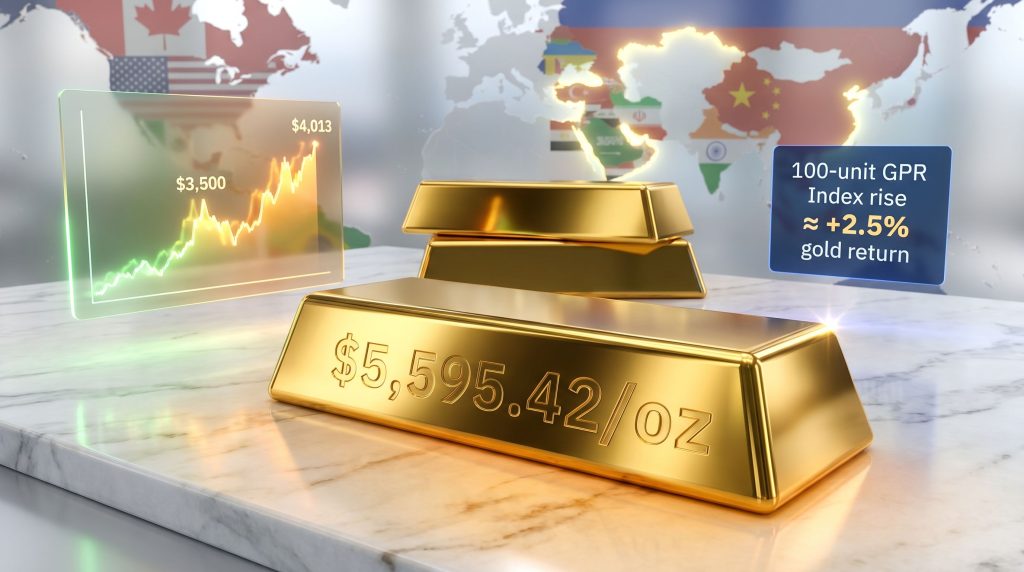
Researchers have developed tools to measure this dynamic more precisely. The Geopolitical Risk (GPR) Index, which tracks the volume and intensity of conflict-related language across major global media sources, provides a quantifiable proxy for market-perceived instability. Academic analysis of this index has found that a 100-unit increase in the GPR correlates with approximately a 2.5% increase in gold's return, even after controlling for inflation expectations and real bond yields. That is a meaningful and statistically robust relationship, as further explored through gold safe-haven dynamics research.
However, the premium is not permanent. It compresses when perceived conflict risk recedes, even if underlying instability has not materially changed. Markets price expectations, not realities. This compression cycle is one of the most misunderstood aspects of gold pricing and explains why many investors who buy gold on conflict headlines end up selling at a loss when the immediate narrative shifts.
Gold does not reward investors for being right about geopolitical outcomes. It rewards those who correctly anticipate how markets will price the probability of those outcomes changing.
What History Reveals About Gold and Geopolitical Shocks
A Comparative Look at Major Event-Driven Price Moves
The historical record offers a clearer picture of how different types of geopolitical events translate into gold price behaviour. Crucially, not all crises are equal in their impact on precious metals.
| Geopolitical Event | Gold Price Reaction | Duration of Premium |
|---|---|---|
| Soviet Invasion of Afghanistan (1979-80) | Price doubled over approximately six weeks, Dec 1979 to Jan 21, 1980 | Short-lived; reversed within months |
| 9/11 Terrorist Attacks (2001) | Approximately +6% in a single trading session | Brief surge; faded within weeks |
| Russia-Ukraine Escalation (2022) | Multi-month rally driven by sanctions uncertainty and reserve reallocation | Extended due to structural monetary shifts |
| Middle East Conflict Premium (2024-25) | Gold reached an all-time high of $5,595.42/oz (as of January 29, 2026) | Partially sustained by central bank accumulation |
The Afghanistan example is particularly instructive. The move from December 1979 to January 21, 1980 was almost entirely geopolitical in nature, not inflation-driven as is commonly assumed. Gold then retreated sharply as the immediate fear subsided. That pattern, rapid advance on conflict escalation followed by retracement on perceived resolution, has repeated across decades. For a broader understanding of the record gold price drivers in the current cycle, the interplay between conflict risk and monetary conditions is especially important to examine.
The Buy-the-Rumour Dynamic in Precious Metals
Gold frequently rises in anticipation of conflict rather than during active hostilities. Once fighting begins and the immediate uncertainty is priced in, profit-taking often produces sharp intraday reversals. This is why some investors observe gold falling on the day that a major conflict headline breaks, which seems counterintuitive until you understand that the market had already positioned ahead of the event.
The key analytical distinction is between short-duration geopolitical spikes and sustained structural rallies. The former are driven by event-specific fear premiums. The latter require a fundamental shift in how investors and institutions perceive the long-term reliability of alternative assets, particularly sovereign bonds and reserve currencies. Furthermore, understanding geopolitical and central bank drivers helps clarify why some rallies prove far more durable than others.
Three Scenarios Where Geopolitics Fails to Lift Gold
-
Dollar flight dominance: When an overseas crisis does not threaten U.S. financial system stability, capital often flows into U.S. Treasuries, strengthening the dollar and suppressing gold through the standard inverse relationship.
-
Monetary policy override: High real interest rates increase the opportunity cost of holding non-yielding assets like gold. Even during active conflicts, persistently positive real rates can cap price appreciation.
-
Swift resolution pricing: When markets assign high probability to rapid conflict resolution, the risk premium dissolves faster than it formed, creating sharp downside corrections for investors who positioned on the initial spike.
Anatomy of the Current Correction: From $5,600 to Sub-$4,000
Why the Geopolitical Premium Compressed
The pullback from all-time highs to below $4,000 per ounce reflects several converging forces rather than a single cause. One underreported factor involves disruptions to Gulf State financial infrastructure during the period of Middle East conflict escalation. Reports indicate that the banking system in Dubai experienced operational outages during Iranian missile strikes, creating forced liquidation pressure as entities holding gold needed access to liquidity that their banking infrastructure temporarily could not provide.
A second and significant source of selling pressure came from sanctioned entities. Parties operating under international financial restrictions who were holding gold as a liquidity reserve were compelled to sell into the market to meet operational funding requirements. This selling was not driven by a change in view on gold's value but by circumstantial liquidity needs, creating price pressure fundamentally disconnected from gold's intrinsic investment case.
A third factor is the market's reassessment of conflict duration. As expectations shifted toward a more contained Middle East outcome, the gold price and geopolitics risk premium embedded in the price from the $5,600 peak began to decompress. In addition, the recession and gold prices dynamic has added further complexity to interpreting recent price movements.
Key Support Levels and What They Signal
Current analytical modelling identifies $3,500/oz as the primary structural support threshold within the current corrective sequence. Whether price reaches that level remains an open question, but it represents the floor boundary of the corrective range as assessed by quantitative models.
Gold was trading around $4,013/oz at the close of the first half of 2025, representing a significant correction from the all-time high but remaining substantially above longer-term technical averages. The question of whether this represents a bottom or an ongoing correction depends materially on the trajectory of the geopolitical risk calendar through the second half of 2025 and into 2026.
What Could Trigger the Next Leg Higher
Several identifiable catalysts could reignite sustained safe-haven demand:
- Escalation of NATO-adjacent conflicts following key diplomatic meetings in July 2026, with the risk calendar intensifying through Q1 2027 based on geopolitical modelling
- Renewed stress in European sovereign debt markets, particularly involving Italy and France, triggering a contagion dynamic
- Energy supply disruptions through the Strait of Hormuz creating cost-push inflation across Asian and European economies
- Continued central bank gold accumulation providing a structural price floor beneath spot
- Resolution failures in Middle East negotiations that had been priced as likely to succeed
Central Banks and the Structural Gold Bid: A Different Category of Buyer
Why Sovereign Reserve Managers Think Differently
Central banks represent a categorically different type of gold market participant compared to retail investors or hedge funds. A $30 move in either direction does not trigger buy or sell decisions at the sovereign reserve management level. These institutions are not optimising for short-term price appreciation. They are managing a specific long-term risk: the possibility that geopolitical conflict or financial warfare could render their foreign currency holdings inaccessible, frozen, or subject to counterparty default.
The logic is straightforward. If two major economic powers entered direct conflict, the sovereign bond holdings of each side in the other's debt market would face de facto default through sanctions, asset freezes, or outright repudiation. Gold eliminates this bilateral counterparty risk entirely, which is precisely the characteristic that makes it a genuinely neutral reserve asset. Consequently, central bank gold demand has become one of the most consequential structural forces in the modern gold market.
The De-Dollarisation Picture Is More Nuanced Than Headlines Suggest
The narrative around de-dollarisation is frequently oversimplified. The reality is that reserve diversification away from the U.S. dollar has been accompanied by simultaneous reductions in European currency and bond holdings as well. Major sovereign buyers are not simply rotating from dollars into euros. They are reducing exposure to all politically weaponisable financial instruments and increasing allocations to assets that carry no counterparty risk.
| Country / Region | Gold Accumulation Trend | Strategic Driver |
|---|---|---|
| China | 17 consecutive months of purchases through 2024 | Reduce U.S. Treasury exposure; hedge against dollar weaponisation |
| India | Significant reserve increases across recent years | Diversification amid global sanctions risk |
| Turkiye | Major buyer since 2022 | Hedge against lira volatility and geopolitical exposure |
| Gulf State Central Banks | Mixed, with some liquidation under financial stress | Debt servicing obligations and conflict-related infrastructure damage |
Switzerland's repositioning in global finance is a particularly instructive case. The country's decision to freeze assets belonging to Russian nationals following the Ukraine invasion fundamentally altered its status as a neutral financial safe haven. Capital that had historically treated Swiss institutions as geopolitically agnostic has since migrated toward Dubai and Singapore, reflecting a broader recognition that financial neutrality can shift rapidly under geopolitical pressure.
The Geopolitical Landscape Shaping Gold Through 2027
Europe's Fiscal Fragility and What It Means for Capital Flows
Italy's GDP growth rate of approximately 0.5% places it in deeply precarious fiscal territory. With a sovereign debt load that already strains bond market appetite, the country has reportedly explored whether Brussels could issue centralised debt on its behalf, an indication that its own bond sales face structural headwinds. A government that cannot roll over its debt when bonds mature faces the classic Ponzi scheme resolution: collapse.
The contagion mechanism is well established. The 2010 European sovereign debt crisis demonstrated exactly how trading desks respond to the first sign of stress in one country: they immediately look for the next most vulnerable. Greece triggered scrutiny of Spain. A future Italian stress event would almost certainly direct attention toward France, which carries its own substantial debt burden and political fragility.
Unlike U.S. Treasuries, which allow an investor to deploy $10 billion into a single liquid instrument with a single transaction, European capital allocation still requires country-by-country decisions. This structural fragmentation prevents European assets from absorbing global capital at the scale required to compete with U.S. Treasuries as a safe-haven alternative, which indirectly reinforces gold's position as the only truly neutral store of value at global scale.
Germany's recent legislative measures requiring individuals of draft age to obtain government permission before leaving the country signals a broader shift in European risk perception that markets have not yet fully priced.
The Middle East: Energy, Debt, and the Banking Chain Risk
The Strait of Hormuz scenario is more complex than most energy market analysis suggests. Closure of the strait would disproportionately impact Asia and Europe rather than the United States, which has achieved a degree of energy self-sufficiency that partially insulates its economy from regional supply disruptions. However, the more significant risk may not be the headline energy price impact but the downstream effect on Gulf State sovereign finances.
During the COVID-19 period, the collapse of oil prices to historic lows forced Gulf State governments to take on substantial sovereign debt to fund their operating budgets. The assumption that these nations are uniformly cash-rich is incorrect. If sustained conflict disrupted oil revenues to the point where debt servicing became impossible, the resulting sovereign defaults would send shockwaves through banking systems with significant Gulf State exposure, with London likely among the most directly affected financial centres.
The fertiliser and diesel supply chain disruption flowing from regional conflict adds another inflationary dimension. Fuel shortages in parts of Asia affected by Hormuz-adjacent disruptions have impaired fishing industries and agricultural supply chains, translating conflict-zone events into consumer food price inflation thousands of miles away.
Taiwan and the Multi-Front Risk Calendar
Taiwan's adoption of a decentralised governance model as a defensive strategic posture signals long-term preparation for a conflict scenario rather than near-term de-escalation. Iran's reorganisation into multiple autonomous tiers of command meant that eliminating senior leadership did not incapacitate the state's operational capacity. Taiwan has evidently drawn lessons from this model.
Geopolitical modelling points to a convergence of unresolved flashpoints building toward Q1 2027 as a period of elevated crisis risk. Ukraine's government has escalated its rhetoric to include threats against Belarus and active attempts to sever Russian supply lines to Crimea, increasing the probability of a wider European conflict. NATO meetings in the near term add further uncertainty to the risk calendar, with the gold price and geopolitics relationship likely to remain tightly correlated throughout this period.
The next major ASX story will hit our subscribers first
How Inflation Compounds the Gold Outlook
Cost-Push Inflation: The Transmission Mechanism
Cost-push inflation differs fundamentally from demand-pull inflation in one critical respect: it cannot be resolved through monetary tightening alone. When regional conflict disrupts energy supply chains, the price increases flow through transportation costs, agricultural input costs, and food prices in a transmission sequence that is largely impervious to central bank interest rate decisions.
The pathway is sequential and compounding:
- Regional conflict disrupts energy supply infrastructure
- Fuel costs rise for shipping, agriculture, and fishing industries
- Food production and distribution costs increase
- Consumer price inflation rises across multiple categories simultaneously
- Second-round effects embed higher prices into wage expectations
This dynamic operates independently of monetary policy and represents the type of inflation that rate hikes can actually worsen by increasing the cost of credit for businesses already under margin pressure. As Aberdeen Investments notes, record gold price levels often reveal deeper structural truths about geopolitics and economies that conventional analysis tends to understate.
The Government Cost Factor: An Underappreciated Inflation Driver
One structural inflation driver that receives insufficient analytical attention is the compounding effect of rising government costs at every level of the economy. When government expenditure increases, and those costs are passed through taxation or regulatory compliance costs embedded in every transaction, they multiply through the price system in the same way that a credit card surcharge compounds across an entire supply chain.
Rising federal, state, and local government cost structures represent a persistent inflation floor that exists regardless of what central banks do with benchmark interest rates. This is one of the reasons why conventional macroeconomic models, most of which were developed during or before the Bretton Woods era of fixed exchange rates and limited capital mobility, increasingly fail to account for the actual inflation dynamics observed in today's interconnected global economy.
Most economic frameworks in current use were built for a world without floating currencies, cross-border capital flows, or financial warfare as a standard geopolitical instrument. Their policy prescriptions are increasingly misaligned with the world they are being applied to.
FAQ: Gold Price and Geopolitics
Does every geopolitical crisis push gold prices higher?
No. Gold's response depends on the nature, location, and perceived duration of the crisis, as well as what alternative assets markets are simultaneously bidding. Crises that redirect capital into the U.S. dollar and Treasuries can actually suppress gold even as geopolitical risk rises.
Why did gold fall from $5,600 to below $4,000 if geopolitical risks remain elevated?
The decline reflects compression of the risk premium as markets priced a more contained conflict outcome, combined with forced liquidation by sanctioned entities needing liquidity, financial infrastructure disruptions in Gulf financial centres, and the ongoing headwind from restrictive monetary policy increasing the opportunity cost of holding non-yielding assets.
What is the difference between a geopolitical gold spike and a structural rally?
- Geopolitical spike: Rapid, event-driven price surge that reverses once the immediate threat is priced in, sometimes within hours or days
- Structural rally: Multi-month or multi-year appreciation driven by central bank accumulation, reserve diversification, and fundamental shifts in the global monetary order
At what level does structural support become most significant?
Quantitative modelling identifies $3,500/oz as the primary structural support boundary within the current corrective range. A sustained break below this level would warrant a meaningful reassessment of the medium-term trend.
Why are central banks buying gold near all-time high prices?
Central banks are managing long-term reserve risk rather than short-term price exposure. The specific risk they are hedging is the possibility that geopolitical conflict or financial sanctions could render their foreign currency holdings inaccessible or subject to counterparty default. Gold eliminates that risk entirely, making its price at any given moment largely irrelevant to the strategic allocation decision.
Key Takeaways: Three Scenarios for Gold Through Q1 2027
Summary of Price Drivers and Their Current Status
| Price Driver | Short-Term Impact | Medium-Term Impact | Current Status |
|---|---|---|---|
| Geopolitical conflict escalation | Strong upward spike | Fades unless systemic | Elevated but partially priced |
| Central bank accumulation | Moderate structural bid | Sustained upward pressure | Active, ongoing purchases |
| Real interest rates | Downward pressure when high | Dominant medium-term driver | Restrictive, headwind for gold |
| U.S. dollar strength | Inverse relationship | Moderate influence | Elevated, compressing gold |
| European sovereign debt stress | Moderate safe-haven flow | Could accelerate with contagion | Building, watch Italy |
| Energy and food inflation | Indirect upward support | Supports debasement narrative | Rising, Hormuz risk factor |
The Three Scenario Framework
-
Bull Case: Geopolitical Escalation – Multiple conflict fronts intensify simultaneously across the Middle East, Ukraine, and Taiwan. European sovereign stress triggers a contagion sequence. Central bank accumulation accelerates. Gold reclaims and surpasses prior all-time highs.
-
Base Case: Gradual Re-Rating – Geopolitical risks build incrementally through Q1 2027. Cost-push inflation persists. Central bank demand provides a structural floor. Gold recovers toward the $4,500 to $5,000 range.
-
Bear Case: Resolution and Rate Cuts – Meaningful de-escalation occurs across key conflict zones. The Federal Reserve pivots toward rate cuts, reducing opportunity cost. The dollar weakens. Gold stabilises but lacks a near-term catalyst for new highs.
This article contains forward-looking analysis, scenario projections, and references to analytical models. Nothing in this article constitutes financial advice. Investors should conduct their own due diligence and consult qualified financial professionals before making investment decisions. Geopolitical forecasts and price level projections involve inherent uncertainty and should not be treated as reliable predictions of future outcomes.
Want to Stay Ahead of the Next Major Mineral Discovery Driven by Geopolitical Shifts?
While macro forces like geopolitical risk and central bank accumulation shape the gold price narrative, Discovery Alert's proprietary Discovery IQ model delivers real-time alerts the moment significant ASX mineral discoveries are announced — turning complex market signals into clear, actionable opportunities for investors at every level. Explore how historic discoveries have generated substantial returns on Discovery Alert's dedicated discoveries page, and begin your 14-day free trial today to position yourself ahead of the market.