August 6, 2026
When Peace Becomes a Catalyst: Understanding Gold's Relationship With Energy Markets and Monetary Policy
There is a widely held assumption in commodity markets that gold rises during conflict and falls when peace breaks out. The reality is considerably more nuanced. The current trajectory of the gold price on Strait of Hormuz reopening hopes illustrates precisely why that simplistic framework fails investors who rely on it. The metal's sensitivity to real interest rates, inflation expectations, and central bank signalling means that geopolitical developments function as indirect levers rather than direct price drivers. Understanding this transmission mechanism is what separates informed positioning from reactive speculation.
When big ASX news breaks, our subscribers know first
Why the Strait of Hormuz Is a Macro-Economic Pressure Valve, Not Just a Shipping Lane
The Strait of Hormuz, connecting the Persian Gulf to the Gulf of Oman, facilitates the movement of roughly 20% of the world's total oil supply. When access to this chokepoint is threatened, the consequences ripple far beyond crude oil futures. Rising energy costs feed directly into headline consumer price indices across major economies. When inflation expectations climb, central banks across the G10 face renewed pressure to maintain or extend tightening cycles.
Higher interest rates increase the opportunity cost of holding non-yielding assets like gold, compressing valuations even as geopolitical anxiety would ordinarily support safe-haven demand. Furthermore, the crude oil price dynamics at play here are inseparable from the broader gold pricing story.
This creates the conceptual chain that investors must internalise: geopolitical disruption leads to energy price increases, which lift inflation forecasts, which raise rate hike probability, which suppresses gold. The Strait of Hormuz sits at the very beginning of this sequence, functioning as a macro-economic pressure valve whose opening or closing sends ripple effects through bond markets, currency markets, and ultimately, bullion pricing.
The Counterintuitive Dynamic: How Conflict Suppressed Gold
Conventional safe-haven logic would suggest that five months of active conflict between the United States and Iran should have driven gold prices sharply higher. Instead, spot gold declined approximately 19% from the onset of the conflict on February 28, a performance that confounds investors operating on the traditional war-equals-gold-rally framework.
The reason lies in what the conflict actually did to macroeconomic conditions. Persistent military tension in and around the Persian Gulf sustained elevated energy prices, which kept inflation fears elevated, which in turn pushed market expectations toward continued rate hikes. Gold, offering no yield and no dividend, loses relative appeal precisely when real interest rates are rising. The conflict didn't create a safe-haven bid large enough to overcome this headwind. Instead, it functioned as an ongoing inflationary shock that reinforced the conditions most hostile to gold valuations.
This cycle illustrates a critical principle for commodity investors: prolonged geopolitical tension that sustains energy inflation can be structurally bearish for gold, even as surface-level logic suggests the opposite. The metal's primary sensitivity is to real yields, not to fear alone.
Deconstructing the $4,285 Rally: Three Headwinds Reversing Simultaneously
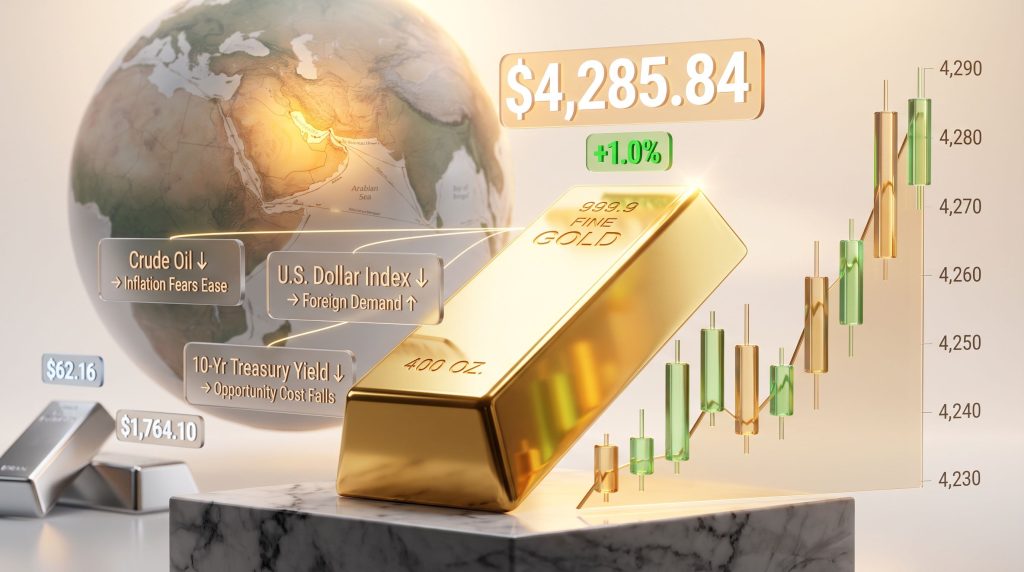
Spot gold climbing to $4,285.84 per ounce on August 7, its highest level since June 18 and the fourth consecutive session of gains, was not the product of a single catalyst. It reflected the simultaneous compression of three distinct headwinds that had weighed on the metal throughout the conflict period. Indeed, the gold price on Strait of Hormuz reopening hopes has proven far more responsive to monetary policy repricing than to the geopolitical headline itself.
The table below captures the directional relationship between key macro variables and gold's pricing mechanics as optimism over a Strait of Hormuz resolution intensified:
| Macro Variable | Direction on Reopening News | Gold Impact |
|---|---|---|
| Crude Oil Prices | Declining | Bullish (lower inflation fears) |
| U.S. Dollar Index | Weakening | Bullish (cheaper for international buyers) |
| 10-Year Treasury Yield | Falling | Bullish (lower opportunity cost) |
| Fed Rate Hike Probability | Declining (67% to 55%) | Bullish (looser policy expectations) |
| Geopolitical Risk Premium | Easing | Mildly Bearish (reduced panic buying) |
Concurrently, U.S. gold futures rose 0.9% to $4,345.80, with the spread between spot and futures prices reflecting genuine near-term demand strength in physical markets rather than purely speculative positioning.
The 200-Day Moving Average and the Path to $5,000
From a technical standpoint, the 200-day moving average represents the most significant threshold for gold's medium-term trajectory. In commodity markets, a sustained close above this level historically signals that a broader trend reversal is underway rather than a short-term bounce driven by news headlines. IG market analyst Tony Sycamore noted that a confirmed break above the 200-day moving average could open the path toward a recovery to the $5,000 per ounce level, provided the macro conditions supporting the current move remain in place.
It is important to frame this target within the context of improving fundamentals rather than momentum chasing. The credibility of a $5,000 move depends on whether the conditions driving the current rally — easing inflation expectations, dollar weakness, and declining rate hike bets — prove durable rather than transitory. In addition, the factors driving gold to record highs in 2025 provide important context for evaluating whether this move has structural legs.
The Diplomatic Framework and Its Market Transmission Channels
The proposed arrangement reported by Reuters involves Iran gaining oversight authority over vessel transit through the Strait of Hormuz as part of a broader conflict de-escalation framework mediated by Oman. Whether or not this deal reaches final implementation, its emergence as a credible diplomatic possibility has already activated three distinct market repricing channels:
- Energy supply risk repricing: Oil markets have begun unwinding conflict premiums that had been embedded in crude prices since February, with prices slipping as optimism around the deal grew.
- Inflation expectation recalibration: As forward energy costs ease, projected CPI trajectories across major economies soften, reducing the perceived urgency for additional rate increases.
- Monetary policy reassessment: Central bank rate hike timelines become less certain when inflation catalysts begin to fade, and that uncertainty directly benefits gold through lower real yield expectations.
Why Yield Compression Outweighs the Loss of Safe-Haven Premium
A nuanced point that is often missed in coverage of gold during peace negotiations is that the metal can experience competing forces simultaneously. On one hand, genuine diplomatic progress reduces the fear-driven panic buying that safe-haven demand depends on. On the other hand, it removes the inflationary catalyst that had been forcing central banks toward hawkishness.
In the current environment, where real yields had already been elevated by months of energy-inflation pressure, the yield-compression effect of peace optimism substantially outweighs the modest reduction in safe-haven demand. Gold's net reaction to the gold price on Strait of Hormuz reopening hopes is therefore a net positive — a conclusion that requires understanding the starting conditions of the market rather than applying a generic geopolitical template. Moreover, central banks influencing gold prices through their policy signals remain a critical variable in this dynamic.
The September Fed Decision and the NFP Wild Card
One of the most significant data points embedded in the current gold rally is the rapid repricing of Federal Reserve rate hike expectations. Within just two trading sessions, market-implied probability of a September rate increase fell from 67% to 55%, a 12 percentage point shift that, while it may appear modest in absolute terms, carries outsized significance for gold given the metal's extreme sensitivity to real interest rate movements.
Even marginal shifts in the trajectory of monetary policy can produce meaningful moves in gold because the metal's entire valuation framework is anchored to the opportunity cost of holding it versus yield-bearing assets. When that cost is expected to fall, the relative attractiveness of bullion improves immediately in forward-looking markets.
The next binary risk event for gold is the July U.S. nonfarm payrolls report. ADP private payrolls data for July already showed a slowdown in hiring activity, which has historically served as a leading signal for weaker official NFP readings. Joshua Rotbart, founder of J. Rotbart and Co., noted that a soft payrolls print would provide additional support for gold, while a significantly stronger-than-expected result could introduce short-term pressure as markets reassess the policy timeline.
| NFP Outcome | Expected Market Reaction | Gold Impact |
|---|---|---|
| Soft/Below-Consensus Print | Rate hike bets fall further | Bullish, potential extension toward $4,400+ |
| Strong/Above-Consensus Print | Markets reprice tightening timeline | Bearish short-term, possible pullback |
The NFP report represents the single most important near-term confirmation or denial of the gold rally's fundamental basis. Investors holding positions into this release face asymmetric risk that demands careful sizing consideration.
Structural Bull Market or Diplomatic Bounce? How to Tell the Difference
The question investors must answer is whether the current gold move represents a genuine macroeconomic regime shift or a temporary relief rally with limited staying power. The distinction matters enormously for positioning decisions.
Geopolitical catalysts in commodity markets exhibit what can be described as a geopolitical half-life: the tendency for optimism driven by diplomatic headlines to fade rapidly if tangible progress stalls or fails to materialise. History shows numerous instances where early-stage peace talks triggered multi-week commodity rallies that fully reversed once negotiations broke down.
For the current gold move to evolve into a durable structural rally rather than an event-driven spike, the following conditions would need to be confirmed over subsequent weeks:
- Confirmed signals from the Federal Reserve suggesting a genuine pause in the tightening cycle
- Sustained weakness in the U.S. dollar beyond the initial diplomatic reaction
- A structural decline in energy prices driven by restored supply rather than demand weakness
- Continued de-escalation in U.S.-Iran tensions beyond the initial framework announcement
- Macro data, particularly inflation readings, confirming that the CPI trajectory is genuinely softening
The next major ASX story will hit our subscribers first
The Broader Precious Metals Complex: Not All Metals Are Equal
Gold's move did not occur in isolation. The broader precious metals market participated in the rally, though with varying degrees of intensity that reflect important differences in market structure and liquidity.
| Metal | Session Price | Change | Notable Context |
|---|---|---|---|
| Spot Gold | $4,285.84/oz | +1.0% | Seven-week high |
| Gold Futures | $4,345.80/oz | +0.9% | Near-term physical demand strength |
| Spot Silver | $62.16/oz | +0.1% | Modest participation |
| Platinum | $1,764.10/oz | +1.7% | Highest level since June |
| Palladium | $1,377.83/oz | +1.1% | Third consecutive session of gains |
Platinum's 1.7% gain to $1,764.10, its highest level since June, and palladium's third consecutive session of gains are notable because these metals tend to exhibit amplified percentage moves during macro-driven precious metals rallies. Their markets are significantly smaller and less liquid than gold, meaning that institutional repositioning can generate outsized price effects relative to the size of capital flows involved.
Silver's comparatively modest 0.1% gain to $62.16 suggests that industrial demand factors, which weigh more heavily on silver's pricing than on gold's, may be tempering the full extent of its participation in the monetary policy repricing narrative.
What History Says About Gold During Middle East De-Escalation
Examining prior cycles of Middle East diplomatic activity reveals a consistent pattern: initial headline-driven price spikes are common, but sustained re-ratings of gold require the diplomatic event to produce a durable change in inflation expectations and central bank behaviour, not merely a reduction in military activity.
The analytical tension at the heart of this situation is what might be called the paradox of peace in commodity markets. Genuine conflict resolution removes one traditional source of gold demand — the fear premium — while simultaneously dismantling one of the most powerful structural headwinds, namely the energy-driven inflation cycle. The net outcome depends critically on the prevailing level of real yields at the time of resolution.
When real yields are already elevated, as they are in the current environment following months of central bank tightening driven partly by energy cost pressures, the yield-compression effect of peace tends to be the dominant force. Furthermore, the relationship between gold, bonds, and economic cycles confirms that a hypothetical scenario in which Strait of Hormuz reopening leads to a further 10 to 15% decline in oil prices would, under current yield and dollar dynamics, be consistent with a sustained gold recovery trajectory rather than a temporary bounce.
Frequently Asked Questions: Gold and the Strait of Hormuz
Why Does the Strait of Hormuz Affect Gold Prices?
The Strait controls roughly 20% of global oil supply. Disruptions to this route push oil prices higher, increase inflation forecasts, and raise the probability of central bank rate increases. Higher rates are negative for gold because they increase the opportunity cost of holding a non-yielding asset. When reopening optimism emerges, the reverse process unfolds across all three variables simultaneously.
Does Gold Always Rise When Tensions Ease?
Not automatically. Gold's reaction to de-escalation depends on whether its prior decline was driven primarily by safe-haven reduction or by inflation and rate-hike fears. In the current cycle, rate expectations were the dominant headwind, which means that peace optimism produces a net bullish outcome for gold despite the simultaneous reduction in panic-driven buying. Analysis from FX Street similarly highlights how acceptance above key technical levels is contingent on these macro conditions holding.
How Does Dollar Weakness Amplify Gold's Gains?
Gold is denominated in U.S. dollars globally. A weaker dollar reduces the effective price of gold for buyers holding other currencies, expanding the pool of accessible demand and supporting higher price levels. This is why the U.S. Dollar Index weakening alongside Treasury yield compression creates a compounding rather than additive effect on gold's upside during episodes like the current one. TradingKey's analysis of Hormuz-linked gold price movements further illustrates how swiftly this dynamic can reverse should the diplomatic situation deteriorate.
Key Risks That Could Derail the Current Rally
Investors should approach the current optimism with a structured risk framework rather than extrapolating the recent gains indefinitely. The primary downside scenarios include:
- Diplomatic negotiations collapse, oil rebounds sharply, and inflation fears resurface with renewed intensity
- The July nonfarm payrolls report significantly exceeds consensus estimates, prompting markets to reprice Fed tightening expectations higher
- Federal Reserve officials make public statements reinforcing continued hawkishness regardless of easing geopolitical conditions
- An unrelated geopolitical or financial shock strengthens the dollar through risk-off capital flows, reversing the currency tailwind supporting gold
Geopolitical headlines are among the most volatile and rapidly reversible drivers in global commodity markets. Treating diplomatic optimism as a confirmed outcome rather than a probabilistic input is among the most common errors made by investors during conflict resolution cycles. Position sizing should reflect the scenario-based nature of the current setup.
This article is intended for informational purposes only and does not constitute financial advice. Commodity and precious metals markets carry significant risk, and past price behaviour is not indicative of future performance. Readers should conduct independent research or consult a licensed financial adviser before making investment decisions.
Want to Stay Ahead of the Next Major Mineral Discovery on the ASX?
While gold's relationship with geopolitical events and monetary policy creates complex opportunities for investors, Discovery Alert's proprietary Discovery IQ model cuts through the complexity by delivering real-time alerts on significant ASX mineral discoveries — explore the historic returns major discoveries have generated and begin your 14-day free trial to position yourself ahead of the broader market.