August 10, 2026
When Patience Becomes Strategy: The Gold Market's New Calculus on Iran
Geopolitical risk premiums in precious metals markets are notoriously short-lived. History shows that gold spikes on conflict headlines, then fades as investors rotate back into yield-bearing assets once the immediate tension stabilises. That playbook has worked reliably for decades. The Trump Iran gold price Strait of Hormuz stalemate of 2026 is quietly dismantling it.
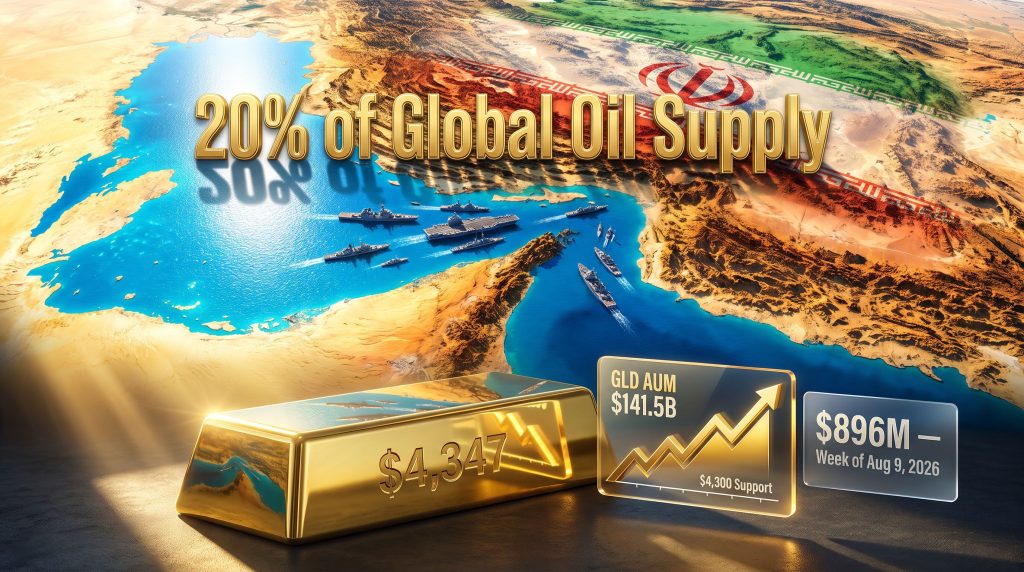
What makes the current environment analytically unusual is not the conflict itself but the duration and character of its persistence. Over five months after the Strait of Hormuz closure began on February 28, 2026, gold is not fading. It is consolidating. At $4,347 per ounce as of August 10, 2026, the metal is holding firm above the $4,300 threshold that professional investors are increasingly treating as a structural support level rather than a transient geopolitical high.
Understanding why requires moving beyond the headline and into the mechanism.
When big ASX news breaks, our subscribers know first
The Feedback Loop That Keeps Gold Supported Despite Rate Pressure
The Strait of Hormuz is not merely a shipping lane. It is the world's most critical oil transit chokepoint, responsible for channelling approximately 20% of global petroleum supply during normal operating conditions. Its sustained closure creates a direct transmission mechanism into broader macroeconomic conditions that gold investors cannot afford to ignore. The oil price disruption risks from this closure are substantial and compounding.
The chain of effects works as follows:
- Sustained Hormuz closure restricts global oil supply, keeping energy prices elevated.
- Elevated energy prices feed into headline inflation figures and longer-term inflation expectations.
- Persistent inflation expectations compress the Federal Reserve's ability to ease monetary policy.
- Constrained rate-cut expectations support real yields, which typically apply downward pressure on gold.
Here lies the analytical puzzle. Despite September rate-hike probability hovering near 60%, gold is not retreating. This behaviour contradicts the standard rate-sensitivity model most investors apply to precious metals pricing. The explanation is that professional capital is no longer treating the Hormuz disruption as a temporary input to be discounted. It is being priced as a persistent structural feature of the current macro landscape.
"When a geopolitical risk event repeats its pattern across more than a dozen cycles without resolving, institutional positioning shifts from tactical to structural. The uncertainty itself becomes the asset case, not the specific outcome."
Decoding the Attrition Signal: What Trump's Language Revealed
On August 9, 2026, Trump communicated to Axios that the United States is approaching its dealings with Iran as a patient exercise in economic attrition rather than active diplomatic engagement. His characterisation of the process as a chess game signals a deliberate pivot away from urgency. The administration's position, as he framed it, is that Iran's deteriorating domestic economic conditions will eventually generate the concessions that direct negotiation has failed to produce.
The economic pressure indicators on Iran are, by most assessments, genuinely severe:
| Economic Pressure Indicator | Status as of August 2026 |
|---|---|
| Iranian oil export capacity | Severely constrained by US naval blockade |
| Domestic inflation (Iran) | Running at damaging levels per US assessment |
| Military funding capacity | Described by Trump as critically strained |
| Frozen sovereign assets | Withheld pending resolution of conditions |
The attrition thesis is not without analytical merit. The conditions that might theoretically compel economic capitulation arguably exist today. However, markets that assume this logic translates cleanly into a near-term diplomatic resolution are making a significant pricing error.
Iran's Foreign Ministry confirmed on August 10, 2026 that no direct negotiations with the United States are occurring. Communications are being routed through Pakistan and Qatar, with Oman conducting a separate channel focused specifically on Hormuz shipping. Tehran is not characterising any of this as negotiation with Washington. According to ABC News, US-Iran talks had already reached a stalemate well before this point, underscoring how deeply entrenched both positions have become.
"The gap between the US framing of these communications and Iran's formal denial of direct negotiation is not a diplomatic nuance. It is a structural divergence in how each party is representing the same set of contacts to their respective domestic and international audiences."
Iran's Four Conditions: Why These Are Not Opening Bids
Iran's Supreme National Security Council outlined its requirements for reopening the Strait over the weekend of August 9–10, 2026. These four conditions are worth examining carefully, because their origin matters:
- Full cessation of the US naval blockade.
- Comprehensive removal of all active sanctions.
- Return of all frozen Iranian sovereign assets.
- Financial compensation for war damages incurred since February 28, 2026.
What is analytically significant is that these are not freshly constructed negotiating positions. According to reporting by Axios on August 9, 2026, Tehran previously applied this same set of demands as conditions for a nuclear deal. Iran has now redeployed them as the baseline requirement for reopening a single shipping lane. The consistency suggests these represent firm political requirements embedded in domestic Iranian politics, not tactical opening bids designed to soften under pressure.
Furthermore, Iran escalated these demands over the weekend rather than moderating them. That behavioural signal indicates Tehran's political calculus is not currently tracking its economic constraints in the way the attrition strategy anticipates.
How Twelve Cycles of Deal Optimism Reshaped Investor Behaviour
One of the most underappreciated dynamics in the current gold market is how the repetition of failed deal signals has itself become a market variable. Since the conflict began, the Trump administration has indicated that a Hormuz resolution was imminent on more than a dozen separate occasions. The market response followed a consistent pattern each time:
- Deal optimism signal released → oil prices fall, equity markets rally.
- 48 to 72 hours elapse without resolution.
- The same standoff reasserts, and prices retrace.
As CNBC reported on August 7, 2026, the administration's repeated deal optimism has moved markets multiple times without producing a deal. Bloomberg confirmed on August 10, 2026 that the administration has formally transitioned toward economic pressure as its primary strategy, signalling that the era of imminent-deal messaging may be concluding.
The consequence for gold positioning is measurable. Rather than treating each signal as a discrete near-term catalyst, professional investors are repricing the stalemate as a durable condition. ETF flow data confirms this shift.
According to ETF Db data reported by Benzinga on August 9, 2026:
- GLD inflows for the week ending August 9: $896 million.
- GLD inflows over the trailing 30-day period: $1.78 billion.
- GLD total assets under management: $141.5 billion.
These figures do not reflect speculative capital chasing individual headlines. The size and consistency of inflows across a full month indicates patient institutional rotation into gold as a prolonged uncertainty vehicle. Indeed, central bank gold buying has reinforced this trend, adding a further layer of structural demand beneath the market.
The Red Sea Variable: An Asymmetric Risk That Markets Have Underpriced
The Hormuz analysis becomes considerably more complex when the Red Sea dimension is added. Houthi rebels conducted two separate attacks on the port of Mocha within a 24-hour window spanning August 9 and 10, 2026. This signals a potential effort to extend shipping disruption to a second critical global transit corridor simultaneously.
The risk asymmetry here deserves attention. If the Red Sea lane is effectively closed in conjunction with Hormuz, the combined oil supply disruption would materially exceed the inflationary impact already embedded in current gold prices. This represents upside exposure that is not yet fully reflected in spot pricing. Consequently, gold safe-haven demand could accelerate sharply if both corridors face sustained disruption.
The next major ASX story will hit our subscribers first
Scenario Framework: Four Paths and Their Gold Price Implications
| Scenario | Current Probability | Gold Price Direction | Primary Driver |
|---|---|---|---|
| Rapid Hormuz resolution (within 2 weeks) | Low, given Iran's stated conditions | Short-term downward pressure | Safe-haven demand reduction |
| Prolonged stalemate (3 to 6 months) | Elevated, tracking current trajectory | Structural floor above $4,300 | Persistent inflation plus uncertainty premium |
| Conflict escalation via Houthi expansion | Moderate, Red Sea attacks ongoing | Sharp upward spike | Compounding oil shock and systemic risk repricing |
| Fed rate cut despite elevated inflation | Low, with 60% hike probability | Strong upward catalyst | Real yield compression |
Why Gold Outperforms Other Geopolitical Hedges in a Prolonged Standoff
Standard geopolitical risk premiums in gold markets typically dissipate within days to weeks once a triggering event stabilises. The Hormuz disruption has now persisted for over five months, and this duration is beginning to expose a structural advantage gold holds over other hedge instruments in extended uncertainty environments. In fact, the geopolitical gold price drivers at work here are more multidimensional than in any prior cycle this decade.
Several characteristics make gold uniquely suited to a prolonged attrition scenario:
- Gold carries no counterparty risk. Its value is not contingent on any sovereign entity's willingness or ability to honour obligations.
- Unlike oil futures or options positions, gold does not experience time-decay. A stalemate that lasts six months does not erode gold's fundamental value proposition.
- Gold does not have earnings to disappoint. In an environment where corporate forecasting is complicated by energy cost uncertainty, gold offers a clean uncertainty exposure with no revenue sensitivity.
- Physical metal and gold-backed instruments benefit from the persistence of uncertainty, not its resolution. Most geopolitical hedges require a specific directional outcome to perform.
"If the Hormuz stalemate extends through Q4 2026 without resolution, energy-driven inflation would likely prevent the Fed from cutting rates, sustaining real yield pressure while simultaneously supporting safe-haven demand. In that scenario, gold's $4,300 support level would be tested from above rather than below, meaning the floor becomes more entrenched with each additional month of inaction."
The August 12 CPI Print: The Near-Term Catalyst Within the Larger Story
While the Hormuz dynamic provides the structural backdrop, the immediate near-term variable for gold pricing is the July CPI release scheduled for Wednesday, August 12, 2026. The consensus expectation is for headline inflation to ease modestly to 3.4% from June's reading of 3.5%.
Two divergent outcomes carry distinct implications:
- Softer than expected print: Reduces September rate-hike probability, compresses real yields, provides a positive technical catalyst for gold potentially toward the $4,380 resistance level.
- Upside inflation surprise: Reinforces the stagflationary scenario, with elevated inflation running alongside a softening labour market. Historically, gold in stagflationary periods represents the metal's strongest fundamental environment.
Technical levels to monitor heading into Wednesday's data release: resistance at $4,380, support at $4,300.
Frequently Asked Questions
Why is gold holding above $4,300 despite high rate-hike probability?
Gold is holding its level because institutional investors are no longer treating the Hormuz disruption as a temporary geopolitical premium. The Trump Iran gold price Strait of Hormuz stalemate has repeated its cycle over a dozen times without resolution, causing professional capital to price the uncertainty itself as a persistent structural condition rather than a single event risk. The $1.78 billion in GLD inflows over the trailing month reflects this repositioning.
What would cause gold to break significantly lower from current levels?
A credible and rapidly implemented resolution to the Hormuz closure would be the primary catalyst for a meaningful pullback. However, given Iran's four non-negotiable conditions and its formal denial of direct US negotiations, this scenario carries relatively low near-term probability on current evidence.
How does gold behave differently from oil futures in a prolonged stalemate?
Oil futures carry time-decay risk and require active rolling of positions. They also respond to supply-side signals with high sensitivity, meaning any hint of resolution produces sharp moves. Gold, by contrast, does not decay with time, carries no counterparty exposure, and benefits from sustained uncertainty rather than a specific directional outcome. In a multi-month attrition contest, gold's structural characteristics provide a more durable hedge profile than commodity futures.
What is the significance of Houthi attacks on the port of Mocha?
The dual attacks on Mocha (August 9–10, 2026) signal a potential effort to extend maritime disruption beyond the Hormuz corridor to the Red Sea simultaneously. If both lanes face effective closure, the combined oil supply impact would exceed what is currently priced into the Trump Iran gold price Strait of Hormuz stalemate, creating asymmetric upside risk that has not yet been fully reflected in spot prices.
Disclaimer: This article is for informational and educational purposes only and does not constitute financial or investment advice. All figures and data referenced reflect information available as of August 10, 2026. Past performance is not indicative of future results. All investment decisions should be made in consultation with a qualified financial adviser.
Ready to Position Yourself Ahead of the Next Major Mineral Discovery?
Discovery Alert's proprietary Discovery IQ model delivers real-time alerts on significant ASX mineral discoveries, turning complex data into actionable investment insights for both short-term traders and long-term investors — explore historic discoveries and their exceptional returns to understand the opportunity, then begin your 14-day free trial today to secure your market-leading edge.