June 16, 2026
The Hidden Architecture of Gold's $4,500 Ceiling
Precious metals have always functioned as mirrors to the world's anxieties. When supply chains fracture, when currencies lose credibility, or when the spectre of armed conflict looms over critical trade arteries, gold absorbs those fears and prices them in with ruthless efficiency. But what happens when those fears begin, however tentatively, to recede? The answer is not a simple reversal. It is a far more complex negotiation between competing forces, and right now, that negotiation is playing out in real time around the psychologically charged $4,500 per ounce level.
Understanding the current relationship between gold price and U.S.-Iran de-escalation requires unpacking the multiple layers of demand that have pushed gold to historically elevated territory, and identifying which of those layers is now being quietly eroded. Furthermore, the gold price forecast for the months ahead depends heavily on how these competing pressures resolve themselves.
When big ASX news breaks, our subscribers know first
Why Gold Prices Are Not a Single Story
The Multi-Variable Framework Behind Spot Valuations
Gold's price at any given moment reflects a composite of at least four distinct analytical forces, each pulling in different directions with different intensities depending on the macro environment.
These four forces are:
- Monetary policy sensitivity – real interest rates remain the most academically studied driver of gold; when real yields fall, the opportunity cost of holding non-yielding gold drops, boosting demand.
- U.S. Dollar correlation – a stronger dollar makes gold more expensive for buyers using other currencies, suppressing global demand at the margin.
- Inflation expectations – gold functions as a store of value when purchasing power is under threat; rising inflation expectations typically support prices.
- Geopolitical risk premium – the least quantifiable but often the most explosive driver; conflict risk, supply chain vulnerability, and systemic uncertainty inject a premium that can be $100 to $300 per ounce or more during periods of acute stress.
What makes the current environment particularly complex is that all four variables are moving simultaneously, and not all in the same direction. The geopolitical premium, which has been a substantial contributor to gold's ascent toward and above $4,500/oz, is now being challenged by diplomatic developments in the Middle East.
What $4,500/oz Actually Means Technically and Behaviourally
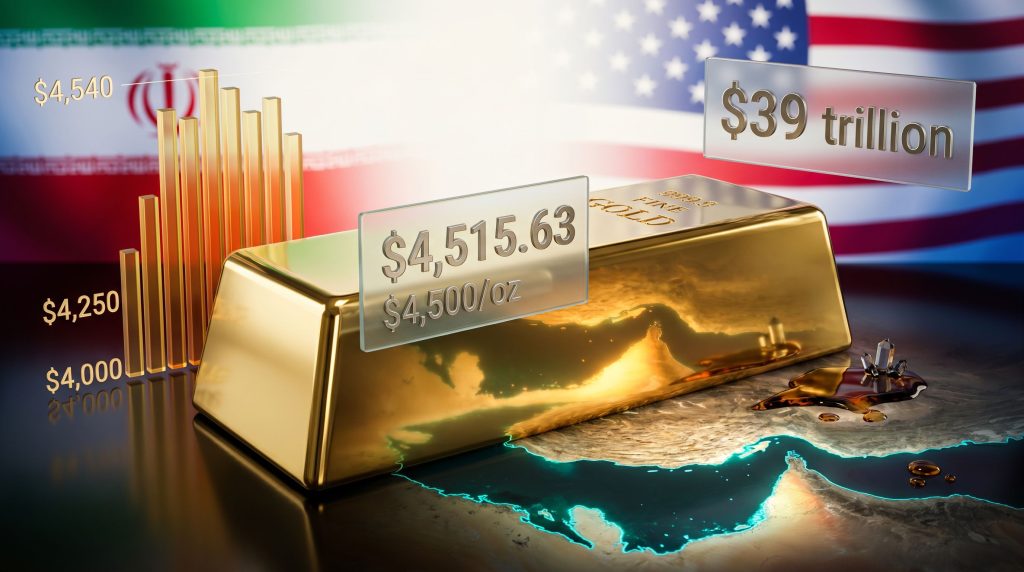
Spot gold trading at approximately $4,515.63/oz on May 22, 2026, a decline of roughly 0.60% on the day, might seem unremarkable in isolation. However, the context transforms the data point entirely. Prices have oscillated within a $4,512 to $4,544/oz corridor across major pricing platforms, and the pattern of intraday behaviour has been telling.
During Asian market hours and the early London session, gold has repeatedly slipped below the $4,500 threshold, only to be bought back once U.S. markets come online. Institutional participants are clearly defending this level, but the conviction behind each recovery appears to be diminishing. In market psychology terms, this is a classic sign of distribution: the buyers are still present, but the enthusiasm that once drove aggressive accumulation is giving way to more cautious position maintenance.
The $4,500/oz level is functioning less as a launch pad and more as a life raft. Buyers are defending it, but each bounce feels incrementally weaker than the last, which raises serious questions about what lies beneath if support gives way.
The Strait of Hormuz: Why One Waterway Moves Global Gold Markets
A Chokepoint With Outsized Systemic Consequences
The Strait of Hormuz is a narrow passage connecting the Persian Gulf to the Gulf of Oman. It is approximately 33 kilometres wide at its narrowest navigable point and serves as the transit corridor for roughly 20% of global oil trade and a significant share of liquefied natural gas exports, particularly from Qatar, one of the world's largest LNG producers.
The geopolitical weight of this passage is difficult to overstate. A credible threat to Hormuz transit, whether through military action, retaliatory mining, or a formal blockade, carries the potential to push crude oil prices toward or above $200 per barrel, a scenario that would reverberate across virtually every asset class on earth. Gold's safe-haven role becomes acutely relevant in precisely these kinds of systemic disruption scenarios.
The transmission mechanism from a Hormuz disruption to gold prices runs through three channels:
- An energy price shock accelerates consumer inflation, compresses real yields, and amplifies gold's monetary hedge function.
- Supply chain instability introduces broad equity market volatility, triggering safe-haven rotation into gold.
- Under stagflationary conditions where energy costs rise while growth contracts, the dollar's reserve currency credibility comes under pressure, reinforcing gold's role as a monetary alternative.
The Current State of U.S.-Iran Diplomacy
Pakistan has reportedly facilitated back-channel communications between U.S. and Iranian officials, with regional actors including Turkey, Qatar, Oman, and Egypt engaged in parallel de-escalation efforts. This multilateral diplomatic architecture reflects the complexity of the underlying dispute, which extends well beyond any single issue.
The primary sticking points remain Iran's nuclear enrichment programme and a series of preconditions set by the U.S. administration. Reports indicate that the threat of renewed military action has not been formally withdrawn, meaning the negotiating environment remains fragile. According to analysts at CNBC, talks have reportedly converged on certain parameters, but a comprehensive, verifiable agreement covering Hormuz navigation rights has not been signed as of late May 2026.
The Competing Forces Acting on Gold Right Now
| Market Force | Directional Impact on Gold | Primary Mechanism |
|---|---|---|
| Hormuz closure threat / active conflict risk | Strongly bullish | Energy inflation + safe-haven demand |
| Peace-talk optimism / de-escalation signals | Bearish / limiting | Geopolitical risk premium unwinding |
| Hawkish Federal Reserve under Warsh | Bearish | Higher real yields, reduced rate-cut probability |
| Rising U.S. Dollar Index | Bearish | Dollar-denominated gold costlier for foreign buyers |
| U.S. federal debt approaching $39 trillion | Conditionally bullish | Structural constraint on rate ceiling |
| Global central bank gold accumulation | Structurally bullish | Long-term reserve diversification trend |
Three Scenarios: How a U.S.-Iran Deal Could Reshape Gold's Trajectory
Scenario One: Full De-Escalation and a Verified Hormuz Agreement
If a durable, internationally verified agreement materialises and the Strait of Hormuz reopens under confirmed terms, the geopolitical risk premium embedded in gold's current valuation would face rapid unwinding. Historical precedent is instructive here: geopolitical risk premiums in gold tend to deflate significantly faster than they accumulated, a dynamic sometimes described as the sell-the-peace effect.
In this scenario, $4,250/oz emerges as the first meaningful structural support zone, representing approximately a 5.5% drawdown from the $4,500 anchor. A more pessimistic reading, in which institutional long positions are unwound simultaneously and liquidity is thin, raises the prospect of prices testing $4,000/oz, a roughly 11% correction from current levels.
Scenario Two: Partial Agreement and Diplomatic Consolidation (Base Case)
The more probable near-term outcome, given the complexity of outstanding issues, is a conditional or incomplete agreement. This would reduce immediate military risk without resolving the deeper structural tensions between the U.S. and Iran. In this environment, gold is likely to consolidate within a $4,400 to $4,550/oz range, with directional conviction remaining suppressed until a definitive catalyst forces a move in either direction.
This is the scenario most consistent with the trading patterns observed during the week of May 22, 2026: a market that is neither running toward exits nor building new positions with conviction.
Scenario Three: Negotiation Collapse and Re-Escalation
If diplomatic efforts fail and the U.S. follows through on threatened military action, the sequence would likely be swift. Energy markets would spike, inflation expectations would re-accelerate, and gold's safe-haven bid would reassert with force. Under this scenario, gold would likely retest the $4,540/oz recent high and potentially break above it with fresh momentum.
Scenario Summary:
- Full de-escalation + Hormuz agreement: Gold tests $4,250, potentially $4,000
- Partial deal / status quo diplomacy: Gold consolidates $4,400 to $4,550
- Negotiation breakdown / re-escalation: Gold retests $4,540+ with upside momentum
The Federal Reserve Variable: Warsh, Debt, and the Rate Ceiling Paradox
What Kevin Warsh's Appointment Means for Gold
The formal installation of Kevin Warsh as Federal Reserve Chair introduced a new monetary policy variable into gold's pricing equation. His inaugural remarks, delivered at the White House on May 22, 2026, contained no indication of a departure from the hawkish pause that characterised the closing period of his predecessor's tenure. For gold, which performs most powerfully in environments of falling real yields, a prolonged period of elevated rates represents a structural headwind that compounds the bearish pressure from de-escalation headlines.
The $39 Trillion Constraint: Why Rate Hikes Have a Structural Ceiling
Here is where a less commonly discussed dynamic enters the analysis. With U.S. federal debt approaching $39 trillion, several market observers are now examining whether the Warsh-led Fed faces a structural constraint on how aggressively it can raise rates. The transmission risk is straightforward in principle but significant in magnitude:
- Materially higher rates increase the federal government's borrowing costs on new and rolling debt issuances.
- Those costs pass through to the U.S. banking system, which must recalibrate lending rates accordingly.
- Corporate balance sheets face higher refinancing costs, compressing margins and investment capacity.
- Consumer credit conditions tighten, reducing spending and slowing economic growth.
This creates an asymmetric rate environment. The ceiling on rate increases may be structurally lower than the hawkish rhetoric implies, which provides a quiet but meaningful floor of support for gold even within a higher-for-longer policy framework. The implication for investors is nuanced: gold faces headwinds from current rate levels, but the probability of a significantly more aggressive tightening cycle may be lower than headlines suggest. Consequently, considering gold as a strategic investment over a longer time horizon remains a well-supported position even in this complex rate environment.
Dollar Strength as a Concurrent Headwind
Healthy U.S. macroeconomic data releases during the week ending May 22, 2026 contributed to a recovery in the U.S. Dollar Index. A stronger dollar exerts direct downward pressure on gold by increasing its effective cost for buyers operating in other currencies. While the dollar-gold relationship is not mechanically inverse across all market conditions, in the current environment, dollar strength is compounding bearish pressures from both de-escalation headlines and the Warsh Fed's hawkish posture.
Technical Levels, Liquidity Risks, and the Memorial Day Factor
Mapping Gold's Key Support Architecture
| Price Level | Significance | Scenario Trigger |
|---|---|---|
| $4,500/oz | Primary psychological support | Currently being defended; conviction declining |
| $4,400/oz | Near-term consolidation floor | Partial de-escalation / status quo base case |
| $4,250/oz | First structural support below $4,500 | Full de-escalation deal materialises |
| $4,000/oz | Deeper structural support | Full deal + dollar strength + confirmed hawkish pivot |
The Air Pocket Problem Below $4,500
One of the more concerning technical dynamics market participants are currently monitoring is the potential for thin bid depth between $4,500 and $4,250. In a scenario where institutional sellers become active, price could gap lower without encountering meaningful buying interest, a condition sometimes described as an air pocket in the order book.
This risk is amplified by the Memorial Day holiday period. Reduced liquidity during long weekends is a well-documented phenomenon in precious metals markets, where even modest directional order flow can produce outsized price movements due to the absence of normal market-making depth.
Risk Note: Thin trading conditions around the U.S. Memorial Day long weekend can amplify volatility in precious metals markets. Reduced participation means that directional moves, in either direction, may be more pronounced than underlying fundamentals would justify.
The next major ASX story will hit our subscribers first
Gold as an Inflation Hedge vs. Gold as a Geopolitical Hedge: Which Is Dominant?
These two functions of gold are analytically distinct but frequently conflated in mainstream market commentary, and the distinction matters enormously for understanding current pricing dynamics.
At present, the geopolitical hedge function appears to be the dominant driver. Gold's elevated valuation relative to traditional inflation-adjusted pricing models suggests that risk premium, not just monetary debasement, represents a meaningful portion of the spot price. If gold price and U.S.-Iran de-escalation converge toward a durable agreement, gold's fair value derived purely from real yield and inflation models may be materially below $4,500/oz.
The energy-inflation linkage adds another dimension. A Hormuz disruption driving oil toward $200/barrel would confront central banks with an extraordinarily difficult dilemma:
- Fight the inflation by raising rates aggressively, which would normally be bearish for gold but risks triggering a supply-shock recession.
- Support growth by cutting or holding rates, which would be directly bullish for gold but could allow inflation expectations to become unanchored.
The policy uncertainty inherent in this dilemma is itself a source of gold demand. When central bank responses are genuinely unpredictable, the appeal of a non-yielding hard asset with a multi-thousand-year track record as a store of value becomes structurally compelling. In addition, the recession impact on gold during periods of stagflationary stress historically reinforces the case for holding meaningful allocations through periods of policy uncertainty.
Portfolio Positioning in a De-Escalation Environment
Tactical vs. Strategic Gold Allocation
Investors approaching gold in the current environment should distinguish clearly between two different holding rationales:
- Tactical geopolitical positioning – exposure held specifically because of U.S.-Iran conflict risk and the Hormuz premium. This component of a position warrants review as diplomatic progress unfolds.
- Strategic structural allocation – exposure held because of long-term dollar credibility concerns, sovereign debt dynamics, ongoing central bank accumulation globally, and inflation uncertainty. This component remains supported regardless of any single diplomatic outcome.
A partial de-escalation scenario does not warrant wholesale position reduction. The structural foundations of gold's long-term bull case, elevated sovereign debt levels, persistent inflation uncertainty, and a multi-year trend of central bank gold demand away from dollar reserves, remain intact.
For longer-term observers, any sustained pullback toward the $4,250 to $4,000/oz range, should a comprehensive agreement materialise, would represent a structural entry opportunity rather than a signal of fundamental deterioration. Market intelligence firm Seeking Alpha notes that de-escalation scenarios tend to produce sharp but ultimately short-lived corrections in gold, a pattern worth bearing in mind when positioning around diplomatic developments.
Disclaimer: This article is for informational purposes only and does not constitute financial advice. Gold prices are subject to significant volatility, and all investment decisions should be made in consultation with a qualified financial professional. Past price levels are not indicative of future performance. Scenario projections are analytical frameworks, not forecasts.
Frequently Asked Questions
Why does the U.S.-Iran conflict affect gold prices?
The conflict affects gold through two primary channels. First, the threat of Hormuz disruption raises the prospect of a major energy supply shock that would accelerate inflation and compress real yields, conditions historically favourable for gold. Second, geopolitical uncertainty itself generates safe-haven demand from investors seeking assets that preserve value during periods of elevated systemic risk.
How much of gold's current price is a geopolitical risk premium?
Precise quantification is inherently difficult, but during periods of acute conflict risk, geopolitical premiums in gold are generally estimated to range between $100 and $300 per ounce. At current levels near $4,500/oz, a successful and durable U.S.-Iran agreement could plausibly trigger a correction of that magnitude as the premium unwinds.
Would a U.S.-Iran deal cause gold to collapse?
A comprehensive agreement would likely produce a meaningful correction, but a collapse scenario is not supported by the structural fundamentals. U.S. federal debt, ongoing global central bank gold accumulation, and long-term dollar credibility concerns provide a persistent floor beneath any purely geopolitical selloff. A pullback toward $4,250 to $4,000/oz is the analytically grounded expectation, not a disorderly collapse.
What is the Strait of Hormuz and why does it matter for gold?
The Strait of Hormuz is the world's most critical oil transit corridor, through which approximately 20% of globally traded crude oil passes. Its closure would constitute a major supply shock with cascading effects on inflation, central bank policy, and financial market stability, all of which directly influence gold demand.
How does the Warsh Fed's stance interact with U.S.-Iran developments?
The hawkish posture maintained under Warsh creates a headwind for gold independent of geopolitical factors. However, the structural constraint imposed by nearly $39 trillion in federal debt may limit how aggressively the Fed can tighten, providing a quiet but meaningful support floor for gold even within a higher-for-longer framework.
What to Watch in the Weeks Ahead
The gold price and U.S.-Iran de-escalation story is unlikely to resolve cleanly or quickly. The key monitoring points for market participants are:
- Primary catalyst: Whether a formal, verifiable U.S.-Iran agreement materialises and whether it explicitly addresses Hormuz navigation rights.
- Secondary catalyst: Federal Reserve communications under Chair Warsh, specifically any softening of the hawkish tone that would provide independent upside support for gold.
- Macro data flow: U.S. dollar trajectory, CPI and PCE inflation readings, energy price movements, and labour market data will all feed into gold's near-term directional bias.
- Technical signal: Whether $4,500/oz holds as support or transitions to overhead resistance on any attempted recovery rally.
The core tension defining gold's near-term direction is the simultaneous presence of structural support and tactical vulnerability. De-escalation is a meaningful headwind, but it is not a ceiling. Gold's case for remaining a premium-priced asset rests on foundations that extend far beyond any single geopolitical flashpoint, and the question investors should be asking is not whether gold can survive a U.S.-Iran agreement, but whether the structural conditions that drove gold to $4,500 in the first place are genuinely being resolved or merely temporarily interrupted.
Want To Know When The Next Major Gold Discovery Hits The ASX?
Discovery Alert's proprietary Discovery IQ model delivers real-time alerts on significant ASX mineral discoveries, cutting through the noise of daily announcements to surface actionable opportunities the moment they emerge — explore historic discovery returns to understand the magnitude of what early positioning can mean, then begin your 14-day free trial at Discovery Alert to secure your market-leading edge.