July 23, 2026
The Mechanics Behind Gold's Sensitivity to Central Bank Policy
Few forces in global finance operate with the consistency and reach of monetary policy when it comes to shaping commodity prices. Gold prices and Fed meeting cycles sit at the intersection of currency dynamics, inflation expectations, and real yield movements, making gold one of the most rate-sensitive assets in any portfolio. Understanding this relationship requires looking beyond the surface-level narrative of interest rates rising and gold falling. The actual mechanics are considerably more nuanced, and the moments that matter most often arrive well before any official decision is announced.
When big ASX news breaks, our subscribers know first
Why the Federal Reserve Commands Gold Markets
The Opportunity Cost Architecture of Non-Yielding Assets
Gold produces no income. It pays no dividend, accrues no coupon, and generates no yield. This structural characteristic means its attractiveness relative to other assets is constantly shifting based on what competing investments offer. When the Federal Reserve tightens monetary policy, Treasury yields rise, and the implicit cost of holding gold increases in proportion.
This is the core of what analysts call the opportunity cost framework. When a two-year U.S. Treasury note yields 5% or more, every ounce of gold held in a portfolio represents a decision to forgo that return. As rate expectations climb higher, gold becomes comparatively less compelling, and institutional capital rotates accordingly. Furthermore, two-year yield trends have become an increasingly important signal for traders navigating this environment.
The relationship is not purely mechanical, however. Inflation complicates the picture significantly. If nominal rates are rising but inflation is rising faster, real yields (nominal yield minus inflation) can remain negative, which historically provides fertile ground for gold appreciation. The gold market, therefore, is tracking real yields far more closely than headline rate decisions.
Forward Guidance as the True Market Mover
Markets do not wait for decisions. By the time a Federal Open Market Committee announcement crosses the wire, experienced traders have already priced in weeks of probabilistic positioning. The actual statement rarely surprises the market as much as the tone, language, and dot plot projections that accompany it.
When Fed officials signal willingness to hold rates higher for longer, or when a significant portion of the voting committee expects further hikes within a cycle, gold markets reprice in anticipation. The announcement itself becomes a confirmation event rather than a discovery event. This is why gold's reaction to a rate hold can sometimes be more negative than its reaction to an actual hike, if the hold comes paired with hawkish guidance that was not fully anticipated.
Gold Prices and Fed Meeting Dynamics: What the Current Environment Reveals
Pre-Meeting Positioning and the CME FedWatch Signal
The period immediately preceding a Federal Reserve meeting tends to compress gold's range as traders reduce exposure and await clarity. Directional conviction gives way to hedging behaviour, and volume patterns shift toward options markets rather than outright futures positions.
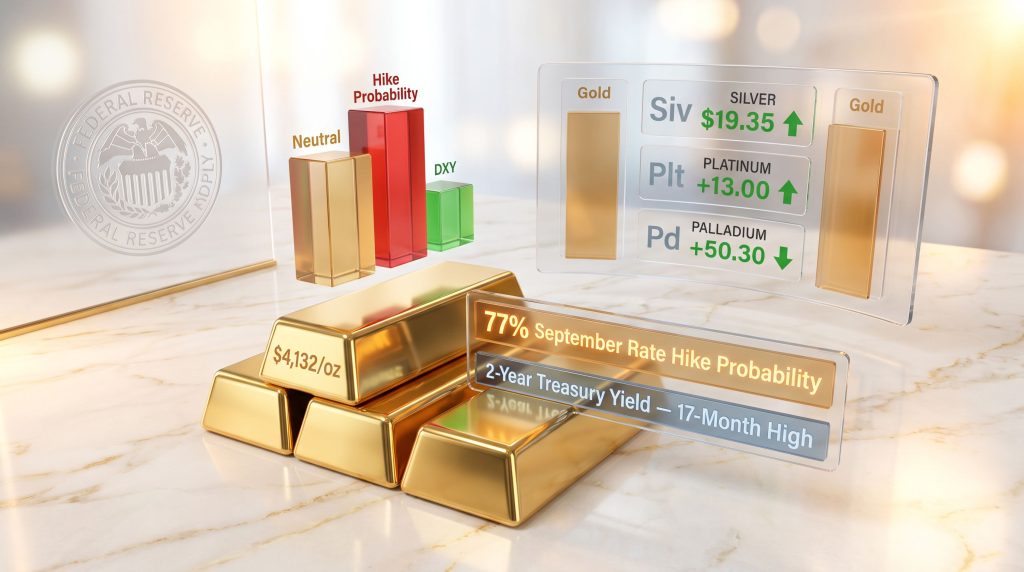
Current market data illustrates this dynamic clearly. Spot gold is trading near $4,132 per ounce, having retreated from a recent session high of $4,165.87, which marked its strongest level since early July. August-delivery U.S. gold futures have slipped 0.4% to approximately $4,134.60, reflecting the cautious posture traders are adopting ahead of the upcoming Fed decision.
The CME FedWatch Tool, which aggregates fed funds futures pricing to estimate policy probabilities, currently shows the market assigning roughly a 77% probability of a rate hike in September. This figure is not trivial. When markets attach this level of confidence to tightening action, the shadow of that expectation hangs over gold even when the current meeting produces no change in rates. Traders are effectively selling forward against a hike that has not yet occurred.
A near-certain rate hold today paired with a three-quarters probability of a hike in two months creates an unusual pricing environment where gold is suppressed not by present policy, but by anticipated future policy. The current consolidation near $4,132 reflects exactly this dynamic.
Why Gold Pulled Back Despite a Softening Dollar
One of the more counterintuitive elements of the current environment is that gold has failed to sustain its rally even as the U.S. Dollar Index (DXY) softened by approximately 0.1%. Under a straightforward inverse relationship, dollar weakness should support dollar-denominated gold by making it cheaper for international buyers.
The explanation lies in the competing force of rising short-term Treasury yields. Two-year U.S. Treasury yields have climbed to their highest level in 17 months, driven by market anxiety that renewed energy price pressures could reignite inflation and force the Fed's hand more aggressively than previously expected. This yield surge is directly counteracting the supportive impulse from the softer dollar, leaving gold in a state of uneasy consolidation.
| Market Variable | Current Reading | Directional Impact on Gold |
|---|---|---|
| Spot Gold Price | ~$4,132/oz | Neutral (consolidating) |
| U.S. Gold Futures (Aug) | ~$4,134.60 | Slightly bearish (-0.4%) |
| U.S. Dollar Index (DXY) | Eased -0.1% | Mildly supportive |
| 2-Year Treasury Yield | 17-month high | Bearish pressure on gold |
| Oil Prices | 6-week high | Inflationary, indirectly caps gold |
| September Rate Hike Probability | ~77% | Bearish for gold near-term |
The Multi-Variable Equation Beyond Interest Rates
Energy Prices, Inflation Feedback, and the Gold Ceiling
Oil markets are introducing a significant complication into the gold price equation. Crude prices have risen to their highest point in more than six weeks, with escalating geopolitical tensions in the Middle East contributing to supply uncertainty. U.S. military strikes targeting Iranian-linked forces and Houthi attacks on oil tankers in the Red Sea have pushed energy costs higher and stoked concerns about sustained inflationary pressure.
The inflationary feedback from oil creates a paradox for gold investors. On one hand, rising inflation historically supports gold as a store of value. On the other hand, if that same inflation compels the Federal Reserve to maintain or extend its tightening cycle, the resulting interest rate pressure works against gold through the opportunity cost mechanism described earlier. In the current environment, the second effect appears to be dominating.
Geopolitical Risk as a Dual-Edged Catalyst
Geopolitical instability traditionally channels capital into gold through its safe-haven function. However, the current Middle East conflict is producing an unusual dynamic: the primary market consequence is feeding through oil prices rather than directly into gold demand. Energy supply disruption is a more immediate market concern, and traders are pricing geopolitical risk through crude oil first, with gold receiving only a partial and secondary benefit.
This sequencing matters for investors trying to interpret gold's apparent resilience near $4,132 despite significant macroeconomic headwinds. The safe-haven floor is real, but it is being offset by rate expectation pressure from above. For deeper context, gold safe-haven insights reveal how this dynamic has evolved across recent market cycles.
How Hawkish and Dovish Fed Signals Historically Shape Gold
The Anatomy of Rate-Driven Gold Moves
Historical patterns reveal clear relationships between Fed communication styles and gold price behaviour, though the magnitude and duration of reactions have varied considerably across cycles.
| Fed Scenario | Market Expectation | Typical Gold Response |
|---|---|---|
| Rate hold + hawkish guidance | Rates stay higher for longer | Selloff; dollar and yields rise |
| Rate hold + dovish signals | Cuts incoming | Rally; dollar softens, yields fall |
| Surprise hike | Tightening accelerates | Sharp initial selloff |
| Surprise cut / pause pivot | Easing begins | Strong rally; safe-haven demand surges |
| Ambiguous / data-dependent language | Uncertainty premium | Volatility; gold may consolidate |
The most dangerous scenario for gold holders is a rate hold accompanied by unexpectedly hawkish forward guidance. Markets that had priced a pause can quickly recalibrate toward a prolonged restrictive stance, causing real yields to spike and gold to sell off despite the absence of any actual rate change. This pattern has repeated across multiple Fed cycles.
The Broader Central Bank Dimension
Europe's Rate Trajectory and Its Ripple Effects
The European Central Bank's upcoming decision carries indirect but meaningful implications for gold. The ECB is broadly expected to hold rates steady while keeping the possibility of additional hikes firmly on the table, particularly given that energy-driven inflation remains a European concern as much as an American one.
When multiple major central banks signal simultaneous tightening resolve, the effect on gold is compounded through two channels: broader global real yield elevation reduces gold's relative attractiveness across all currency bases, and coordinated monetary tightening tends to amplify dollar strength as the Fed's rate differential advantage is preserved or expanded. Consequently, understanding central bank gold prices provides essential context for navigating these multi-directional pressures.
G10 Currency Dynamics and Dollar-Denominated Gold
Gold priced in U.S. dollars is inherently sensitive to the relative strength of the greenback against a basket of developed-market currencies. When European, Japanese, or British monetary authorities diverge from the Fed in their tightening trajectories, the dollar typically appreciates, creating additional headwinds for gold even when the Fed itself holds steady. In addition, gold and bonds dynamics across economic cycles further illustrate how these cross-asset pressures interact.
The next major ASX story will hit our subscribers first
Silver, Platinum, and Palladium: Reading the Divergence Signal
Precious Metals Relative Performance
An instructive feature of the current market environment is that gold's industrial counterparts are outperforming on a session basis, suggesting that demand dynamics beyond monetary policy are influencing the broader precious metals complex.
| Metal | Price Level | Session Change | Key Driver |
|---|---|---|---|
| Silver (XAG) | ~$59.90/oz | +0.3% | Industrial demand + safe-haven |
| Platinum (XPT) | ~$1,656.24/oz | +0.7% | Supply constraints |
| Palladium | ~$1,301.25/oz | +0.8% | Automotive demand recovery |
Silver occupies a hybrid position between monetary metal and industrial input, making it less purely rate-sensitive than gold. Platinum and palladium are driven substantially by automotive manufacturing demand, particularly the ongoing transition in catalytic converter requirements. When these metals outperform gold, it often signals that industrial activity expectations are holding firm even as monetary conditions tighten.
This divergence is worth monitoring. A sustained period where industrial precious metals outperform gold can indicate that risk appetite remains healthy in the real economy even as financial markets wrestle with rate uncertainty.
A Framework for Interpreting Gold Around Fed Meetings
Three Analytical Lenses Every Gold Investor Should Apply
Reducing gold prices and Fed meeting analysis to a simple hike-or-hold binary misses the majority of what actually drives price. A more robust analytical approach incorporates three simultaneous perspectives:
- Rate Expectation Repricing – Is the market trajectory moving toward more hikes or fewer cuts? The direction of probability shifts in CME FedWatch matters as much as the absolute probability level.
- Real Yield Direction – Are inflation-adjusted Treasury yields rising or falling? Rising real yields represent the most direct mechanical headwind for gold, operating independently of nominal rate decisions.
- Dollar Trend Confirmation – Is dollar strength consistent with the prevailing rate narrative? When dollar moves and yield moves diverge, gold pricing becomes more complex and potentially more volatile.
Gold's reaction to a Fed decision is rarely about the decision itself. It is almost always about whether the outcome matches, exceeds, or disappoints what was already embedded in futures market positioning. A rate hold that was 90% priced in may produce negligible movement, while a hold accompanied by unexpectedly hawkish projections can trigger a material selloff even without a single rate change.
The Danger of Post-Decision Binary Thinking
Investors who position for a directional gold move based purely on the rate decision outcome frequently find themselves on the wrong side of the initial reaction. Gold markets are priced on expectations, not outcomes. When an outcome is widely anticipated, the information content of the announcement itself is low, and price reactions are driven by the delta between expectation and delivery.
This is particularly relevant in the current environment, where a rate hold is the consensus base case but the surrounding guidance on September and beyond carries the real market-moving potential. For broader context on where prices may be heading, the gold price forecast highlights the upward momentum underpinning longer-term sentiment despite near-term headwinds.
FAQ: Gold Prices and the Federal Reserve
Does gold always fall when the Fed raises interest rates?
No. While rate hikes generally create headwinds for gold through rising real yields and dollar strength, the actual market response depends heavily on what was already priced in. If a hike was fully anticipated, gold may not fall meaningfully, and in some cases rallies if the hike signals a near-end to the tightening cycle.
What is the relationship between the U.S. dollar and gold prices?
Gold is priced in U.S. dollars globally, so dollar strength typically makes gold more expensive for non-dollar buyers, reducing demand and pushing prices lower. Dollar weakness has the opposite effect. However, this relationship can be overridden by strong movements in real yields or geopolitical safe-haven demand.
Why do Treasury yields matter for gold investors?
Treasury yields represent the return available from risk-free U.S. government bonds. When yields are high, the opportunity cost of holding non-yielding gold increases. Two-year yields are particularly relevant because they most closely reflect near-term Fed rate expectations.
How does the CME FedWatch Tool help predict gold price movements?
FedWatch aggregates fed funds futures pricing to calculate implied probabilities of various rate outcomes at upcoming Fed meetings. Shifts in these probabilities, particularly when they move rapidly, often precede directional gold moves as traders reprice rate expectations across the forward curve.
Can geopolitical events override Fed-driven gold price trends?
Yes, in acute scenarios. Severe geopolitical crises can generate safe-haven demand powerful enough to push gold higher even in high-rate environments. However, sustained geopolitical risk without escalation tends to provide only a partial floor rather than a sustained upward catalyst.
What does a 77% rate hike probability mean for gold's near-term outlook?
A 77% probability signals that the market has largely pre-positioned for a September hike. This level of conviction suppresses gold's near-term upside because the market is effectively already short gold against the anticipated tightening. If data softens and that probability falls, gold could rally sharply as those short positions are unwound.
How far in advance do gold markets begin pricing in Fed decisions?
Markets begin adjusting positioning weeks before a scheduled Fed meeting, with the most significant repricing typically occurring following major data releases such as CPI, employment figures, and GDP revisions. By the time the meeting arrives, a well-telegraphed decision may already be 80–90% priced into gold futures, making the surrounding guidance far more consequential than the decision itself.
Key Takeaways: Navigating Gold Through a Monetary Policy Cycle
- Gold's primary rate-sensitivity mechanism operates through real yields and dollar dynamics, not nominal rate decisions in isolation
- Pre-meeting trader positioning frequently front-runs the official announcement, making the lead-up period analytically as important as the decision itself
- A 77% September rate hike probability represents the dominant near-term bearish overhang on gold prices and Fed meeting outcomes, even as the softening dollar provides partial relief
- Rising oil prices are introducing an inflationary feedback loop that simultaneously threatens to extend Fed tightening and provide a partial safe-haven floor for gold
- Silver, platinum, and palladium are outperforming gold on a relative basis, suggesting industrial demand dynamics are partially decoupling from gold's rate-sensitivity narrative
- Interpreting gold around Fed meetings requires tracking three simultaneous variables: rate expectation direction, real yield trajectory, and dollar trend confirmation rather than the rate decision outcome alone
Disclaimer: This article is intended for informational and educational purposes only and does not constitute financial advice. Gold prices and interest rate expectations are subject to rapid change based on evolving economic data, geopolitical developments, and central bank communications. Readers should conduct independent research and consult a licensed financial adviser before making any investment decisions. All price data referenced reflects market conditions as reported near the time of writing.
Want to Stay Ahead of the Next Major ASX Mineral Discovery?
While gold's sensitivity to Fed policy and real yields demands careful macro analysis, Discovery Alert's proprietary Discovery IQ model cuts through the complexity by delivering real-time alerts on significant ASX mineral discoveries — instantly translating raw announcement data into actionable opportunities for both traders and long-term investors. Explore how historic discoveries have generated exceptional returns and begin your 14-day free trial today to position yourself ahead of the broader market.