June 27, 2026
Gold Prices at a Crossroads: How the Fed and US-Iran Developments Are Reshaping the Market
Few assets reveal the fault lines of global macro uncertainty quite like gold. Historically, the metal has served as a barometer for collective anxiety, a mirror for inflation expectations, and a silent referendum on the credibility of central banks. Yet what makes 2026 so analytically interesting is that gold prices and Fed and US-Iran developments are no longer moving in isolation. Instead, they are pulling the market simultaneously in opposing directions by two forces of near-equal magnitude: the interest rate trajectory of a newly led Federal Reserve and the geopolitical recalibration triggered by a landmark diplomatic framework.
When big ASX news breaks, our subscribers know first
The Mechanics of Gold Pricing: Why Two Forces Are Colliding Right Now
Gold pricing has always been more nuanced than popular narrative suggests. While media coverage tends to reduce the metal to a simple panic-buying instrument, professional market participants analyse it through several interconnected lenses: real interest rates, US dollar strength, inflation expectations, geopolitical risk premiums, and structural demand from sovereign buyers.
In a conventional rate-hiking cycle, gold faces headwinds on multiple fronts simultaneously. Rising nominal rates increase the opportunity cost of holding a non-yielding asset. A stronger dollar, which often accompanies tighter monetary policy, makes gold more expensive in other currencies, suppressing international demand. Furthermore, if rate hikes successfully cool inflation, the inflation-hedge argument for gold also weakens considerably.
What makes mid-2026 unusual is that a countervailing geopolitical force has emerged at precisely the moment when Fed policy is at its most consequential inflection point. The announcement of a preliminary US-Iran agreement introduced dollar softness, lower oil price expectations, and a temporary reduction in risk premiums — all of which create pockets of support for gold even as rate pressures mount. Gold and bond dynamics add another dimension, as shifting yield environments reshape how investors allocate across asset classes.
Current Price Snapshot: Reading the Numbers Accurately
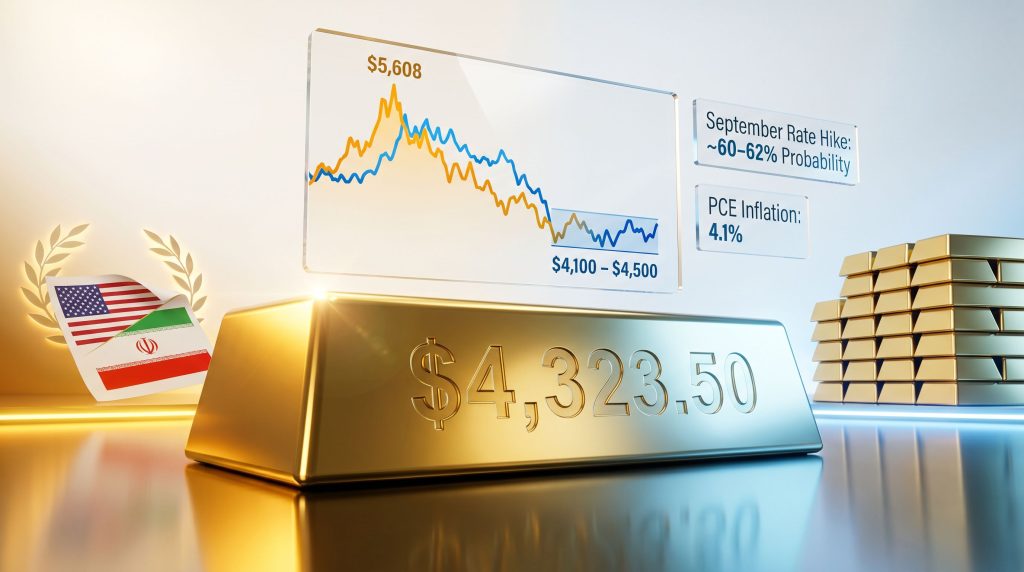
As of June 17, 2026, spot gold was trading at $4,323.50 per ounce with minimal directional movement recorded at 0852 GMT. US gold futures were marginally weaker, declining 0.3% to $4,342.40. The flat price action followed four consecutive sessions of modest gains, suggesting that bullish momentum had reached a natural ceiling rather than a fundamental inflection.
The broader precious metals complex reflected similar consolidation pressure:
| Metal | Spot Price | Session Change |
|---|---|---|
| Gold | $4,323.50 | Little changed |
| US Gold Futures | $4,342.40 | -0.3% |
| Silver | $69.59 | -0.8% |
| Platinum | $1,784.85 | -1.1% |
| Palladium | $1,344.21 | -0.6% |
The correlation of weakness across silver, platinum, and palladium is not coincidental. These metals share gold's characteristic of offering no income yield, meaning the same rate-pressure logic that constrains gold applies broadly across the precious metals complex. When the macro backdrop is ambiguous, the entire sector tends to tread water.
Perhaps the most significant contextual figure is not the current spot price but the distance from gold's January 2026 all-time high of $5,608 per ounce. The current price represents roughly a 20% drawdown from that peak — a correction substantial enough to warrant serious analysis of whether this constitutes a structural trend reversal or an extended consolidation within a longer secular bull market. The gold price forecast for the medium term remains a subject of intense debate among professional analysts.
The US-Iran Deal: Short-Term Catalyst With Long-Term Complexity
When a preliminary US-Iran agreement was announced earlier in the week, spot gold climbed to a one-week high, recovering from a near six-month low recorded the prior week. On the surface, this seems counterintuitive: a peace agreement reduces geopolitical risk, which should logically reduce safe-haven demand for gold. The reality, however, is more layered.
The initial rally was driven primarily by dollar weakness rather than a direct increase in safe-haven buying. Diplomatic progress between Washington and Tehran introduced optimism that Iranian oil could re-enter global markets at scale, reducing energy price pressure and easing inflation expectations. This transmission mechanism — running from oil supply to inflation to rate expectations to gold — is a key dynamic that many retail investors overlook.
Gold's relationship with geopolitical events is rarely linear. A diplomatic breakthrough does not simply remove a risk premium and send gold lower. It reshapes the entire macro environment, altering dollar dynamics, commodity pricing, and inflation forecasts in ways that can ultimately benefit gold pricing even as the headline risk diminishes.
The scenario matrix below illustrates the range of potential outcomes depending on how the diplomatic process evolves:
| Scenario | Oil Market Impact | Dollar Reaction | Gold Price Implication |
|---|---|---|---|
| Full agreement finalised | Supply surge; prices fall to $80-$90 | Softens | Mildly positive via lower inflation expectations |
| Extended negotiation phase | Uncertainty sustained | Mixed | Range-bound gold pricing |
| Deal collapses | Oil spikes higher | Strengthens | Sharp spike in safe-haven demand |
| Sanctions fully removed, Strait opened | Maximum supply impact | Weakens | Net positive for gold medium-term |
An often-overlooked nuance here is the energy-inflation-gold transmission channel. When oil prices ease from conflict-elevated levels back toward the $80 to $90 per barrel range, this directly reduces inflationary pressure in the US economy. Lower inflation, in turn, reduces the urgency for additional Federal Reserve rate hikes, which consequently diminishes the opportunity cost of holding gold. The safe-haven dynamics at play here create a circuitous but real pathway through which a Middle East peace deal can actually support gold prices over the medium term, even while removing direct geopolitical risk.
Kevin Warsh's Federal Reserve Debut: Why June 17 Matters for Gold
The same day gold was consolidating at $4,323.50 marked the first Federal Reserve policy decision chaired by Kevin Warsh, who succeeded Jerome Powell in the role. This institutional transition adds an additional layer of uncertainty that markets are still pricing in.
Ole Hansen, commodities analyst at Saxo Bank, noted that market participants were watching carefully to understand how the new Fed chair would interpret recent economic data and whether his communication style would signal any departure from the prior policy framework. This observation captures something important: it is not just the rate decision itself that markets care about, but the tone and framing of how a new central bank leader positions future policy.
Central bank communication has evolved into a policy tool in its own right. Forward guidance, dot plots, and press conference language can move markets as significantly as actual rate changes. A new Fed chair brings inherent ambiguity about how these communication instruments will be deployed, and that ambiguity itself introduces a risk premium into gold pricing.
The fundamental rate mechanics remain unchanged regardless of who chairs the Fed:
- Gold generates no interest income or dividend yield
- When risk-free rates rise, the relative attractiveness of yield-bearing assets like US Treasuries increases
- This makes holding gold comparatively more expensive on an opportunity-cost basis
- Elevated real yields therefore apply persistent downward pressure on gold valuations
With US PCE inflation running at 4.1%, well above the Fed's 2% target, markets have been pricing in approximately a 60 to 62% probability of a further rate hike at the September meeting. This elevated rate expectation is the primary structural ceiling constraining gold's recovery from its multi-month low.
Technical Constraints: Why Gold Cannot Simply Rally on Good News
Even when the fundamental environment offers partial support, gold faces meaningful technical resistance that limits the pace and scale of any recovery. Significant overhead resistance sits roughly 4.2% above current spot price levels, representing a zone where prior sellers have previously re-entered the market.
The convergence of key moving averages at current price levels signals reduced directional momentum — a technical condition that typically leads to range-bound behaviour until a sufficiently powerful fundamental catalyst breaks the equilibrium. Gold's four-session winning streak stalling precisely at this juncture reflects the interplay between fundamental optimism from the Iran deal and technical selling pressure from overhead resistance.
The broader context of the 20% drawdown from the January 2026 record raises a legitimate analytical question: is this a cyclical correction within a secular bull market, or the beginning of a more sustained reversal? Historical precedent suggests that gold corrections of this magnitude during periods of aggressive monetary tightening are not unusual. The metal experienced similar drawdowns during the 2013 taper tantrum and various phases of the 2015–2018 rate-hiking cycle. For further context on how downturns affect gold specifically, the recession impact on gold is a critical consideration for longer-term investors.
The next major ASX story will hit our subscribers first
Central Bank Demand: The Structural Floor Beneath Spot Prices
One of the most consequential and least-discussed dynamics in the current gold market is the behaviour of central bank buyers. Sovereign gold purchases have reached record levels in 2026, driven in part by the same Middle East geopolitical risks that are influencing spot market psychology.
Central bank demand is fundamentally different from speculative or retail buying in several important ways:
- It is largely price-insensitive over short time horizons, as reserve managers are focused on long-term allocation targets rather than tactical entry points
- It occurs consistently across market cycles, providing a demand floor during periods when speculative selling is heaviest
- It operates independently of Fed policy, meaning it continues even when rate pressures are weighing on speculative positioning
- It is structurally de-dollarisation driven, reflecting a multi-year trend of sovereigns reducing US dollar exposure in their reserves
This divergence between institutional and sovereign demand (structurally bullish) and retail or speculative positioning (cautious or net short) creates a market architecture where gold declines are consistently cushioned. It helps explain why, despite a 20% correction from peak levels, spot prices have not collapsed further.
Medium-Term Outlook: Three Macro Scenarios
The trajectory of gold prices and Fed and US-Iran developments across the next six to twelve months will be determined by how several intersecting variables resolve themselves. The following scenario framework provides a structured way to think through the range of outcomes.
Scenario 1: Fed Pivots Earlier Than Expected
If US inflation falls faster than current projections and Warsh signals rate cuts by early 2027, the dollar would weaken materially, real yields would compress, and gold could retest the $4,800 to $5,000 resistance zone. The catalyst would likely be a meaningful deterioration in US employment or GDP data.
Scenario 2: Stagflationary Pressure Builds
Should inflation remain sticky above 4% while economic growth slows simultaneously, gold would benefit from dual demand as both an inflation hedge and a safe-haven asset. Historical precedent from the 1970s stagflationary cycle demonstrates that this environment can drive multi-year bull markets in gold.
Scenario 3: Soft Landing Achieved
If the Fed successfully navigates inflation back toward target without triggering a recession, and the US-Iran diplomatic framework solidifies, gold would likely consolidate in the $4,100 to $4,500 range without a strong directional catalyst in either direction. Gold steady amid uncertainty remains a plausible baseline for many analysts in this scenario.
| Variable | Current Status | Gold Market Impact |
|---|---|---|
| Fed rate trajectory | Hawkish; ~60-62% September hike probability | Bearish |
| US-Iran diplomatic progress | Framework agreed; details pending | Mildly bullish short-term |
| PCE inflation | 4.1%, above Fed target | Bearish |
| Central bank demand | Record levels in 2026 | Structurally bullish |
| US Dollar Index | Softening on Iran deal optimism | Mildly bullish |
| Oil prices | Moving toward $80-$90 range | Reduces inflation pressure; mildly bullish |
| Technical resistance | ~4.2% above current spot | Bearish near-term |
Frequently Asked Questions
Why did gold initially rise after the US-Iran deal was announced?
The primary mechanism was dollar weakness rather than a spike in fear-based buying. Diplomatic progress between the US and Iran introduced expectations of additional oil supply entering global markets, which reduced inflationary pressure and modestly softened the case for further rate hikes. This weakened the dollar, which historically supports gold pricing on a cross-currency basis.
Does a peace deal between the US and Iran ultimately help or hurt gold prices?
The short-term effect is mildly supportive via dollar softness and lower oil prices. The medium-term effect is more ambiguous. A fully finalised agreement that removes geopolitical risk premiums would reduce one of gold's demand drivers. However, if the deal meaningfully lowers inflation expectations, it could simultaneously reduce rate hike pressure in a way that benefits gold on a net basis.
What is the most likely near-term price range for gold?
Given the balance of forces currently in play, range-bound trading between approximately $4,100 and $4,500 per ounce represents the most probable near-term outcome. A breakout in either direction would require either a definitive signal from the Fed on future rate policy or a significant escalation or resolution of geopolitical tensions.
What would need to happen for gold to reclaim its January 2026 all-time high?
A combination of a confirmed Fed pivot toward rate cuts, sustained and material dollar weakness, persistent inflation above current levels, or a new significant geopolitical shock would likely be required. The probability of all three aligning in the near term is relatively low, making a near-term return to $5,608 unlikely without a major macro regime change. Understanding the full scope of gold prices and Fed and US-Iran developments remains essential for investors positioning for any such scenario.
Disclaimer: This article is intended for informational and educational purposes only and does not constitute financial advice. All price levels, probability figures, and scenario projections involve uncertainty and should not be relied upon as predictions of future market performance. Investors should conduct independent research and consult qualified financial advisors before making investment decisions. All data referenced reflects market conditions as of June 17, 2026.
Want to Stay Ahead of the Next Major Mineral Discovery on the ASX?
While gold's macro dynamics play out across Fed decisions and geopolitical frameworks, Discovery Alert's proprietary Discovery IQ model cuts through the complexity by delivering real-time alerts on significant ASX mineral discoveries — explore the historic returns major discoveries have generated and begin a 14-day free trial to ensure you're positioned before the broader market moves.