August 26, 2026
Why Gold Rarely Moves for Just One Reason
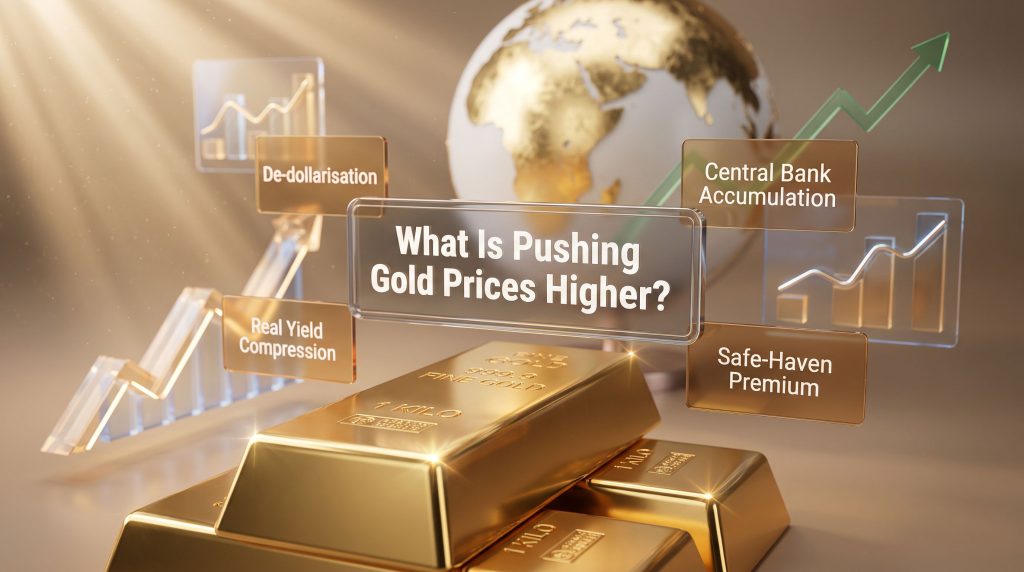
Precious metals markets have a long history of confounding analysts who attempt to reduce price movements to a single variable. Throughout every major gold bull market cycle, from the inflationary surge of the 1970s to the post-2008 financial crisis rally, the underlying architecture of demand has always been layered. What is pushing gold prices higher in the current environment is no different in that regard, though the specific combination of forces at work today carries some genuinely novel characteristics that deserve careful examination.
Understanding gold's current trajectory requires looking beyond the headlines and interrogating the mechanics of each major driver in turn: monetary conditions, currency dynamics, sovereign reserve strategy, geopolitical risk, and an emerging demand channel tied to the technology sector's extraordinary wealth generation. When these forces converge simultaneously, gold's price response tends to be amplified well beyond what any individual catalyst would produce in isolation.
When big ASX news breaks, our subscribers know first
The Monetary Policy Foundation: Real Yields and the Opportunity Cost of Gold
How Interest Rate Dynamics Create the Floor for Gold's Appeal
Gold produces no income. It pays no dividend, coupon, or interest. This fundamental characteristic means its attractiveness as an investment is directly sensitive to the real return available from competing assets, particularly government bonds and cash instruments. When real interest rates, which represent nominal rates minus inflation expectations, decline or turn negative, the cost of holding gold effectively falls toward zero.
This relationship between real yields and gold prices is one of the most empirically robust in all of commodity economics. Across multiple rate cycles since the early 1970s, periods of negative or deeply compressed real yields have corresponded with gold's strongest performance phases. Furthermore, the gold price forecast for 2025 reflects precisely this kind of upward momentum driven by sustained real yield compression.
| Driver | Mechanism | Gold Price Impact |
|---|---|---|
| Rising inflation expectations | Erodes real returns on fixed income | Strongly positive |
| Government debt expansion | Raises currency debasement risk | Positive |
| Rate cut expectations | Lowers opportunity cost of holding gold | Strongly positive |
| Negative real yields | Makes gold relatively more competitive | Strongly positive |
| Stagflation risk | Combines persistent inflation with weak growth | Very strongly positive |
Real yield compression acts as the gravitational engine beneath gold's price structure. When bond markets offer negative real returns, capital seeks stores of value that cannot be inflated away, and gold has historically been the primary beneficiary of that rotation.
The forward guidance trajectory of major central banks, particularly the U.S. Federal Reserve, remains one of the most closely watched variables in precious metals markets. Any sustained pause in tightening, or pivot toward accommodation, tends to activate gold's investment case well ahead of the official policy change, as market participants position in anticipation rather than reaction.
Dollar Weakness and the Fiscal Credibility Premium
Why U.S. Fiscal Deterioration Is Becoming a Structural Gold Catalyst
Because gold is priced globally in U.S. dollars, the direction of the dollar exerts a powerful mechanical influence on gold demand. When the dollar weakens against a basket of major currencies, gold becomes cheaper for buyers operating in those currencies, stimulating purchasing activity from international investors, central banks, and industrial consumers alike.
The more consequential dynamic, however, is not simply short-term dollar fluctuation but the structural erosion of confidence in the dollar's long-term purchasing power. Citi's global head of international economics, Nathan Sheets, has characterised the current U.S. fiscal trajectory as a position that has moved beyond manageable bounds, with deficit spending expanding in ways that market participants increasingly view as unsustainable. This assessment, shared across an expanding cohort of institutional economists, directly supports gold as a reserve asset alternative.
Key U.S. dollar and fiscal metrics that gold investors should monitor:
- The trajectory of the U.S. federal deficit as a percentage of GDP
- Foreign central bank appetite for U.S. Treasury securities at auction
- The U.S. Dollar Index (DXY) trend direction over rolling six to twelve month periods
- The spread between U.S. nominal yields and inflation breakeven rates
- Relative monetary policy divergence between the Fed and other major central banks
A weakening dollar and deteriorating fiscal credibility are not merely cyclical phenomena. They represent a structural argument for gold that institutional investors with long time horizons are taking increasingly seriously, regardless of near-term price volatility. In addition, understanding the dynamics of gold and bonds across economic cycles helps contextualise why these fiscal pressures translate so directly into precious metals demand.
Central Bank De-Dollarisation: The Most Powerful Structural Force
Why Sovereign Reserve Managers Are Accumulating Gold at Historic Rates
Among all the forces currently driving gold prices, sustained official-sector buying may represent the most durable and least reversible. Central banks across emerging market and non-Western economies have been accumulating gold at rates not seen in decades, driven by a strategic imperative to reduce dependency on U.S. dollar-denominated reserve assets.
The World Gold Council reported that central banks globally purchased more than 1,000 tonnes of gold in both 2022 and 2023, establishing back-to-back record years for official sector demand. This represents a structural shift in reserve management philosophy, not a tactical trade. Consequently, central bank demand has become one of the most significant pillars boosting gold's performance throughout 2025.
Why sovereign reserve managers are choosing gold over alternatives:
- De-dollarisation imperative – reducing exposure to USD-denominated assets following the demonstrated use of financial system access as a geopolitical tool
- Sanction-resistant reserve asset – gold held within a central bank's own vaults cannot be frozen, seized, or blocked through international financial mechanisms
- Long-horizon inflation protection – gold preserves purchasing power across institutional time scales measured in decades, not quarters
- Monetary credibility signalling – gold reserves enhance the perceived soundness of a central bank's balance sheet, particularly for emerging market economies with volatile domestic currencies
- Counterparty-free asset – unlike bonds or bank deposits, physical gold carries no counterparty risk
One of the most underappreciated aspects of central bank gold demand is its price insensitivity. Unlike speculative investors who may reduce positions as prices rise, sovereign reserve managers are executing against long-term strategic allocation targets. This creates a persistent demand floor beneath gold that absorbs selling pressure and compresses downside volatility.
The Geographic Spread of Official Sector Buying
The accumulation is notably broad-based, extending well beyond any single region or political bloc:
- The People's Bank of China has been among the most consistent buyers, though its official reporting is widely considered by metals analysts to understate actual accumulation
- Middle Eastern central banks and sovereign wealth entities have increased gold allocations as part of broader reserve diversification programs
- Eastern European and Central Asian monetary authorities have accelerated purchases, partly in response to geopolitical realignments following the 2022 conflict in Ukraine
- India's Reserve Bank has repatriated and expanded its gold holdings, signalling long-term commitment to hard asset reserve building
- Turkey's central bank has been among the most aggressive accumulators in percentage terms relative to total reserve size
A critical but lesser-known dynamic is that official sector gold purchases are often not fully captured in real-time data. Countries sometimes accumulate gold through indirect channels before officially reporting the additions to their reserves. This means actual central bank demand tends to be systematically underreported in contemporaneous market data, which in turn means analysts frequently underestimate the scale of structural buying pressure.
Geopolitical Risk Architecture: The Multi-Front Fear Premium
How an Overlapping Risk Landscape Sustains Gold's Safe-Haven Bid
Gold's role as a safe-haven asset is most forcefully activated when multiple sources of geopolitical or systemic stress are active simultaneously. The current global environment presents precisely this kind of overlapping risk architecture, with no single risk dominating but several running in parallel. For a deeper perspective on this, gold as a safe haven in 2025 has attracted considerable institutional attention as these conditions persist.
| Risk Category | Active Stress Points | Gold Demand Effect |
|---|---|---|
| Military conflict | Ongoing regional conflicts across multiple theatres | Elevated safe-haven flows |
| Trade fragmentation | Tariff escalation, supply chain rewiring | Structural uncertainty premium |
| Financial system stress | Banking sector fragility, sovereign debt concerns | Flight-to-quality demand |
| Currency instability | EM currency volatility, dollar depreciation pressure | Reserve substitution demand |
| Political unpredictability | Policy uncertainty in major economies | Risk premium expansion |
What makes the current geopolitical environment particularly supportive for gold is its persistence. Unlike isolated shock events that generate brief safe-haven spikes followed by rapid reversals, the current mosaic of risk has been self-sustaining for several years. This gives gold's geopolitical premium a structural character rather than a purely reactive one.
Nicky Shiels, head of metals strategy at MKS PAMP, one of the world's largest precious metals refiners, has argued that the intersection of government buying and AI-sector wealth effects represents a particularly potent combination for gold that distinguishes the current cycle from prior bull markets.
The AI Wealth Effect: An Emerging and Underanalysed Demand Channel
How Technology Sector Wealth Generation Is Feeding Precious Metals Markets
One of the most genuinely novel aspects of what is pushing gold prices higher in the current cycle is the role of technology sector wealth accumulation as a demand channel for hard assets. The extraordinary equity valuations generated by the artificial intelligence investment boom have produced significant realised and unrealised gains among technology sector participants, institutional investors, and AI-adjacent companies.
A portion of that wealth is finding its way into gold through portfolio diversification mechanics. High-net-worth individuals, family offices, and institutional funds with concentrated technology sector exposure have historically used gold as a counterweight to equity market risk. The AI cycle has substantially enlarged the pool of capital seeking this kind of diversification. Understanding what drives the price of gold at a foundational level helps contextualise why this new source of demand is so consequential.
The AI wealth effect represents a demand channel that operates independently from traditional macroeconomic gold drivers. It reflects deliberate portfolio construction decisions by a new generation of technology-enriched investors who treat gold as a durable store of value rather than simply a crisis hedge. This is a meaningful structural evolution in the buyer base for precious metals.
This dynamic is distinct from speculative gold buying and different again from the inflation hedging or safe-haven motivations that dominate traditional analytical frameworks. It represents a long-duration allocation decision driven by wealth preservation logic, which makes it more persistent and less price-sensitive than conventional investment demand.
Characteristics of AI wealth effect gold demand:
- Driven by portfolio construction rather than macroeconomic fear
- Concentrated among high-net-worth and ultra-high-net-worth individuals with technology exposure
- Expressed through both physical gold and gold ETF vehicles
- Complements rather than competes with traditional safe-haven demand
- Likely to persist as long as technology sector wealth generation continues
The next major ASX story will hit our subscribers first
ETF Flows and the Self-Reinforcing Mechanics of Investment Demand
How Gold ETF Inflows Amplify Price Momentum
The democratisation of gold investment through exchange-traded funds has fundamentally altered the mechanics of how retail and institutional capital enters and exits precious metals markets. Gold ETFs require fund managers to purchase physical gold to back each share issued, meaning that net inflows create direct physical demand rather than purely synthetic price exposure. Indeed, record gold ETF inflows in 2025 have reflected precisely this self-reinforcing dynamic playing out across global markets.
This creates a well-documented self-reinforcing cycle during bull market phases:
- A macro or geopolitical trigger activates initial safe-haven or investment demand
- Early price appreciation attracts momentum-following investors and systematic trading strategies
- Rising ETF inflows require physical gold purchases by fund managers, adding genuine physical demand pressure
- Strengthening price momentum triggers media coverage, broadening retail investor awareness
- Fear of missing out draws additional retail and semi-institutional participation
- Structural buyers, particularly central banks and long-term holders, provide a persistent demand floor beneath the speculative activity
Key ETF and flow metrics for gold market monitoring:
- Total gold ETF holdings measured in tonnes (rising trend confirms institutional conviction)
- Net weekly ETF inflows and outflows as a directional momentum signal
- COMEX futures speculative long positioning as a sentiment intensity indicator
- Physical gold premium or discount relative to spot price as a supply-demand tightness signal
- Mint and refiner delivery premiums as an indicator of physical market tightness
Short-Term Triggers Versus Long-Term Structural Forces
Separating What Moves Gold This Quarter from What Moves It This Decade
A sophisticated understanding of gold price dynamics requires distinguishing between cyclical triggers that can reverse quickly and structural forces that operate across multi-year time horizons. The current gold rally is unusual in that it features compelling drivers at both time scales simultaneously.
| Time Horizon | Primary Driver | Reversibility |
|---|---|---|
| Short-term (0-12 months) | Rate cut expectations, geopolitical events, dollar weakness | High, can reverse with policy shifts |
| Medium-term (1-3 years) | ETF inflows, AI wealth effect, inflation hedging demand | Moderate, depends on macro regime |
| Long-term (3-10 years) | Central bank de-dollarisation, fiscal deterioration, structural dollar decline | Low, deeply embedded structural shift |
The most important insight for investors is that the long-term structural drivers are not merely extensions of the cyclical story. De-dollarisation is a sovereign policy choice that evolves over years and decades, not quarters. Fiscal deterioration in major Western economies is a mathematical trajectory that requires either dramatic policy reversal or currency adjustment to resolve. These are not variables that correct with a single central bank meeting or geopolitical resolution. Analysts tracking key factors affecting gold rates consistently emphasise this distinction between short-term noise and long-term structural drivers.
Frequently Asked Questions About What Is Pushing Gold Prices Higher
Is gold in a speculative bubble right now?
Gold's current price reflects identifiable fundamental drivers including real yield compression, dollar weakness, and persistent central bank demand. The absence of a single speculative catalyst and the presence of multiple structural underpinnings distinguish this rally from purely sentiment-driven price spikes. That said, any asset experiencing strong momentum can develop speculative excess above its fundamental value, making ongoing monitoring of real yields, ETF positioning, and central bank activity essential for assessing valuation.
Does the inverse dollar-gold relationship always hold?
Historically, the negative correlation between the U.S. dollar and gold is among the most reliable in commodity markets. However, temporary decoupling occurs during extreme risk-off events, when investors simultaneously seek safety in both the dollar and gold as competing safe-haven assets. These decouplings tend to be short-lived.
How is central bank gold buying different from retail investment demand?
Central bank purchases are strategic, price-insensitive, and executed against long-term allocation mandates. They create a structural demand floor that absorbs selling pressure across market cycles. Retail and ETF demand is more reactive to price momentum and sentiment, providing cyclical amplification above the structural base established by official sector buying.
What would cause the current gold rally to reverse?
The primary reversal catalysts would include a sharp rise in real interest rates globally, a significant dollar strengthening cycle driven by credible fiscal consolidation in the U.S., a de-escalation of geopolitical tensions sufficient to reduce safe-haven premiums, and a sustained reduction in central bank purchasing. All of these would need to occur in combination to meaningfully reverse gold's structural bull case.
Key Takeaways: The Convergence Architecture Behind Gold's Ascent
Understanding what is pushing gold prices higher requires holding multiple analytical frameworks simultaneously rather than reaching for a single explanation. The current bull market is architecturally distinct from prior cycles precisely because it is built on overlapping structural foundations rather than a single catalyst:
- Monetary conditions have compressed real yields toward levels that structurally disadvantage income-bearing assets relative to gold
- Dollar credibility is being challenged by fiscal trajectories that prominent institutional economists describe as genuinely unsustainable
- Central bank de-dollarisation is creating a persistent, price-insensitive demand floor at historically elevated volumes
- Geopolitical risk across multiple simultaneous theatres is sustaining a measurable fear premium in gold pricing
- AI sector wealth effects are generating a novel, behaviourally-driven demand channel from technology-enriched investors rotating into hard asset diversification
- ETF mechanics are amplifying each of these underlying drivers through self-reinforcing inflow and physical demand dynamics
This article is intended for informational and educational purposes only. It does not constitute financial advice, investment recommendations, or an offer to buy or sell any financial instrument. Gold and precious metals markets involve significant risk and past price performance is not indicative of future results. Readers should conduct their own due diligence and consult qualified financial advisors before making investment decisions.
Want to Know When the Next Major Mineral Discovery Hits the ASX?
Discovery Alert's proprietary Discovery IQ model scans ASX announcements in real time, instantly identifying significant mineral discoveries and turning complex data into actionable investment insights — explore historic discovery returns to understand the scale of opportunity, then start your 14-day free trial at Discovery Alert to position yourself ahead of the broader market.