July 16, 2026
The Structural Forces Rewriting Gold's Role in the Global Financial System
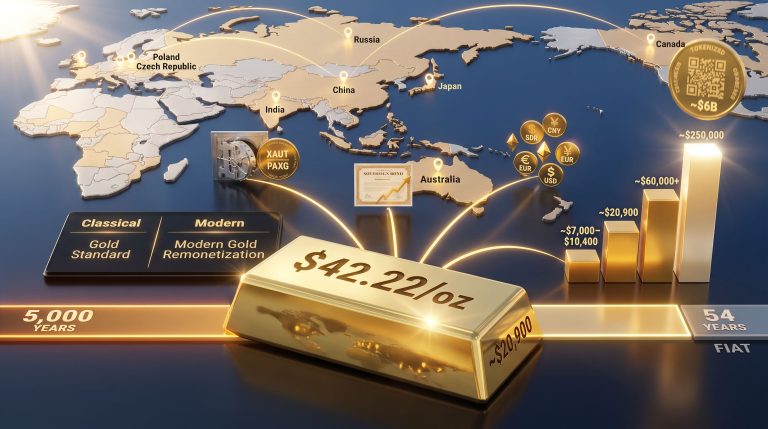
For most of the past two decades, gold functioned as a reactive asset — rising during crises and retreating when stability returned. That behavioural pattern is breaking down. What is unfolding across global commodity markets in 2025 and into 2026 represents something categorically different: a fundamental repricing of gold driven not by fear cycles, but by the deliberate, policy-driven restructuring of how the world's largest institutions store and protect sovereign wealth. Understanding this distinction separates informed positioning from reactive speculation.
The gold prices outlook heading into 2026 and 2027 has become one of the most debated topics in institutional finance, with major investment banks producing forecasts that span an unusually wide range. That divergence is itself informative — it reflects not analytical disagreement, but genuine macro uncertainty across monetary policy, geopolitical risk, and reserve management strategy.
When big ASX news breaks, our subscribers know first
Why Gold's Demand Profile Has Fundamentally Changed
From Speculative Positioning to Structural Accumulation
The mechanics of gold demand have shifted in ways that traditional price models were not built to capture. For decades, analysts relied on a straightforward inverse relationship between real yields and gold prices: when inflation-adjusted bond returns fell, gold became more attractive; when they rose, gold lost its relative appeal. That framework remains partially valid, but it now competes with a more powerful and less price-sensitive force: sovereign reserve diversification.
Central banks across emerging market economies have been net buyers of gold for more than a decade, but the pace and conviction of that buying accelerated sharply after 2022. The freezing of approximately $300 billion in Russian sovereign foreign exchange reserves by Western governments in response to the invasion of Ukraine sent a clear signal to reserve managers globally: dollar-denominated assets held in foreign jurisdictions carry a political risk that had previously been treated as negligible. For central banks in non-aligned economies, that calculation changed overnight.
The consequence has been a structural rotation into physical gold at the institutional level. Furthermore, this demand is fundamentally different from ETF flows or retail investment because it operates on multi-year policy mandates, executes on schedule regardless of quarterly price movements, and compounds as more institutions shift their allocation targets upward. Gold's appeal as a jurisdiction-neutral, counterparty-free reserve asset — one that cannot be frozen, sanctioned, or seized through the international financial system — has become a core policy argument rather than a peripheral investment preference.
"The 2022 sovereign asset freeze effectively demonstrated that reserve currency status and asset security are not the same thing. Gold remains the only major reserve asset that exists entirely outside the counterparty risk framework of the international banking system."
The Technical Reality of Supply Constraints
What makes the current gold prices outlook particularly compelling is that structural demand growth is colliding with geological and operational constraints on the supply side. Global gold mine production has plateaued in recent years, with the industry facing a well-documented pipeline problem: the average time from discovery to first production for a major gold deposit now exceeds fifteen to twenty years, and the discovery rate of large, high-grade deposits has been declining for decades.
Several supply-side dynamics are worth understanding:
- Grade decline: Average ore grades at operating mines have fallen significantly over recent decades as the highest-quality deposits were mined first. Lower grades mean more ore must be processed to produce the same amount of gold, raising costs and reducing margins at lower price points.
- Discovery deficit: The industry has been consuming known reserves faster than new economically viable deposits are being found. This structural underinvestment in exploration during the low-price years of 2013 to 2018 is now feeding through into constrained future supply.
- Jurisdictional complexity: Many of the world's remaining large undeveloped gold deposits are located in geopolitically complex or operationally challenging jurisdictions, adding development risk and timeline uncertainty.
- Rising all-in sustaining costs (AISC): The industry benchmark for measuring the true cost of gold production has risen materially, meaning higher prices are increasingly required to incentivise new supply rather than just maintaining existing output.
These supply-side realities mean that even if demand growth moderates, the structural floor beneath gold prices is likely to remain elevated relative to historical averages.
What Are Major Investment Banks Forecasting for Gold Prices in 2026 and 2027?
Institutional Price Target Comparison: 2026 to 2027
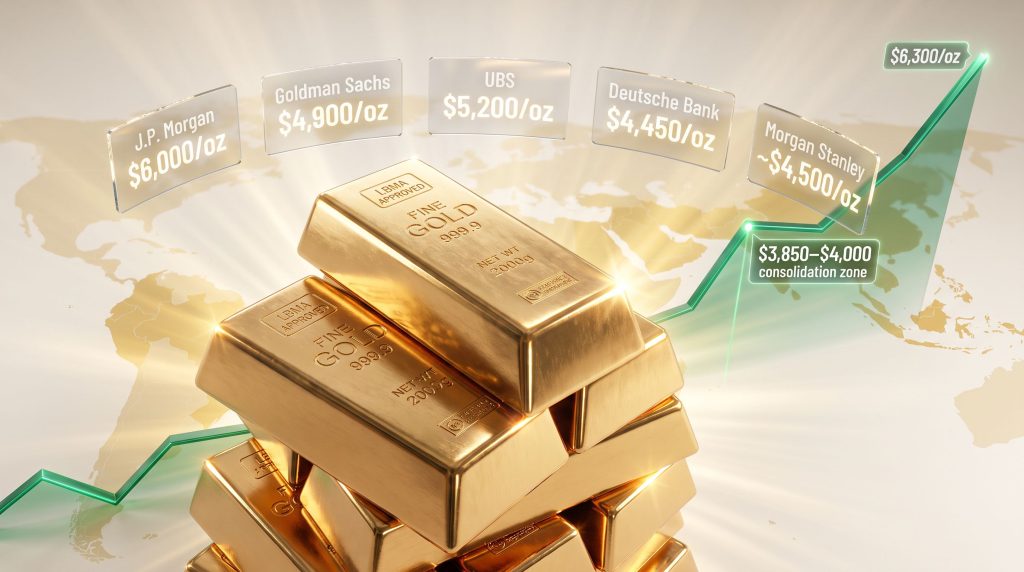
The range of institutional forecasts currently in circulation reflects the genuine macro uncertainty facing analysts. The table below presents current consensus targets from major investment banks:
| Institution | End-2026 Price Target | 2027 Outlook / Key Assumption |
|---|---|---|
| J.P. Morgan | $6,000/oz (Q4 average) | $6,300/oz; driven by EM reserve diversification |
| Goldman Sachs | $4,900/oz (December) | Structurally bullish; central bank demand as anchor |
| UBS | $5,200/oz (12-month) | Views current levels as a tactical entry opportunity |
| Deutsche Bank | $4,450/oz (base case) | Range scenario: $3,950 to $4,950/oz |
| Morgan Stanley | ~$4,500/oz | Cautions on near-term volatility risk |
"The spread between J.P. Morgan's most bullish projection of $6,300/oz and Deutsche Bank's floor scenario of $3,950/oz spans more than $2,350 per ounce. In historical context, this is an extraordinarily wide institutional divergence, suggesting that the outcome will be determined by macro variables that remain genuinely unresolved."
Why J.P. Morgan's $6,000 Target Commands Attention
J.P. Morgan's end-2026 forecast of $6,000 per ounce represents one of the most aggressive institutional calls in the current cycle. Their analytical framework rests on the compounding effect of three simultaneous tailwinds: accelerating central bank accumulation, Federal Reserve rate cuts progressively reducing the opportunity cost of holding non-yielding assets, and a structural weakening of dollar dominance across global reserve portfolios. Their 2027 extension to $6,300/oz implies the current bull cycle has substantially more runway than consensus pricing currently suggests.
Critically, J.P. Morgan's thesis is not primarily a fear-driven or geopolitical risk trade. It is a structural demand argument grounded in the mathematics of reserve rebalancing: if the world's emerging market central banks continue to increase their gold allocation from current levels toward targets that more closely resemble those of advanced economy institutions, the incremental demand required to close that gap far exceeds the market's capacity to supply it at current prices.
Goldman Sachs and the Price-Insensitive Buyer Thesis
Goldman Sachs' $4,900/oz December 2026 forecast operates on a more measured assumption about the pace of Federal Reserve easing, but shares J.P. Morgan's conviction on the central bank gold demand thesis. Goldman's analysis has repeatedly emphasised a point that is often underappreciated in retail investment commentary: emerging market central banks are not buying gold tactically in response to price movements. They are executing multi-year reserve rebalancing programs that are largely insensitive to short-term price fluctuations.
This distinction matters enormously for understanding price dynamics. When the marginal buyer is price-insensitive, traditional supply-demand equilibrium models break down. Consequently, the market's clearing mechanism shifts from price discovery to allocation sequencing — institutions buy on schedule, and the price adjusts to whatever level is required to source the physical metal.
What Are the Three Primary Forces Driving the Gold Prices Outlook?
Driver 1: Central Bank Reserve Diversification
The World Gold Council has documented that central banks have been net buyers of gold for more than a decade, with annual purchases in recent years reaching levels not seen since the early 1970s. The structural characteristics of this demand make it uniquely powerful as a price support mechanism:
- Non-discretionary in nature: Driven by policy mandates and reserve management targets, not quarterly return optimisation
- Compounding over time: As more institutions revise their allocation targets upward, the total institutional demand pool expands independently of price levels
- Geographically broadening: Countries in Southeast Asia, the Middle East, Central Asia, and Latin America have all increased gold purchases, diversifying the demand base beyond any single regional driver
- Transparent but lagged: Monthly IMF reserve reporting provides visibility into central bank activity, but with a lag that means the market often prices the trend before the data confirms it
In addition, central bank gold reserves across emerging markets continue to expand as institutions formalise multi-year rebalancing targets, further entrenching the structural demand floor.
Driver 2: Federal Reserve Policy and the Real Yield Equation
Gold's inverse relationship with real yields remains one of the most reliably documented dynamics in commodity markets. The 10-year Treasury Inflation-Protected Securities (TIPS) yield serves as a standard proxy for the real cost of holding gold — when this figure falls, gold becomes comparatively more attractive as a store of value. Furthermore, gold and bond dynamics across economic cycles consistently reinforce this relationship, making rate policy one of the most critical variables to monitor.
With the Federal Reserve widely expected to continue its easing trajectory through 2026, the mechanics of this relationship favour continued gold price appreciation. Key considerations include:
- Rate cut sequencing is pulling forward demand from institutional allocators who had been deliberately underweight gold during the elevated real yield environment of 2022 to 2024
- Dollar softening that typically accompanies Fed easing cycles provides an additional tailwind for gold priced in US dollars, as it becomes cheaper in foreign currency terms and attracts international buying
- Inflation persistence above the Federal Reserve's 2% target keeps real yields suppressed even as nominal rates decline, extending the structural tailwind for gold
- Portfolio rebalancing flows from traditional 60/40 portfolios seeking inflation protection are adding a new layer of institutional demand that was not a significant factor in previous cycles
Driver 3: Geopolitical Risk and the Durable Fear Premium
Previous gold price spikes driven by geopolitical events typically followed a predictable pattern: rapid appreciation during the crisis, followed by a reversion once tensions eased. The current geopolitical risk premium behaves differently because it reflects structural fragmentation rather than episodic conflict. Trade policy uncertainty, the fracturing of multilateral institutions, and the broadening of economic sanctions as a geopolitical instrument have collectively created a persistent baseline elevation in global uncertainty that shows no clear resolution pathway.
Technical analysts tracking gold's price behaviour have noted that the metal has repeatedly found buying support at levels that would previously have represented resistance — a characteristic pattern of an asset whose floor is rising due to structural rather than speculative demand.
Scenario Modelling: Gold Price Pathways Through 2026 and 2027
Macro Scenario Framework
Rather than relying on single-point forecasts, a scenario-based approach more honestly captures the distribution of outcomes investors should plan for. The framework below models gold's expected performance across four distinct macro environments:
| Scenario | Macro Conditions | Projected Gold Performance |
|---|---|---|
| Baseline / Range-Bound | Moderate growth, gradual Fed easing | -5% to +5% from current levels |
| Mild Cooling / Accelerated Rate Cuts | Growth softens, Fed cuts faster than expected | +5% to +15% upside |
| Recession / Systemic Shock | Hard landing, financial stress, safe-haven surge | +15% to +30% upside |
| Strong Growth / Dollar Strength | Resilient economy, Fed pauses or reverses | -5% to -20% downside |
The probability-weighted outcome across these scenarios skews positive, with institutional analysts broadly assigning the highest likelihood to the mild cooling scenario. At mid-2026 levels in the $4,800 to $5,000/oz range, this scenario implies a 5 to 15% upside potential.
Near-Term Consolidation: Reading the Technical Landscape
Despite the structurally compelling macro backdrop, gold is navigating a period of near-term consolidation. Technical analysts, including commentary from Carter Worth of Worth Charting featured on CNBC's Fast Money, have characterised the current environment as one where gold remains in a broader uptrend but faces near-term resistance. However, this creates a more attractive risk-reward entry point for buyers willing to tolerate short-term volatility. Worth's position is that the consolidation represents a buying opportunity within the context of the larger structural move rather than a trend reversal.
Key near-term technical and macro headwinds include:
- Resistance at psychologically significant price levels following a rapid appreciation phase
- Episodic dollar resilience compressing gold's upside during short-term trading windows
- Profit-taking from institutional positions established at considerably lower entry points
- Temporary real yield spikes triggered by stronger-than-expected economic data releases
A consolidation range of approximately $3,850 to $4,000/oz has been cited by analysts as a plausible near-term floor before any resumption of the broader uptrend toward UBS's 12-month target of $5,200/oz.
The Bear Case: What Would Have to Go Wrong?
Conditions Required for a Significant Price Decline
A minority of analysts maintain that gold prices could retreat toward the $2,875 to $2,994/oz range under a specific and demanding set of circumstances. This scenario requires the simultaneous occurrence of multiple reversals:
| Risk Factor | Potential Impact on Gold |
|---|---|
| Fed rate hike resumption | Significant negative; raises opportunity cost sharply |
| Sharp USD appreciation | Moderate negative; compresses non-USD demand |
| Resolution of major geopolitical conflicts | Moderate negative; reduces the structural fear premium |
| EM central bank demand slowdown | Significant negative; removes the structural price anchor |
| Strong global growth surprise | Moderate negative; reduces safe-haven allocation rationale |
"This bearish scenario stands in direct contrast to the consensus view held by J.P. Morgan, Goldman Sachs, and UBS. Its realisation would require a simultaneous reversal of multiple independently operating structural trends — individually unlikely, and collectively improbable in the near term."
The next major ASX story will hit our subscribers first
How Investors Are Positioning for the Gold Prices Outlook in 2026
Strategic vs. Tactical Allocation Frameworks
Investors approaching gold in the current environment face a fundamental positioning choice that reflects differing time horizons and risk tolerances.
Strategic (Long-Duration) Allocation:
- Treats gold as a portfolio hedge against systemic risk and progressive dollar debasement
- Typically targets a 5% to 15% portfolio weighting depending on mandate and risk profile
- Designed to be indifferent to short-term price volatility, with a focus on the 3 to 5 year structural thesis
- Common vehicles include physical bullion, gold-backed ETFs such as GDX, and allocated account structures
Tactical (Momentum-Driven) Allocation:
- Seeks to exploit near-term price movements and consolidation entry points within the broader uptrend
- Uses technical support levels in the $3,850 to $4,000 range as entry triggers
- Targets price objectives aligned with the $4,900 to $5,200 institutional forecast range
- Typically executed through futures contracts, leveraged ETFs, or options strategies
For instance, undervalued gold stocks have attracted growing attention from tactical allocators seeking leveraged exposure to the broader uptrend without paying spot bullion premiums.
Key Metrics Every Gold Investor Should Monitor
- Federal Reserve meeting outcomes — rate decisions and the precise language used in forward guidance
- US Dollar Index (DXY) trajectory — the most direct inverse correlation with gold prices in the short term
- Central bank purchase data — monthly IMF reserve reporting and World Gold Council quarterly updates
- 10-year TIPS yield — the standard real yield proxy and a leading indicator for gold's directional moves
- ETF flow data — shifts in institutional positioning within gold-backed funds signal near-term demand trends
- Geopolitical risk indices — escalation or de-escalation in key conflict zones can generate rapid repricing events
Frequently Asked Questions: Gold Prices Outlook 2026 to 2027
What is the gold price forecast for the end of 2026?
Major investment banks forecast gold prices ranging from approximately $4,450/oz (Deutsche Bank base case) to $6,000/oz (J.P. Morgan) by the end of 2026, with Goldman Sachs at $4,900/oz and UBS projecting $5,200/oz over a 12-month horizon. The wide institutional spread reflects differing assumptions about Federal Reserve policy timing and the pace of central bank gold accumulation. The gold price forecast for 2025 and beyond provides additional context for understanding how these projections have evolved.
Why are emerging market central banks buying gold at record levels?
The primary driver is reserve diversification away from US dollar-denominated assets, accelerated by the 2022 precedent of sovereign asset freezes. Gold's status as a jurisdiction-neutral, counterparty-free store of value — one that cannot be frozen through the international banking system — has become a core strategic argument for reserve managers in non-aligned economies executing multi-year rebalancing programs.
Could gold prices fall significantly in 2026?
A minority of analysts project a potential decline toward the $2,875 to $2,994/oz range if the Federal Reserve reverses course and resumes rate hikes while the US dollar strengthens materially. This scenario contradicts the consensus view of major investment banks and would require a simultaneous reversal of multiple structural demand trends — a low-probability but non-zero outcome.
Is gold in a speculative bubble in 2026?
Institutional analysts broadly argue that gold's current price levels reflect genuine structural demand shifts rather than speculative excess. The persistent and price-insensitive buying from emerging market central banks executing mandated rebalancing programs provides a demand floor that structurally distinguishes this cycle from previous speculative gold rallies, which were characterised by ETF-driven momentum rather than sovereign accumulation. According to the World Gold Council's mid-year outlook, these structural drivers are expected to remain intact well into the forecast horizon.
Key Takeaways: Gold Prices Outlook Summary
- Institutional consensus is strongly bullish, with major bank targets ranging from $4,450/oz to $6,000/oz by end-2026, extending to $6,300/oz in J.P. Morgan's 2027 projection
- Three structural drivers underpin the long-term bull case: central bank reserve diversification, Federal Reserve easing reducing the opportunity cost of holding gold, and a durable geopolitical risk premium
- Supply-side constraints including declining ore grades, a discovery deficit, and rising all-in sustaining costs are limiting the market's ability to bring new supply online at pace
- Near-term consolidation in the $3,850 to $4,000/oz range is possible before any resumption of the broader uptrend
- A credible bear case exists but requires the simultaneous reversal of multiple independently operating structural trends — a low-probability outcome under current macro conditions
- Investors should monitor Federal Reserve guidance, DXY movements, central bank purchase data via the IMF and World Gold Council, and the 10-year TIPS yield as the most reliable leading indicators for the next directional move
This article is intended for informational purposes only and does not constitute financial advice. All price forecasts referenced are drawn from publicly available institutional research and are subject to change. Past performance and analyst projections are not guarantees of future results. Investors should seek independent financial advice before making investment decisions.
Want to Capitalise on the Next Major Gold Discovery Before the Broader Market?
While institutional forecasts point to gold prices reaching $4,450 to $6,000 per ounce by end-2026, the most significant returns in previous cycles have often come from identifying major ASX mineral discoveries early — and Discovery Alert's proprietary Discovery IQ model delivers real-time alerts the moment significant gold and mineral discoveries are announced, turning complex data into actionable insights. Explore Discovery Alert's dedicated discoveries page to see the historic returns major mineral discoveries have generated, and begin a 14-day free trial to position yourself ahead of the market.