July 30, 2026
The Mechanics Behind Gold's Sensitivity to Federal Reserve Inaction
Precious metals markets operate on a logic that confounds many casual observers. When a central bank raises interest rates, the relative appeal of income-generating assets like bonds increases, drawing capital away from non-yielding alternatives. When that same central bank pauses, holds steady, or signals hesitation, that calculus reverses. Understanding gold and bonds dynamics helps explain why gold prices rise after Fed holds rates unchanged — gold, which produces no dividends and pays no coupon, suddenly becomes more competitive simply because the cost of not holding it has decreased.
This is the foundational mechanism driving gold's behaviour around Federal Reserve policy meetings. Furthermore, understanding it unlocks a broader framework for interpreting price action in the precious metals complex, particularly during periods of monetary uncertainty like the one markets are currently navigating.
When big ASX news breaks, our subscribers know first
The Opportunity Cost Engine: Why Rate Pauses Structurally Favour Gold
Real Yields Are the Variable That Actually Matters
Most retail investors track nominal interest rates as the key variable for gold pricing. Institutional traders, however, focus on real yields, which are nominal rates adjusted for inflation expectations. Gold has a historically strong inverse relationship with real yields on U.S. Treasury Inflation-Protected Securities (TIPS). When real yields rise, the opportunity cost of holding gold increases substantially. When they fall or stagnate, gold's relative attractiveness improves.
A Federal Reserve that holds rates unchanged while inflation remains elevated effectively pushes real yields lower in relative terms. This compression is the primary structural mechanism behind gold's tendency to rise after a Fed pause, not simply the headline rate decision itself.
The Non-Yielding Asset Premium
Gold's lack of income generation is frequently cited as a weakness. Yet this characteristic transforms into a strength when yield differentials narrow. During rate hold environments, the premium investors sacrifice by owning gold instead of short-duration Treasuries compresses meaningfully. At the extreme, when rate cut expectations build following a pause, the anticipated future decline in yields effectively provides a forward tailwind that gets priced into gold immediately.
Decoding the Signal: Not All Rate Holds Are Created Equal
Hawkish Hold Versus Dovish Hold: A Critical Distinction
The Federal Reserve's rate decision itself carries less market-moving weight than the accompanying communication. A central bank can hold rates unchanged while simultaneously signalling that further hikes are actively under consideration, which is known as a hawkish hold. Alternatively, it can hold while expressing uncertainty, acknowledging downside risks, or softening its rhetoric around future tightening, which constitutes a dovish hold.
Gold's post-meeting trajectory depends heavily on which version of a pause the market receives. The table below illustrates how different communication postures translate into typical gold market reactions:
| Fed Communication Signal | Market Interpretation | Typical Gold Reaction |
|---|---|---|
| Pause + Dovish tone | Rate cycle nearing peak | Strong upside |
| Pause + Hawkish tone | Higher for longer risk | Muted or fading gains |
| Pause + Divided committee | Policy uncertainty elevated | Moderate upside with volatility |
| Pause + Inflation concern | Renewed hike risk priced in | Gains capped or reversed |
Why Fed Chair Tone Overrides the Official Decision
Markets are forward-pricing mechanisms, meaning they respond less to what has happened and more to what they believe will happen next. This is why the tone, language, and emphasis of post-meeting press conferences routinely generate larger price moves than the policy decision itself. A chair who appears reluctant to articulate a clear path forward for rate hikes removes a significant headwind for gold, even if no rates were officially changed.
Following the most recent Federal Reserve meeting, commentary from Marex analysts indicated that the Fed Chair's apparent reluctance to signal aggressive future rate action was interpreted by markets as a form of policy disengagement. According to Investing News, this read on central bank psychology, rather than the mechanical rate outcome, was what initially drove the sharp spike in gold prices.
Anatomy of Gold's Post-Fed Price Action
The Immediate Surge and Its Subsequent Fade
The pattern following a Fed rate hold that markets read as dovish is remarkably consistent. An initial spike occurs within minutes of the announcement or press conference, driven by algorithmic trading systems responding to keyword triggers and rate probability recalibrations. This is followed by a consolidation phase as fundamental traders assess whether the move is justified by the underlying macro environment.
In the current session, this pattern played out with notable precision:
- Spot gold registered an immediate surge of approximately $40 on the initial Fed decision reaction
- Subsequent session gains held at more than 1%, reflecting sustained but tempered buying interest
- Gold futures for near-term delivery tracked spot prices closely, confirming broad-based demand rather than speculative positioning alone
- The following session saw gains moderate to +0.3%, consistent with the consolidation dynamic that typically follows an initial spike
The convergence between spot and futures pricing is a technically meaningful signal. When both markets align closely, it suggests that the move is supported by genuine demand rather than being driven purely by short-term derivatives positioning.
Current Price Levels in Context
| Metric | Current Level | Significance |
|---|---|---|
| Spot Gold Price | $4,076.29 per ounce | Multi-year elevated range |
| U.S. Gold Futures (August) | $4,073.60 per ounce | Near-parity with spot |
| Intraday Peak (Prior Session) | +2.0% above prior close | Strong initial buying conviction |
| Sustained Session Gain | +0.3% (following session) | Consolidation after spike |
Gold trading above $4,000 per ounce is not simply a technical milestone. At this level, the price is embedding multiple distinct risk premiums simultaneously: monetary policy uncertainty, geopolitical stress, and inflation ambiguity. The fact that prices are holding above this level after the initial spike fades is arguably more significant than the spike itself.
The Multi-Variable Framework: What Is Actually Driving Gold Right Now
Three Concurrent Forces Sustaining Elevation Above $4,000
Gold's current pricing environment cannot be reduced to a single driver. Three distinct macro forces are operating simultaneously:
-
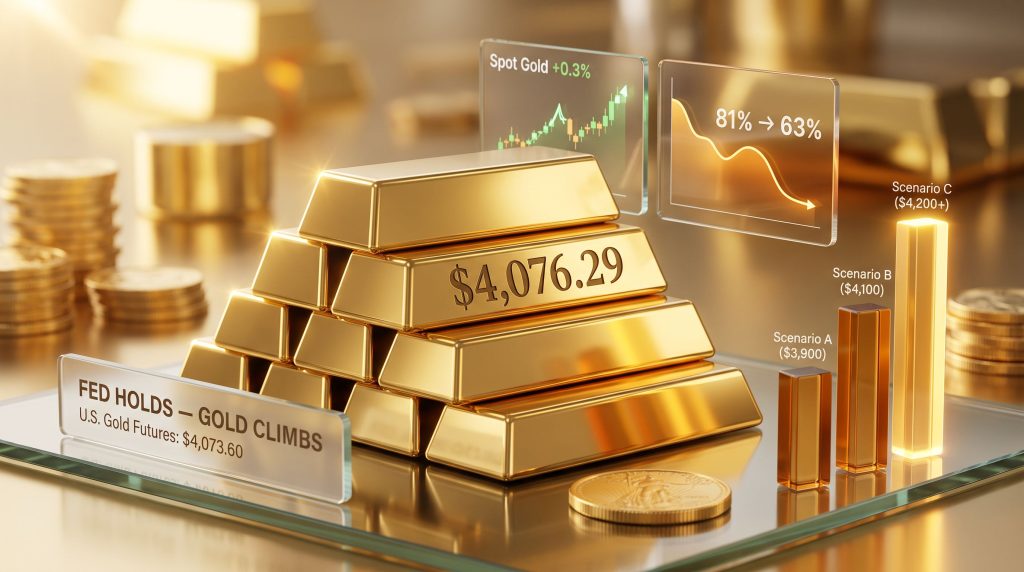
Monetary policy ambiguity — A divided Fed with no articulated rate path removes a key near-term headwind for gold, with the probability of a September rate hike falling from 81% to 63% following the meeting according to the CME Group's FedWatch tool. That 18-percentage-point swing represents a direct compression in the yield pressure working against gold.
-
Geopolitical escalation — Active military conflict in the Middle East, including fresh U.S. strikes in Iran, sustains safe-haven demand and provides a structural floor that is independent of monetary policy dynamics.
-
Inflation data uncertainty — Pending U.S. Personal Consumption Expenditure (PCE) data creates a binary risk event. Investors with gold exposure benefit from holding through this data release, as a downside inflation surprise would likely reinforce the case for a prolonged Fed pause.
The Gold-Oil Linkage and What Divergence Signals
Gold and crude oil frequently move in the same direction during geopolitical stress events, as both serve as real-asset hedges against instability. However, when the two assets diverge, it carries interpretive value. If gold rises while oil retreats or consolidates, the move in gold is more likely driven by monetary policy expectations than by pure risk-off sentiment.
This distinction matters for positioning, because monetary policy-driven gold moves tend to be more durable than geopolitical fear-driven spikes, which historically mean-revert more quickly once the triggering event stabilises. Current conditions show oil prices facing headwinds as tanker traffic normalises out of the Middle East, while gold continues to hold elevated. This divergence supports the interpretation that monetary policy ambiguity, rather than purely geopolitical fear, is the dominant driver.
Rate Hike Probability Shifts as a Leading Indicator for Gold
CME FedWatch as a Real-Time Positioning Tool
The CME Group's FedWatch tool provides real-time probability estimates for future Fed rate decisions, derived from federal funds futures pricing. For gold traders, this tool functions as a leading indicator, capturing the marginal shift in market expectations that precedes price moves in the metal.
Data Point: Prior to the Fed's rate hold decision, markets assigned an 81% probability to a September rate hike. That figure dropped to 63% following the meeting — an 18-percentage-point swing that directly reduced the near-term headwind for gold positioning.
The practical implication is that gold's upward bias persists as long as rate hike probabilities remain below roughly 70–75%. As that probability climbs back toward 80%, the opportunity cost argument for holding gold reasserts itself, and prices typically face renewed selling pressure. Monitoring this single variable offers more predictive value for short-to-medium term gold price direction than most other indicators.
The next major ASX story will hit our subscribers first
The Inflation Hedge Question: Does Gold's Role Hold in High-Rate Environments?
Resolving the Apparent Contradiction
Gold is widely described as an inflation hedge, yet high inflation environments that produce aggressive rate hike cycles have historically been damaging for gold prices. This apparent contradiction resolves when the transmission mechanism is properly understood. Gold hedges against the persistence of inflation, not against the policy response to it.
When inflation is high and rates are low, gold thrives because real yields are deeply negative. When inflation is high and rates are also high, gold faces a genuine structural conflict between its inflation hedge appeal and its yield disadvantage. The resolution depends on which force dominates market psychology at any given point.
| Market Condition | Gold's Inflation Hedge Role | Gold's Yield Disadvantage | Net Effect on Price |
|---|---|---|---|
| High inflation + Low rates | Strong | Minimal | Strongly bullish |
| High inflation + High rates | Strong | Significant | Neutral to mildly bullish |
| Falling inflation + Rate pause | Moderate | Moderate | Conditionally bullish |
| Falling inflation + Rate cuts | Moderate | Minimal | Bullish via yield compression |
The current environment occupies the third row of this framework: a rate pause with inflation that has moderated but not been fully extinguished. This is conditionally bullish for gold, with the condition being that the Fed does not quickly pivot back toward aggressive tightening.
What Analysts Are Forecasting: Bull Case, Bear Case, and Base Case
The Bear Case: TD Securities' $3,900 Target
Institutional research from TD Securities suggests gold may struggle to sustain its current levels. Their analysis points to oil price dynamics as a key mechanism: if crude prices face sustained upward pressure through the summer months, the geopolitical risk premium embedded in gold could diminish as market attention shifts toward energy markets. Under this scenario, gold could drift back toward $3,900 per ounce, representing a meaningful retracement from current levels.
Scenario Modelling: Three Paths for Gold Over the Next 90 Days
Scenario A — Bearish Drift:
- PCE data comes in hotter than expected
- September rate hike probability rebounds above 80%
- Gold retraces toward $3,900–$3,950
Scenario B — Range Consolidation:
- PCE data is in-line with forecasts
- Fed maintains ambiguous forward guidance
- Gold oscillates between $3,950–$4,100
Scenario C — Sustained Breakout:
- PCE data surprises to the downside
- Geopolitical escalation intensifies
- September hike probability falls below 50%
- Gold tests $4,200+
Please note: scenario modelling involves assumptions about future events and should not be interpreted as investment advice or a reliable forecast of future price performance.
The Broader Precious Metals Picture
Silver, Palladium, and Platinum: Reading the Complex
Gold rarely moves in isolation. The behaviour of other precious metals in the aftermath of the Fed's rate hold provides additional signal about the nature of the broader move. In addition, understanding the gold-bond market relationship helps contextualise how yield dynamics ripple across the entire precious metals complex.
| Metal | Price Level | Session Change | Key Driver |
|---|---|---|---|
| Gold (Spot) | $4,076.29/oz | +0.3% | Monetary policy ambiguity |
| Silver (Spot) | $57.86/oz | +0.4% | Inflation hedge + industrial demand |
| Palladium | $1,264.49/oz | +1.5% | Risk appetite recovery |
| Platinum | $1,602.34/oz | -0.6% | Sector-specific demand weakness |
Silver's marginal outperformance relative to gold on a percentage basis suggests that industrial demand optimism is layering on top of the monetary policy tailwind. Furthermore, gold-silver ratio insights reveal that silver carries a dual identity as both a monetary metal and an industrial input, meaning it benefits from risk appetite recovery in addition to the same Fed-driven dynamics affecting gold.
Palladium's +1.5% gain is the most telling signal across the complex. Palladium has minimal monetary metal characteristics and is overwhelmingly driven by autocatalytic and industrial demand. Its strong session gain suggests that broader risk appetite recovered meaningfully following the Fed meeting, with investors moving back into cyclically sensitive assets alongside safe-haven ones.
Platinum's underperformance, posting a -0.6% decline, reflects sector-specific supply and demand dynamics that are currently working against it, independent of the macro backdrop.
Key Risk Factors That Could Undermine Gold's Current Positioning
For investors assessing gold exposure in the current environment, the following risk factors represent the most material threats to the bullish case:
- Upside surprise in PCE inflation data, which would reignite rate hike expectations
- A hawkish restatement of Fed policy intent at subsequent speeches or meetings
- Rapid de-escalation of Middle East conflict, removing the geopolitical risk premium
- U.S. dollar strengthening on risk-off flows, which historically pressures gold in USD terms
- Institutional profit-taking after a rapid appreciation from investors who entered at lower levels
Investors should note that gold's performance above $4,000 per ounce involves a convergence of multiple risk premiums. If even one or two of these underlying drivers dissipates, the magnitude of any retracement could exceed what standard volatility metrics might suggest.
Frequently Asked Questions: Gold Prices and Federal Reserve Rate Decisions
Why Do Gold Prices Rise After the Fed Holds Rates Unchanged?
When the Fed holds rates unchanged, the opportunity cost of holding non-yielding assets like gold decreases relative to income-generating alternatives. If the pause is interpreted as a signal that the rate hiking cycle is nearing completion, markets also begin pricing in future yield compression, which provides an additional forward tailwind for gold.
How Much Did Gold Rise After the Most Recent Fed Rate Hold Decision?
Spot gold rose as much as 2.0% on the day of the decision, settling at a sustained gain of +0.3% the following session at $4,076.29 per ounce. U.S. gold futures for August delivery gained 1% to $4,073.60.
What Is the Relationship Between the U.S. Dollar and Gold During Fed Pauses?
Gold is priced in U.S. dollars, meaning a stronger dollar makes gold more expensive for international buyers and typically suppresses demand. Fed pauses that signal a softening rate outlook tend to weaken the dollar slightly, which provides an additional tailwind for gold. However, if a pause triggers risk-off sentiment that drives dollar strength as a safe-haven currency, this relationship can temporarily invert.
Can Gold Maintain Gains Above $4,000 if the Fed Signals Future Rate Hikes?
Sustaining prices above $4,000 in the face of renewed rate hike signals would require the geopolitical risk premium and inflation uncertainty premium to more than offset the increased yield disadvantage. It is possible but historically uncommon for gold to hold multi-year highs when rate hike probabilities are climbing above 75–80%. Gold as a safe haven tends to perform best when monetary policy remains accommodative or uncertain rather than aggressively restrictive.
What Role Does PCE Inflation Data Play in Gold's Post-Fed Price Movement?
The Personal Consumption Expenditure index is the Fed's preferred inflation measure. A reading that comes in above expectations increases the probability of future rate hikes, which is bearish for gold. A below-expectations reading reinforces the case for a prolonged pause or pivot, which is constructive for gold prices. In the current environment, the PCE release represents the next major binary risk event for gold positioning.
How Do Geopolitical Events Amplify Gold's Reaction to Fed Decisions?
Geopolitical stress events increase demand for safe-haven assets independent of monetary policy. Consequently, when geopolitical tension coincides with a dovish Fed signal, the two forces compound each other, producing larger and potentially more durable gold price moves than either driver would generate in isolation. The role of central banks influencing gold adds yet another layer to this dynamic, as institutional reserve accumulation can sustain elevated prices even when speculative demand temporarily fades. According to Reuters, these combined forces have consistently underpinned gold's resilience during periods of coordinated macro stress.
Key Takeaways: Understanding Why Gold Prices Rise After the Fed Holds Rates Unchanged
- A Fed rate hold reduces the opportunity cost of holding non-yielding gold, creating an immediate price tailwind that is amplified when the accompanying tone is perceived as dovish
- The magnitude and durability of gold's gains depend heavily on the Fed's communication posture, not just the rate decision itself
- Rate hike probability tools like the CME FedWatch serve as real-time leading indicators for gold positioning, with the September probability dropping from 81% to 63% following the latest meeting
- Gold's current elevation above $4,000 per ounce reflects a convergence of monetary uncertainty, geopolitical stress, and inflation ambiguity rather than any single driver
- Analyst consensus from TD Securities points to mean reversion risk toward $3,900 unless macro conditions deteriorate further or PCE data surprises to the downside
- Across the precious metals complex, silver and palladium showed stronger relative momentum than gold in the immediate post-decision session, suggesting broader risk appetite recovery beyond pure safe-haven positioning
This article is intended for informational purposes only and does not constitute financial or investment advice. Precious metals markets carry significant price risk. Past performance and historical patterns are not reliable indicators of future results. Readers should consult a licensed financial professional before making investment decisions.
Want to Stay Ahead of the Next Major Mineral Discovery on the ASX?
While gold's sensitivity to Fed policy drives macro-level price movements, the most significant returns in the resources sector have historically come from being positioned early in transformative mineral discoveries — Discovery Alert's proprietary Discovery IQ model scans ASX announcements in real time, delivering instant alerts on high-potential discoveries across 30+ commodities, so subscribers can act before the broader market catches on. Explore historic discovery returns on Discovery Alert's dedicated discoveries page and begin your 14-day free trial to secure a genuine market-leading edge.