July 30, 2026
The Hidden Economics of Mill Liner Performance in Gold Processing
Comminution, the process of crushing and grinding ore to liberate valuable minerals, consistently accounts for between 30% and 50% of a gold mine's total energy consumption. Within that energy-intensive circuit, the humble mill liner plays a role that far exceeds its physical appearance. These wear-resistant shells, bolted to the interior walls of rotating grinding mills, are not passive components. They actively shape ore trajectories, govern grinding efficiency, and ultimately determine how many tonnes a plant can push through in a given year.
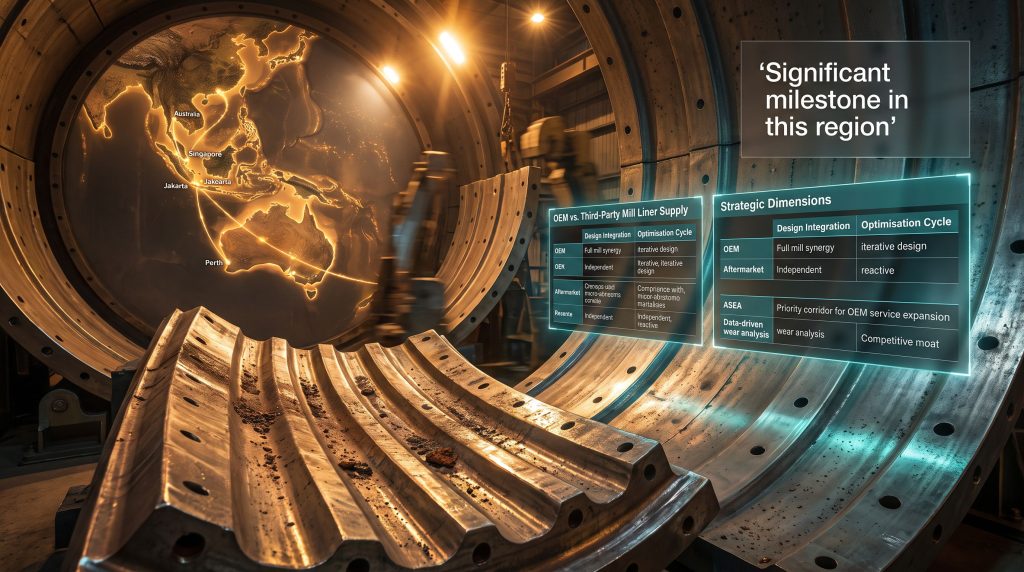
The FLS mill liner contract in the gold sector, booked in Q2 2026 for an undisclosed value and covering an operation in the Australia-South-East Asia (ASEA) region, is worth examining not simply as a commercial transaction but as a window into how the competitive dynamics of mining OEM services are shifting beneath the surface.
When big ASX news breaks, our subscribers know first
What Mill Liners Actually Do, and Why Gold Mines Care So Much
The Engineering Function Inside the Mill
A grinding mill, whether it is a Semi-Autogenous Grinding (SAG) mill, an Autogenous (AG) mill, or a ball mill, works by tumbling ore and steel grinding media against the mill shell. The liner's job is to protect that shell from direct abrasion while simultaneously imparting a specific lifting and tumbling motion to the charge inside.
Liner geometry is the critical variable here. The profile of each liner row, its height, angle, and spacing, determines:
- The trajectory of ore particles and steel balls during rotation
- How effectively grinding energy is transferred from the rotating shell to the ore
- The rate at which liners themselves wear away, measured as tonnes processed per millimetre of liner material consumed
When liner geometry degrades through wear, the grinding charge trajectory changes. Steel balls begin to strike the mill shell at sub-optimal angles, energy transfer efficiency drops, and throughput falls. In a high-volume gold processing environment, even a 2–3% reduction in SAG mill throughput can translate to meaningful revenue shortfalls across a full operating year.
Why Gold Ore Creates Specific Liner Challenges
Gold deposits across the ASEA region present a particularly demanding set of conditions for mill liner performance. Unlike the relatively consistent hardness profiles found in some base metal deposits, gold-bearing ore bodies often display significant variability in competency, ranging from soft, oxidised material near the surface to extremely hard, fresh rock at depth.
This hardness variability creates a genuinely difficult optimisation problem:
- Soft ore causes steel grinding balls to impact liner surfaces more directly, accelerating localised wear
- Hard ore generates higher mill loading conditions and shock impacts on liner faces
- Variable blends require liner designs that perform acceptably across a wide range of conditions, rather than being optimised for a single hardness profile
Technical Insight: In gold processing circuits handling variable ore hardness, liner wear rates can fluctuate by as much as 40–60% across different ore domains within the same deposit. This variability makes wear life prediction, and therefore planned maintenance scheduling, genuinely challenging without site-specific performance data.
OEM vs. Aftermarket: Understanding the Structural Difference
A Comparison of Supply Models
The distinction between OEM and aftermarket mill liner supply is not simply a matter of brand preference. It reflects fundamentally different capabilities in data access, design integration, and continuous improvement.
| Feature | OEM Mill Liner Contract | Third-Party/Aftermarket Supply |
|---|---|---|
| Design integration | Optimised for original mill geometry | Generic or reverse-engineered fit |
| Wear data access | Proprietary historical performance database | Limited baseline data |
| Technical service | Dedicated OEM engineering and field support | Variable service capability |
| Contract structure | Multi-year, performance-linked agreements | Transactional, often spot-based |
| Optimisation cycle | Continuous design iteration per site | Infrequent updates, if any |
| Switching cost for operator | High, due to embedded data and relationships | Low, but performance risk is higher |
The OEM advantage is most pronounced in the data layer. A company that originally manufactured a SAG mill holds dimensional records, design tolerances, and charge trajectory models that no aftermarket supplier can independently replicate. When that OEM also manages the liner programme over multiple years, it accumulates site-specific wear data that compounds in value over time, enabling progressively more accurate wear life predictions and more precisely tuned liner profiles.
Why Multi-Year Contracts Suit Both Parties
For the mine operator, a long-term liner supply agreement converts an unpredictable maintenance cost into a manageable, performance-linked programme. Change-out intervals become more predictable, procurement planning is simplified, and the risk of unplanned liner failure — which can force emergency shutdowns during peak production periods — is substantially reduced.
For the OEM, multi-year agreements generate recurring revenue with improving margins over time, as the cost of service delivery declines as site-specific knowledge deepens. The initial contract is often won at competitive pricing to establish the reference site relationship; subsequent extensions carry progressively better economics. This dynamic directly influences mining company performance across the OEM services sector.
How FLS Secured the ASEA Gold Contract
The Competitive Review Process
The FLS mill liner contract in the gold sector was not awarded through routine procurement. According to publicly available reporting, the contract followed a structured review of historical wear data and benchmarking against global installation performance across comparable operations.
This process reveals the specific competitive levers FLS deployed:
- Historical data review of existing liner performance at the site, establishing a measured baseline
- Global benchmarking against analogous gold processing operations from FLS's worldwide installation portfolio
- Design proposal demonstrating a quantified improvement in projected wear life and throughput consistency
- Value proposition development incorporating wear monitoring, technical service, and continuous optimisation commitments
The contract structure itself is instructive: an initial two-year term with a five-year extension option. This architecture signals that both parties expect performance outcomes to justify a long-duration relationship, not merely a short-term trial. A total potential contract life of seven years represents a substantial embedded position at a single operating site.
Breaking Into Established Competitor Territory
What makes the FLS mill liner contract in the gold sector particularly notable is the competitive context in which it was won. The ASEA mill lining market features well-entrenched incumbent suppliers with long-standing customer relationships, proprietary wear data from years of site service, and established local teams.
Displacing an incumbent liner supplier is considerably harder than winning a new site contract. Incumbents benefit from:
- Accumulated site-specific wear performance data that new entrants cannot easily match
- Established trust relationships with site maintenance and engineering teams
- The operational risk aversion of mine managers, who are often reluctant to change suppliers mid-lifecycle
FLS's ability to overcome these barriers — through data-led benchmarking and a demonstrably superior technical proposition — positions this specific contract win as a reference site anchor for broader regional market development. In the OEM services sector, a single high-profile installation in a competitive market functions as proof-of-concept for prospective clients who demand demonstrated regional capability before committing to long-term agreements.
Strategic Implication: The ASEA region encompasses some of the world's most active and capital-intensive gold processing operations, including major Western Australian producers and rapidly expanding South-East Asian mines. Establishing a flagship installation in this corridor provides FLS with a tangible performance reference for pipeline development across multiple prospective sites.
The Technical Architecture of Modern Mill Liner Performance Programmes
Advanced Liner Design Beyond Simple Material Hardness
A common misconception in discussions of mill liner performance is that wear life is primarily a function of liner material hardness. In practice, the engineering challenge is considerably more nuanced. Furthermore, the shift towards data-driven mining operations has fundamentally changed how liner performance programmes are designed and evaluated.
Modern high-performance mill liners are designed around three interacting variables:
- Material composition: The balance between hardness and toughness determines whether a liner wears predictably or fractures under impact. Chrome-molybdenum alloys and rubber-steel composite designs each offer different trade-offs depending on the ore's abrasivity and the mill's operating speed.
- Profile geometry: Liner bar height and face angle are calculated using charge trajectory modelling software that simulates how grinding media moves at different mill speeds and fill levels. A one-degree change in lifter angle can measurably shift where steel balls land, affecting both wear rate and grinding efficiency.
- Wear progression modelling: The best liner designs account not just for initial geometry but for how performance changes as the liner wears. A profile that grinds efficiently when new but degrades rapidly through its mid-life creates a different economic outcome than one that maintains consistent performance across its full service life.
Wear Monitoring as a Competitive Differentiator
Wear monitoring technology has evolved from manual thickness measurements during planned shutdowns to continuous monitoring systems that track liner wear in near-real-time. Advanced implementations now include:
- Electromagnetic wear sensors embedded within liner materials
- Laser scanning systems deployed during short inspection windows to generate 3D wear maps
- Predictive analytics platforms that integrate wear data with ore hardness variability forecasts to generate remaining-useful-life estimates
For gold operations with tight production schedules, the value of accurate wear prediction is direct and measurable. A liner change-out that can be scheduled 48 hours in advance, aligned with a planned maintenance window, costs a fraction of an emergency replacement that forces unscheduled mill downtime.
Step-by-Step: How a Modern OEM Liner Performance Review Unfolds
- Baseline establishment through measurement and analysis of existing liner wear profiles across multiple change cycles
- Ore characterisation using data on hardness, abrasivity index, and feed size distribution to define the specific wear regime at the site
- Global benchmarking comparing site performance against the OEM's database of analogous operations worldwide
- Custom design development using charge trajectory modelling to propose an optimised liner profile for the specific mill dimensions and operating conditions
- Pilot deployment with enhanced monitoring to validate performance against projected wear life targets
- Iterative refinement across subsequent change cycles, progressively improving liner design based on measured outcomes
- Long-term contract formalisation once demonstrated performance establishes the business case for a multi-year supply and service agreement
The Broader Industry Shift: From Equipment Sales to Lifecycle Partnerships
Why Mining Companies Are Changing How They Buy Services
The FLS mill liner contract in the gold sector reflects a wider structural shift in how large mining operations manage their processing infrastructure. The traditional model — purchasing equipment and consumables through transactional procurement with competitive tendering at each renewal — is giving way to integrated lifecycle partnerships. Consequently, mining efficiency gains are increasingly being attributed to the quality of these long-term OEM relationships rather than to individual equipment upgrades.
Several forces are driving this transition:
- Total Cost of Ownership (TCO) focus: Mining finance teams have become increasingly sophisticated in measuring not just the purchase price of wear parts but the full cost of each change cycle, including labour, lost production, and maintenance overhead. OEM-managed programmes can demonstrably reduce TCO even when the per-unit liner cost is higher than aftermarket alternatives.
- Operational complexity: Modern large-scale gold processing plants are running at throughput rates and mill sizes that make unplanned downtime far more expensive than it was a decade ago. A single unplanned SAG mill shutdown at a large operation can cost hundreds of thousands of dollars per day in lost production.
- Data scarcity in aftermarket supply: As wear monitoring and predictive analytics become standard features of OEM service contracts, the data advantage held by aftermarket suppliers continues to erode relative to OEM competitors.
The Economics of Unplanned Liner Failure in Large Gold Operations
Consider the production economics of a large SAG mill operating in the ASEA region. A mill running at 75% availability processing gold ore at standard rates generates revenue that is directly proportional to time in operation. When a liner change-out extends beyond its planned duration — whether due to premature wear, incorrect scheduling, or poorly fitting replacement liners — every additional hour offline represents production revenue deferred or permanently lost.
| Scenario | Change-Out Duration | Additional Downtime | Production Impact |
|---|---|---|---|
| Optimised OEM programme | 24 hours (planned) | 0 hours | No variance |
| Extended change-out (poor wear prediction) | 36 hours | 12 hours per event | Multiple events annually |
| Unplanned emergency change-out | Variable | Highly variable | Significant unbudgeted loss |
Across a gold operation running multiple mill change-out cycles per year, the compounding value of an optimised OEM liner programme — measured in reduced downtime hours and improved production consistency — frequently outweighs the cost premium of OEM supply over aftermarket alternatives. This is the economic argument that data-driven OEM providers are deploying in competitive ASEA market reviews, and it is directly relevant to gold mining equities that depend on consistent throughput to underpin earnings forecasts.
Key Takeaways on the Strategic Dimensions of the FLS ASEA Win
| Strategic Dimension | Implication |
|---|---|
| OEM market positioning | Deepening embedded presence beyond initial equipment supply contracts |
| Contract structure evolution | Multi-year, performance-linked agreements replacing transactional purchasing |
| Technical differentiation | Proprietary wear data analysis as a sustainable competitive moat |
| Regional growth strategy | ASEA as a priority corridor for long-duration OEM service expansion |
| Reference site leverage | Single flagship contracts used to unlock broader regional pipeline opportunities |
| Switching cost creation | Long-term data accumulation raises the cost of competitor displacement over time |
The next major ASX story will hit our subscribers first
Frequently Asked Questions: Mill Liner Contracts in Gold Processing
What constitutes a complete mill liner solution?
A complete mill liner solution extends well beyond the physical supply of liner segments. It encompasses the full engineering design process, installation and fitment support, structured wear monitoring programmes, field service during change-outs, and continuous design optimisation across successive liner campaigns. The distinction between liner supply and a complete liner solution is significant from a total cost of ownership perspective.
How long do mill liner contracts typically run in gold mining?
Arrangements vary by operation and OEM, but multi-year contracts structured with an initial term of two to three years and extension options ranging from three to five years are increasingly standard for large-scale processing operations. The FLS ASEA contract, with its two-year initial term and five-year extension option, sits within this evolving industry norm. A definitive feasibility study for new operations will frequently identify long-term OEM liner agreements as a key input to processing plant cost modelling.
What makes OEM mill liner suppliers harder to displace over time?
The primary factor is accumulated site-specific wear data. With each successive liner campaign, an OEM provider builds a richer dataset linking ore characteristics, mill operating parameters, and liner wear outcomes. This data advantage is not easily replicable by a new entrant and grows more valuable with each passing year of the contract relationship.
How does wear monitoring improve gold mine production outcomes?
Accurate wear monitoring shifts liner change-outs from reactive events driven by observable failure to proactively scheduled activities aligned with planned maintenance windows. This transition meaningfully reduces the frequency and duration of unplanned mill downtime, directly improving mill availability and annual production consistency.
Why is the ASEA region significant for mill lining OEM strategy?
Australia and South-East Asia collectively represent one of the world's highest concentrations of large-scale gold processing infrastructure, with significant ongoing capital investment in both greenfield developments and brownfield expansions. The region's combination of established majors and emerging mid-tier producers creates a deep and growing addressable market for high-performance mill lining solutions, as evidenced by the FLS mill liner contract in the gold sector and the broader pipeline of OEM service opportunities it is expected to unlock.
This article contains forward-looking analysis and scenario modelling for illustrative purposes. Readers should not rely on the production or financial scenarios presented as predictions of specific operational outcomes. All investments in mining equities and related sectors carry risk.
Want to Invest in the Next Major ASX Mineral Discovery Before the Market Moves?
Discovery Alert's proprietary Discovery IQ model delivers real-time alerts on significant ASX mineral discoveries, transforming complex mineral data into actionable insights for investors at every level — explore the historic returns major discoveries have generated to understand what's possible, then begin your 14-day free trial at Discovery Alert to position yourself ahead of the broader market.