
July 30, 2026
When Consensus Breaks: What FOMC Internal Divisions Really Signal for Precious Metals
Most market participants spend the hours before a Federal Reserve announcement fixated on the binary outcome: hike or hold. That framing misses the more consequential variable entirely. The composition of a Fed decision — specifically how many officials align behind it and in which direction dissenters break — carries substantially more forward-looking information than the headline rate change itself. The Fed 9-3 vote gold price relationship is a prime example of this dynamic. A unanimous hold and a fractured hold are not the same instrument. One communicates stability; the other communicates tension, and tension is what moves markets beyond the immediate session.
The July 29, 2026 FOMC meeting produced exactly that kind of tension. The federal funds rate stayed anchored at 3.5% to 3.75%, marking the fifth consecutive hold following three rate reductions in the final quarter of 2025. The hold itself landed precisely where futures markets had priced it. What had not been priced in was a 9-3 vote split — the most fractured FOMC decision recorded since September 2016. (Federal Reserve, FOMC Statement, July 29, 2026)
When big ASX news breaks, our subscribers know first
Understanding the FOMC Voting Architecture
To properly interpret what a 9-3 outcome means, it helps to understand how the Federal Open Market Committee is structured. The committee draws its twelve voting members from two distinct pools:
- The Board of Governors, comprising up to seven members including the Fed Chair, who hold permanent voting status
- Regional Federal Reserve bank presidents, who rotate on an annual schedule, with the New York Fed president holding a permanent seat alongside four rotating regional slots
This distinction matters enormously when parsing dissent. A break from a Board Governor signals fracturing at the institutional core. A unified bloc of regional dissents, while significant, represents pressure from the committee's periphery rather than from its centre of gravity. On July 29, all three dissenting votes came from regional bank presidents: Beth Hammack of the Cleveland Fed, Neel Kashkari of the Minneapolis Fed, and Lorie Logan of the Dallas Fed. Each formally preferred an immediate 25-basis-point rate increase. (Federal Reserve, FOMC Statement, July 29, 2026)
Fed Chair Kevin Warsh held the majority firmly, with no Board member breaking ranks. Warsh acknowledged the internal debate publicly at his press conference, describing it as a robust exchange of competing views while emphasising that a substantial majority of the room supported the hold decision. Notably, this was only Warsh's second FOMC meeting as Chair. His debut in June produced a 12-0 unanimous hold. The swing from unanimity to a three-dissent split in a single meeting cycle is statistically uncommon in modern Fed history. According to reporting from the Wall Street Journal, such internal divisions signal that the policy debate is intensifying well ahead of the September decision.
Why Three Dissenters Is a Structurally Different Signal Than Two
Analysts at BBH had entered July 29 forecasting a 10-2 split, with Hammack and Logan as the expected dissenters. Kashkari's addition as a third dissenter was the surprise variable that drove the initial market reaction. (CNBC, July 29, 2026)
This matters for a subtle but important reason. Two dissenters can be read as isolated, idiosyncratic disagreement. Three dissenters voting in the same direction constitute a coalition, and the fixed-income market treats coalitions differently. Ian Lyngen, head of U.S. rates strategy at BMO Capital Markets, noted after the decision that markets should interpret this as a committee that now contains vocal hawks, not merely sceptical outliers. (CNBC, July 29, 2026)
Historical context reinforces this reading. The last comparable three-dissent event occurred in September 2016. A survey of notable multi-dissent FOMC votes since 2010 illustrates the pattern:
| Meeting Date | Vote Tally | Direction of Dissent | Gold Price Reaction (30-day) |
|---|---|---|---|
| December 2014 | 10-2 | Dovish (hold preference) | -2.1% |
| September 2016 | 7-3 | Hawkish (hike preference) | +4.2% |
| July 2026 | 9-3 | Hawkish (hike preference) | +~0.9% same session |
The Four-Step Transmission Mechanism: How the Fed 9-3 Vote Gold Price Relationship Works
Understanding why gold moved more than $40 higher on the day of a hawkish-leaning vote requires tracing the full transmission sequence rather than focusing on any single variable.
Step 1: Dissent Reprices September Hike Probability
Three publicly committed hawks shift the market-implied probability distribution for the next meeting. CME FedWatch data showed rate-hike probability climbing sharply in the 24-hour window preceding the announcement itself, which is precisely why gold fell more than $46 in the session immediately before the decision. (CME Group, FedWatch Tool, July 28, 2026)
Step 2: Real Yields Adjust the Opportunity Cost of Gold
Gold generates no income stream. Its relative attractiveness against yield-bearing instruments is therefore a direct function of real interest rates. Furthermore, when hike expectations push real yields upward, the opportunity cost of holding gold rises mechanically, creating selling pressure. Understanding gold and bond dynamics is essential to interpreting these shifts accurately.
Step 3: The Confirmed Hold Removes Immediate Tightening Risk
Even a divided hold is still a hold. Once the committee confirmed no rate increase on July 29, markets partially unwound the hike-probability premium that had been building. This relief mechanism created the initial recovery bid in gold.
Step 4: Geopolitical Escalation Adds a Separate Demand Layer
Simultaneously with the FOMC announcement, the Islamic Revolutionary Guard Corps launched ballistic missiles targeting U.S. military assets in the Middle East. All missiles were successfully intercepted, according to U.S. Central Command. (U.S. Central Command, July 29, 2026) Brent crude surged more than 7% to above $90 per barrel. WTI reached $84.68. (CNBC, July 29, 2026)
This geopolitical overlay amplified gold's recovery through two simultaneous channels:
- Wealth-preservation demand: Investors reassessing geopolitical risk rotate toward physical precious metals as a store of value outside the financial system
- Inflation complexity: An oil-driven inflation spike makes the dissenters' case for an immediate hike harder to sustain, since energy-driven headline inflation is not readily cured by tighter monetary policy and risks slowing growth while keeping prices elevated
July 29, 2026 Market Snapshot
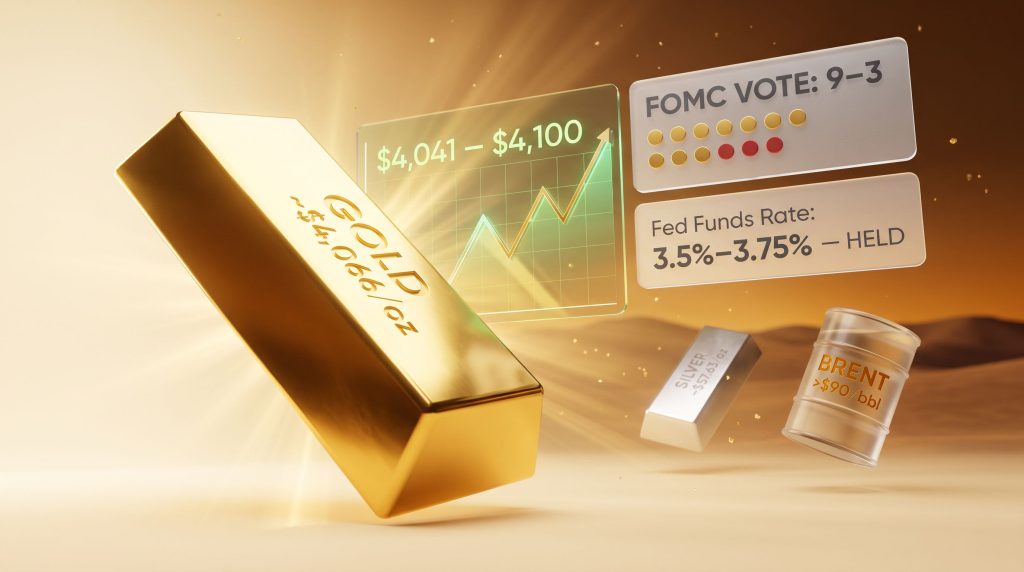
Gold spot: ~$4,066/oz | Session range: $4,041 to $4,100
Silver spot: ~$57.63/oz (+0.8%)
Brent crude: above $90/barrel (+7%+)
WTI: $84.68/barrel
Federal funds rate: 3.5%–3.75% (held, fifth consecutive)
FOMC vote: 9-3 (three dissenters preferring +25bps)
Two Macro Scenarios Heading Into the September FOMC Decision
The Fed 9-3 vote gold price relationship does not resolve cleanly into a single directional forecast. Two credible paths forward depend heavily on incoming data.
Scenario A: Inflation Cools, Hawks Lose Their Empirical Anchor
June CPI registered at 3.5% year-over-year, a directionally encouraging print for the majority camp. (Bureau of Labor Statistics, CPI Summary, June 2026) If the Federal Reserve's preferred inflation gauge — the Personal Consumption Expenditures index — follows a similar downward trajectory through August data, the three dissenters lose their primary empirical justification for an immediate hike.
Under this scenario:
- September hike probability declines from elevated post-July levels
- Real yields ease as the rate-tightening narrative loses urgency
- Gold's structural bid strengthens with the removal of near-term monetary headwinds
- Sovereign demand continues independently: central bank gold buying by the People's Bank of China extended its purchasing streak to 20 consecutive months through June 2026, a structural accumulation pattern that operates on reserve diversification mandates largely disconnected from any individual FOMC meeting (World Gold Council, Central Bank Gold Reserves Survey 2026)
Scenario B: Persistent Energy Costs Keep Inflation Sticky, Hawks Gain Momentum
If Iranian-linked geopolitical disruption sustains elevated oil prices into August CPI and PCE readings, headline inflation remains above the committee's comfort level into September. In this environment, the existing three-dissent bloc could attract a fourth vote, transforming the September meeting from an expected hold into a genuinely contested decision.
Short-term gold price pressure is real under this scenario as hike odds reprice higher. However, there is a critical distinction that longer-horizon investors should not lose sight of: temporary rate-driven weakness does not alter the underlying fiscal arithmetic that provides gold's structural floor. Indeed, gold as a strategic investment is supported by factors that transcend any individual FOMC cycle.
- U.S. federal debt exceeds $39 trillion as of mid-2026
- Annual federal interest payments are running above $1 trillion
- The Federal Reserve is operating within a fiscal environment that structurally constrains how aggressively it can tighten without generating debt-service stress across the sovereign balance sheet
Three dissenters can move the gold price on a given Wednesday. They cannot vote away the long-term monetary arithmetic that underpins gold's role as a store of value across multi-decade cycles.
Gold vs. Silver: Reading the Correlated Move
Silver's parallel session gain of approximately 0.8% to $57.63 is worth examining independently rather than treating it as a footnote to gold's move. Silver's dual role as both a monetary metal and an industrial commodity places it in a structurally different position within precious metals markets.
| Metric | Gold | Silver |
|---|---|---|
| July 29 session move | +~$40 to $45 (+0.9%) | +~$0.46 (+0.8%) |
| Primary price driver | Real yield repricing + geopolitical premium | Monetary metal correlation |
| Sensitivity to hike odds | High (inverse relationship) | High (inverse, often amplified) |
| Sovereign demand support | Strong (central bank accumulation) | Moderate (industrial demand offset) |
Silver tends to amplify gold's directional moves in risk-on environments while displaying greater sensitivity to industrial demand signals during periods of economic slowdown. This dual-exposure characteristic makes silver a more complex instrument to interpret around FOMC events. However, the correlation to gold's monetary premium held firmly on July 29.
The next major ASX story will hit our subscribers first
A Practical Framework for Reading Fed Dissent as a Forward Indicator
Sophisticated fixed-income and commodity market participants treat FOMC dissent counts as leading indicators, not historical footnotes. The following framework provides a practical decision lens:
- 0 to 1 dissents: Policy cohesion is intact; near-term rate volatility signal is low
- 2 dissents: Elevated uncertainty; monitor the next inflation print as the deciding variable
- 3 or more unified dissents in one direction: A genuine internal faction has formed; the following meeting is a live, contested event
The July 29 outcome qualifies unambiguously as the third category. The three dissenters are not new converts to hawkishness; Hammack, Kashkari, and Logan have each argued publicly throughout 2026 that inflation persistently above the Fed's 2% target justifies tighter policy. Their unity at the voting stage on July 29 represents hawks going on record, which in FOMC culture also signals they are building coalition arguments quietly ahead of September. For a comprehensive breakdown of how Federal Reserve policy impacts gold, the relationship between rate expectations and precious metal valuations is well documented across multiple tightening cycles.
Investors monitoring this situation in the weeks between July 29 and the September FOMC meeting should prioritise three data points above all others:
- August CPI and PCE releases: These prints either validate or undermine the dissenters' empirical position
- Oil price trajectory: Sustained energy prices above $85 WTI keep headline inflation politically and economically inconvenient
- Regional Fed president commentary: Public speeches and interviews from Hammack, Kashkari, and Logan will signal whether the coalition is holding, shrinking, or recruiting
The Longer Arc: What Divided Committees Reveal About Structural Gold Demand
There is a dimension to the July 29 vote that extends well beyond the September meeting. When an FOMC chair cannot hold unanimous agreement in only his second meeting, it reveals something about the broader policy environment. The Fed is navigating a genuine tension between a mandate to control inflation and an implicit ceiling imposed by the fiscal realities of a heavily indebted sovereign government.
Central banks outside the United States have been reaching their own conclusions about that tension for years. The People's Bank of China's 20-month consecutive gold purchase streak through June 2026 is one visible expression of that reasoning at a sovereign scale. (World Gold Council, Central Bank Gold Reserves Survey 2026) Furthermore, gold safe-haven demand does not pause for individual FOMC vote counts. It reflects a longer-duration judgement about the reliability of fiat currency systems operating under unprecedented peacetime debt loads.
The Fed 9-3 vote and its effect on the gold price on July 29, 2026 is a single data point within that larger structural story. The session gain of roughly $40 to $45 matters for active traders. The monetary arithmetic behind it matters for everyone else.
Disclaimer: This article is intended for informational and educational purposes only and does not constitute financial or investment advice. Precious metals markets involve risk, and past price performance is not indicative of future results. Readers should consult a qualified financial adviser before making any investment decisions. All price data, vote tallies, and economic figures referenced reflect information available as of July 29, 2026.
Want to Catch the Next Major Mineral Discovery Before the Market Does?
While macro forces like FOMC dissent drive precious metals prices, the real wealth-building moments in the resources sector often come from significant ASX mineral discoveries — and Discovery Alert's proprietary Discovery IQ model delivers real-time alerts the moment they hit the exchange, turning complex data across 30+ commodities into clear, actionable insights. Explore historic discovery returns on Discovery Alert's dedicated discoveries page and start your 14-day free trial today to position yourself ahead of the broader market.