July 30, 2026
The Architecture of a Tier-1 Gold Asset: How District Consolidation Creates Compounding Value
Most transformational moments in the gold mining sector don't arrive as sudden discoveries. They emerge gradually, through the patient assembly of adjacent geological systems into unified operating platforms. The history of the world's most productive gold districts, from the Witwatersrand in South Africa to the Carlin Trend in Nevada, reflects a consistent pattern: scale is built through consolidation, and the companies willing to consolidate early tend to capture disproportionate value. That structural logic sits at the heart of the G Mining Ventures G2 Goldfields acquisition, a transaction that reshapes the competitive landscape of gold mining in Guyana and positions GMIN on a credible trajectory toward tier-1 producer status.
When big ASX news breaks, our subscribers know first
Understanding the Strategic Logic Behind the G Mining Ventures G2 Goldfields Acquisition
The Oko district of Guyana has long attracted geological attention for its structural continuity and grade consistency across multiple deposits. What made the district particularly compelling from a corporate strategy perspective was the proximity of two substantive mineralised systems, Oko West and Oko-Ghanie, sitting adjacent to one another within the same broader geological architecture. Developing these deposits in isolation would have been technically feasible but economically inefficient, duplicating infrastructure costs, processing facilities, and operational overheads that could otherwise be shared.
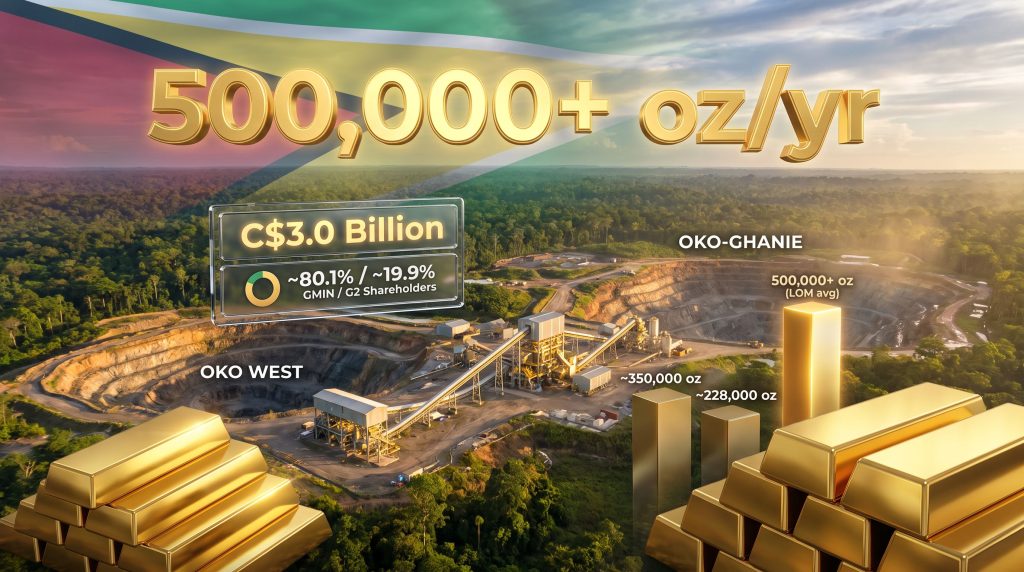
G Mining Ventures completed the full acquisition of G2 Goldfields through an all-share reorganisation plan, creating a combined gold mining complex with a projected life-of-mine average production exceeding 500,000 ounces per year. The total transaction was valued at approximately C$3.0 billion, making it one of the more significant gold consolidation transactions in the Americas in recent years.
The deal structure involved a precise share exchange mechanism. For every G2 Goldfields share held, shareholders received:
- 0.212 ordinary GMIN shares representing their stake in the enlarged combined entity
- 0.50 ordinary G3 Goldfields shares as part of a concurrent spinout of non-core assets
Following the close, former G2 shareholders collectively hold approximately 19.9% of the enlarged GMIN entity, with existing GMIN shareholders retaining the remaining 80.1% ownership.
Deal Structure at a Glance
| Component | Detail |
|---|---|
| GMIN Shares per G2 Share | 0.212 ordinary GMIN shares |
| G3 SpinCo Shares per G2 Share | 0.50 ordinary G3 shares |
| G2 Shareholder Ownership Post-Close | ~19.9% |
| Existing GMIN Shareholder Ownership | ~80.1% |
| Total Transaction Value | ~C$3.0 billion |
| G3 SpinCo Listing Target | Canadian Securities Exchange (CSE) |
The G3 SpinCo Separation: What Non-Core Assets Were Carved Out
A notable structural feature of this transaction was the simultaneous creation of G3 Goldfields Inc. as a separate entity housing assets that fell outside the core Oko district development thesis. This kind of spinout mechanism serves multiple strategic purposes. It allows the acquiring company to maintain focus on its primary operational mandate without absorbing the management complexity or capital distraction of unrelated exploration assets. It also allows shareholders to retain optionality over those separated assets without them acting as a drag on the combined entity's valuation.
G3 has applied for a listing on the Canadian Securities Exchange, with that listing subject to meeting CSE requirements. For investors in the combined GMIN entity, G3 represents a separate speculative exposure, not a component of the core Oko production thesis.
As a consequence of the deal's completion, G2 Goldfields shares are expected to be delisted from both the Toronto Stock Exchange and the OTCQX Best Market, with G2 ceasing to operate as a reporting issuer under applicable Canadian securities law.
What the Combined Oko Gold Complex Looks Like in Practice
The geological rationale for merging these two deposits is straightforward but consequential. Oko West and Oko-Ghanie are not simply neighbouring properties — they are interpreted as components of the same broader mineralised system, meaning that combined geological modelling may reveal continuity and extensions not visible when each deposit is evaluated in isolation. This is a critical distinction for resource estimation and mine planning.
On a standalone basis, each project was already meaningful:
- Oko West (standalone projection): approximately 350,000 oz/yr
- Oko-Ghanie (standalone projection): approximately 228,000 oz/yr
- Combined Oko Complex (life-of-mine average): 500,000+ oz/yr
The production uplift from combining the two operations is not simply additive. Shared processing infrastructure, optimised haul routes, integrated mine sequencing, and unified tailings management all contribute to a lower per-ounce cost structure that neither deposit could achieve independently. In the gold mining industry, crossing the 500,000 oz/yr threshold with a low-cost profile is generally considered the tier-1 asset benchmark — a designation that carries material implications for project financing, institutional investor interest, and acquisition premiums.
The combination of adjacent deposits within a unified geological system allows mine planners to sequence ore extraction across multiple zones, smoothing production profiles and extending the high-grade feed periods that drive economic returns.
Guyana's Geological Appeal: Why the Oko District Matters
Guyana occupies a distinctive position in the global gold mining landscape. Located on the Guiana Shield, one of the world's oldest and most geologically stable cratons, the country hosts gold mineralisation patterns that bear comparison to West African greenstone belts. The shield's structural integrity reduces many of the geotechnical risks associated with younger, more tectonically active terrains.
The Cooperative Republic of Guyana has progressively developed its mining regulatory framework, and the country has attracted significant capital from international mining companies in recent years. The Oko district specifically benefits from its location within a known gold-productive structural corridor, with shear-zone hosted mineralisation that is broadly analogous to high-quality gold systems found elsewhere along the Guiana Shield.
For investors comparing jurisdictional exposure across mid-tier gold producers operating in the Americas, Guyana presents a different risk and opportunity profile than Brazil, Mexico, or Colombia. It offers geological prospectivity, an established but developing regulatory environment, and, as GMIN's CEO Louis-Pierre Gignac has indicated through corporate communications, the conditions to build a fully permitted and fully funded large-scale gold complex.
The next major ASX story will hit our subscribers first
NI 43-101 Compliance and the Historical Estimate Distinction
One of the more technically important disclosures associated with the G Mining Ventures G2 Goldfields acquisition involves the regulatory classification of the Oko-Ghanie mineral resource estimate. GMIN has made clear that all references to Oko-Ghanie resources currently represent a historical estimate under National Instrument 43-101, Canada's mineral disclosure standard, rather than a current resource estimate.
This distinction matters significantly for investors. A historical estimate lacks the independent technical verification required for it to be relied upon in the same way as a current NI 43-101-compliant resource.
Under NI 43-101, a mineral resource estimate qualifies as current only when a qualified person has completed sufficient independent work to verify the data, methodology, and conclusions underpinning the estimate. Until that verification is complete, the estimate must be treated with additional caution by investors making decisions based on the resource size of the combined project.
The pathway to converting the Oko-Ghanie historical estimate into a current resource involves a defined sequence of technical work, broadly analogous to the processes outlined within a definitive feasibility study framework:
- Consolidation of all geological data from both the Oko-Ghanie and Oko West projects
- Unified geological modelling of the combined deposit system
- Additional drilling programmes to validate the resource envelope and test extensions
- Publication of a combined mineral resource announcement upon completion
- Filing of a full NI 43-101 technical report within 45 days of the resource announcement
- Additional technical studies to determine optimal mine sequencing, throughput capacity, and production scheduling for the integrated complex
- Target publication of a comprehensive integrated technical report in 2027
The historical estimate for Oko-Ghanie is supported by a technical report titled the NI 43-101 Technical Report for the Preliminary Economic Assessment of the Oko Gold Project in the Cooperative Republic of Guyana, with an effective date of 8 December 2025.
Comparing the Pre- and Post-Deal Oko Complex Parameters
| Metric | Oko West (Pre-Deal) | Oko-Ghanie (G2) | Combined Oko Complex |
|---|---|---|---|
| Estimated Annual Production | ~350,000 oz | ~228,000 oz | 500,000+ oz (LOM avg) |
| Operational Status | Fully funded and permitted | Under development | Integrated complex |
| Resource Classification | Current NI 43-101 | Historical estimate | Pending combined update |
| Exchange Listing | TSX / NYSE American | TSX / OTCQX (delisting) | GMIN (TSX / NYSE American) |
What This Transaction Signals About Gold Sector M&A Dynamics
The completion of this deal reflects a broader pattern visible across the gold industry during the current phase of the gold price cycle. When gold prices sustain elevated levels, the economics of consolidation become increasingly compelling. Furthermore, higher gold prices increase the net present value of undeveloped deposits, making all-share transactions more attractive because the currency used for acquisition — in this case GMIN shares — carries a stronger underlying asset backing.
District-scale consolidation transactions are particularly valued by institutional investors because they reduce development-stage risk through shared infrastructure, improve production visibility across multiple zones, and often unlock resource upside that wasn't apparent when deposits were modelled independently. For mid-tier producers specifically, achieving scale through consolidation can be more capital-efficient than greenfield exploration, particularly in well-understood geological districts. Current gold M&A activity demonstrates how this dynamic is playing out across multiple jurisdictions simultaneously.
Several dynamics specific to the current environment are worth noting:
- All-share structures are favoured when both parties have strong share performance, avoiding cash dilution while providing target shareholders with participation in future upside
- Spinouts of non-core assets have become a standard mechanism to maintain shareholder optionality without burdening the combined entity's balance sheet
- Adjacent deposit consolidation generates the highest geological synergy potential compared to mergers of distant assets
- Tier-1 threshold targeting (broadly defined as 500,000+ oz/yr at low all-in sustaining costs) is a deliberate strategic objective for mid-tier producers because it materially expands the institutional investor base willing to hold the stock
Key Catalysts for GMIN Investors to Monitor
How Does the Current Gold Price Environment Shape the Outlook?
The prevailing gold price outlook remains a significant tailwind for projects of this scale. Elevated spot prices not only improve project economics but also enhance the relative attractiveness of undervalued mining stocks that have yet to fully reflect their combined resource potential in their market valuations.
What Milestones Should Investors Track?
Following the close of the G Mining Ventures G2 Goldfields acquisition, the forward investment thesis hinges on a sequence of measurable technical and corporate milestones. Investors focused on this story should watch for:
- Combined mineral resource announcement: The first major de-risking event, integrating Oko West and Oko-Ghanie into a single NI 43-101-compliant resource statement
- 45-day technical report filing: The supporting report that will provide full geological and methodological transparency for the combined resource
- 2027 integrated technical report: Expected to include updated mine planning, production scheduling, and cost estimates for the full Oko complex
- G3 SpinCo CSE listing: Confirmation of listing will determine whether the separated non-core assets trade as a liquid vehicle and whether they attract separate exploration capital
- Ongoing Oko West construction progress: Separately, the development timeline for the already-permitted and funded Oko West project remains a production catalyst independent of the integration work
For further detail on the transaction structure and investor presentations, the full acquisition announcement provides additional context on the deal's strategic rationale and combined project parameters.
This article is intended for informational purposes only and does not constitute financial or investment advice. Mineral resource estimates, production projections, and transaction valuations referenced herein involve forward-looking assumptions that may differ materially from actual outcomes. Investors should conduct independent due diligence and consult qualified financial advisers before making investment decisions.
Want to Catch the Next Major Gold Discovery Before the Market Does?
Discovery Alert's proprietary Discovery IQ model scans ASX announcements in real time, instantly identifying significant mineral discoveries and delivering actionable alerts to subscribers — visit the Discovery Alert discoveries page to explore how historic finds have generated extraordinary returns, and begin your 14-day free trial to position yourself ahead of the broader market.