June 29, 2026
When War Pushes Gold Lower: Understanding the Rate-Inflation-Conflict Loop
Precious metals markets operate on a set of assumptions that most investors learn early: uncertainty drives demand for gold, and conflict drives uncertainty. For decades, this logic held with reasonable consistency. Yet the current episode of gold prices and U.S.-Iran strikes is exposing a more complicated reality — one where the very forces that generate geopolitical fear also create the macroeconomic conditions that suppress gold's appeal. Understanding why these two variables are moving in opposite directions requires examining the full transmission chain, not just the headline risk.
When big ASX news breaks, our subscribers know first
The Inflation Trap Hidden Inside Geopolitical Risk
Most market commentary focuses on what conflict does to sentiment. Far less attention goes to what conflict does to supply chains, commodity prices, and central bank behaviour. These second-order effects are precisely what's driving gold lower right now.
When military activity threatens the Strait of Hormuz, one of the world's most critical petroleum transit routes, crude oil prices respond almost immediately. The Strait facilitates the movement of approximately 20% of global seaborne oil trade, making it uniquely vulnerable to any disruption. Furthermore, Iranian missile and drone strikes targeting U.S. military installations in Kuwait and Bahrain have already pushed oil prices up more than 3% in a single session, with market participants pricing in further supply risk.
The oil price shock risks this creates for gold investors lie in what happens next in the economic chain. Rising oil prices lift transportation costs, energy inputs, and consumer price indices broadly. When inflation expectations climb, bond markets reprice, and central banks respond with tighter monetary policy. The Federal Reserve, already navigating a complex post-pandemic rate environment, has signalled readiness to act if conflict-driven energy inflation becomes entrenched.
This is where gold's structural vulnerability becomes apparent. Gold generates no yield. When interest rates rise, every basis point increase in real rates represents a higher opportunity cost for holding the metal compared to Treasuries, money market funds, or interest-bearing deposits. Consequently, the higher rates go, the more gold must compete on pure capital appreciation expectations alone — and in a rising-rate environment, that is a difficult argument to sustain.
Precious Metals Snapshot: Where Prices Stand
The numbers reflect the weight of these competing forces clearly.
| Metal | Price | Recent Move | Trend Context |
|---|---|---|---|
| Spot Gold | $4,061.35/oz | -0.7% | 4th consecutive monthly loss |
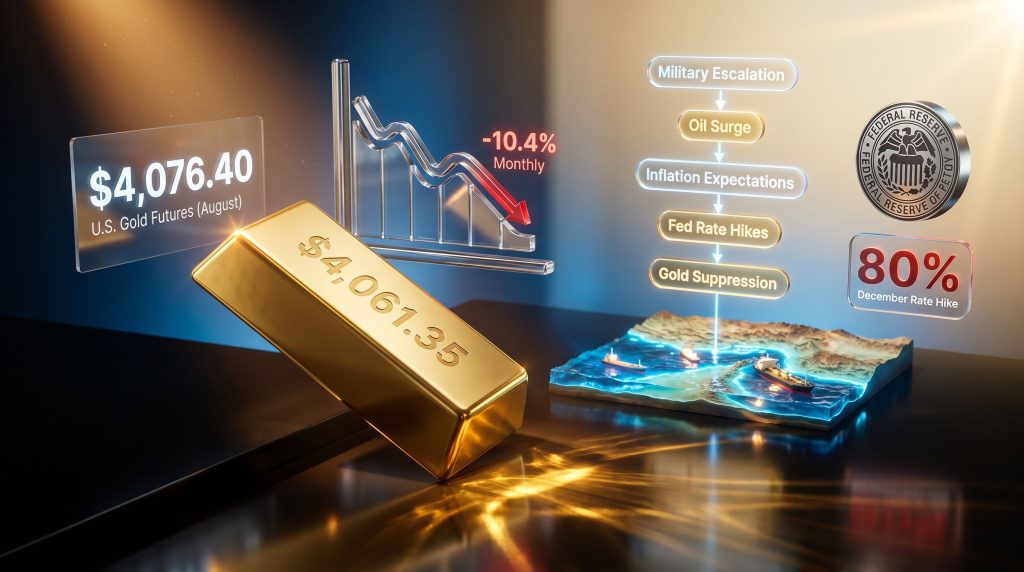
| August Gold Futures | $4,076.40 | -0.5% | Bearish near-term momentum |
| Spot Silver | $58.51/oz | -1.1% | Underperforming gold |
| Platinum | $1,630.13/oz | +1.0% | Industrial demand supportive |
| Palladium | $1,218.92/oz | +0.8% | Automotive sector driven |
Gold is now recording its fourth consecutive monthly loss, with the cumulative decline reaching approximately 10.4% over that period. From the conflict's escalation point in late February 2026, the drawdown from prior highs has reached roughly 21 to 22%, a substantial correction by any historical measure. Spot gold recently hit a two-month low following the most recent round of strikes, underscoring how each fresh escalation reinforces the bearish macro thesis rather than triggering the traditional safe-haven bid.
Platinum and palladium are behaving very differently, rising modestly as their prices are more tightly linked to industrial demand cycles rather than monetary policy sensitivity. Silver's steeper decline relative to gold reflects its hybrid nature as both a monetary and industrial metal. When economic uncertainty rises, industrial demand expectations for silver weaken, compounding the monetary pressure it shares with gold. The widening gold-silver ratio that has emerged from this dynamic is historically associated with pronounced risk-off conditions across the entire precious metals complex.
The Federal Reserve Variable: Why Rate Expectations Are the Decisive Factor
The single most important variable suppressing gold right now is not the conflict itself but what the conflict implies for Federal Reserve policy. According to CME FedWatch Tool data, markets are currently pricing in three Federal Reserve rate hikes for the current year, with the probability of a December increase sitting near 80%.
Federal Reserve officials have made their position reasonably clear: if conflict-driven energy inflation proves persistent, the policy response will be continued tightening. This stance reflects the Fed's mandate to control inflation above all other near-term considerations, even when the inflation source is exogenous rather than demand-driven.
The transmission mechanism connecting military strikes to gold suppression can be mapped systematically:
- U.S.-Iran military exchanges intensify, threatening Strait of Hormuz transit security
- Crude oil prices surge on supply disruption fears
- Consumer and producer inflation expectations rise across energy-intensive sectors
- Federal Reserve rate hike pricing accelerates in interest rate futures markets
- Real yields on Treasuries increase, raising the opportunity cost of holding non-yielding assets
- Gold demand weakens from yield-seeking institutional investors
- Spot prices decline despite elevated geopolitical risk
This chain illustrates why gold's traditional safe-haven role is being systematically overridden. The geopolitical risk premium that would normally support gold is being more than offset by the rate premium being priced into fixed income markets. Indeed, the gold-bond market relationship has rarely been more consequential in determining the metal's near-term direction.
Dollar Strength as a Compounding Headwind
A secondary mechanism reinforcing gold's weakness is U.S. dollar appreciation. The conflict environment has pushed the dollar to a one-week peak, and because gold is priced globally in U.S. dollars, a stronger greenback makes the metal materially more expensive for buyers operating in other currencies.
| Dollar Condition | Effect on Foreign Gold Demand | Net Gold Price Impact |
|---|---|---|
| Strengthening | Reduces affordability for international buyers | Bearish |
| Weakening | Improves affordability for international buyers | Bullish |
| Stable | Demand determined by other variables | Rate differentials dominate |
This currency effect is not trivial. A significant share of physical gold demand originates from markets in Asia, the Middle East, and Europe. When dollar appreciation makes gold 2 to 3% more expensive in local currency terms, the demand response can be measurable in spot price pressure. Combined with the rate hike dynamic, the dollar effect is amplifying an already hostile macro environment for the metal.
Decomposing Gold's Fair Value: The Five-Component Framework
Sophisticated gold analysis moves beyond simple safe-haven narratives. Gold's spot price at any moment reflects the aggregated weight of multiple distinct premiums, each driven by different variables:
- Monetary policy premium — inversely correlated with real interest rates; the higher real rates go, the more this component deflates
- Dollar valuation discount — inversely correlated with U.S. Dollar Index strength; dollar appreciation compresses this premium
- Geopolitical risk premium — positively correlated with conflict intensity; currently elevated but insufficient to offset other forces
- Inflation hedge premium — positively correlated with CPI expectations; present but being redirected toward rate-hike pricing rather than gold demand
- Central bank demand premium — driven by reserve diversification; providing a structural floor through ongoing accumulation programmes
The current market structure has the first two components exerting overwhelming downward pressure, while the third and fourth offer insufficient offsetting support. The fifth component is the most important structural anchor preventing a more severe selloff. Central bank gold demand from emerging markets remains robust as part of long-term de-dollarisation strategies — demand that is relatively price-insensitive and does not respond to short-term rate cycles in the way institutional investors do.
The next major ASX story will hit our subscribers first
What Employment Data Could Mean for Gold's Next Move
Near-term price direction will be heavily influenced by two key data releases: the ADP Employment Change report covering private sector job creation, and the more consequential U.S. Nonfarm Payrolls figure. Both are due later in the current week and will be parsed for signals about the economy's resilience under geopolitical and inflationary stress.
Strong employment data reinforces the case for Federal Reserve tightening, which is structurally bearish for gold. Weak employment data introduces the possibility of a policy recalibration, which could provide gold with a meaningful floor and potentially a sharp recovery.
The asymmetry here is notable. If payrolls disappoint significantly, the repricing of rate expectations could be swift, as markets are currently positioned quite aggressively for continued tightening. A downside employment surprise would force a recalibration of the three-hike consensus, potentially triggering a short-covering rally in gold from its currently depressed levels.
Scenario Analysis: The Conditions Required for a Return to $5,000
Tim Waterer, chief market analyst at KCM Trade, outlined the conditions under which gold could return to the $5,000 level, identifying de-escalation, a sustained crude price decline to pre-conflict levels, and a softer U.S. dollar as the necessary combination of triggers.
| Recovery Scenario | Required Trigger | Realistic Timeframe |
|---|---|---|
| Geopolitical de-escalation | Confirmed U.S.-Iran ceasefire or formal diplomatic resolution | Near-term if talks progress |
| Oil price normalisation | Crude returning to pre-February 2026 levels | 2 to 3 months post-ceasefire |
| Dollar softening | Fed signalling a pause or policy pivot | Conditional on employment data |
| Inflation subsidence | Energy price decline flowing through to CPI readings | 3 to 6 month lagged horizon |
| Central bank accumulation boost | Accelerated reserve diversification by sovereign buyers | Structural, ongoing |
An important nuance is that ceasefire-driven rallies in gold historically tend to produce short-term relief moves rather than sustained trend reversals. The underlying structural damage to the macro backdrop — specifically the recalibration of rate expectations — does not unwind immediately even when conflict risk subsides. Oil prices can decline rapidly, but the inflation they generated takes months to fully flow through consumer price data, and central banks tend to respond to observed inflation rather than anticipated deflation.
This creates a scenario where even a genuine diplomatic resolution may not immediately restore gold to its pre-conflict trajectory. The metal would need the full combination of easing conflict, falling crude, declining inflation readings, and a shift in Fed guidance to sustain a move back toward $5,000.
The Broader Lesson: Gold's Safe Haven Status Has Conditions Attached
The current episode offers a valuable corrective to oversimplified thinking about gold as an unconditional crisis asset. The metal's safe-haven role is real but contingent. It functions most effectively as a refuge when crises create financial uncertainty without simultaneously generating inflationary pressure that forces central banks to tighten.
When conflicts are deflationary or uncertainty is financial rather than commodity-driven, gold performs as expected. However, when conflicts are inflationary — as the current confrontation has proven through its impact on oil markets — the same forces driving people toward gold are simultaneously creating the macroeconomic conditions that push investors away from it. The geopolitical drivers of gold are therefore never straightforward, and this episode reinforces that point clearly.
Understanding this distinction is arguably the most important insight for navigating gold markets in a world where geopolitical risk and inflationary commodity shocks increasingly coincide. Investors monitoring gold prices and U.S.-Iran strikes should watch the oil-inflation-rate chain as their primary analytical framework, rather than simply tracking conflict intensity.
Disclaimer: This article is intended for informational purposes only and does not constitute financial advice. All price data, probability figures, and forward projections referenced are subject to change. Forecasts and scenario analyses involve inherent uncertainty and should not be relied upon as the basis for investment decisions. Past price behaviour is not necessarily indicative of future results.
Want to Stay Ahead of Major ASX Mineral Discoveries in Real Time?
Discovery Alert's proprietary Discovery IQ model delivers instant alerts on significant ASX mineral discoveries, cutting through market complexity to surface actionable opportunities the moment they emerge — start your 14-day free trial today, or explore how historic discoveries have generated extraordinary returns for investors who moved early.