June 13, 2026
When the Perfect Storm Loses Its Thunder: Decoding Gold's Sudden Vulnerability
Commodity bull markets rarely end with a single catalyst. More often, they exhaust themselves against a wall of competing forces that gradually erode the narrative underpinning them. That is precisely the dynamic unfolding in gold markets today. After one of the most spectacular multi-year runs in the history of precious metals, the gold rally falters on Fed rate expectations and a stronger dollar, creating a rare and uncomfortable inflection point for investors who had grown accustomed to seemingly frictionless upside.
Understanding what is happening beneath the surface requires moving beyond the headline price decline and examining the machinery driving it.
When big ASX news breaks, our subscribers know first
The Architecture of a Bull Market Under Stress
Gold's ascent from 2023 through early 2026 was not a single-thesis trade. It was the product of several powerful and mutually reinforcing forces converging simultaneously. Central bank gold demand accelerated across the developing world following the freezing of Russian foreign assets in 2022, a geopolitical shock that caused many sovereign reserve managers to fundamentally reassess the custodial risk of dollar-denominated holdings. This structural shift created a demand floor largely indifferent to price.
Simultaneously, anticipation of Federal Reserve rate cuts built steadily throughout 2024 and into 2025, compressing the opportunity cost of holding non-yielding bullion relative to yield-bearing alternatives. Geopolitical fragmentation, ballooning U.S. fiscal deficits, and concerns over the long-term purchasing power of fiat currencies added further momentum.
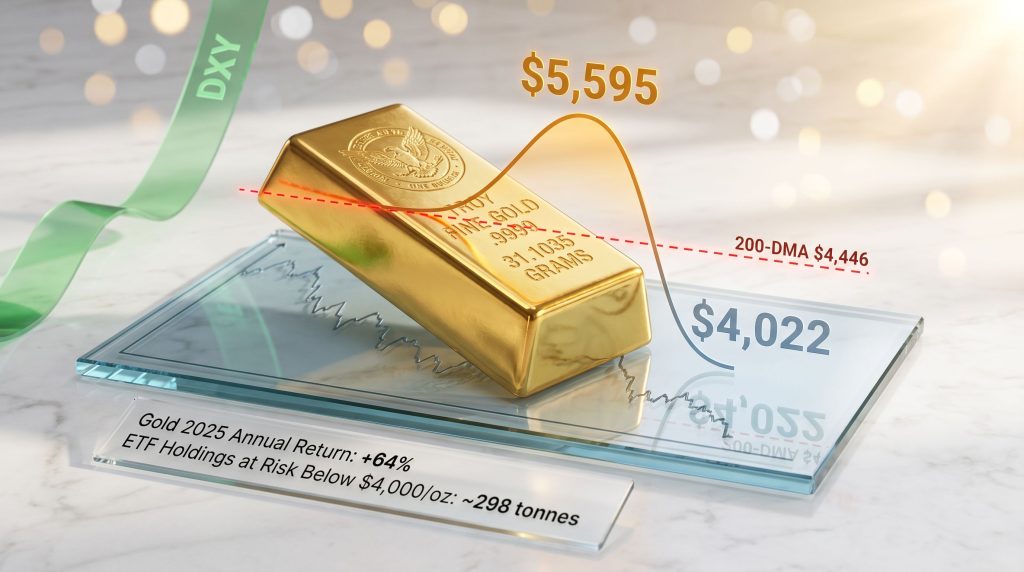
The result was a +64% return for gold in 2025, the largest annual gain recorded in 46 years, culminating in an all-time high of $5,595 per troy ounce in January 2026.
What has changed is not the long-term structural case for gold, but the near-term monetary policy narrative that was quietly doing much of the heavy lifting for speculative positioning.
How Far Has Gold Actually Fallen? The Data in Context
| Metric | Value |
|---|---|
| All-time high (January 2026) | $5,595 per troy ounce |
| Price as of June 13, 2026 | ~$4,188 per troy ounce |
| Six-month low (June 12, 2026) | $4,022 per troy ounce |
| Total decline from peak | ~25% |
| Gold's 2025 annual return | +64% (largest in 46 years) |
| 200-day moving average (resistance) | $4,446 per troy ounce |
A 25% correction from the January peak sounds alarming in isolation. In context, it represents a partial retracement of a gain that was itself extraordinary by any historical standard. Nevertheless, the manner of this decline carries important technical signals that go beyond the raw percentage.
For the first time in approximately two and a half years, gold has broken and closed below its 200-day moving average (200-DMA). That level, previously a reliable support floor during the bull run, now sits at $4,446 and functions as overhead resistance. This inversion from support to resistance is a technically significant development closely watched by institutional and algorithmic trading systems.
Why the 200-Day Moving Average Matters More Than Most Retail Investors Realise
The 200-DMA is not simply a chart line. For large institutional participants and systematic trend-following funds, it functions as an explicit regime signal. Many algorithmic strategies are programmed to reduce or liquidate long exposure when an asset prints sustained closes below this threshold, creating a self-reinforcing selling dynamic independent of any fundamental assessment.
In practical terms, this means that reclaiming $4,446 is not merely a technical milestone. It is a prerequisite for reigniting systematic buying from the same class of participants whose selling has amplified the current decline. Until that level is reclaimed convincingly, the path of least resistance remains sideways to lower.
The Three Forces Compressing Gold Simultaneously
Factor One: Labour Market Resilience and the Rate-Hike Repricing
Stronger-than-expected U.S. non-farm payrolls data shifted market expectations toward Federal Reserve rate hikes rather than cuts. This matters enormously for gold because the metal generates no income. Its relative attractiveness against yield-bearing assets like U.S. Treasuries is entirely a function of the opportunity cost embedded in interest rate expectations. Furthermore, the gold and bond dynamics at play here highlight how sensitive bullion pricing is to shifting yield environments.
When employment data surprises to the upside, two things happen simultaneously:
- Inflation expectations firm, as a tight labour market sustains wage growth and consumer spending.
- The Fed's capacity to pivot dovish is constrained, removing the rate-cut narrative that had become a structural prop for gold's valuation.
The result is a direct repricing of the speculative premium that rate-cut expectations had embedded in bullion prices throughout 2024 and 2025.
Factor Two: Oil, Iran, and the Paradox of Geopolitical Inflation
The Iran conflict introduced one of the more analytically complex dynamics the gold market has navigated in recent memory. Conventionally, geopolitical conflict is bullish for gold as capital seeks safe-haven assets. However, in this cycle, the Iran conflict triggered a sharp spike in crude oil prices, with Brent crude trading above $104 per barrel. Elevated oil prices generate inflationary pressure that makes the Fed's dual mandate harder to satisfy, reinforcing the case for tighter monetary policy.
This creates an almost paradoxical feedback loop: the very geopolitical shock that might ordinarily drive investors into gold is, through the mechanism of oil-driven inflation, actively undermining bullion by strengthening the rate-hike case. Consequently, gold's safe-haven role becomes considerably more complicated to assess when inflationary dynamics are simultaneously pushing monetary policy in a hawkish direction.
Nicky Shiels, head of metals strategy at MKS PAMP, has noted that gold prices are expected to remain range-bound over the coming months pending the emergence of new strategic catalysts. That assessment captures the current impasse well.
Should Middle East tensions ease materially and crude oil retreat toward $80 per barrel, the inflationary impulse would diminish, reopening the door for a more accommodative Fed stance and potentially reviving gold's safe-haven bid. Aakash Doshi, head of gold and metals strategy at State Street Investment Management, has outlined this scenario as a plausible pathway for near-term recovery.
Factor Three: Dollar Strength as a Mechanical Suppressant
Gold is priced globally in U.S. dollars. When the dollar index (DXY) appreciates, the dollar price of gold faces mechanical downward pressure through two distinct channels:
- Direct pricing effect: It takes fewer dollars to represent the same physical quantity of gold as the dollar's purchasing power rises.
- Demand suppression effect: Gold becomes more expensive in local currency terms for buyers in India, China, and other major physical consumption markets, dampening demand at the source.
Physical demand from India is currently described as seasonally weak, with bullion trading at a notable discount in that market. This is significant because India represents one of the world's largest consumers of physical gold, and seasonal softness in that demand removes a natural price floor that typically absorbs Western selling.
ETF Flows and Positioning: Where the Structural Vulnerabilities Are Building
| ETF Flow Metric | Data Point |
|---|---|
| Gold ETF outflows, May 2026 | 16 tonnes |
| Gold ETF outflows, first week of June 2026 | 7 tonnes |
| ETF holdings at risk below $4,250/oz | ~270 tonnes |
| ETF holdings at risk below $4,000/oz | ~298 tonnes |
Standard Chartered analyst Suki Cooper has estimated that at least 270 tonnes of gold held in exchange-traded funds are currently in loss-making territory at prices below $4,250. Should prices fall further to the $4,000 level, that figure rises to approximately 298 tonnes.
This creates a non-linear risk dynamic. As prices decline, more ETF holders find themselves underwater, generating increasing incentive to redeem. Those redemptions require fund managers to sell physical gold or futures, adding further selling pressure and pushing more holders into negative territory. It is a self-reinforcing feedback loop that makes the $4,000 level a structurally critical threshold for the market. According to recent gold market analysis, this dynamic is one of the most closely watched risks by institutional participants.
The COMEX Positioning Problem: A Missing Short-Squeeze Catalyst
One frequently overlooked dimension of the current market structure is the composition of COMEX futures positioning. Managed short positions were at their lowest levels since January 2025 in the week ending June 2, 2026. In past corrections, heavily shorted markets have recovered sharply as bearish bets were forcibly covered. That mechanism is largely absent here.
Adrian Ash, head of research at BullionVault, has noted that the relatively low level of short interest leaves considerable scope for bearish positions to build. Equally, it means any recovery in gold prices must be driven by genuine long accumulation rather than technical short-covering, raising the threshold for a sustainable bounce.
The absence of a significant short position to squeeze means gold bulls cannot rely on the kind of violent, technically-driven reversals that have rescued the market in previous corrections.
The Long-Term Case Remains Structurally Intact
Central Bank Demand: The Price-Insensitive Buyer
Despite the near-term headwinds, the structural underpinnings of the gold bull market have not been dismantled. Global central bank gold purchases have been one of the defining features of the post-2022 precious metals landscape. These buyers are motivated by reserve diversification, geopolitical risk management, and reduced dependence on dollar-denominated assets. Their demand is largely indifferent to quarterly price movements.
This category of demand provides a demand floor that is qualitatively different from speculative or ETF-driven buying. Central banks accumulate on price weakness rather than selling into it, which creates a counterweight to the ETF outflow dynamic currently pressuring markets.
The Fiscal Debasement Thesis: A Multi-Year Foundation
Over longer time horizons, expanding U.S. fiscal deficits continue to underpin the fundamental case for gold as a store of value. As government debt-to-GDP ratios climb and structural spending commitments grow, the implicit long-term purchasing power of fiat currencies faces erosion that is independent of short-term interest rate cycles.
This thesis does not provide near-term trading signals, but it does establish a durable foundation beneath gold's value proposition that short-term monetary headwinds cannot permanently override. In addition, the broader gold market outlook suggests that the structural case for accumulation remains compelling over a multi-year horizon, even as near-term volatility persists.
The next major ASX story will hit our subscribers first
Scenario Analysis: Three Paths Forward
| Scenario | Trigger Conditions | Likely Gold Price Direction |
|---|---|---|
| Bullish Recovery | Middle East de-escalation, oil falls to ~$80/bbl, Fed pauses rate hikes | Rebound toward $4,446 resistance and beyond |
| Continued Consolidation | Mixed macro signals, range-bound oil, Fed on hold | Sideways trading between $4,000 and $4,400 |
| Bearish Extension | Fed hikes rates, dollar strengthens further, ETF outflows accelerate | Test of $3,800 to $4,000 support zone |
The base case, supported by consensus metals strategy commentary, is a period of range-bound consolidation. The market is effectively in a holding pattern, waiting for the macroeconomic narrative to resolve in one direction or the other. Furthermore, how tariffs and gold prices interact over coming months will add another variable to an already complex macro picture.
Key Indicators to Monitor Going Forward
For investors seeking to position around gold's next directional move, the following signals carry the highest informational value:
- U.S. CPI and PCE inflation data: Upside surprises reinforce rate-hike expectations; downside surprises reopen the rate-cut narrative.
- FOMC minutes and Federal Reserve speaker commentary: Hawkish signals strengthen the dollar and suppress gold; any dovish pivot language provides meaningful relief.
- U.S. Non-Farm Payrolls: Labour market resilience constrains Fed flexibility; deterioration increases rate-cut probability.
- Crude oil price trajectory: Brent above $100 per barrel sustains inflationary pressure; a retreat toward $80 reduces the rate-hike impulse significantly.
- DXY (U.S. Dollar Index): Dollar strength remains the most direct mechanical headwind for dollar-denominated gold prices.
- COMEX managed money positioning: Rising short interest signals building bearish conviction; short-covering can still drive technical recoveries if positioning shifts sufficiently.
- Weekly gold ETF flow data: Sustained outflows indicate ongoing institutional de-risking; a reversal to inflows would signal renewed accumulation and a potential inflection point. Live spot gold prices can provide a useful real-time reference when monitoring these developments.
Frequently Asked Questions
Why does a stronger U.S. dollar push gold prices lower?
Gold is priced globally in U.S. dollars, so dollar appreciation has two compounding effects. First, it mechanically reduces the dollar price needed to represent the same physical value of gold. Second, it makes gold more expensive for buyers using other currencies, reducing demand in key physical markets like India and China, which further pressures prices.
Why do higher interest rate expectations hurt gold specifically?
Because gold generates zero income. It pays no dividend, no coupon, and no yield of any kind. When interest rates rise or rate-hike expectations build, yield-bearing assets become relatively more attractive by comparison. Capital that might otherwise sit in gold rotates toward bonds and other income-generating instruments, reducing demand for bullion.
Can gold recover even in a rate-hiking environment?
Historically, yes, under specific conditions. If inflation expectations remain elevated despite rate hikes, if geopolitical risks are severe, or if central bank buying is strong enough, gold can hold its value or even appreciate during rate-hiking cycles. However, a simultaneous combination of rate hikes, dollar strength, and ETF outflows creates a more challenging environment than any single headwind in isolation. The gold rally falters on Fed rate expectations and a stronger dollar most acutely when all three forces align against it.
Why is the $4,000 level so important for gold markets?
It is both a psychological threshold and a structural risk point. Below $4,000, an estimated 298 tonnes of gold held in ETFs would move into loss-making territory, creating material incentives for redemptions. Those redemptions require physical gold sales, which can amplify selling pressure and push prices lower still, triggering more redemptions in a cascading dynamic. The level therefore represents a key line of defence for gold bulls.
This article is intended for informational purposes only and does not constitute financial advice. All price forecasts, scenario analyses, and market projections involve inherent uncertainty and should not be relied upon as predictions of future performance. Investors should conduct independent research and seek professional financial advice before making investment decisions in commodity markets.
For ongoing coverage of gold market dynamics, central bank activity, and macroeconomic trends affecting global metals markets, visit MINING.COM.
Want to Know When the Next Major Gold Discovery Hits the ASX?
While gold prices navigate short-term headwinds from Fed rate expectations and dollar strength, the structural case for precious metals remains compelling — and significant new discoveries can deliver outsized returns regardless of broader market conditions. Discovery Alert's proprietary Discovery IQ model scans ASX announcements in real time, instantly alerting subscribers to high-potential mineral discoveries before the broader market reacts; explore historic discovery returns to see what's possible, then begin your 14-day free trial at Discovery Alert to position yourself ahead of the next major find.