
June 23, 2026
The Silent Revenue Leak That Most Gold Mines Never Fix
Every tonne of ore that passes through a gold processing circuit carries with it a hidden assumption: that the primary recovery infrastructure is capturing all the value available. In practice, this assumption is routinely wrong. A measurable fraction of liberated gold, too fine to be intercepted by conventional gravity separation or standard flotation circuits, exits the system suspended in process water. It does not reappear in the concentrate. It does not report to tailings in a recoverable form. It simply leaves.
This is not a rare edge case or a geological anomaly. In hard-rock gold operations where fine grinding is required to achieve adequate mineral liberation, the production of ultra-fine gold particles is an inherent consequence of the milling process itself. Particles in the sub-micron to low-micron size range are physically present, chemically liberated, and in principle recoverable. However, conventional processing infrastructure was never designed to intercept them at this scale.
For decades, the industry accepted this loss as a structural feature of the economics of gold processing. The technology to address it simply did not exist at commercial scale. That calculus is now changing, and the Sofi Alchemist gold recovery service at Pampalo mine in Finland represents one of the clearest demonstrations of how far the field has advanced.
When big ASX news breaks, our subscribers know first
Understanding the Ultra-Fine Gold Problem in Hard-Rock Operations
Why Fine Grinding Creates a Recovery Paradox
The relationship between grind size and gold recovery is one of the foundational tensions in mineral processing engineering. Finer grinding liberates more gold from the host rock matrix, improving theoretical recoverable value. However, as particle size decreases below approximately 10 to 20 microns, the behaviour of those particles in conventional flotation and gravity circuits changes dramatically. Surface area to mass ratios increase, particles become more susceptible to hydraulic entrainment, and the probability of reporting to the concentrate rather than the overflow stream declines sharply.
This creates a paradox: the very process that makes more gold accessible also makes a portion of it harder to capture. In orogenic gold deposits, where gold occurs in structurally controlled veins with complex gangue mineralogy, the fine-grinding requirement is often non-negotiable if acceptable overall liberation is to be achieved. Furthermore, considerations around ore mineralogy economics reveal that Pampalo, hosted within the Karelian Craton of eastern Finland, is exactly this type of deposit.
The Compounding Financial Cost of Fine Particle Loss
The financial significance of ultra-fine gold losses is rarely visible in headline recovery statistics. A mine reporting an overall circuit recovery of 92% may have a primary flotation circuit performing at 95% or better, with the shortfall attributable largely to fine particle losses in process water side streams. These losses are:
- Continuous across every tonne processed, compounding over the mine's operating life
- Invisible to standard metallurgical accounting without dedicated fine particle sampling
- Disproportionately valuable at current gold prices, where even marginal improvements in recovery translate to material revenue uplift
- Environmentally relevant, since gold-bearing process water discharge carries both metal losses and regulatory compliance implications
The economic case for addressing fine particle losses is not about finding new gold. It is about recovering gold that has already been mined, crushed, and liberated, but exits the circuit before it can be monetised.
How the Sofi Alchemist System Works
From Industrial Water Treatment to Gold Recovery Technology
Sofi Filtration is a Finnish water technology company whose primary product line, the Sofi Prima filtration platform, was developed for demanding industrial water treatment applications. The Prima system is built around a proprietary filtration mechanism capable of intercepting fine and ultra-fine particles from high-volume liquid streams with high efficiency and operational continuity.
The Sofi Alchemist represents a purposeful adaptation of this proven platform for the mineral processing environment. The engineering challenge was substantial: gold processing filtrate is chemically aggressive, carries variable particle loads, and must be processed at volumes consistent with full-scale milling operations without introducing bottlenecks to the primary circuit. The Alchemist platform was engineered to meet these requirements while delivering the particle interception performance that makes recovery commercially meaningful.
Technical Architecture of the Recovery Process
The Sofi Alchemist operates downstream of the primary processing circuit, positioned to intercept process water side streams before they exit the plant boundary. Its core functional sequence involves:
- Intake of process water filtrate from milling and flotation side streams, where ultra-fine gold concentrate particles are most concentrated
- Particle interception using the Sofi Prima-derived filtration mechanism, targeting particles below the threshold of conventional recovery equipment
- Concentrate accumulation for return to the primary circuit or direct recovery, depending on particle grade and operational logistics
- Water purification as an integrated co-function, producing treated process water suitable for direct reuse within the mill's closed-loop water system
The system is designed for continuous operation through complete production cycles, requiring no modification to the upstream processing circuit and generating no throughput disruption during normal operations.
Performance Benchmarks: What the Data Shows
| Performance Metric | Sofi Alchemist (Pampalo Trials) | Conventional Circuit Benchmark |
|---|---|---|
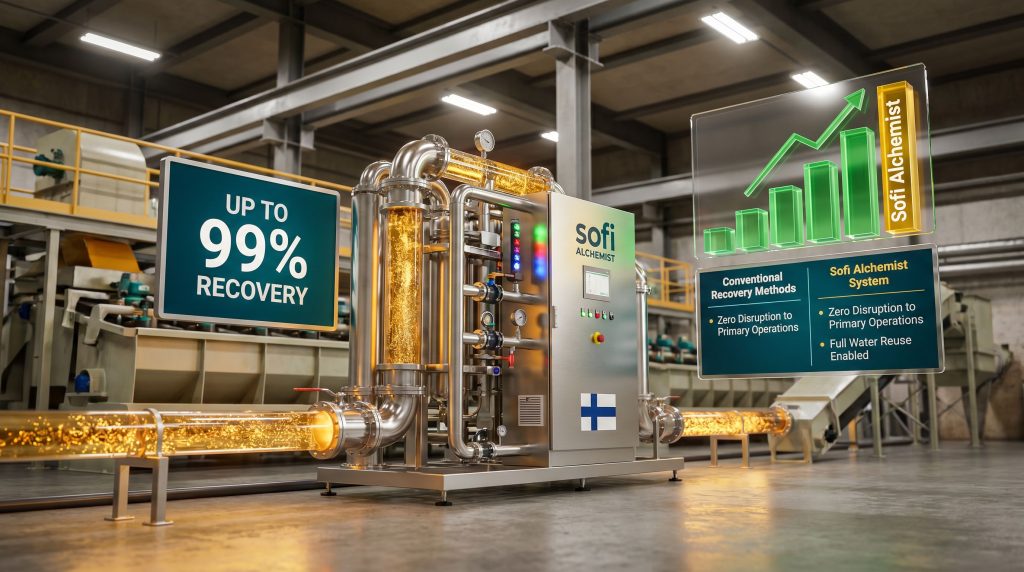
| Ultra-fine concentrate recovery rate | Up to 99% | Typically 40–70% for sub-10 micron fraction |
| Operational disruption to primary circuit | Zero recorded | Variable depending on integration approach |
| Process water treatment capability | Full reuse enabled | Separate infrastructure typically required |
| Particle size target | Sub-micron to fine micron range | Generally effective above 20–38 microns |
| Commercial model | Recovery-as-a-Service | Capital purchase standard |
The 99% recovery rate figure warrants careful contextualisation. This metric applies specifically to the ultra-fine gold concentrate fraction within the process water side stream, not to the full ore feed. Its significance lies in the additive nature of the improvement: existing circuit performance is unchanged, and the Alchemist recovery sits on top of it as an incremental gain. For a mine already operating at 90–92% primary circuit recovery, recovering 99% of the fine fraction that was previously exiting with process water can represent a meaningful uplift in total gold recovered per tonne milled.
Pampalo Mine: Operational Context and Deployment Background
Endomines and the Pampalo Asset
Endomines AB is a Swedish-Finnish gold mining company whose operational centre is the Pampalo underground mine in Ilomantsi, North Karelia. The deposit sits within the Karelian Craton, one of the oldest and most geologically stable Precambrian cratons in Europe, which hosts a series of orogenic gold occurrences associated with major structural corridors.
Pampalo's gold mineralisation is characteristic of orogenic systems: gold occurs in quartz-carbonate veins and their alteration halos, with grades sufficient to support underground selective mining. The processing circuit employs conventional crush-grind-float methodology to produce a gold-bearing sulphide concentrate. This type of circuit, while technically mature and operationally reliable, is precisely the configuration in which fine particle losses are most pronounced, because the sulphide flotation process is optimised for particles in a moderate size range and progressively less effective as particle size approaches the sub-10 micron threshold.
The Path from Plant Trials to Full-Scale Deployment
The Pampalo deployment did not emerge overnight. Plant trials were conducted at the site during 2025, providing Sofi Filtration with real-world data on Pampalo's specific process water chemistry, particle size distribution, and volumetric flow characteristics. This site-specific optimisation phase is critical for fine particle recovery technology, because the performance envelope of any filtration system is highly sensitive to the chemical and physical properties of the feed stream.
The trials delivered the 99% fine concentrate recovery figures that underpinned the decision to proceed to full commercial deployment. In June 2026, Sofi Filtration delivered the first Sofi Alchemist system to Pampalo and commenced full-scale recovery operations. This activation marks the first commercial deployment of the Alchemist platform globally, making Pampalo a reference site of international significance for the technology.
Riina Salmimies, CEO of Sofi Filtration, described the Pampalo launch as the beginning of a new chapter in mineral processing, a characterisation that reflects the broader commercial ambition the company holds for the Alchemist platform beyond this initial deployment.
The Recovery-as-a-Service Model: Rethinking Technology Adoption in Mining
A Structural Shift in How Mining Technology Is Delivered
Perhaps the most strategically significant aspect of the Sofi Alchemist gold recovery service at Pampalo mine is not the technology itself but the commercial framework surrounding it. Sofi Filtration retains ownership and operational responsibility for the Alchemist system under a Recovery-as-a-Service (RaaS) model. Endomines pays for the service, not the equipment.
This distinction has far-reaching implications for how mining companies approach advanced processing technology adoption:
- Capital allocation is preserved for core mining activities including development, drilling, and primary processing infrastructure
- Technology risk transfers from the mine operator to the technology provider, whose revenue depends directly on system performance
- Operational expertise requirements at the mine are eliminated for a specialised technology that most operations would lack the in-house knowledge to optimise
- Balance sheet treatment shifts from capitalised asset to operating expenditure, improving capital efficiency metrics
- Upgrade pathway is managed by the service provider, insulating the mine from the risk of technology obsolescence
Why the RaaS Model Is Particularly Suited to Fine Particle Recovery Technology
Fine particle recovery systems occupy an unusual position in the mining technology landscape. Their value is highly site-specific, dependent on ore mineralogy, grind characteristics, and process water chemistry. A system that performs at 99% recovery at Pampalo may require significant reoptimisation at a different operation with different feed characteristics.
This site-specificity creates a natural alignment between the RaaS model and the technology's operating requirements: the party best positioned to manage that optimisation is the technology developer, not the mine operator. Consequently, considerations around cut-off grade economics and marginal value recovery become directly relevant to how such service agreements are structured and priced.
| Procurement Dimension | Traditional Capital Purchase | Recovery-as-a-Service |
|---|---|---|
| Upfront capital required | Significant | None |
| Technology risk | Borne by mine operator | Borne by Sofi Filtration |
| Performance accountability | Warranty-limited | Ongoing operational obligation |
| Optimisation responsibility | Mine's engineering team | Sofi Filtration specialists |
| Balance sheet impact | Capitalised asset | Operating expenditure |
| Upgrade pathway | New capital cycle required | Managed by service provider |
Environmental Co-Benefits: Process Water Reuse and Regulatory Alignment
The Dual Function That Changes the Economic Calculus
The Sofi Alchemist's capacity to purify process water as an integrated function of the gold recovery process is not a secondary feature. In the context of EU mining regulation and Finland's stringent environmental framework, the ability to treat and reuse process water within a closed-loop system carries direct compliance value that operates independently of the gold recovery benefit.
Finnish mining operations are subject to the EU Water Framework Directive and Finland's own Environmental Protection Act, both of which impose rigorous standards on water discharge quality and volumes. Process water containing fine concentrate particles, even at low concentrations, represents a potential compliance liability if discharged without adequate treatment.
The Alchemist system addresses this liability as a direct consequence of its recovery function. By intercepting fine particles before they exit the plant boundary, it simultaneously:
- Reduces the total dissolved and suspended metal load in any water stream approaching the discharge boundary
- Enables full recirculation of treated process water, reducing net freshwater withdrawal from the environment
- Provides a measurable, auditable reduction in process water discharge volume, directly relevant to water stewardship reporting
ESG Implications for Mine Operators and Investors
For gold mining stocks and the companies behind them, operating under increasing investor scrutiny of environmental, social, and governance performance, the Alchemist's dual-benefit profile creates a genuinely differentiated value proposition. Improving gold recovery while simultaneously reducing the environmental footprint of water management is not a trade-off. It is an aligned outcome, and aligned outcomes are increasingly valued in ESG-focused capital allocation frameworks.
Technology that improves both financial performance and environmental compliance simultaneously is rare in any sector. In mining, where these objectives have historically been in tension, such convergence represents a structural competitive advantage.
Quantifiable ESG improvements from Alchemist-type deployments include reduced gold-equivalent losses per tonne of water discharged, improved water intensity metrics per ounce of gold produced, and a documentable contribution to circular water economy principles within the processing plant.
The next major ASX story will hit our subscribers first
Finland's Mining Technology Ecosystem: The Broader Context
Why This Innovation Emerged from Finland
The Pampalo deployment is not coincidental in its Finnish geography. Finland has developed one of the most sophisticated mineral processing technology ecosystems in the world, supported by institutions including Aalto University's department of chemical and metallurgical engineering and the Geological Survey of Finland (GTK), which has an extensive track record in ore characterisation and process mineralogy research.
Finnish technology companies operating in mining-adjacent sectors benefit from direct access to active underground mining operations, a culture of industrial collaboration between universities and private companies, and EU research funding frameworks that support applied innovation in resource efficiency. In addition, the broader context of mining sustainability transformation has accelerated demand for exactly this type of dual-benefit technology. Sofi Filtration's development of the Alchemist platform within this environment, and its first commercial deployment at a Finnish gold mine, reflects the depth of the country's integrated mining technology infrastructure.
Scalability Pathways Beyond Pampalo
Establishing a first commercial reference site is a critical milestone for any novel mining technology. The performance data generated at Pampalo under real operational conditions provides Sofi Filtration with the validated evidence base required to approach additional gold operations globally. The expansion logic follows a clear hierarchy:
- Nordic and Baltic gold operations with comparable orogenic deposit geology and similar EU environmental frameworks
- European gold producers operating under comparable regulatory constraints where the water reuse function carries additional compliance value
- Global operations in water-stressed jurisdictions where the process water treatment capability provides value independent of gold recovery economics
- Extension to base metal and critical mineral processing circuits where fine particle losses represent an analogous, if less immediately visible, revenue drain
| Expansion Stage | Target Market | Primary Value Driver |
|---|---|---|
| Near-term | Nordic and Finnish gold operations | Reference site proximity, similar geology |
| Medium-term | Broader European gold producers | EU regulatory alignment, water reuse value |
| Long-term | Global gold and critical mineral operations | Recovery economics at scale |
| Strategic extension | Base and critical mineral circuits | Platform versatility demonstration |
What the Pampalo Deployment Means for the Future of Mineral Processing
Three Convergent Trends Meeting at a Single Finnish Mine
The activation of the Sofi Alchemist gold recovery service at Pampalo mine is significant beyond the operational improvement it delivers to Endomines. It is a visible convergence point for three structural trends that are reshaping how the mining industry approaches value extraction, technology adoption, and environmental responsibility.
First, advances in fine particle recovery technology have reached a performance threshold, demonstrated at up to 99% recovery of ultra-fine concentrate, that makes previously uneconomic loss streams commercially worth addressing. This was not true even a decade ago.
Second, the RaaS commercial model has matured sufficiently to be deployed in a core recovery function at an operating mine, not merely in peripheral services. This lowers the barrier to technology adoption for junior and mid-tier producers who compete for capital allocation with every operational priority on their balance sheets.
Third, the regulatory and investor environment for mining has shifted to the point where technologies that simultaneously improve financial performance and environmental compliance are not merely desirable but strategically necessary for maintaining social licence and access to capital. Furthermore, sound geological logging codes and rigorous data capture underpin the metallurgical confidence required to validate precisely these kinds of incremental recovery improvements.
The Pampalo deployment does not resolve all challenges in fine particle recovery. Questions remain about performance consistency across different ore types, the economics of the RaaS model at varying gold price levels, and the logistical complexity of deploying and maintaining specialised systems at remote mine sites. These are legitimate uncertainties that investors and operators should weigh against the demonstrated performance data.
Disclaimer: This article contains forward-looking assessments and technology performance projections based on publicly available information from plant trials at a single operational site. Past performance of any mineral recovery system does not guarantee equivalent results at other operations with different geological, metallurgical, or operational characteristics. This content does not constitute financial or investment advice.
What the Pampalo deployment does establish is a credible, commercially validated proof of concept for a recovery model that addresses one of the most persistent and underappreciated value leakage points in gold processing. For an industry that has spent decades optimising the front end of the recovery circuit while accepting losses at the back end as inevitable, the Sofi Alchemist represents a meaningful recalibration of what is actually recoverable from every tonne of ore put through the mill.
Want to Stay Ahead of the Next Major Gold Discovery on the ASX?
Discovery Alert's proprietary Discovery IQ model delivers real-time alerts the moment significant mineral discoveries are announced on the ASX, turning complex geological and metallurgical data into clear, actionable investment insights for both short-term traders and long-term investors. Explore how historic discoveries have generated substantial returns and begin your 14-day free trial today to position yourself ahead of the broader market.