
June 18, 2026
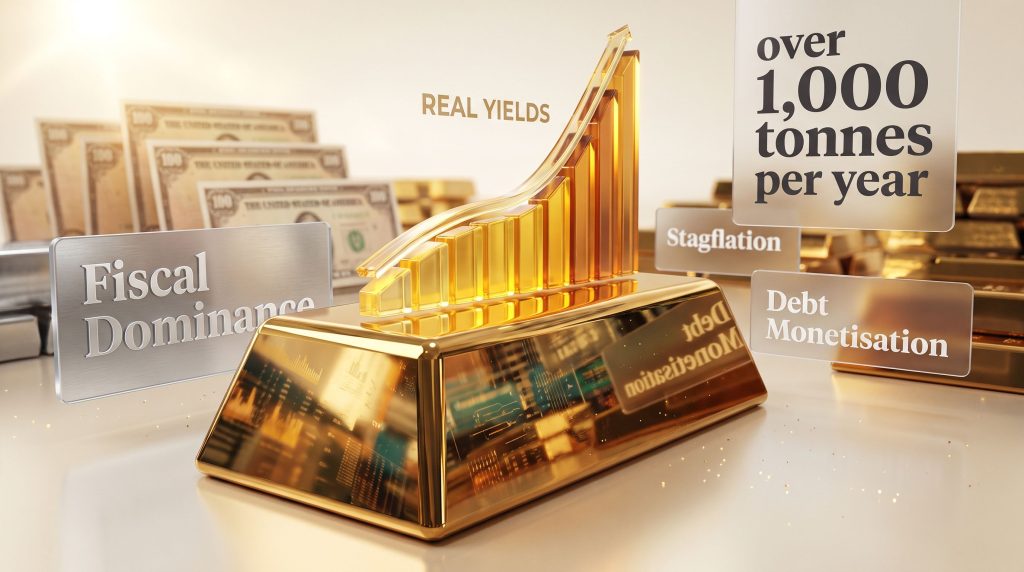
When Bonds and Gold Rise Together: Understanding the New Macro Order
Decades of financial orthodoxy taught investors a simple rule: when bond yields climb, gold falls. The logic was clean, mechanical, and for much of the post-Bretton Woods era, broadly reliable. But something has shifted in the underlying architecture of global capital markets. Across the United States, Europe, Japan, and the United Kingdom, yields have reached multi-year highs while gold has continued its ascent. For investors still operating on the old framework, this divergence is disorienting. For those willing to examine the deeper structural forces at work, it represents one of the most significant macro regime transitions in a generation.
Understanding why gold and rising bond yields are now moving in the same direction requires dismantling several foundational assumptions and rebuilding the analytical model from the ground up. The gold and bonds dynamics at play today reflect a structural break that demands a fundamentally different analytical lens.
When big ASX news breaks, our subscribers know first
The Mechanics Behind the Old Correlation
Why Higher Rates Were Supposed to Suppress Gold
The traditional framework rested on two interconnected pillars. First, gold produces no yield. When interest rates rise, income-generating assets become comparatively more attractive, raising what economists call the opportunity cost of holding gold. Second, rate increases typically strengthen the U.S. dollar, since higher yields attract foreign capital into dollar-denominated instruments. A stronger dollar mechanically reduces the price of gold when measured in USD, since they historically trade inversely.
These dynamics were observable and consistent across much of the 1980s and 1990s, a period when the Federal Reserve's credibility was high, fiscal deficits were modest relative to GDP, and sovereign debt markets functioned with reasonable discipline. The inverse relationship between gold and bond yields was essentially an artefact of a world in which rising rates actually reflected economic strength and effective monetary governance.
What the Current Environment Is Telling Us
The co-movement of gold and yields observed since 2022 is not statistical noise. It represents a fundamental regime change driven by forces that the old model was never designed to capture.
When yields rise because central banks are credibly tightening monetary policy in response to manageable inflation, the traditional inverse holds. But when yields rise because bond markets are questioning the long-run fiscal sustainability of the issuing government, the interpretation changes entirely. In the latter case, rising yields and a rising gold price are both expressing the same underlying anxiety: that sovereign debt is becoming structurally impaired.
The U.S. fiscal position illustrates this dynamic directly. With federal debt exceeding $34 trillion and annual interest payments surpassing $1 trillion for the first time in 2024, the debt service burden has become self-compounding. Higher yields increase the interest bill, which widens the deficit, which requires more debt issuance, which pushes yields higher still. In this environment, gold is not competing with Treasuries. It is providing insurance against them.
When rising yields reflect fiscal deterioration rather than genuine monetary tightening, gold and bond yields can move in the same direction simultaneously, both responding to the same underlying erosion of confidence in fiat currency management.
Nominal vs. Real Yields: The Distinction That Actually Drives Gold Prices
Why the Headline Number Misleads
Investors who anchor their gold analysis to nominal yield movements are working with incomplete information. A 10-year Treasury yielding 4.5% tells you very little about the true return on that instrument without knowing what inflation is expected to do over the same period.
Nominal yields can rise alongside gold when both are responding to the same signal: an increase in expected inflation or a deterioration in sovereign creditworthiness. The type of yield increase, not its direction, is what matters for determining gold's response. Furthermore, the gold-bond market relationship has grown considerably more nuanced as fiscal conditions across major economies have deteriorated.
Real Yields as the Primary Driver
Real yields, calculated by subtracting inflation expectations from nominal yields, represent the genuine purchasing-power-adjusted return available on bonds. This figure is the structurally dominant driver of gold pricing over meaningful time horizons.
When real yields are deeply negative, as they were between 2008 and 2012 and again during 2019 to 2022, the cost of holding gold relative to bonds shrinks dramatically. Gold surged through both of these windows. Conversely, the sharp rise in real yields through 2022 and into 2023 created genuine pressure on gold, consistent with the underlying framework.
The critical variable to monitor now is whether real yields have peaked. If nominal yields remain elevated while inflation expectations creep higher, or if central banks are eventually pressured into accepting above-target inflation to manage debt loads, real yields could plateau or decline even as nominal rates stay high. That scenario would be structurally constructive for gold. For a detailed view of long-term real yield trends versus gold, historical charting data provides a compelling visual illustration of this relationship.
| Yield Environment | Real Yield Direction | Typical Gold Response |
|---|---|---|
| Credible tightening cycle | Rising sharply | Bearish pressure |
| Fiscal expansion with inflation | Flat or declining | Bullish support |
| Stagflation | Volatile and mixed | Strong safe-haven bid |
| Debt monetisation or QE | Deeply negative | Historically very bullish |
The Inflation Expectations Wedge
One of the more technically sophisticated ways to monitor this dynamic is through breakeven inflation rates, derived from the spread between nominal Treasuries and Treasury Inflation-Protected Securities (TIPS). When this spread widens, it signals that the bond market is pricing in accelerating inflation. When nominal yields rise faster than real yields, the inflation expectations component expands, and this has historically been a bullish signal for gold.
The U.S. Fiscal Position and Dollar Debasement Risk
A Debt Spiral With No Clean Exit
The structural debt problem underpinning current Treasury market dynamics is significant and, by conventional fiscal metrics, unsustainable. When a government's debt-to-GDP ratio reaches levels where neither tax receipts nor organic growth can service obligations, the options narrow quickly. The U.S. government currently spends more on interest payments than on defence, a threshold that historically signals fiscal stress.
Matthew Piepenburg of Von Greyerz has long argued that rising yields in this context are not a sign of economic vitality but of structural fragility. His view, supported by observable debt dynamics, is that each tick higher in yields compounds the federal deficit by increasing the annual cost of carrying outstanding obligations. This creates a self-reinforcing cycle where the bond market's discomfort becomes the very mechanism accelerating the problem it is reacting to.
De-dollarisation and Structural Gold Demand
The global shift away from U.S. Treasuries as the primary reserve asset is a structural phenomenon that is reshaping the long-term demand floor for gold. Central banks worldwide purchased more than 1,000 tonnes of gold in both 2022 and 2023, according to World Gold Council data, representing the highest levels of sovereign accumulation on record.
This is not speculative portfolio rebalancing. Central bank gold buying at record levels reflects nations systematically replacing Treasury holdings with gold, which carries no counterparty risk and no political conditionality. As sovereign demand for U.S. Treasuries weakens, the Federal Reserve faces increasing pressure to absorb excess supply, effectively expanding the money base and reinforcing the debasement pathway that has historically preceded gold price re-ratings.
Forced Sell-Offs as Entry Points
One of the less intuitive features of gold market dynamics is that liquidity-driven sell-offs during yield spikes can represent structural buying opportunities rather than signals of fundamental deterioration.
During the 2008 financial crisis, gold fell sharply in the acute phase of the credit crunch as margin calls forced indiscriminate liquidation across asset classes. It then proceeded to more than double over the following three years. The same pattern played out in March 2020, when gold dropped alongside equities before resuming its upward trajectory. These episodes illustrate a critical distinction: mechanical selling driven by portfolio stress is temporary, while the underlying conditions driving gold higher are structural.
Forced gold sell-offs during yield spikes are a function of portfolio mechanics, not fundamental repricing. Investors who conflate the two tend to exit positions precisely when the structural case is strengthening.
War, Fiscal Expansion, and the Gold-Yield Paradox
How Geopolitical Conflict Rewires the Relationship
Military conflict introduces a specific and underappreciated dynamic into the gold-yield relationship. War spending is almost universally debt-financed, expanding bond supply and placing upward pressure on yields. Simultaneously, geopolitical uncertainty drives investors toward safe-haven assets, increasing demand for both government bonds and gold. This bifurcated flight-to-safety response helps explain why gold and yields can rise in tandem during conflict-heavy macro environments.
Historical data supports this pattern across multiple cycles:
- During the Gulf War in 1990, gold rallied sharply as conflict uncertainty escalated before moderating as resolution became visible.
- Following the September 2001 attacks, gold entered a sustained multi-year uptrend as defence spending began its structural expansion.
- Since the escalation of the Russia-Ukraine conflict in 2022, gold has maintained elevated levels even as nominal yields reached cycle highs across major developed markets.
Strategic De-dollarisation as a Geopolitical Signal
The record central bank gold purchases of 2022 and 2023 are not purely a monetary phenomenon. Nations operating within geopolitical tension with the U.S.-dominated financial system have accelerated their reserve diversification, reducing UST exposure and increasing gold holdings as a hedge against sanctions risk and dollar weaponisation.
This dynamic establishes a structural demand floor beneath gold prices that operates independently of yield movements, inflation data, or Federal Reserve policy. Furthermore, gold safe-haven demand continues to strengthen as a long-duration structural tailwind that is distinct from the cyclical forces that typically drive gold's shorter-term price movements.
Three Macro Scenarios and Their Implications for Gold
Investors navigating the current environment benefit from scenario planning rather than single-point forecasts. Three plausible trajectories carry meaningfully different implications for gold's trajectory over the medium term.
Scenario 1: Controlled Disinflation
Central banks successfully bring inflation toward target, real yields stabilise at moderate positive levels, and fiscal concerns recede. Gold faces modest headwinds in this outcome but retains support from structural central bank demand and geopolitical uncertainty.
Scenario 2: Fiscal Dominance
Governments prioritise debt management over strict inflation control. Central banks implicitly or explicitly cap long-end yields to prevent the debt spiral from accelerating. Real yields decline even as nominal rates remain elevated, and gold enters a sustained upward repricing cycle as currency debasement becomes the operative mechanism.
Scenario 3: Bond Market Dislocation
Demand for long-duration sovereign debt collapses. Yields spike in a disorderly manner, triggering forced gold selling in the short term. However, the fiscal response would almost certainly involve monetary expansion at scale, creating the conditions for a sharp recovery and a structural re-rating of gold.
Across all three scenarios, gold's medium-to-long-term trajectory remains structurally supported. The key variable is the timing and short-term volatility of the path, not the ultimate direction.
The next major ASX story will hit our subscribers first
Portfolio Construction in a High-Yield, High-Uncertainty World
Beyond the 60/40 Framework
The traditional 60/40 portfolio, split between equities and bonds, was constructed for an environment in which bonds provided both income and negative correlation to equities during stress periods. That structural relationship broke down during the 2022 inflation shock, when both asset classes declined simultaneously. In an inflationary or fiscally stressed regime, bonds lose their diversification utility precisely when investors need it most.
Real assets, including commodities, infrastructure, and precious metals, offer structural diversification properties that financial assets cannot replicate in this environment. Gold's very low correlation to equities over long time horizons, combined with its deep liquidity and zero counterparty risk, makes it a uniquely versatile portfolio component. For investors seeking to understand gold in the monetary system more broadly, these portfolio characteristics reflect a deeper structural role that gold has historically played.
Comparing Inflation Hedges Across Asset Classes
| Asset Class | Yield Sensitivity | Inflation Hedge Quality | Liquidity | Geopolitical Hedge |
|---|---|---|---|---|
| Gold | Low (real yields most relevant) | High | Very High | Very High |
| Silver | Moderate | Moderate to High | High | Moderate |
| Broad Commodities | Low to Moderate | High | Moderate | Moderate |
| TIPS (Inflation-Linked Bonds) | High | Moderate | High | Low |
| Real Estate | High | Moderate | Low | Low |
Currency Debasement and Multi-Asset Allocation
For investors outside the United States, gold's performance must be evaluated through the lens of domestic currency dynamics. When the USD weakens due to monetary expansion, dollar-priced gold rises mechanically, benefiting U.S.-based holders. However, investors in currencies that are themselves depreciating against the USD may find that gold provides even stronger local-currency returns, functioning as a currency-neutral store of value in a world where competitive debasement is becoming a feature rather than an exception.
This is one of the less commonly understood dimensions of gold's investment case. Its value is not measured purely against the dollar but against the purchasing power of whichever currency the investor uses as their baseline. Notably, uncommon instances where gold and interest rates rise together further challenge the conventional wisdom that has guided portfolio construction for decades.
Frequently Asked Questions: Gold and Rising Bond Yields
Does gold always fall when bond yields rise?
No. The relationship is context-dependent. Higher real yields typically pressure gold by raising the opportunity cost of holding a non-yielding asset. However, when yields rise due to fiscal deterioration, inflation expectations, or geopolitical stress rather than genuine monetary tightening, gold can rise alongside yields. This has been observable across multiple developed markets in recent years.
What is the difference between real and nominal yields, and which matters more for gold?
Nominal yields represent the stated coupon return on a bond. Real yields subtract inflation expectations, reflecting the true purchasing-power-adjusted return. Real yields are the more structurally significant driver of gold prices. When real yields are negative or declining, gold's lack of income becomes a much smaller disadvantage because bonds are themselves losing real value.
Why are central banks buying gold if bond yields are rising?
Central banks are diversifying away from U.S. Treasuries for strategic, geopolitical, and fiscal risk management reasons. Rising yields on U.S. debt reflect growing concerns about debt sustainability, which makes gold, as a zero-counterparty-risk asset, more attractive as a reserve holding. The motivation is structural, not tactical.
Can gold sell off during periods of rising yields?
Yes, particularly during short-term liquidity events where investors must sell gold to meet margin calls or rebalance portfolios. These sell-offs are mechanical rather than fundamental and have historically been followed by recoveries once the stress event resolves.
What macro conditions are most bullish for gold alongside rising yields?
The most constructive environment for gold and rising bond yields to coexist bullishly combines several factors:
- Fiscal dominance where governments cannot afford to allow rates to rise freely.
- Central bank debt monetisation that expands the money supply.
- Negative or declining real yields despite elevated nominal rates.
- Sustained geopolitical uncertainty driving safe-haven demand.
- Ongoing central bank gold accumulation reducing available float.
Key Takeaways: Rethinking the Gold-Yield Framework
The old inverse relationship between gold and bond yields was always a product of specific macro conditions, not a law of financial physics. As those conditions evolve, so too must the analytical framework investors use to evaluate gold's role in their portfolios.
Several structural realities now define the landscape:
- The inverse correlation between gold and rising bond yields is regime-dependent, not universal, and the current regime has shifted fundamentally.
- Real yields, not nominal yields, remain the primary long-run driver of gold pricing.
- Rising yields driven by fiscal risk and debt sustainability concerns can be simultaneously bullish for gold.
- Forced liquidation events during yield spikes represent tactical entry opportunities, not evidence of structural reversal.
- Record central bank gold accumulation and global de-dollarisation trends provide a durable structural demand floor beneath gold prices.
- Understanding the bond cycle, the nature of yield movements, and currency debasement mechanics gives investors the conviction needed to hold positions through short-term volatility.
This article is intended for informational and educational purposes only and does not constitute financial advice. All forecasts, scenarios, and analytical frameworks presented involve inherent uncertainty. Investors should conduct their own due diligence and consult qualified financial advisers before making investment decisions. Past performance of gold or any asset class is not indicative of future results.
Want to Stay Ahead of the Next Major Mineral Discovery on the ASX?
While understanding macro forces like gold's relationship with bond yields is essential, Discovery Alert's proprietary Discovery IQ model does the heavy lifting for investors seeking real-time opportunities — instantly scanning ASX announcements across 30+ commodities and delivering actionable alerts the moment a significant mineral discovery is made. Start your 14-day free trial today and see why subscribers were positioned early in historic discoveries like De Grey Mining and WA1 Resources, or explore Discovery Alert's dedicated discoveries page to understand the transformative returns that major ASX mineral discoveries have historically delivered.