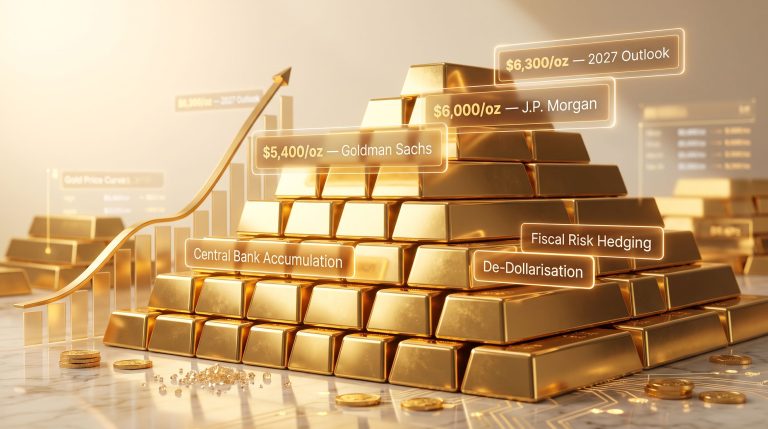
August 8, 2026
The Hidden Architecture of a Gold Sector Recovery Rally
Few forces in financial markets are as misunderstood as the gold sector recovery rally. Most observers mistake it for a simple price rebound, a reflexive bounce after a selloff. In reality, what unfolds during these periods is far more structurally complex: a convergence of monetary policy drift, sovereign accumulation behaviour, technical signal alignment, and shifting institutional risk appetite. Understanding how these forces interact is the difference between recognising an opportunity early and arriving after the move has already matured.
When big ASX news breaks, our subscribers know first
Why Gold Rallies Rarely Happen in Isolation
Gold prices do not recover in a vacuum. Every meaningful gold sector recovery rally is preceded by a confluence of conditions that, taken individually, might seem insufficient to drive sustained price appreciation. Combined, however, they create the conditions for a durable trend shift rather than a short-lived technical bounce.
Three structural forces are currently underpinning the present recovery:
- Persistent inflationary pressure: Core inflation across multiple major economies has continued to exceed central bank target thresholds despite aggressive tightening cycles. This sustained erosion of purchasing power reinforces gold's fundamental role as a store of value over time.
- Central bank reserve diversification: Central bank gold demand from sovereign institutions across Asia, the Middle East, and Eastern Europe has continued at pace, reducing their dependence on USD-denominated assets. This is not speculative demand. It is strategic allocation driven by geopolitical risk management.
- Policy uncertainty premium: Fiscal imbalances in developed economies and geopolitical fragmentation have elevated the perceived risk of holding conventional financial assets, increasing gold's risk-adjusted appeal among institutional allocators who treat it as a portfolio stabiliser rather than a speculative position.
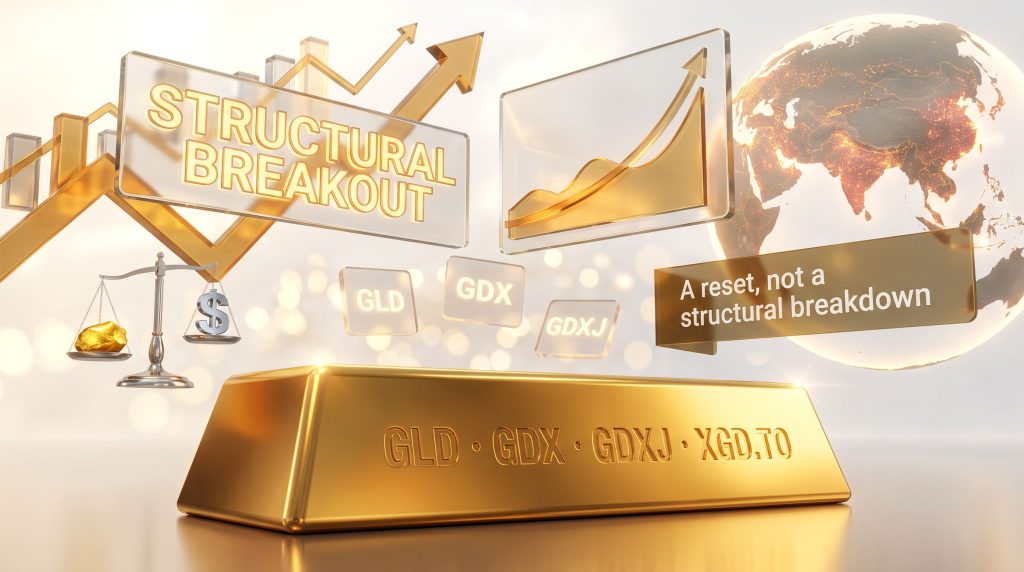
Analysts have characterised the preceding drawdown as a reset within a broader uptrend rather than a structural breakdown, pointing to inflation persistence, policy ambiguity, and sovereign demand as durable medium-term supports for the gold price.
The Mechanics of a Gold Sector Recovery Rally
Understanding how a gold sector recovery rally actually unfolds helps investors distinguish signal from noise. The sequence is recognisable across historical cycles:
- Price stabilisation – Gold spot prices find support after a sharp drawdown, frequently at technically significant levels that attract systematic buying interest.
- Oversold signal activation – Technical indicators across benchmark instruments, including GLD, GDX, GDXJ, and XGD.TO, reach extreme readings that trigger rules-based and algorithmic buying programmes.
- Institutional re-entry – Value-oriented funds begin rebuilding positions in gold equities that have been disproportionately sold relative to the metal itself.
- Miner outperformance – Gold stocks begin generating returns that exceed bullion's percentage gain, driven by operating leverage embedded in their cost structures.
- Momentum confirmation – Cycle indicators and trend-following models flip from bearish to bullish, expanding the pool of participating capital beyond early movers.
What makes the current episode notable is that all four of the major gold sector ETF benchmarks — specifically GLD, GDX, GDXJ, and XGD.TO — have registered simultaneous short-term buy signals. Technical analysts treat this kind of multi-instrument confluence as a meaningful confirmation of directional momentum rather than isolated noise in a single instrument.
Simultaneously, a proprietary cycle indicator used by technical analysts to identify market rhythm has shifted to an upward reading. Importantly, this type of timing model tracks when markets tend to move rather than relying solely on fundamental inputs. When the cycle indicator aligns with trend direction across gold, gold equities, and even the USD, it is considered a broadly constructive configuration for the sector.
Furthermore, gold-to-equity valuation signals have moved onto a buy signal, indicating that gold sector assets appear attractively valued relative to broader risk assets — a condition that historically precedes meaningful re-rating events.
Disclaimer: Cycle indicators and technical buy signals are probabilistic analytical tools, not guarantees of future price performance. Short-term whipsaws are possible, particularly in volatile macro environments. All investment decisions should be made within an appropriate risk management framework.
Why Gold Mining Stocks Outperform Bullion During a Recovery
The operating leverage dynamic is central to understanding why a gold sector recovery rally produces outsized returns in mining equities compared to holding the metal directly.
| Factor | Gold Bullion | Gold Mining Stocks |
|---|---|---|
| Price sensitivity | 1:1 with spot price | 2x to 4x amplified (typical range) |
| Revenue driver | Spot price only | Spot price multiplied by production volume |
| Fixed cost exposure | Not applicable | Labour, energy, capex regardless of price |
| Downside risk | Moderate | Higher during corrections |
| Upside potential in bull phases | Moderate | Significantly elevated |
Mining companies carry fixed operational costs — including labour, energy, and capital expenditure — regardless of where gold trades. Every dollar the gold price moves above a miner's all-in sustaining cost (AISC) drops almost entirely to earnings. This cost structure creates powerful leverage to the upside, amplifying the percentage return relative to bullion itself.
The reverse is equally true. During corrections, miners fall harder than the metal because their cost structures do not compress proportionally with declining revenue. This is precisely why gold miners outperform during recovery phases — and why speculation in gold equities can contract to bear market valuation levels even within an underlying bullish trend, creating the kind of asymmetric entry conditions that contrarian investors actively seek.
A condition analysts describe as speculation at bear market value occurs when positioning in gold equities has contracted to levels typical of structural bear markets, even when the broader price trend remains upward. Historically, these conditions have tended to precede sharp recoveries in the sector as the valuation gap between sentiment and fundamentals eventually closes.
Is the Current Gold Sector Recovery Rally Sustainable?
The Bull Case
Several converging factors support the argument that the current recovery has structural rather than purely technical foundations:
- The broader trend for both gold and gold equities remains upward, with the preceding drawdown displaying characteristics more consistent with a cyclical reset than a trend reversal.
- ETF flows into gold-backed instruments turned net positive during July, with investors actively buying into weakness — a behavioural pattern associated with conviction rather than speculative momentum chasing.
- Asian gold safe-haven demand has surged, with multiple analysts suggesting this reflects a structural shift in wealth allocation rather than short-cycle speculative positioning. If accurate, this represents a demand floor that conventional price models may underestimate.
- The gold-to-equity ratio has moved onto a buy signal, indicating that gold sector assets are attractively valued relative to broader risk assets.
The Bear Case
Not all analysts share an optimistic near-term view. Several credible risks could truncate the rally:
- USD strength: Gold is priced in US dollars, meaning a rising dollar makes gold more expensive for foreign buyers, compressing demand and capping upside. Notably, trend analysis currently shows an upward trajectory for the USD alongside gold — a configuration that warrants careful monitoring.
- Elevated real interest rates: Higher real rates increase the opportunity cost of holding a non-yielding asset like gold. If the Federal Reserve maintains its hawkish posture longer than markets anticipate, this could limit further price appreciation.
- Technical vulnerability: Gold remains below its prior cycle peaks, leaving the sector exposed if momentum stalls at resistance levels before establishing new highs.
- Short-lived bounces: Some market commentary has flagged that recent gains could prove transient if macroeconomic conditions — particularly rates and dollar dynamics — fail to shift in gold's favour.
Scenario Comparison
| Scenario | Key Trigger | Likely Sector Outcome |
|---|---|---|
| Bullish continuation | USD weakens, Fed pauses or pivots | Gold tests new highs; miners outperform significantly |
| Consolidation | Rates stay elevated, dollar stable | Gold trades sideways; miners lag bullion |
| Rally reversal | USD surges, hawkish Fed surprise | Correction resumes; miners surrender gains quickly |
| Structural breakout | Central bank buying accelerates further | Multi-year bull market extension across the sector |
The USD Paradox: When Gold and the Dollar Rise Together
The conventional understanding of the gold-dollar relationship is that the two assets move inversely. A stronger dollar makes gold more expensive in other currencies, suppressing demand, while a weaker dollar does the opposite. This relationship holds across most market cycles, but it is not absolute.
The current environment presents an interesting anomaly: trend analysis indicates an upward trajectory for the USD at the same time that gold and gold equities are trending higher. When both assets trend upward simultaneously, it typically signals that gold demand is being driven by factors that operate independently of currency dynamics — most commonly geopolitical risk accumulation, systemic financial uncertainty, or central bank buying.
Central bank gold purchases are particularly important to understand in this context. Sovereign institutions do not accumulate gold based on short-term price sensitivity or currency relationships. They purchase gold as a strategic reserve asset — a long-duration store of value that carries no counterparty risk and cannot be frozen or sanctioned by a foreign government. Consequently, this structural demand operates as a price floor that can sustain gold even when USD strength would traditionally be expected to suppress it. According to recent analysis from VanEck, gold's rally has remained resilient above US$4,000, underscoring the durability of these structural demand forces.
The next major ASX story will hit our subscribers first
How Different Investor Types Should Read the Current Signals
| Participant Type | Recommended Posture | Rationale |
|---|---|---|
| Short-term traders | Enter near cycle bottoms, exit at cycle tops | Capture short-term momentum efficiently |
| Long-term investors | Remain in cash or hedged until trend fully confirms | Reduce whipsaw risk during volatile cycle transitions |
| Institutional allocators | Monitor ETF flow data and ratio signals closely | Use macro confirmation before deploying large positions |
The distinction between trader and investor positioning is critical and frequently overlooked. A cycle indicator shifting upward is most actionable for traders seeking to capitalise on short-duration momentum. For longer-term investors, the more relevant signal is sustained trend confirmation across multiple timeframes, supported by fundamental drivers. In addition, the relationship between gold price and mining equities remains a key variable that institutional allocators should track when assessing sector-wide positioning.
Key Takeaways for the Gold Sector Recovery Rally
- Simultaneous buy signals across GLD, GDX, GDXJ, and XGD.TO, combined with an upward cycle indicator reading, represent a technically meaningful confluence rather than isolated noise.
- The structural drivers underpinning the rally — including central bank accumulation, persistent inflation, and geopolitical risk premiums — remain intact and support a medium-term bullish thesis.
- Gold mining stocks are positioned to outperform bullion during the recovery phase due to operating leverage, but carry elevated risk if the rally loses momentum.
- The simultaneous uptrend in both gold and the USD is an unusual configuration that suggests demand is being driven by factors beyond simple currency hedging.
- Whether the current move represents a cyclical reset within a larger bull market or a temporary technical bounce remains the central analytical question. Current evidence leans toward the former, but confirmation is ongoing.
This article is for informational and educational purposes only and does not constitute financial advice. All references to market signals, cycle indicators, and price trends involve inherent uncertainty. Past performance of any indicator or market instrument is not indicative of future results. Readers should conduct independent research and consult a qualified financial adviser before making any investment decisions.
Ready to Capitalise on the Next Major Gold Discovery Before the Market Moves?
Discovery Alert's proprietary Discovery IQ model delivers real-time alerts on significant ASX mineral discoveries, instantly transforming complex data across 30-plus commodities into clear, actionable insights for both traders and long-term investors — explore historic discoveries that have generated exceptional returns to understand the full opportunity, and begin your 14-day free trial at Discovery Alert to position yourself ahead of the broader market.