
August 9, 2026
When the Jobs Report Becomes a Starting Gun for Precious Metals
There is a peculiar irony embedded in modern monetary economics: the worse the news about employment, the better the news tends to be for gold and silver. This is not because precious metals investors celebrate economic hardship. It is because labor market weakness sets off a chain reaction through the financial system that systematically dismantles the primary argument against holding non-yielding assets. Understanding this mechanism is the foundation for understanding why gold and silver surge on weak jobs report releases with such consistency and force.
This pattern played out with textbook precision during the week of August 9, 2026, delivering one of the most dramatic precious metals rallies in recent memory. However, the story behind the numbers is richer and more instructive than any single price chart can convey.
When big ASX news breaks, our subscribers know first
How a Single Labor Report Reshapes the Entire Rate Outlook
The relationship between employment data and precious metals prices is not linear. It operates through a sequenced transmission mechanism, where each step amplifies the previous one. When investors understand this chain reaction, the speed and magnitude of price moves becomes far less surprising.
The sequence unfolds as follows:
- Weak payroll data is released, immediately contradicting the prevailing economic narrative.
- Bond markets reprice rate expectations within minutes, as traders reassess the probability of further Federal Reserve tightening.
- Treasury yields fall, reducing the return available on competing risk-free assets.
- The U.S. dollar weakens against major global currencies as rate differentials compress.
- Gold and silver become relatively cheaper for international buyers priced in non-dollar currencies, expanding the global buyer base.
- Futures and spot markets reprice upward in real time as algorithmic and discretionary buyers respond simultaneously.
The critical insight here is that precious metals do not respond to economic conditions directly. They respond to expectations about the future path of monetary policy. A single data point can reset those expectations within minutes, collapsing weeks or months of accumulated market positioning in a single session.
The Opportunity Cost Framework: Gold's Gravitational Force
Gold's most fundamental characteristic as an investment is also its most misunderstood liability: it produces no income. No dividend, no coupon, no yield. In a high-interest-rate environment, this makes gold compete unfavorably against bonds and cash. Furthermore, when interest rates fall, or even when they are simply expected to fall, this liability shrinks and gold's relative attractiveness expands materially.
Real yields, meaning Treasury yields adjusted for inflation expectations, function as the gravitational force acting on gold prices. When real yields decline, gold rises. When real yields rise, gold faces headwinds. This inverse relationship, explored in depth when examining gold bonds dynamics across economic cycles, has held with remarkable consistency and is the lens through which sophisticated investors interpret every major macro data release.
Silver shares this dynamic but layers an additional variable on top: industrial demand. Roughly half of annual silver consumption comes from industrial applications, including solar panels, electronics, and medical devices. This dual identity as both a monetary metal and an industrial commodity creates a higher-beta response to macro shifts, which explains why silver consistently outpaces gold during confirmed precious metals bull phases.
The July Jobs Report: What the Numbers Actually Showed
The July 2026 nonfarm payrolls report represented one of the most significant labor market disappointments in the current economic cycle. Markets had positioned for modest but positive job creation. What arrived was something considerably more alarming.
| Metric | Expectation | Actual Result | Market Impact |
|---|---|---|---|
| July Nonfarm Payrolls | +80,000 to +83,000 | -23,000 | Treasury yields fell sharply |
| Prior Month Revisions | Minimal adjustment | Revised materially lower | Reinforced slowdown narrative |
| Dollar Index Response | Stable | Weakened | Boosted global gold demand |
| Fed Rate Hike Probability | Elevated | Repriced significantly lower | Reduced opportunity cost of gold |
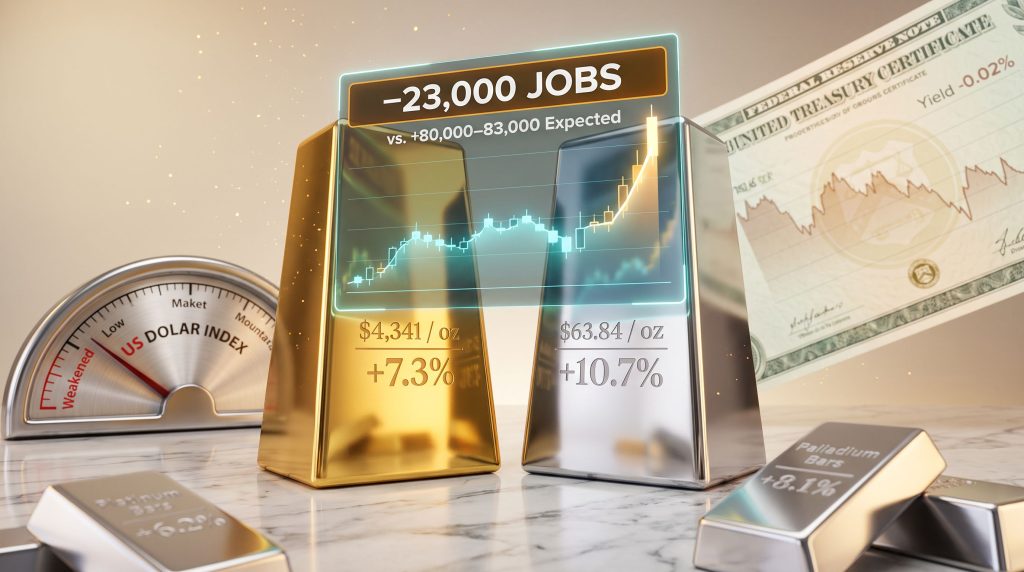
Indeed, gold and silver prices surged as the US economy shed 23,000 jobs, confirming the scale of the market reaction. The compounding effect of downward revisions to prior months amplified the report's negative signal considerably. A single month of job losses could be dismissed as statistical noise. Simultaneous revisions to previous months transformed the data into a pattern, and markets priced that pattern instantly.
Why the Fed's "Higher for Longer" Consensus Began to Fracture
For approximately three years, the Federal Reserve justified maintaining restrictive monetary conditions by pointing to a resilient labor market as evidence the economy could absorb elevated rates. The July report introduced the first credible structural crack in that foundational argument.
What made the timing particularly significant was that it arrived against a backdrop of already-emerging internal Fed dissent. The preceding week's policy meeting had produced an unusually public display of disagreement among Fed policymakers, signaling that the internal consensus around continued tightening was less unified than official communications had suggested. The combination of institutional fracture and deteriorating labor data created a compounding signal that markets interpreted as a potential inflection point in the rate cycle.
The week's most consequential development was not any single price move. It was the growing market conviction that the economic pillar supporting the Fed's restrictive policy stance was beginning to erode beneath its own weight.
Gold's Price Performance: Anatomy of a Historic Weekly Rally
Gold's price action during the week demonstrated how multi-day accumulation can precede a single-session acceleration event. The rally was not manufactured by Friday's jobs report alone. It was constructed gradually through a sequence of supportive developments:
- Treasury yields drifted lower through the early part of the week, reducing the opportunity cost headwind incrementally.
- The U.S. dollar softened ahead of the payrolls release as traders anticipated downside risk in the data.
- Crude oil prices eased as Middle Eastern geopolitical tensions showed signs of de-escalation.
- Lower energy prices reduced near-term inflation pressure, which further dampened rate hike expectations.
- Each of these factors independently supported gold; their simultaneous convergence created a compounding tailwind.
By the end of the week, spot gold had climbed to approximately $4,341 per ounce, with gold futures surging above $4,400 in some delivery months. The weekly advance of approximately $300 per ounce represented a 7.3% gain, the strongest weekly performance for gold since January. The metal reached a seven-week high, clearing a zone of technical resistance that had contained previous rallies. This is consistent with broader patterns of market volatility and gold's record performance observed throughout recent cycles.
Silver's Outperformance: The Amplification Effect in Action
Silver's behaviour during the week illustrated one of the most reliable and least-discussed patterns in precious metals markets: its tendency to lag during uncertainty, then dramatically overshoot once directional momentum becomes established.
Silver recorded a weekly gain of 10.7%, advancing more than $6 per ounce to trade near $63.84 per ounce. This performance outpaced gold by more than three percentage points on a relative basis, consistent with silver's historical behaviour during confirmed precious metals bull phases. Furthermore, the gold-silver ratio analysis highlights how these divergences in relative performance carry meaningful signals for forward-looking investors.
| Characteristic | Gold | Silver |
|---|---|---|
| Weekly Gain (%) | +7.3% | +10.7% |
| Price Level | ~$4,341/oz | ~$63.84/oz |
| Market Depth | Deep, institutional | Thinner, more reactive |
| Industrial Demand Component | Minimal | Significant (~50% of demand) |
| Behaviour During Uncertainty | Leads | Lags, then accelerates |
The structural reason for silver's amplified response lies in the intersection of its monetary and industrial identities. When macro conditions shift toward lower rates and a weaker dollar, silver benefits from the same monetary tailwinds as gold. However, its thinner market depth means that equivalent capital flows produce larger price moves. Institutional money rotating into the precious metals complex encounters less liquidity in silver, which translates directly into outsized percentage gains.
Silver's behaviour pattern carries a critical risk caveat: the same asymmetry that produces outperformance in bull phases creates deeper drawdowns during reversals. Silver is a higher-beta expression of the monetary metals thesis, not simply a cheaper version of gold.
Platinum and Palladium: The Platinum Group Metals Enter the Conversation
While gold and silver dominated headlines, the platinum group metals participated meaningfully in the week's rally. In addition, their performance warrants separate analysis given the structural differences in their underlying demand dynamics.
| Metal | Weekly Gain ($) | Weekly Gain (%) | Price Level |
|---|---|---|---|
| Gold | ~+$300 | +7.3% | ~$4,341/oz |
| Silver | ~+$6 | +10.7% | ~$63.84/oz |
| Platinum | ~+$100 | +6.2% | ~$1,753/oz |
| Palladium | ~+$100 | +8.1% | ~$1,389/oz |
Platinum's Structural Case as a Potential Next-Stage Mover
Platinum's 6.2% weekly gain, while meaningful, lagged gold and silver on a percentage basis. This relative underperformance, however, may be masking a compelling longer-term structural thesis that is less discussed in mainstream precious metals commentary. For a deeper examination of these dynamics, platinum and palladium market analysis provides valuable context on the investment opportunities these metals present.
Several supply and demand dynamics differentiate platinum from other precious metals:
- Approximately 70-80% of global platinum supply originates from South Africa, creating a concentrated geopolitical and operational supply risk that has no equivalent in gold or silver markets.
- The platinum-to-gold ratio remains historically compressed, a condition that has historically preceded periods of platinum outperformance when monetary conditions ease.
- Growing adoption in hydrogen fuel cell technology introduces a secular industrial demand driver that gold simply does not possess, positioning platinum at the intersection of monetary metals and the clean energy transition.
- South African mining operations face persistent structural challenges including ageing infrastructure, energy supply constraints, and labour relations issues, all of which create ongoing production uncertainty.
Palladium's 8.1% weekly gain outpaced platinum in percentage terms, but palladium faces a fundamentally different long-term demand trajectory. Its primary industrial application, automotive catalytic converters designed for internal combustion engines, is structurally challenged by the ongoing global transition toward battery electric vehicles. Palladium may continue to benefit from near-term monetary tailwinds, but its long-term demand curve is under pressure in a way that platinum's is not.
The next major ASX story will hit our subscribers first
The Fed Policy Pivot: Mapping the Conditions Required for a Rate Reversal
One jobs report, however dramatic, does not constitute a trend in the Federal Reserve's analytical framework. The Fed has repeatedly emphasised its data-dependency approach, and a single month of negative payrolls, while notable, is unlikely to trigger an immediate policy reversal. The following conditions would need to materialise before a formal pivot becomes probable:
- Multiple consecutive months of below-consensus payroll growth confirming a genuine labour market deterioration.
- Core inflation maintaining its trajectory toward the Fed's 2% target without a rebound.
- The unemployment rate rising to a level that meaningfully activates the Fed's employment side of its dual mandate.
- Financial conditions demonstrating sufficient tightening to suppress demand without requiring additional Fed action.
Three Scenarios and Their Precious Metals Implications
Scenario 1: Soft Landing with Gradual Rate Cuts
The Fed engineers a controlled economic deceleration, cutting rates slowly over 12 to 18 months. Gold consolidates near current highs before resuming a measured uptrend. Silver follows with periodic outperformance during momentum phases.
Scenario 2: Hard Landing with Accelerated Policy Reversal
Labour market deterioration accelerates beyond the July data point, forcing a faster-than-anticipated rate cutting cycle. Real yields collapse, and gold and silver surge on weak jobs report signals are validated as a genuine inflection. The primary headwind for precious metals is consequently removed simultaneously.
Scenario 3: Stagflationary Persistence
Inflation proves stickier while growth continues to slow, placing the Fed in a genuine policy dilemma. Gold performs strongly as a hedge against both inflation and policy error. Silver's industrial demand component may face pressure in this scenario, potentially creating a divergence in performance between the two metals.
Frequently Asked Questions
Why do gold and silver prices rise when jobs data is weak?
Weak employment data reduces the likelihood of further Federal Reserve rate increases. Lower rate expectations push Treasury yields down and soften the U.S. dollar, both of which reduce the opportunity cost of holding non-yielding assets like gold and silver and make them more attractive to international buyers.
What is the relationship between Treasury yields and gold prices?
Treasury yields represent the return available on risk-free government bonds. When yields fall, the relative disadvantage of holding gold, which pays no interest, diminishes. This inverse relationship is one of the most consistent and well-documented dynamics in financial markets.
Why does silver outperform gold during precious metals rallies?
Silver's smaller and less liquid market means that equivalent capital inflows produce larger price moves. Its dual monetary and industrial identity also means it benefits from both the rate-driven monetary tailwind and any improvement in industrial demand sentiment simultaneously.
What would cause this rally in gold and silver to reverse?
A reversal would most likely be triggered by stronger-than-expected inflation readings, a rebound in labour market conditions, or renewed hawkish signals from Federal Reserve officials, any of which would restore the opportunity cost headwind that is gold's primary structural challenge.
Is platinum positioned to be the next precious metal to surge?
Platinum's compressed ratio to gold, concentrated supply geography, and emerging role in hydrogen fuel cell technology create a differentiated structural thesis. However, platinum's lower liquidity and different demand drivers mean its price behaviour can diverge significantly from gold and silver, and investors should evaluate it as a distinct asset within the broader precious metals complex.
Disclaimer: This article is for informational and educational purposes only and does not constitute financial or investment advice. All price levels, economic data, and scenario analyses referenced are based on publicly available information as of the date of publication. Precious metals markets involve significant price volatility and investment risk. Past performance is not indicative of future results. Readers should conduct their own due diligence and consult a qualified financial adviser before making investment decisions.
Want to Stay Ahead of the Next Major Precious Metals Discovery?
Discovery Alert's proprietary Discovery IQ model scans ASX announcements in real time, instantly identifying significant mineral discoveries across gold, silver, platinum, and beyond — turning complex data into actionable investment insights before the broader market reacts. Explore how historic mineral discoveries have generated substantial returns on Discovery Alert's dedicated discoveries page, and begin your 14-day free trial today to position yourself ahead of the next major move.