August 5, 2026
The Macro Architecture Behind Gold's Explosive Move Above $4,100
Few financial relationships are as structurally reliable as the inverse connection between the U.S. dollar and gold. When the greenback loses ground, gold denominated in dollars becomes cheaper for international buyers, demand rises, and the price climbs. Yet this mechanism alone rarely explains the full picture. In August 2026, gold rises on softer dollar and lower oil prices through a simultaneous convergence of three distinct macro forces that compound each other in ways that accelerate price movement far beyond what any single catalyst would produce.
Understanding why gold rises on softer dollar and lower oil prices requires tracing a chain of economic transmission mechanisms that most retail investors overlook entirely. Furthermore, the gold market surge seen in recent months provides important context for interpreting the current move.
When big ASX news breaks, our subscribers know first
Three Converging Macro Forces Driving Gold Above $4,100
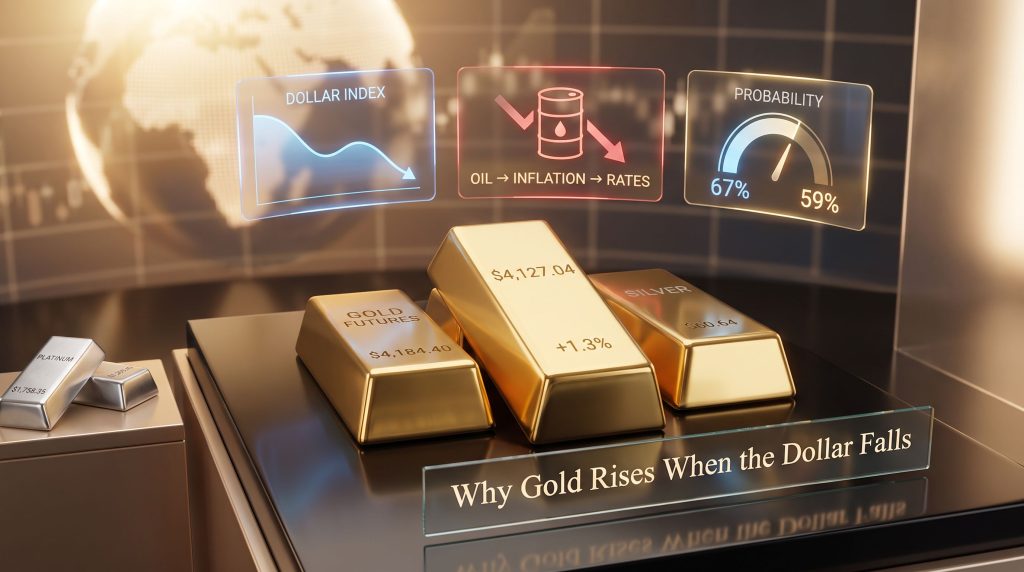
Spot gold advanced 1.3% to $4,127.04 per ounce during the August 5, 2026 session, while U.S. gold futures climbed 0.8% to $4,184.40. Critically, this was not a single-session anomaly. The move marked a third consecutive session of gains, a pattern that signals sustained directional momentum rather than opportunistic short-covering.
Three macro forces arrived simultaneously:
- Dollar softness reducing the effective cost of gold for non-U.S. buyers
- Falling oil prices creating a disinflationary signal that reduces interest rate pressure
- Shifting Federal Reserve rate expectations lowering the opportunity cost of holding non-yielding assets
When multiple macro headwinds converge at once, gold's response is rarely linear. Each factor amplifies the others, compressing the yield advantage of competing assets while expanding gold's relative appeal across international markets simultaneously.
What makes this moment analytically significant is not just that gold is moving higher, but why it is moving higher and whether those drivers have structural staying power. In addition, central bank gold demand has continued to reinforce the broader bullish narrative across global markets.
How Dollar Weakness Mechanically Translates Into Higher Gold Prices
The Currency Pricing Mechanism Most Investors Underestimate
Gold's global benchmark price is expressed in U.S. dollars. This creates a structural sensitivity to the dollar's relative value that operates independently of physical supply and demand fundamentals.
| Dollar Condition | Effect on International Buyers | Typical Price Direction |
|---|---|---|
| Dollar strengthens | Foreign currency buys fewer ounces | Downward pressure on gold |
| Dollar weakens | Foreign currency buys more ounces | Upward pressure on gold |
| Dollar stable | Macro fundamentals dominate | Direction mixed |
When the dollar softens, three things happen almost simultaneously:
- International buyers in Europe, Asia, and the Middle East gain effective purchasing power over gold without any change in their local currency position
- Demand increases from non-dollar markets, bidding up the dollar price of gold
- Speculative traders rotate out of dollar-denominated assets into commodity alternatives, adding momentum to the directional move
In this session, the dollar remained subdued due to a combination of geopolitical uncertainty tied to the ongoing U.S.-Iran conflict and repriced Federal Reserve expectations ahead of major employment data releases. Neither of these factors is temporary in nature, which helps explain why gold's gains have been sustained across multiple sessions rather than fading intraday. According to Reuters, easing inflation fears driven by lower oil have been a consistent supporting factor in gold's recent trajectory.
Oil Prices and Their Hidden Role in Gold's Valuation
Following the Transmission Chain From Crude to Gold
Oil's connection to gold is indirect but highly consistent. The mechanism operates through inflation expectations, which then flow into interest rate pricing, which ultimately determines how attractive gold is relative to yield-bearing alternatives.
The transmission sequence works as follows:
- Oil prices decline sharply across two or more consecutive sessions
- Energy costs fall, reducing headline inflation pressure across consumer and producer price indices
- Inflation expectations ease, diminishing the urgency for central banks to tighten monetary policy
- Rate-hike probability drops, reducing the yield premium available from interest-bearing assets
- The opportunity cost of holding gold falls, making the metal more competitive against bonds and savings instruments
- Gold prices rise as capital rebalances toward the non-yielding safe-haven asset
After significant declines over two sessions, oil steadied on August 5. Progress reported by Qatar in mediating U.S.-Iran tensions had already introduced a geopolitical de-escalation narrative into oil markets. However, Tehran's denial of active negotiations kept uncertainty elevated, which itself contributed to gold's safe-haven bid remaining well-supported.
A senior market analyst at OANDA noted that the relationship between the gold and oil relationship remained intact given oil's substantial influence on global inflation dynamics, and that a clear pathway toward geopolitical de-escalation could drive gold prices even higher.
The gold-oil relationship is not a simple price correlation. It is a multi-channel transmission mechanism that runs through inflation expectations, central bank policy, dollar demand, and geopolitical risk premiums simultaneously.
Federal Reserve Rate Expectations: The Opportunity Cost Calculus
Why Declining Rate-Hike Probability Is Directly Bullish for Gold
Gold generates no yield. It pays no dividend, no coupon, and no interest. In an environment where interest rates are rising, gold must compete against assets that offer increasingly attractive returns, which places structural pressure on the metal's relative valuation.
The current Fed pricing environment has shifted meaningfully:
| Metric | Previous Session | Current Session | Net Change |
|---|---|---|---|
| September rate-hike probability | 67% | 59% | -8 percentage points |
| Target meeting date | — | September 15-16, 2026 | — |
| Fed policy stance | Hawkish | Cautiously data-dependent | Softening |
Philadelphia Federal Reserve Bank President Anna Paulson indicated she was keeping an open mind on the monetary policy path while acknowledging the possibility that conditions could warrant higher rates. The language was cautiously hawkish but stopped well short of pre-committing to a September increase.
The 8-percentage-point decline in September rate-hike probability over a single session meaningfully reduced the theoretical yield advantage of holding dollar-denominated interest-bearing assets, which directly benefits gold. Every incremental reduction in rate-hike expectations functions as a micro-catalyst for gold, lowering the cost of holding a zero-yield position.
Traders are now focused on two near-term data releases:
- The ADP private employment report, released later in the same session
- The July Non-Farm Payrolls report, scheduled for release on Friday
A weaker-than-expected jobs print on either release would likely push rate-hike probability lower still, extending the current rally in gold.
Is Gold's Rally Sustainable or Structurally Range-Bound?
Reading the Signals Carefully
Analysts at TD Securities have noted that gold is expected to remain range-bound near current levels, suggesting the current rally is being driven by macro tailwinds rather than a structural demand shift. This is an important distinction for investors to understand. Consequently, monitoring the gold safe-haven dynamics at play becomes essential for assessing whether these gains will hold.
Conditions that could extend the rally:
- A weaker-than-expected July payrolls figure reducing rate-hike probability further
- Continued dollar weakness driven by global risk-off positioning
- Further oil price declines amplifying the disinflationary narrative
Conditions that could reverse the move:
- A strong jobs report reigniting Fed tightening expectations
- An oil price rebound driven by OPEC supply management or geopolitical escalation
- Dollar recovery as risk appetite returns and safe-haven flows rotate back into U.S. assets
Disclaimer: Forecasts and price projections for gold and related assets involve inherent uncertainty and should not be interpreted as financial advice. Past performance of commodity prices is not indicative of future results.
The next major ASX story will hit our subscribers first
Precious Metals Broad Market Performance: Silver Leading the Move
How the Wider Complex Is Responding
Gold's gains were not isolated. The entire precious metals complex advanced in the same session, with silver notably outperforming:
| Metal | Price | Session Change | Notable Context |
|---|---|---|---|
| Spot Gold | $4,127.04/oz | +1.3% | Third consecutive session gain |
| Gold Futures | $4,184.40 | +0.8% | Sustained directional follow-through |
| Spot Silver | $60.64/oz | +1.9% | Outperforming gold on the session |
| Platinum | $1,758.35/oz | +1.4% | Highest level since mid-June |
| Palladium | $1,365.62/oz | +0.9% | Second consecutive session gain |
Silver's outperformance relative to gold is consistent with how the metal behaves during dollar-driven precious metals rallies. Unlike gold, silver carries dual demand characteristics as both a monetary metal and an industrial commodity. When dollar weakness is the primary catalyst, silver benefits across both demand categories simultaneously, creating a higher-beta response compared to gold. The gold-silver ratio is therefore worth monitoring closely as silver's outperformance narrows the historical spread.
Platinum reaching its highest level since mid-June signals that the macro tailwind is broad enough to lift metals beyond the traditional gold-silver safe-haven pair, suggesting genuine macro momentum rather than narrow speculative positioning. As noted by TradingView, the broader precious metals complex climbing in unison is a strong indicator of macro-driven demand rather than isolated short-term speculation.
The Gold-Oil-Dollar Triangle: A Framework for Investors
Three Channels That Explain Cross-Commodity Price Dynamics
Sophisticated investors track the gold-oil-dollar relationship across three distinct channels:
Channel 1: Inflation Expectations
Rising oil drives inflation expectations higher, which forces central banks toward tighter monetary policy. Tighter policy increases the yield premium on competing assets, raising the opportunity cost of holding gold. The reverse sequence applies when oil falls.
Channel 2: Dollar Demand from Commodity Importers
Because oil is globally priced in U.S. dollars, falling oil prices reduce the volume of dollar purchases required by commodity-importing nations. This softens dollar demand at the margin, contributing to dollar weakness, which then amplifies gold's attractiveness for international buyers.
Channel 3: Geopolitical Risk Premium
Oil price spikes often coincide with geopolitical instability in major production regions. During these episodes, gold simultaneously benefits from safe-haven demand. When tensions ease and oil retreats, gold may temporarily consolidate as the risk premium deflates, before the underlying macro drivers reassert directional control.
Investors who monitor oil price trends alongside dollar movements and central bank rate expectations develop a more complete picture of gold's near-term directional risk than those tracking gold in isolation.
Frequently Asked Questions: Gold, Oil, and the Dollar
Why does gold tend to rise when the U.S. dollar weakens?
Gold's global benchmark price is denominated in U.S. dollars. A weaker dollar reduces the effective price of gold for buyers using other currencies, increasing international demand and driving the dollar price of gold higher.
Does lower oil always mean higher gold?
Not automatically. Falling oil reduces inflation expectations, which lowers the urgency for interest rate increases. Lower rate expectations reduce the opportunity cost of holding gold by shrinking the yield advantage of competing assets. The chain is indirect but historically reliable. This is one reason why gold rises on softer dollar and lower oil prices tends to emerge as a recurring theme during periods of macro uncertainty.
What is the opportunity cost of holding gold?
It represents the yield or interest income an investor forgoes by holding gold rather than an interest-bearing asset such as a government bond. When rates rise, this cost increases, making gold comparatively less attractive relative to fixed-income alternatives.
Why does silver sometimes outperform gold?
Silver has both monetary and industrial demand drivers. When macro conditions favour precious metals broadly, silver's dual demand profile amplifies its price response, particularly during dollar weakness events where international buyers increase exposure across the full precious metals complex.
How do U.S. jobs reports influence gold prices?
Employment data directly shapes Federal Reserve rate decisions. A strong payrolls report signals economic strength, increases the probability of rate hikes, and raises the opportunity cost of holding gold. A weak report reduces rate-hike expectations and supports higher gold prices. Understanding how gold rises on softer dollar and lower oil prices helps investors contextualise each data release within the broader macro framework driving precious metals.
Want to Know When the Next Major ASX Gold Discovery Hits the Market?
Discovery Alert's proprietary Discovery IQ model scans ASX announcements in real time, instantly identifying significant mineral discoveries across gold and the broader precious metals complex — translating complex data into actionable opportunities before the broader market reacts. Start your 14-day free trial today and explore historic discoveries that have generated exceptional returns to understand just how transformative early positioning can be.