
August 5, 2026
The Hidden Economics of Mill Bottlenecks in Multi-Mine Gold Districts
In gold mining, the processing plant is often the least glamorous asset on site, yet it quietly dictates the ceiling on every ounce the operation can ever produce. Underground mines can blast, muck, and haul with increasing efficiency, but if the mill cannot absorb the ore, that effort translates into nothing more than a growing stockpile. This inverse relationship between mine output acceleration and fixed processing capacity is one of the most underappreciated value constraints in the sector, and it is precisely the dynamic now playing out across Westgold Resources' (ASX: WGX) Murchison operations in Western Australia.
The Westgold Cue Hub expansion is not a reactive measure born of operational stress. It is the logical endpoint of a deliberate multi-year strategy to scale underground ore production first, then invest in processing infrastructure once the ore supply justification is unambiguous. Understanding why that sequencing matters, and what it means for production economics from FY28 onwards, requires a closer look at both the engineering mechanics and the geological drivers behind this capital commitment.
When big ASX news breaks, our subscribers know first
The Cue Hub as a Central Processing Node in the Murchison District
The Cue processing hub functions as the ore absorption centre for a cluster of underground and open pit mines spread across Westgold's Murchison district portfolio. Its current installed throughput capacity sits at 1.4 million tonnes per annum (Mtpa), a figure that has served as the operational ceiling for everything the surrounding mines can deliver to the mill.
What makes centralised processing hubs like Cue particularly attractive in multi-mine gold districts is the economics of shared infrastructure. Rather than constructing standalone processing facilities for each deposit, a single hub draws ore from multiple sources, spreading fixed costs across a larger tonne base and driving down the cost per ounce processed. This model is especially powerful when the surrounding mine portfolio is growing, because incremental ore volumes from new or expanding operations can be absorbed without proportional capital expenditure on new plant.
Current Ore Sources Feeding the Cue Hub
| Ore Source | Type | Status |
|---|---|---|
| Big Bell | Underground (Sub-level cave + LHOS) | Primary feed source |
| Great Fingall | Underground | Active and growing output |
| Fender | Underground | Operating contributor |
| Cue Open Pits | Open pit | Recently commenced |
| Meekatharra Open Pits | Open pit | Recently commenced |
The diversity of feed sources is itself a risk management feature. When any single mine experiences production variability, which is a normal characteristic of underground operations, the hub can draw more heavily on other ore streams to maintain throughput. This blended feed strategy also has metallurgical implications: combining ores of varying hardness and grade from different sources can stabilise mill performance and reduce variability in gold recovery rates.
What the Cue Expansion Plan Actually Changes at the Circuit Level
The Cue Expansion Plan (CXP) is classified internally as a capital-light infrastructure upgrade, a term that carries specific meaning in mining capital allocation frameworks. It signals that the primary investment is being made into an existing, operational plant rather than into new civil works, tailings infrastructure, or reagent systems from scratch. The financial risk profile of capital-light expansions is therefore materially lower than greenfield construction, which typically carries timeline overruns, cost escalation exposure, and commissioning risk on newly built systems.
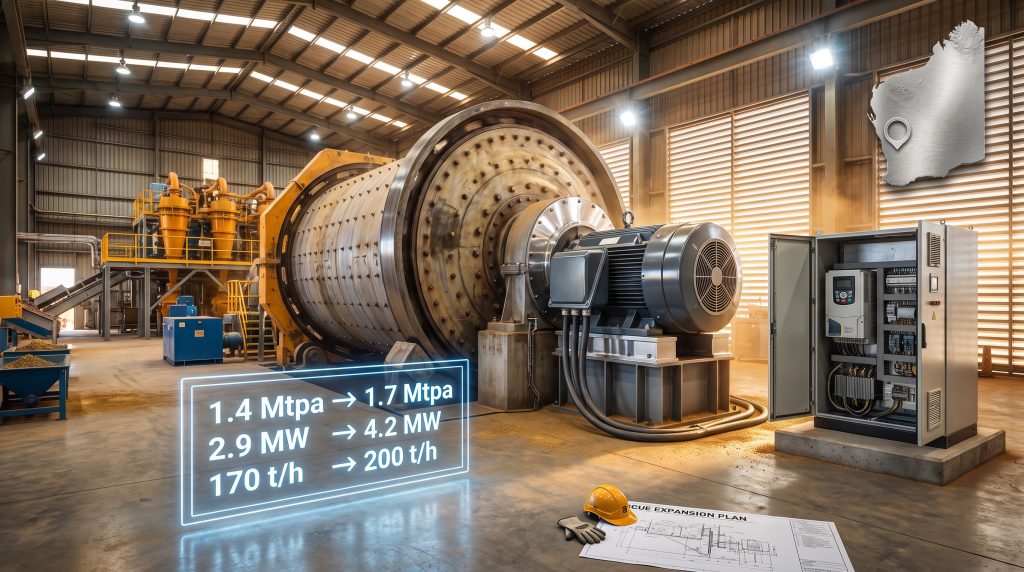
The core mechanical change involves replacing the existing 2.9 megawatt (MW) mill motor with a 4.2 MW liquid-cooled unit, paired with a variable speed drive (VSD). Associated upgrades to pumping systems and broader circuit support infrastructure complete the scope. Furthermore, the project's engineering approach reflects a considered assessment of long-term ore supply, not unlike the analysis underpinning a definitive feasibility study for a major capital decision.
Why Variable Speed Drives Matter Beyond Raw Power
The addition of a variable speed drive is technically significant in ways that go beyond the headline power increase. In conventional fixed-speed mill configurations, the rotational speed of the grinding mill is constant regardless of the hardness or particle size of the ore being processed. This creates inefficiencies when ore hardness varies across different feed sources, which is almost always the case in multi-mine hub operations like Cue.
A VSD allows mill operators to adjust rotational speed in real time to match the characteristics of the current ore blend. Harder ores benefit from slower, more aggressive grinding action, while softer ores can be processed faster without sacrificing grind size targets. The practical outcomes include:
- Improved energy efficiency per tonne processed
- Reduced mechanical wear on grinding media and mill liners
- More consistent particle size distribution in the mill discharge
- Greater operational flexibility when switching between ore sources with different hardness profiles
These are not marginal benefits. In a hub processing 1.7 Mtpa at full capacity, small improvements in energy efficiency and liner wear rates translate into meaningful reductions in operating cost per tonne across the full year.
The Core Numbers: Before and After the CXP
| Metric | Pre-CXP (Current) | Post-CXP (FY28+) | Change |
|---|---|---|---|
| Annual throughput capacity | 1.4 Mtpa | 1.7 Mtpa | +21% |
| Mill motor power | 2.9 MW | 4.2 MW | +44.8% |
| Nominal hourly milling rate | 170 t/h | 200 t/h | +17.6% |
| Estimated production uplift | Baseline | +~15,000 oz/year | Incremental |
The asymmetry between the 44.8% power increase and the 21% throughput gain is worth noting. Mill throughput does not scale linearly with installed power because grinding efficiency is also a function of ore hardness, feed size distribution, and circuit configuration. The power headroom built into the 4.2 MW motor provides operational flexibility to handle harder ore blends without throttling back throughput, protecting the 200 t/h target even when feed conditions are less favourable.
Big Bell's Geological Transition: The Engine Behind the CXP's Ore Supply Logic
No analysis of the Westgold Cue Hub expansion is complete without understanding what is happening underground at Big Bell, because it is Big Bell's changing production profile that makes the mill upgrade economically necessary rather than merely opportunistic.
In November 2023, Westgold approved an extension of Big Bell underground operations beneath the existing sub-level cave (SLC) footprint, transitioning to long hole open stoping with paste fill (LHOS) as the primary mining method for the deeper resource. This is a meaningful methodological shift with significant geological and economic implications. Consequently, the economics of this transition are shaped by careful attention to cut-off grade economics, which determine which portions of the orebody are viable to mine under the new method.
Sub-Level Caving vs. Long Hole Open Stoping: Key Differences
Sub-level caving is a bulk mining method well suited to large, low-grade ore bodies where maximising tonnes extracted per development metre is the priority. It is relatively simple to operate but involves intentional dilution as caved waste mixes with ore during extraction. As a mine transitions deeper, SLC typically becomes less economic because ore grades thin or the caved zone above creates geotechnical instability.
Long hole open stoping with paste fill, by contrast, is a selective mining method. Stopes are drilled and blasted in defined shapes, ore is extracted, and the void is subsequently filled with paste, which is a mixture of classified tailings, cement binder, and water. This approach offers several advantages at depth:
- Higher ore selectivity, meaning less dilution and better recovered grade
- Improved geotechnical stability through void backfilling, enabling mining of adjacent stopes
- Access to ore geometries that bulk caving methods cannot efficiently recover
- Lower dilution rates that improve the economics of processing lower-grade margins of the orebody
The LHOS transition at Big Bell opens access to approximately 1.5 million ounces of gold at a grade of roughly 3 grams per tonne (g/t Au), extending the mine's operational horizon to more than 16 years. First ore from the LHOS operation was targeted for the first half of FY25. The combination of longer mine life and increasing ore production rate from this expanded resource base is the primary driver of ore stockpile accumulation expected from FY27 onwards.
The geological grade of approximately 3 g/t Au at Big Bell is considered solid for a bulk underground operation in Western Australia, where many long-life underground mines operate economically at grades between 2.5 g/t and 4 g/t Au depending on mining method and cost structure.
Great Fingall as a Growing Secondary Contributor
Great Fingall represents a secondary but increasingly material ore source for the Cue hub. Its growing underground outputs are cited alongside Big Bell as the twin pillars of the CXP's ore supply justification. The combined ramp-up from both underground mines is expected to generate the ore stockpile volumes needed to sustain higher mill throughput rates continuously from FY28, rather than running the upgraded mill at partial capacity during ramp-up. Accurate drilling results interpretation at Great Fingall has been essential in confirming the ore continuity required to underpin this longer-term production forecast.
Feed Optionality: How Westgold Is Building Throughput Insurance
One of the less obvious aspects of the Westgold Cue Hub expansion strategy is the layered approach to ore supply optionality. Rather than relying solely on Big Bell and Great Fingall to fill the upgraded mill, Westgold is simultaneously developing multiple supplementary feed pathways.
Near-Hub Open Pit Development
Small open pit operations are now underway at both Cue and Meekatharra. These represent low-strip, near-surface opportunities that add ore volume without requiring standalone processing infrastructure. Open pit feed typically has different metallurgical characteristics to underground ore, including lower grade and higher variability in hardness, but in blended feed scenarios these differences can be managed effectively at the mill.
Brownfields Resource Targets at Big Bell South and Cuddingwarra
Two larger-scale brownfields open pit resource targets have been identified within approximately 50 kilometres of the Cue hub: Big Bell South and Cuddingwarra. Both remain contingent on drilling success and should be understood as upside optionality rather than committed feed. In addition, interpreting drill results from these targets will be a critical step in determining whether they can realistically contribute to the hub's long-term ore inventory.
If drilling at Big Bell South and Cuddingwarra confirms mineable resources, the Cue hub's effective ore catchment radius expands materially. This could support throughput rates at or above the 1.7 Mtpa target for an extended multi-year period beyond FY28, meaningfully extending the return-on-investment horizon for the CXP capital expenditure.
Third-Party Ore Purchase Agreements as a Throughput Buffer
Existing ore purchase agreements provide a mechanism to source external feed if internal mine outputs fall short of mill capacity requirements during transition periods. This is a relatively uncommon but strategically valuable feature of the Cue hub's operating model. Third-party ore supply effectively de-risks the economics of the processing upgrade by ensuring the mill can operate near capacity even during periods of internal mine ramp-up variability or planned maintenance shutdowns. Rigorous check sampling methods are, however, essential when assessing the quality and grade of externally sourced ore under these agreements.
Capital Efficiency: Why Hub Optimisation Beats Greenfield Construction
The CXP's capital-light classification deserves analytical unpacking because it reflects a broader philosophy in how Westgold is approaching capital allocation across its multi-hub portfolio.
| Dimension | Cue Hub (CXP) | Greenfield Alternative | Toll Treatment |
|---|---|---|---|
| Capital intensity | Low | Very High | Zero (but margin leakage) |
| Timeline to production uplift | ~2 years (FY27 completion) | 4-6+ years | Immediate |
| Operational control | Full | Full | Limited |
| Infrastructure leverage | High (existing plant) | None | None |
| Long-term cost structure | Improved (lower $/t) | Uncertain | Structurally higher |
The toll treatment comparison is particularly instructive. When mine outputs exceed current mill capacity, the default fallback is to send excess ore to a third-party processing facility under toll treatment arrangements. While this generates some revenue from ore that would otherwise sit on the stockpile, toll treatment involves a structural margin leakage because the processing fee paid to the third party represents value that could otherwise be retained within the operation. By investing in hub capacity, Westgold captures that margin permanently for every tonne processed above the previous 1.4 Mtpa ceiling. For broader context on how major gold producers approach similar infrastructure decisions, the World Gold Council provides useful industry-level analysis of processing economics and capital allocation trends.
The project is now progressing through detailed engineering, procurement planning, and execution sequencing, with scheduled completion in late FY27 and full capacity benefits flowing from FY28 onwards.
The next major ASX story will hit our subscribers first
FY27 as the Strategic Staging Year
FY27 is not simply a waiting period before the upgraded mill comes online. It is an active ore inventory accumulation phase, deliberately engineered into the project sequencing. As Big Bell and Great Fingall ramp up production under their expanded underground programs, the ore they generate ahead of the mill upgrade is stockpiled rather than processed immediately.
This approach serves two functions. First, it ensures the upgraded 1.7 Mtpa mill has sufficient ore inventory to operate at or near its design throughput from day one of commissioning in FY28, avoiding the partial-capacity ramp-up period that often undermines the early-year economics of plant expansions. Second, the open pit operations at Cue and Meekatharra add supplementary ore volumes to the stockpile during this transition period, further strengthening the inventory buffer. Investors tracking the Westgold Cue Hub expansion can follow updates via Westgold's ASX announcements page for the latest operational disclosures.
The incremental production increase of approximately 15,000 ounces of gold per year from FY28 represents the baseline floor benefit of the expansion, assuming only currently committed ore sources are utilised. Additional upside exists if brownfields drilling delivers new ore sources or if third-party ore purchase agreements are activated at meaningful scale.
This article is intended for informational purposes only and does not constitute financial or investment advice. Forecasts, production targets, and timelines referenced in this article are based on Westgold Resources' ASX announcements and are subject to change. Investors should conduct their own due diligence and consult a licensed financial adviser before making any investment decisions. Past operational performance does not guarantee future outcomes.
Want to Catch the Next Major ASX Gold Discovery Before the Market Does?
Discovery Alert's proprietary Discovery IQ model scans ASX announcements in real time, instantly identifying significant mineral discoveries across gold and 30+ other commodities and translating complex data into actionable investment insights — see why historic discoveries like those by De Grey Mining and WA1 Resources have delivered extraordinary returns on Discovery Alert's dedicated discoveries page, and begin your 14-day free trial today to position yourself ahead of the broader market.