July 31, 2026
When Sentiment and Structure Collide: Reading Gold's Divided Market
Two fundamentally different types of gold buyers currently occupy opposite ends of the market. One group is selling. The other is buying at a pace not seen in recent memory. This divergence between retail-oriented institutional sentiment and official-sector accumulation has created one of the more analytically interesting setups in the gold market in years, and understanding which force carries more structural weight is the central question facing investors right now.
The concept of gold undervalued as central banks extend buying is not simply a price call. It is a structural observation rooted in positioning data, reserve policy behaviour, and currency dynamics that collectively tell a more nuanced story than spot price movements alone.
When big ASX news breaks, our subscribers know first
The Positioning Reversal That Changed the Narrative
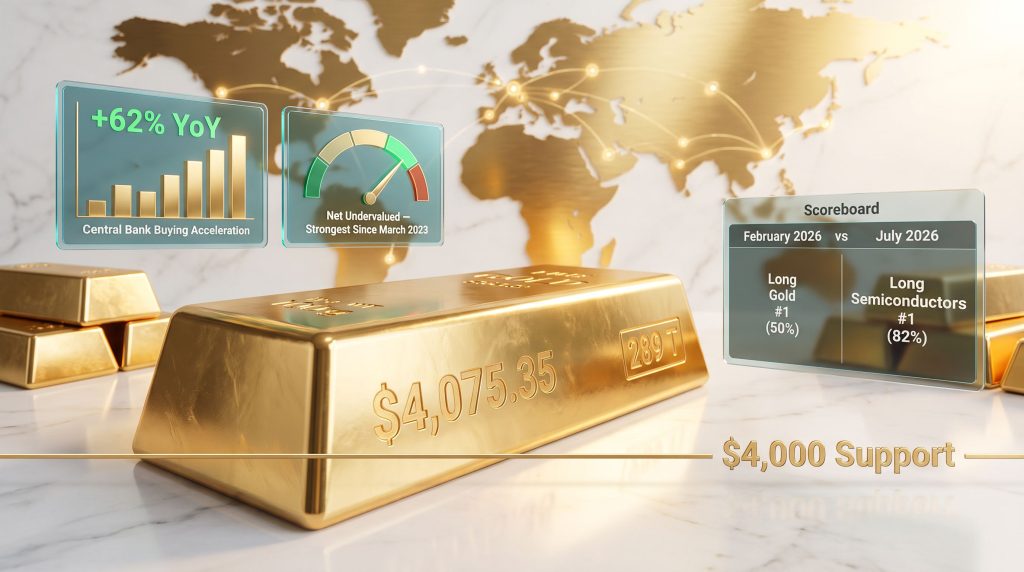
For much of late 2025 and into early 2026, gold occupied an uncomfortable position in institutional portfolios: it was the most crowded trade on the planet. At the peak of crowding in February 2026, approximately 50% of surveyed fund managers identified long gold as the market's most congested positioning. Crowded trades carry inherent risk because they leave little room for incremental buyers while creating significant vulnerability to any catalyst that triggers coordinated exits.
That exit materialised. By July 2026, gold had fallen entirely out of the top five most crowded trades, displaced by a capital rotation into technology. Long semiconductor positions absorbed the institutional attention that had previously flowed into gold, reaching a record crowding reading of 82% among surveyed managers.
| Timeframe | Gold Crowded Trade Ranking | Most Crowded Trade | Crowding Level |
|---|---|---|---|
| February 2026 | #1 | Long Gold | 50% of respondents |
| July 2026 | Outside Top 5 | Long Semiconductors | 82% of respondents |
The consequence of this rotation is revealing. A net 5% of fund managers now classify gold as undervalued, marking the strongest such reading since March 2023 and completing a full cycle from one of the most overvalued readings in years to a net undervalued stance. This is not a minor oscillation in sentiment. It represents a complete repositioning of how professional money views the metal's relative worth.
Historically, the conditions most associated with durable contrarian opportunities in commodities occur when price consolidation coincides with lighter professional positioning and continued structural demand. Gold is currently exhibiting all three simultaneously.
Why Crowding Metrics Matter More Than Price Alone
Many investors focus exclusively on price charts when evaluating gold. Positioning data adds a dimension that price cannot provide: it tells you how much professional capital is already deployed in a given direction and therefore how much incremental buying power remains available.
When crowding collapses from 50% to effectively zero in the top five, it signals that the sellers have largely completed their rotation. The remaining holders are structurally motivated, meaning their holding decisions are driven by factors unrelated to short-term price momentum. This is the environment in which contrarian accumulation tends to generate its best results, though timing remains highly dependent on macro catalysts that lie outside gold's own supply-demand dynamics. For a broader perspective on gold market analysis and investment outlook, this dynamic is well worth examining in the context of longer-term positioning cycles.
Central Bank Demand: The Structural Floor Beneath the Noise
While institutional sentiment was cooling, official-sector buyers were moving in the opposite direction with notable conviction. Central banks added a net 289 tonnes to global gold reserves during Q2 2026, representing a 62% increase year-over-year. This acceleration occurred simultaneously with 45 tonnes of ETF outflows, creating a clear bifurcation between the two demand streams. Furthermore, understanding central bank demand helps illuminate why these two forces can diverge so dramatically.
Understanding Why Central Banks Buy Gold at Elevated Prices
The willingness of central banks to accumulate gold at historically high price levels confounds investors conditioned to think of demand as a function of price sensitivity. Official-sector gold buying operates on an entirely different motivational framework:
-
Reserve diversification away from concentrated exposure to US dollar-denominated assets, particularly US Treasury securities
-
Sanctions insulation following the weaponisation of cross-border financial infrastructure in recent years, which demonstrated that dollar reserves can be frozen whereas physical gold held domestically cannot
-
Inflation-adjusted store of value characteristics that protect national balance sheets from purchasing power erosion across multi-decade timeframes
-
Monetary sovereignty as a strategic objective, increasing the proportion of national wealth held in assets that exist outside any single legal jurisdiction
These motivations do not disappear when gold prices are elevated. Reserve managers are not executing tactical trades. They are implementing multi-year reserve policy decisions that weigh geopolitical stability and long-term asset quality alongside near-term price levels. According to VanEck's analysis of central bank buying, these official-sector institutions remain among gold's most consistent and structurally motivated customers.
The World Gold Council reported total central bank gold purchases of 863.3 tonnes in 2025, a figure that, while below the record-setting pace of the prior two years, remains historically elevated and demonstrates the sustained nature of the accumulation cycle. The fact that buying has continued through a period of record-high prices suggests that official-sector demand is not primarily price-driven, though the pace has moderated somewhat from its peak. In addition, gold reserves held by central banks have become an increasingly important indicator of long-term confidence in the metal.
Important Nuance: Central bank gold buying is not uniform across all nations at all times. Individual countries periodically reduce gold holdings for domestic fiscal or liquidity reasons. These episodes are idiosyncratic events driven by country-specific circumstances and should not be interpreted as evidence of a broad structural retreat from gold as a reserve asset class.
The ETF vs. Physical Demand Divergence: What the Data Actually Shows
The 45 tonnes of ETF outflows recorded in Q2 2026 initially appears concerning but becomes considerably less alarming when placed alongside the broader demand picture.
| Demand Category | Q2 2026 Change | H1 2026 Change |
|---|---|---|
| Gold ETF Flows | -45 tonnes | Not specified |
| Physical Bar and Coin Demand | -3% quarter-over-quarter | +21% year-over-year |
| Central Bank Net Purchases | +289 tonnes | Elevated |
ETF outflows in this context reflect retail and tactical investors reducing exposure following a correction from record highs. This is a well-documented behavioural pattern: price-momentum-driven participants exit when an asset retreats from peak levels, particularly when an alternative trade (semiconductors in this instance) offers compelling momentum.
Physical bar and coin demand tells a different story. A 3% quarterly decline from elevated levels, combined with a 21% year-over-year increase for the first half of 2026, indicates that consumer demand for physical gold remains fundamentally robust. Buyers of physical metal tend to be structurally motivated by wealth preservation and inflation hedging rather than momentum trading, making their demand patterns more durable across price cycles.
The combination of resilient physical demand and accelerating central bank accumulation creates a demand floor that short-term ETF outflows cannot structurally undermine. When structural buyers absorb supply during a period of retail selling, the resulting price consolidation is more accurately characterised as accumulation than as a breakdown in demand fundamentals. Consequently, gold's role as a safe haven investment remains as compelling as ever during periods of institutional repositioning.
Dollar Weakness and the Japanese Intervention Factor
Currency dynamics have added a further dimension to gold's near-term price environment. Spot gold recorded a 0.7% daily decline to $4,075.35 per ounce while remaining up 1.7% for the month, demonstrating that buyers were consistently defending elevated levels through a five-month period of consolidation. The metal was on track for its first monthly gain across that stretch at the time of analysis.
How Japanese Intervention Created a Dollar Tailwind for Gold
Suspected Japanese currency market intervention drove the yen to its largest single-session gain since 2022, subsequently weakening the US dollar by 2.4% in one of its sharpest single-day declines since January 2023. Citi estimated that approximately $8.1 billion in dollar/yen selling occurred within a 10-minute window, illustrating the scale and velocity of official intervention in currency markets.
The mechanism through which dollar weakness supports gold is straightforward but important. A declining dollar reduces the effective purchase price of gold for buyers transacting in non-dollar currencies, broadening price-sensitive demand across Asian, European, and Middle Eastern markets. This is not a marginal effect. For buyers in currencies that have appreciated against the dollar, gold becomes materially more accessible precisely when dollar-denominated spot prices are elevated.
Japan's public justification for intervention centres on the link between yen weakness and rising import costs, creating ongoing political pressure for continued support operations. The Bank of Japan had deployed over $70 billion in yen support earlier in the year. Its next rate decision carries direct implications for gold: if sustained rate increases strengthen the yen independently of intervention, the dollar-weakening tailwind that has supported non-US gold demand could diminish. Conversely, if intervention continues without a structural policy shift, dollar pressure may persist.
The Federal Reserve's Role in Gold's Support Framework
The Fed held interest rates unchanged at its most recent meeting, with Chair Kevin Warsh providing limited forward guidance and directing market attention toward incoming economic data. This posture of policy uncertainty tends to support gold by reducing the opportunity cost calculus that competing assets present. However, the gold price forecast for 2025 suggests that Fed policy remains one of the most watched variables for investors positioning around rate-sensitive assets.
Scenario Analysis: Gold Across Different Macro Pathways
| Macro Scenario | Dollar Direction | Fed Stance | Gold Implication |
|---|---|---|---|
| Fed holds, BoJ intervenes again | Weakening | Neutral | Broadly supportive for non-US demand |
| Fed signals September rate increase | Strengthening | Hawkish | Raises opportunity cost, pressures $4,000 |
| BoJ raises rates independently | Mixed | Neutral | Reduces intervention tailwind, partial headwind |
| Geopolitical escalation | Weakening | Easing | Strongly supportive via safe-haven demand |
The September Fed meeting is the next critical decision point for gold's support structure. A signal of renewed tightening would simultaneously strengthen the dollar and increase the opportunity cost of holding a non-yielding asset, placing both downward pressure vectors on gold at the same time. Until that decision arrives, the absence of hawkish guidance keeps the structural case largely intact.
The next major ASX story will hit our subscribers first
The Contrarian Case: When All Signals Point the Same Direction
The conditions currently present in the gold market are not individually unusual. What makes the current setup analytically distinctive is how many of these signals are aligned simultaneously. Indeed, the concept of gold undervalued as central banks extend buying becomes considerably more credible when viewed through this multi-signal lens.
Contrarian Signal Assessment:
-
Institutional crowding has collapsed from the most congested position (#1 at 50%) to outside the top five entirely
-
Fund manager valuation sentiment has shifted to a net undervalued reading, the strongest since March 2023
-
Central bank quarterly buying accelerated 62% year-over-year in Q2, reaching 289 tonnes
-
Physical demand remains 21% above prior-year levels despite a minor quarterly decline
-
The $4,000 price level has been repeatedly defended through five months of consolidation
-
Retail ETF selling has largely completed its rotation cycle
The primary risks to this framework remain Fed policy hawkishness and a sustained dollar strengthening that could be triggered by either US rate decisions or a structural shift in Japanese monetary policy. These are not trivial risks, and investors should weigh them against the structural demand picture rather than dismissing them. According to Brookings Institution research on central bank gold holdings, the strategic importance of gold to reserve managers has grown materially in the current geopolitical environment.
Three Indicators to Monitor Before Making a Positioning Decision
-
Fed rate expectations and September guidance – any signal of renewed tightening materially alters the opportunity cost framework for holding gold
-
Q3 central bank demand figures – whether the 62% year-over-year acceleration observed in Q2 is sustained or moderates as price sensitivity increases among reserve managers
-
Monthly fund manager positioning surveys – tracking whether the net undervalued reading deepens further or reverses as capital flows shift
Frequently Asked Questions
Why are central banks buying gold at historically high prices?
Reserve managers operate on multi-year policy mandates driven by diversification objectives, geopolitical risk management, and monetary sovereignty considerations. These factors remain relevant regardless of short-term price levels. While elevated prices have introduced some degree of caution in the pace of accumulation, the structural rationale for holding gold as a non-dollar reserve asset has strengthened considerably in recent years following geopolitical events that demonstrated the vulnerability of currency-based reserves to external legal constraints.
What does a net 5% undervalued reading from fund managers actually mean?
It indicates that more professional investors believe gold is priced below its fundamental worth relative to current demand drivers than believe it is priced above that level. The shift from a net overvalued to a net undervalued reading reflects both the price consolidation of recent months and continued structural demand. It does not confirm objective cheapness, but it does signal that professional positioning is light enough to allow meaningful incremental buying without creating crowding dynamics.
Can ETF outflows and central bank buying coexist for an extended period?
Yes, and they frequently do. The two demand streams are driven by fundamentally different motivational frameworks. ETF outflows primarily reflect retail and tactical investors responding to price momentum, while central bank purchases reflect long-term reserve policy that is relatively insulated from short-term sentiment. These streams can move in opposite directions for extended periods, and history suggests the structural buyer's behaviour exerts more durable influence on medium-term price direction. Furthermore, the phenomenon of gold undervalued as central banks extend buying is itself a product of exactly this kind of divergence between short-term sentiment and long-term structural demand.
Disclaimer: This article is intended for informational purposes only and does not constitute financial advice. All forecasts, scenario analyses, and market projections involve inherent uncertainty and should not be relied upon as the sole basis for any investment decision. Past performance of gold or any other asset class is not indicative of future results. Readers should conduct their own due diligence and consult a qualified financial adviser before making investment decisions.
Want to Know When the Next Major Mineral Discovery Hits the ASX?
Discovery Alert's proprietary Discovery IQ model delivers real-time alerts on significant ASX mineral discoveries, cutting through complex data to surface actionable opportunities the moment they are announced — explore the historic returns major discoveries have generated and begin your 14-day free trial to position yourself ahead of the broader market.