June 12, 2026
Gold as a Gauge of US-China Tensions and Taiwan Risk
Every generation or so, a single asset class graduates from being a portfolio tool into something more revealing: a real-time barometer of civilisational stress. Gold as a gauge of US-China tensions and Taiwan risk has never been more relevant than it is today. The metal is no longer simply responding to inflation prints or central bank policy shifts. It is functioning as a continuous market referendum on whether the world's two largest economies are moving toward a workable arrangement or edging toward something far more destabilising.
Understanding why gold has assumed this role, and what it is currently communicating, requires looking beyond the headline price and examining the transmission mechanisms, the structural dependencies, and the strategic psychology that connects commodity markets to the highest levels of diplomacy.
When big ASX news breaks, our subscribers know first
Why Gold Has Become a Real-Time Diplomatic Signal
From Inflation Hedge to Geopolitical Instrument
For most of the post-2008 era, gold's primary function in investor narratives was as a hedge against currency debasement and rising consumer prices. That framing still holds partial validity, but it no longer captures the full story. What has changed is the nature of the risk that gold is being asked to price.
The current era of US-China friction involves not just tariffs but technology access, semiconductor architecture, rare earth supply chains, and the unresolved question of Taiwan's political future. These are not the kinds of risks that bond yields or equity volatility indexes fully capture. Gold, by contrast, has no counterparty. It carries no sovereign liability. Crucially, it has historically been accumulated by nation-states before crises materialise, not during them.
This pre-conflict accumulation dynamic is central to understanding gold's behaviour. The heaviest sovereign buying tends to occur during the lead-up period, when diplomatic friction is rising and military posturing is visible but active conflict has not yet commenced. Nations build gold reserves precisely because they anticipate scenarios in which financial assets denominated in foreign currencies could be frozen or weaponised as sanctions tools. Gold's neutrality as a reserve instrument has become strategically valuable in a world where economic coercion has become routine.
What Gold Above $4,000 Per Ounce Actually Signals
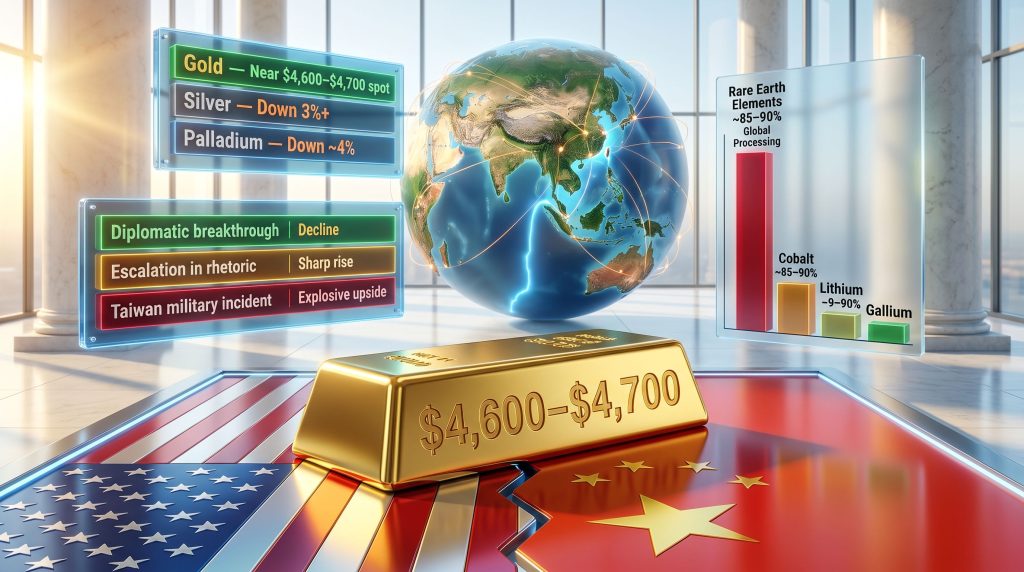
Gold trading near $4,600 to $4,700 per ounce on the spot market represents more than an inflation-adjusted price level. It reflects a market that has embedded a substantial geopolitical risk premium into the metal's valuation. When futures pushed above $4,267 during a prior surge in US-China tensions, the move was not primarily driven by inflation expectations or real yield movements. Furthermore, it was the market actively pricing tail risk: the possibility that something in the US-China relationship was deteriorating faster than official communications were acknowledging.
The three-way interpretive framework is worth understanding clearly:
- Gold rising sharply indicates markets are concluding that diplomatic outcomes are dangerous or that escalation risk has increased
- Gold falling suggests markets believe genuine and substantive progress has occurred
- Gold trading flat implies markets have concluded that nothing material was resolved, that the meeting produced ambiguity rather than clarity
That last signal is perhaps the most underappreciated. A flat gold price during a high-stakes diplomatic summit is not a neutral outcome. It is a verdict: the meeting changed nothing of substance.
How the US-China Relationship Moves Gold Prices
The Three-Channel Transmission Mechanism
Gold's sensitivity to US-China dynamics operates through three distinct but interconnected channels: trade policy, technology competition, and the Taiwan security question. Each channel carries different time horizons and volatility characteristics.
Trade developments tend to produce faster, more reversible market reactions. The US-China trade war impact on global markets has demonstrated this clearly, with technology competition around semiconductor access and AI infrastructure creating slower-burning structural pressures that accumulate over months. Taiwan represents the ultimate tail risk: an event with low assigned probability but catastrophic potential consequences for global financial systems if it materialises.
| Scenario | Expected Gold Response | Supporting Signal |
|---|---|---|
| Confirmed diplomatic breakthrough | Decline, risk appetite returns | Equities rally, dollar strengthens |
| Vague communique, no specifics | Sideways, uncertainty persists | Metals mixed, bonds flat |
| Escalation in rhetoric or military posturing | Sharp rise, safe haven demand surges | VIX spikes, emerging market currencies weaken |
| Taiwan military incident or blockade threat | Explosive upside, systemic risk pricing | Credit spreads widen, oil rallies |
Why Private Conversations Matter More Than Press Releases
A critical and often overlooked dimension of interpreting summit outcomes through gold is the information leakage timeline. What is said officially in press conferences and joint statements is, almost by definition, pre-negotiated and designed to avoid market disruption. The real signal comes from what was said privately, what tone was adopted across the table, and how participants behave in the days and weeks following a meeting.
That information does not stay contained. It surfaces gradually through secondary reporting, through shifts in policy posture, and through the behaviour of officials in subsequent engagements. The gold market absorbs this information over a period of days to weeks following a major summit. A sustained directional move in gold over a four to twelve week window following high-level diplomatic contact is therefore a significantly more reliable read of what actually occurred than the immediate price reaction to official statements.
Taiwan's Role in the Gold Risk Equation
The Intersection of Semiconductors, Security Commitments, and Strategic Leverage
Taiwan occupies a structurally unique position in global risk calculus. It is simultaneously the home of the world's most advanced semiconductor fabrication capacity, the subject of competing sovereignty claims with no clear legal resolution, and the specific flashpoint most likely to transform US-China economic competition into direct military confrontation.
The semiconductor dimension amplifies Taiwan's significance far beyond its geographic scale. TSMC's advanced node manufacturing represents a concentration of industrial capability with no near-term replacement. A cross-strait crisis would not merely disrupt bilateral trade. It would sever the supply chain for the components that underpin modern defence systems, artificial intelligence infrastructure, consumer electronics, and automotive technology simultaneously.
That level of systemic exposure explains why a Taiwan-specific escalation scenario would likely produce the largest single safe-haven move in precious metals markets in living memory. It is not simply a regional security event. It is a potential supply chain catastrophe layered on top of a great power confrontation, priced by markets that have never had to fully discount that scenario before.
The 30-Year Versus 3-Year Timeline Question
One of the more consequential analytical distinctions for gold positioning relates to whether Taiwan's status is understood as a long-horizon issue or an imminent one. A scenario in which both sides accept a multi-decade timeline for resolution allows markets to price Taiwan risk as a persistent but manageable premium embedded in gold. A scenario in which leadership calculus shifts toward near-term action compresses that timeline dramatically and would translate directly into a repricing of gold toward levels that current models have not seriously stress-tested.
The distinction matters for portfolio construction. Investors treating Taiwan risk as a distant abstraction may be systematically underweighting the premium that gold already reflects, and therefore misinterpreting current price levels as stretched rather than rationally calibrated.
China's Critical Mineral Dominance: The Risk Markets Are Underpricing
Not Just Raw Materials but the Entire Refining Architecture
One of the most important and least widely understood dimensions of the US-China structural competition is that China's advantage in critical minerals does not rest primarily on geological endowment. It rests on an integrated industrial architecture that encompasses raw material access, the specialised chemicals required for processing, the refining equipment itself, and the accumulated human capital to operate that system at scale.
China's rare earth export restrictions have underscored just how deeply this dependency runs, with near-monopoly control across multiple critical materials.
| Critical Material | China's Estimated Global Refining Share | Strategic Dependency Risk |
|---|---|---|
| Rare earth elements | Approximately 85-90% of global processing | Extreme |
| Cobalt refining | Over 70% of global capacity | Very High |
| Lithium processing | Over 60% of refined output | High |
| Gallium and Germanium | Near-monopoly with active export controls | Extreme |
This distinction is critical for understanding why diplomatic progress on rare earth trade access, even if genuine, would not quickly resolve supply chain dependencies. Building alternative refining capacity requires not just capital but the chemicals, equipment, and expertise that are themselves concentrated in China. The timeline for meaningful diversification is measured in years to decades, not quarters.
The market's periodic enthusiasm that diplomatic summits might unlock unrestricted rare earth access reflects a fundamental misreading of the structural situation. China is unlikely to voluntarily surrender leverage that took decades to construct and that sits at the foundation of its strategic negotiating position. In addition, America's rare earth supply chain faces significant structural challenges in closing this gap in the near term.
Gold and the Dollar: Why Both Can Strengthen Simultaneously
Debunking the Simple Inverse Relationship
The conventional framing of gold as a dollar hedge implies that the two assets must move in opposite directions. This inverse relationship holds reasonably well during normal market conditions when gold is functioning primarily as an inflation hedge. However, it breaks down during periods when gold is pricing a war risk premium or systemic financial stress.
During pre-conflict accumulation phases, sovereign buyers and institutional investors build gold positions precisely because they are concerned about scenarios in which dollar-denominated assets could be frozen or devalued through sanctions or financial fragmentation. In those scenarios, gold's appeal is not that the dollar is weak. It is that gold carries no counterparty risk that any state actor can unilaterally cancel.
The coexistence of dollar strength and elevated gold prices is therefore not a contradiction. It is a specific signal that markets are pricing geopolitical tail risk rather than currency debasement. The two dynamics can, and during periods of acute international tension regularly do, reinforce each other simultaneously. As gold prices remain at record highs amid ongoing geopolitical tension, this dynamic has become increasingly apparent to institutional investors.
The next major ASX story will hit our subscribers first
Silver, Platinum, and What the Metals Board Reveals
Reading Divergence as a Composite Signal
When gold trades flat near multi-year highs while silver falls more than three percent in the same session, and platinum and palladium both decline by similar magnitudes, the divergence carries analytical content. It indicates that the market is not in a broad commodity risk-on phase, nor in a generalised inflation trade. It is specifically pricing gold as a geopolitical and monetary reserve asset while the industrial metals complex reflects a different set of concerns.
| Metal | Primary Driver | Geopolitical Sensitivity |
|---|---|---|
| Gold | Safe haven demand plus central bank accumulation | Extreme |
| Silver | Industrial demand combined with speculative flows | Moderate |
| Platinum | Automotive sector plus supply constraints | Low to Moderate |
| Palladium | Russian supply dynamics plus EV transition | Moderate |
| Copper | AI infrastructure demand plus reindustrialisation | Low, primarily industrial |
Silver's behaviour in this context deserves specific attention. After its previous substantial run, a correction of more than three percent on a day when gold is flat is consistent with what might be described as a commodity aftershock pattern. The typical pattern involves a primary peak, a significant pullback, a partial recovery that draws in momentum buyers, a second decline that often exceeds the first, and then an extended consolidation before a new cycle potentially begins. Treating any single silver correction as either a buying signal or a trend reversal without reference to this structural pattern leads to mispositioned trades.
The AI Infrastructure Boom and Its Connection to Hard Assets
AI Is an Energy and Physical Infrastructure Problem First
A persistent misframing of the artificial intelligence investment opportunity treats it primarily as a software and semiconductor story. The more accurate framing is that AI is fundamentally an energy and physical infrastructure story, with software and semiconductors sitting several layers up a much longer supply chain.
The physical requirements of the AI buildout span a supply chain that begins with copper extraction and moves through cable manufacturing, silicon wafer production, power generation equipment, grid infrastructure, and data centre construction before a single query is processed. Each layer of that chain is subject to supply constraints, capital bottlenecks, and in several cases, geopolitical dependencies.
| Supply Chain Layer | Key Bottleneck | Investment Implication |
|---|---|---|
| Raw materials | Copper scarcity and rare earth access | Mining and extraction exposure |
| Processing and refining | China's near-monopoly on critical mineral refining | Supply chain diversification plays |
| Power generation | Insufficient grid capacity and backup generator shortages | Small modular nuclear and industrial power |
| Connectivity infrastructure | High-speed networking demand across data centres | Legacy telecoms pivoting to AI infrastructure |
| Data centre buildout | Energy demand exceeding local grid capacity | Energy storage and industrial batteries |
The copper supply crunch sits at the base of this chain, which is why the metal has been pressing toward all-time highs. Furthermore, the copper supply crunch is driven not by speculation but by simultaneous demand from AI data centres, electric vehicle infrastructure, grid modernisation, and industrial reshoring. The current price level may represent only the early stages of a multi-year demand cycle with significant runway remaining.
The Reindustrialisation Imperative and Its Inflationary Consequences
The push to rebuild domestic industrial capacity in the United States is not independent of the AI buildout. The two are mutually reinforcing. Advanced manufacturing requires advanced computing infrastructure. Advanced computing infrastructure requires physical manufacturing capacity. Together they represent a capital expenditure cycle of a scale not seen since the post-war industrialisation period.
The inflationary implications of this cycle are significant but differ in character from consumption-driven inflation. When capital flows into productive assets — factories, power infrastructure, and data centres — the inflationary impulse is partially offset by the long-term productivity gains those assets generate. However, near-term supply bottlenecks in commodities, specialised equipment, skilled labour, and permitting mean price pressures arrive well before productivity benefits materialise.
Backup generators provide a concrete illustration: the queue for industrial-scale backup power equipment from major manufacturers has extended dramatically as data centre developers compete for limited supply. That is not a speculative dynamic. It is physical scarcity creating pricing power for manufacturers and inflationary pressure throughout the supply chain.
The fiscal dimension compounds this. Funding a reindustrialisation cycle at the required scale demands either tax revenue that does not currently exist or monetary expansion that does. The Federal Reserve's approach since 2008 has demonstrated a clear operational framework: equity markets function as a stability gauge, and liquidity is injected when asset prices approach levels that could trigger systemic stress. This is not unorthodox policy anymore. It has become the standard operating procedure, and it is structurally inflationary over any meaningful time horizon.
The Cooperative Versus Competitive Framework
Why the Binary Win-Lose Frame Is the Wrong Analytical Lens
Much of the commentary surrounding US-China competition defaults to a zero-sum analytical framework: which nation will dominate AI, which will control critical minerals, which will set the rules for the next technological era. This framing may be rhetorically compelling but it is analytically misleading and, more importantly, it misidentifies where value is actually created and destroyed.
The iPhone serves as an instructive case study. The device represents one of the most commercially successful products in human history, and it could not exist without the integrated contributions of American design, software engineering, and brand architecture on one side, and Chinese manufacturing precision, supply chain management, and industrial scale on the other. The value generated by that collaboration vastly exceeds what either party could have produced independently. Dismantling the relationship that makes that kind of product possible does not redistribute its value. It destroys it.
The choice facing both governments is whether to pursue a path of elevating mutual prosperity or escalating competitive confrontation. That choice, and the signals it generates in private diplomatic interactions, may be the single most important macro variable for global asset prices over the next two to five years. Gold as a gauge of US-China tensions and Taiwan risk is the market's most efficient instrument for continuously repricing which path appears more probable.
How Investors Should Position Across the Risk Spectrum
Building a Geopolitical Risk Portfolio
Positioning across a geopolitical risk spectrum requires scenario-based thinking rather than point forecasts. The relevant scenarios span a wide range of outcomes, and portfolio construction should reflect explicit probability weights rather than conviction in any single trajectory.
| Geopolitical Scenario | Gold Positioning | Industrial Metals | Equities |
|---|---|---|---|
| Genuine US-China detente | Reduce overweight, rotate to risk assets | Maintain, AI buildout continues regardless | Increase tech and industrial exposure |
| Status quo and slow progress | Hold core gold allocation | Accumulate copper and energy infrastructure | Selective AI infrastructure plays |
| Escalating trade and technology war | Increase gold allocation significantly | Cautious given supply chain disruption risk | Defensive rotation |
| Taiwan military crisis | Maximum safe haven positioning | Severe disruption, reduce exposure | Risk-off across the board |
Dollar-cost averaging into precious metals during the current cycle deserves particular emphasis. The combination of structural fiscal expansion, a reindustrialisation-driven commodity cycle, and persistent geopolitical tail risk creates a backdrop in which a core precious metals allocation functions as portfolio stabilisation across most scenarios. In addition, central bank gold demand has been a significant structural support for prices, reinforcing the case for a core precious metals position that functions as an inflation hedge regardless of geopolitical direction.
Small modular nuclear reactors and industrial energy storage represent an additional category worth monitoring. Energy is the primary choke point in the AI infrastructure buildout, and solutions that can deliver reliable, scalable power at data centre locations without dependence on grid expansion timelines carry structural demand that is unlikely to diminish regardless of the broader macro environment.
Frequently Asked Questions: Gold, US-China Tensions, and Taiwan Risk
Does Gold Always Rise When US-China Relations Deteriorate?
Not automatically. Gold responds most sharply to deterioration that is unexpected or accelerating beyond what markets have already absorbed. Slow-moving, well-understood tensions have limited incremental impact on price because the risk has already been embedded in valuations. Sudden escalations, credible military signalling, or breakthrough developments in sensitive areas like Taiwan produce the most pronounced moves.
How Long After a Diplomatic Summit Does Gold Reflect the Real Outcome?
The adjustment period typically spans days to weeks as private communications, policy signals, and secondary reporting gradually surface. A sustained directional move over a four to twelve week window following a major summit is considerably more informative than the immediate price reaction, which is often dominated by headline-driven noise rather than substantive information.
Why Are Central Banks in Asia Buying Gold at Elevated Levels?
Official sector buyers are hedging against dollar dependency, geopolitical fragmentation, and the specific risk that financial sanctions could freeze reserve assets denominated in Western currencies. The weaponisation of the SWIFT system and dollar-denominated reserves as tools of economic coercion since 2022 has materially altered the risk calculus for sovereigns holding concentrated positions in any single reserve currency. Gold's institutional neutrality addresses that concern directly.
Is Silver a Reliable Confirmation Signal for Gold's Geopolitical Move?
Silver's dual function as both an industrial and monetary metal makes it a less precise geopolitical signal than gold. During speculative phases, silver amplifies gold's directional moves with higher volatility. During pure risk-off events where industrial demand concerns are prominent, silver can diverge from gold as the monetary and safe-haven buying is partially offset by industrial demand anxiety. Silver confirms gold's direction most reliably during phases where inflation expectations and speculative momentum are both running simultaneously.
What Would Cause Gold to Fall Sharply From Current Levels?
A credible and verifiable reduction in US-China tensions, particularly around Taiwan and rare earth trade architecture, combined with rising real yields and a strengthening dollar, would represent the most significant set of headwinds for gold from current levels. As noted by Reuters on recent gold market movements, even the perception of easing trade war concerns is sufficient to trigger meaningful price corrections. Markets have developed a high threshold for treating diplomatic statements as genuine progress, having repeatedly seen early optimism reverse.
How Does the AI Infrastructure Buildout Affect Gold Demand?
The connection operates through two channels. Indirectly, the buildout is structurally inflationary, driving up commodity prices, energy costs, and ultimately broader consumer prices, which supports gold as a gauge of US-China tensions and Taiwan risk over a multi-year horizon. More directly, the fiscal expansion required to fund reindustrialisation increases sovereign debt levels, gradually eroding confidence in fiat currency stores of value and reinforcing gold's appeal as an alternative reserve asset.
Key Takeaways: What Gold Is Telling Markets Right Now
- Gold near $4,600 to $4,700 per ounce signals that markets have not yet priced in a credible breakthrough in US-China relations
- A flat gold price during a diplomatic summit is a verdict of inconclusive outcomes, not a neutral signal
- The three to twelve month gold trend following major high-level meetings is a far more reliable signal than the immediate price reaction
- China's dominance across critical mineral refining infrastructure, not just geological deposits, represents a structural leverage point that markets may be systematically underpricing
- The AI infrastructure buildout creates independent commodity demand that supports industrial metals regardless of geopolitical developments
- Reindustrialisation-driven fiscal expansion is structurally inflationary across most portfolio scenarios, supporting a core precious metals allocation
- The cooperative versus escalatory trajectory of US-China relations may be the single most consequential macro variable for global asset prices over the next two to five years
- The Taiwan timeline question — whether both parties accept a multi-decade resolution horizon or whether one party seeks near-term action — is the specific variable most likely to produce an asymmetric repricing in gold as a gauge of US-China tensions and Taiwan risk
This article is intended for informational and educational purposes only and does not constitute financial advice. All references to asset prices, market scenarios, and investment strategies involve inherent uncertainty. Past performance is not indicative of future results. Readers should conduct their own due diligence and consult a qualified financial adviser before making any investment decisions. All market data referenced reflects conditions at the time of writing and may have changed materially.
Want to Stay Ahead of the Next Major Mineral Discovery Driving These Market Shifts?
While gold continues to signal deepening geopolitical stress between the US and China, Discovery Alert's proprietary Discovery IQ model delivers real-time alerts on significant ASX mineral discoveries — turning complex commodity and exploration data into actionable investment insights for both traders and long-term investors. Explore historic discoveries and their exceptional market returns to understand the opportunity, then begin your 14-day free trial and position yourself ahead of the market.