August 12, 2026
The Architecture of Modern Money: How Removing Gold Convertibility Reshaped Civilisation
Few monetary experiments in recorded history have been as consequential as the one quietly launched on a Sunday evening in August 1971. Most people alive today have never known any other system. They have grown up in a world where money is created by institutional decree, where governments can finance almost unlimited spending through the expansion of credit, and where the purchasing power of wages erodes year after year in ways that feel mysterious but never quite get explained.
Understanding why this happened requires going back to the system that existed before it collapsed, and examining what was actually lost when Nixon closing the gold window severed the final link between the world's reserve currency and a physical commodity.
When big ASX news breaks, our subscribers know first
What Was the Gold Window and Why Did Its Architecture Matter?
The Bretton Woods System: Engineering Monetary Stability After War
The 1944 Bretton Woods Conference assembled representatives from 44 Allied nations at a resort in New Hampshire with a singular objective: prevent the competitive currency devaluations and monetary chaos that had accelerated the Great Depression and contributed to the conditions enabling World War II.
The system they designed was elegant in its logic. Every participating nation would peg its currency to the U.S. dollar within a narrow band. The dollar itself would be pegged to gold at a fixed rate of $35 per troy ounce. The United States, holding the largest gold reserves in the world at the time, would serve as the monetary anchor for the entire global trading system.
This was not a pure gold standard. Private citizens could not walk into a bank and exchange their paper dollars for gold. The convertibility privilege was restricted to foreign governments and central banks, who could present dollars to the U.S. Treasury and receive physical gold in return. The system was designed to maintain discipline without the rigidity of full gold-coin convertibility.
The Gold Window: Operational Mechanics of Dollar-Gold Convertibility
The term "gold window" refers specifically to the mechanism through which foreign central banks could redeem U.S. dollar reserves for physical gold at the Treasury's fixed rate of $35 per ounce. As long as this window remained open, the quantity of dollars in global circulation was theoretically constrained by the size of U.S. gold reserves.
This created a self-correcting discipline mechanism. If the United States issued too many dollars relative to its gold stock, foreign nations could exercise their convertibility rights, draining U.S. reserves and forcing monetary contraction. The threat of gold redemption was, in theory, a hard external ceiling on American monetary expansion.
The gold window functioned as the world's monetary enforcement mechanism. Its existence meant that no matter how politically convenient deficit spending became, the physical reality of finite gold reserves placed a structural limit on how far monetary expansion could proceed.
When Nixon Closed the Gold Window: The Events of August 15, 1971
A Sunday Evening That Changed Global Finance
On August 15, 1971, President Richard Nixon addressed the American public in a televised Sunday evening broadcast and announced the immediate suspension of dollar-gold convertibility. The timing was deliberate, chosen to prevent currency markets from reacting before the administration could frame the narrative. Nixon described the move as a temporary measure to defend the dollar against speculative attacks. It was never reversed.
The Nixon Shock now stands as one of the most consequential unilateral economic decisions of the 20th century, a date that monetary historians mark as the true birth of the modern fiat currency era.
The Pressure Points That Made Collapse Inevitable
The gold window did not simply close without warning. A convergence of structural pressures had been building for years, each eroding confidence in the dollar's ability to maintain its gold peg.
| Pressure Factor | Description | Approximate Timeline |
|---|---|---|
| Vietnam War Spending | Massive deficit financing eroded confidence in dollar stability | Mid-1960s to 1971 |
| Great Society Programs | Domestic social spending expanded the money supply beyond gold-backed limits | 1964 to 1971 |
| Balance of Payments Deficit | Persistent trade imbalances drained U.S. gold reserves | Late 1960s |
| Foreign Gold Redemptions | Allied nations, particularly France, began converting dollar holdings into gold | 1965 to 1971 |
| Inflation Acceleration | Rising domestic prices signalled monetary overexpansion | 1969 to 1971 |
| Currency Speculation | International markets bet against dollar parity, forcing reserve depletion | 1971 |
France under President de Gaulle was particularly aggressive in exercising redemption rights, dispatching naval vessels to transport gold from the United States back to Paris. The optics were unmistakable: a key ally was openly signalling distrust in the dollar. According to the Federal Reserve's historical account, these mounting redemption pressures made the closure of the gold window increasingly inevitable throughout 1971.
The Nixon Shock: Three Policy Levers Pulled Simultaneously
Nixon's announcement encompassed more than simply closing the gold window. The full policy package included three coordinated interventions:
- Suspension of dollar-gold convertibility, effectively ending the Bretton Woods system.
- A 90-day freeze on all wages and prices, representing the most sweeping peacetime price controls in American history.
- A 10% surcharge on all imports, designed to pressure trading partners into accepting currency revaluations that would ease the U.S. balance of payments deficit.
The combination of these measures reflected an administration managing simultaneous monetary, inflationary, and trade crises. Whether the closure of the gold window was a genuine emergency response to acute reserve pressure or a premeditated policy decision that simply used the 1971 crisis as political cover remains a matter of ongoing academic debate. Nixon's Camp David meetings with senior economic advisors in the days before the announcement suggest the decision was more deliberate than spontaneous.
How the Monetary System Was Rebuilt After 1971
The Failed Rescue Attempt: The Smithsonian Agreement
Four months after Nixon's announcement, finance ministers from the major industrial nations gathered at the Smithsonian Institution in Washington and attempted to reconstitute a modified fixed-rate system. Nixon called it the greatest monetary agreement in the history of the world. Within fourteen months, it had collapsed. By 1973, floating exchange rates had become the new global standard by default rather than design.
The transition to floating rates created an entirely new class of financial market. Currency trading, previously a technical backwater of international banking, became one of the largest and most volatile markets on earth. Central banks lost the automatic discipline that gold convertibility had imposed and gained in its place the far more subjective responsibility of maintaining institutional credibility.
Fiat Currency: A System Built on Trust Rather Than Tangibility
A fiat currency derives its value entirely from legal mandate and institutional credibility rather than any physical commodity backing. The closure of the gold window marked the moment the world's reserve currency became fully fiat, a structural shift with no genuine historical precedent at global scale. Furthermore, the role of gold in the monetary system was fundamentally redefined as a result.
This created a fundamental change in how monetary policy operates:
- Pre-1971: Monetary expansion was bounded by the physical constraint of gold reserves and the threat of convertibility demands from foreign governments.
- Post-1971: Monetary expansion became bounded only by the inflation tolerance of the domestic economy and the willingness of global markets to absorb dollar-denominated assets.
- Practical implication: The ceiling on money creation shifted from a hard physical limit to a soft institutional one, with far greater political flexibility to expand the money supply in response to short-term pressures.
Why the Dollar Remained the World's Reserve Currency
One of the more counterintuitive outcomes of 1971 is that the dollar retained its global reserve currency status despite losing its gold backing. Several structural forces explain this apparent paradox.
First, the petrodollar arrangement negotiated in the early 1970s ensured that global oil trade would be denominated in dollars, creating sustained international demand for dollar holdings entirely independent of gold. Second, the sheer scale of existing dollar-denominated debt, trade contracts, and financial infrastructure created enormous switching costs for any nation attempting to operate outside the dollar system. Third, no viable alternative existed. The euro did not yet exist, and no other currency had the depth, liquidity, or institutional backing to serve as a replacement reserve currency.
The dollar's reserve status became a structural feature of global commerce rather than a monetary guarantee, an important distinction that shapes its vulnerabilities today.
The Long-Run Economic Consequences of Abandoning the Gold Standard
Purchasing Power Erosion: Five Decades of Measurement
The U.S. dollar has lost over 97% of its purchasing power since the Federal Reserve was established in 1913, with the most severe erosion concentrated in the decades after 1971. This is not coincidental.
| Time Period | Key Monetary Context | Purchasing Power Trajectory |
|---|---|---|
| 1913 to 1971 | Federal Reserve era under gold constraints | Gradual erosion, partially offset by gold discipline |
| 1971 to 1980 | Post-gold window, stagflation era | Sharp acceleration in inflation and purchasing power loss |
| 1980 to 2000 | Volcker disinflation, relative stabilisation | Slower erosion as Fed credibility was rebuilt |
| 2000 to 2024 | Quantitative easing, pandemic spending cycles | Renewed acceleration, particularly post-2020 |
| 1913 to 2024 | Full Federal Reserve era | Cumulative loss exceeds 97% |
The compounding nature of even modest annual inflation produces devastating long-run effects on real purchasing power. A 3% annual inflation rate reduces the real value of money by approximately 50% over 24 years. For wage earners whose nominal pay increases lag behind inflation, the result is a declining standard of living that feels gradual but compounds relentlessly.
Federal Debt: The Numbers That Define the Post-1971 Era
The relationship between fiat money creation and federal debt escalation is not coincidental. It is structural. With the external constraint of gold convertibility removed, governments gained the practical ability to finance spending through debt monetisation at a scale previously impossible.
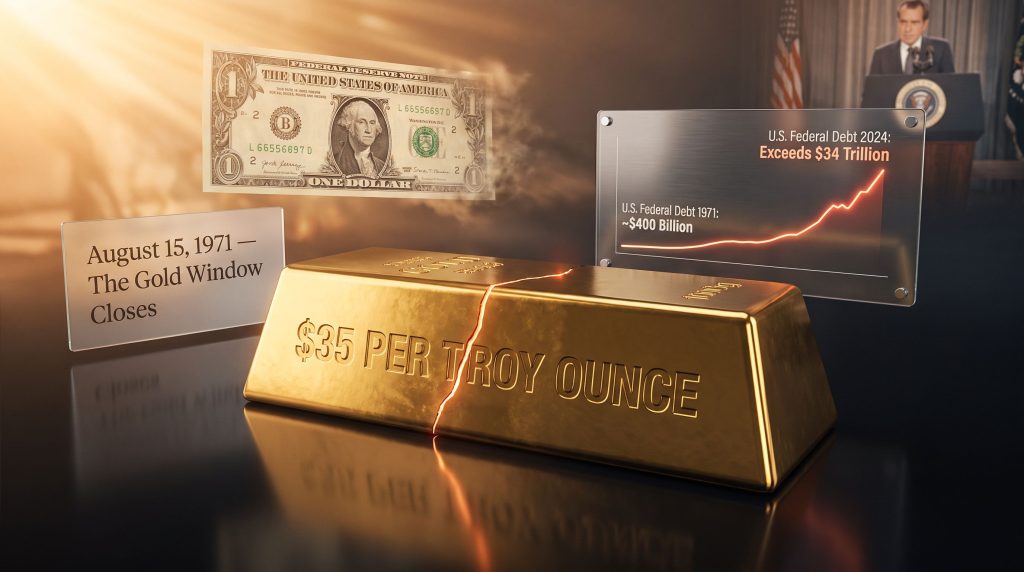
- U.S. federal debt in 1971: approximately $400 billion
- U.S. federal debt by 1981: crossed $1 trillion, a 150% increase in a single decade
- U.S. federal debt as of 2024: exceeds $34 to $35 trillion
- Current rate of debt accumulation: approximately $1 trillion every three to five months
When the gold window closed, U.S. federal debt stood at roughly $400 billion. Within a decade it crossed $1 trillion. Today it surpasses $34 trillion and is growing at a pace that would have been unimaginable to the architects of Bretton Woods. This trajectory is structurally inseparable from the removal of monetary discipline.
The Debt-Interest Rate Feedback Loop
The expanding national debt creates its own internal pressure on monetary policy. As the total debt load grows, even small increases in interest rates translate into enormous increases in annual debt servicing costs. This creates a feedback loop:
- Government accumulates debt through deficit spending.
- Higher debt levels increase the political sensitivity of interest rate decisions.
- Central banks face institutional pressure to keep rates lower than inflation dynamics alone would warrant.
- Artificially low rates encourage additional borrowing by both governments and private actors.
- Expanded debt further intensifies the political constraints on future rate decisions.
- The cycle self-reinforces over successive economic cycles.
This mechanism is one reason why the post-2008 era of near-zero interest rates persisted for over a decade, and why the inflationary consequences of that prolonged accommodation ultimately proved difficult to contain.
The Wage-Inflation Gap and the Affordability Crisis
The erosion of real wages relative to the cost of essential goods represents one of the most socially significant downstream consequences of the post-1971 monetary architecture. Fiat money is the structural root of the modern affordability crisis.
Housing, healthcare, and education — the three largest components of household expenditure for working families — have experienced price inflation that has dramatically outpaced wage growth over the past five decades. This is not primarily a supply problem or a regulatory failure, though those factors contribute. It is a monetary phenomenon rooted in the sustained expansion of the money supply and the resulting erosion of purchasing power.
Importantly, this dynamic does not resolve itself through political intervention. Regardless of whether government spending is directed toward industrial subsidies, tariffs, social programs, or tax cuts, if the underlying monetary expansion continues, the purchasing power erosion compounds. Fiscal policy interventions that increase government spending may temporarily redistribute economic outcomes, but they accelerate the underlying debt accumulation that intensifies monetary pressure over time.
The Political Economy of Fiat: Why Spending Grows Regardless of Ideology
How Debt Monetisation Works in Practice
Understanding why fiat systems tend toward spending growth requires understanding the mechanics of debt monetisation:
- Government issues Treasury bonds to finance spending that exceeds tax revenues.
- Central bank purchases bonds from secondary markets, creating new money in the process.
- Expanded money supply increases nominal spending capacity across the economy.
- If real economic output does not grow proportionally, inflation absorbs the excess.
- Inflation reduces real purchasing power, effectively functioning as a hidden tax on savers and wage earners.
- As debt levels rise, the political incentive to repeat this cycle intensifies.
The critical insight is that debt monetisation is politically attractive precisely because its costs are diffuse and delayed while its benefits are concentrated and immediate. A government that issues debt today and monetises it through central bank accommodation receives the spending benefit now. The inflationary cost is distributed across every holder of the currency and arrives gradually, making political attribution difficult.
Why Both Political Traditions Expand Debt
The post-1971 fiscal record is striking in its bipartisan consistency. Debt has grown under Republican and Democratic administrations alike, through periods of economic growth and recession, under hawks and doves, under supply-siders and Keynesians. The pattern suggests that the drivers of fiscal expansion are structural rather than ideological.
The asymmetry is fundamental: the political benefits of government spending are visible, attributable, and immediate. The costs of the resulting monetary inflation are invisible, diffuse, and delayed. No rational political actor operating within this system has a strong incentive to accept the political cost of fiscal restraint when the alternative is to defer that cost through monetary accommodation.
The next major ASX story will hit our subscribers first
Could the Dollar Lose Its World Reserve Currency Status?
The Triffin Dilemma: A Structural Contradiction Built Into Reserve Currency Status
Belgian-American economist Robert Triffin identified in the 1960s a fundamental contradiction embedded in any system where a national currency serves as the world's reserve asset. To supply sufficient reserves for global trade, the reserve currency issuer must run persistent current account deficits. However, persistent deficits ultimately undermine confidence in the reserve currency itself. This tension, known as the Triffin Dilemma, has no clean resolution within the current framework.
The British pound's loss of reserve currency status in the 20th century provides a historical template. The process was gradual, nonlinear, and accompanied by significant economic adjustment. The United Kingdom did not wake up one day to find the pound irrelevant; it experienced decades of declining relative economic power, periodic currency crises, and eventually a managed transition to a secondary reserve currency role.
Scenario Analysis: Pathways for Dollar Reserve Status
| Scenario | Assessed Probability | Key Trigger | Economic Impact |
|---|---|---|---|
| Gradual Multipolar Shift | Moderate to High | Sustained U.S. fiscal deterioration | Managed but painful adjustment over decades |
| Accelerated De-Dollarisation | Low to Moderate | Major geopolitical rupture or fiscal crisis | Significant dollar depreciation and import inflation |
| Dollar Retains Dominance | Moderate | No viable alternative emerges at scale | Continuation of current debt-inflation dynamics |
| Return to Commodity Anchor | Very Low | Coordinated international agreement | Structural monetary reset with significant transition costs |
The gradual multipolar shift scenario is gaining credibility as BRICS economies develop bilateral trade settlement mechanisms in non-dollar currencies, and as central bank gold buying has become a consistent global trend since 2010.
Gold in the Post-1971 Monetary Landscape
From $35 to $2,300: What Gold's Price Trajectory Actually Measures
Gold's price trajectory after 1971 is best understood not as gold becoming more valuable but as the dollar becoming less so. The $35 per ounce price was an artificially maintained ceiling sustained by U.S. policy. When that ceiling was removed, gold's price began reflecting the actual rate of dollar depreciation.
Key price milestones reveal the pattern:
- 1971: $35 per ounce (artificially fixed)
- 1980: Approximately $850 per ounce at the peak of the inflationary surge
- 2011: Approximately $1,900 per ounce, driven by post-2008 quantitative easing
- 2024: Exceeding $2,300 per ounce, with continued central bank accumulation supporting prices
The long-run price appreciation of gold in dollar terms does not reflect speculative excess. It reflects the measured, compounding depreciation of fiat purchasing power over more than five decades. As noted by Yale School of Management researchers, the ripple effects of Nixon closing the gold window continue to shape global economic dynamics to this day.
Central Bank Gold Accumulation: Reading the Institutional Signal
Perhaps the most instructive signal in contemporary monetary markets is the behaviour of central banks themselves. After decades of being net sellers of gold through the 1980s and 1990s, central banks globally became consistent net buyers from around 2010 onward. In addition, the pace of accumulation has accelerated in recent years, with emerging market central banks — particularly those of China, Russia, India, Poland, and Turkey — adding substantially to central bank gold reserves.
This institutional behaviour carries information that retail commentary often misses. Central banks are not speculating on short-term price movements. They are making multi-decade strategic reserve allocation decisions. The consistent direction of those decisions — toward gold and away from purely dollar-denominated assets — reflects institutional assessment of long-run fiat currency risk that public communications rarely articulate explicitly.
Gold as a Long-Run Store of Value: Evidence and Honest Limitations
The empirical record supports gold as ultimate money — a multi-decade store of value and purchasing power preserver. Over 30 to 50 year horizons, gold has broadly maintained its real purchasing power relative to essential goods and services in ways that fiat currencies demonstrably have not.
However, honest assessment requires acknowledging gold's limitations as a short to medium-term inflation hedge:
- Gold underperformed significantly during the disinflationary period from 1980 to 2000, losing substantial nominal value even as moderate inflation continued.
- Gold's price is sensitive to real interest rates, typically performing poorly when real yields are positive and strongly when real yields turn negative.
- Gold generates no income, meaning its opportunity cost rises in high real interest rate environments.
- Short-term volatility can be substantial, making gold unsuitable as a capital preservation vehicle over short time horizons.
The appropriate frame for gold in a portfolio context is as a long-run monetary insurance position rather than a tactical trading vehicle. Its value proposition is most directly tied to the cumulative effects of monetary policy decisions that trace their structural origins to the moment Nixon closing the gold window permanently altered the relationship between money and physical constraint.
Frequently Asked Questions
What exactly did Nixon do when he closed the gold window?
On August 15, 1971, Nixon suspended the legal right of foreign governments and central banks to exchange U.S. dollars for physical gold at the fixed rate of $35 per ounce. This ended the Bretton Woods system and transitioned the world to floating exchange rates and pure fiat currency.
Why did Nixon close the gold window in 1971?
A convergence of pressures made the fixed rate unsustainable. Deficit spending on Vietnam and domestic social programs had expanded the dollar supply beyond gold-backed limits. Foreign nations, particularly France, were aggressively redeeming dollars for gold, draining U.S. reserves at an alarming rate. Inflation was accelerating. Currency speculators were betting against the dollar parity. The system had become indefensible.
What was the Nixon Shock?
The Nixon Shock describes the full package of economic interventions announced on August 15, 1971: suspension of dollar-gold convertibility, a 90-day freeze on wages and prices, and a 10% surcharge on all imports. The combination represented an emergency restructuring of U.S. monetary and trade policy.
Has closing the gold window caused long-term inflation?
The removal of gold convertibility eliminated the primary structural constraint on money creation. While multiple factors influence inflation in any given period, the post-1971 monetary architecture has enabled a scale of monetary expansion that has produced sustained, compounding purchasing power erosion over five decades.
Could the U.S. ever return to a gold standard?
A formal return faces profound practical barriers. U.S. federal debt now exceeds $34 trillion, a figure that cannot be meaningfully gold-backed at any politically viable price. Global trade volumes require far greater monetary flexibility than a commodity-backed system typically provides. The transition costs alone would be structurally disruptive, which is why a return to any form of gold standard remains, for now, a theoretical rather than practical consideration.
Disclaimer: This article is intended for informational and educational purposes only. It does not constitute financial advice. Past monetary policy outcomes and historical gold price performance are not necessarily indicative of future results. Readers should consult qualified financial advisors before making any investment decisions.
Want to Position Yourself Ahead of the Next Major Mineral Discovery?
Discovery Alert's proprietary Discovery IQ model delivers real-time alerts on significant ASX mineral discoveries, transforming complex geological data into actionable investment insights for both new and experienced investors — start your 14-day free trial today and explore the historic returns that major mineral discoveries have generated.