August 11, 2026
The Structural Forces Rewriting Gold's Long-Term Price Story
Commodity price forecasting is rarely a straight line. The most instructive signals often lie not in the final number, but in the reasoning behind revisions, the variables that were added or removed, and the demand forces left deliberately unchanged. When one of the world's most closely watched investment banks adjusts a Goldman Sachs gold forecast $4,900 by $500 per ounce, the question worth asking is not simply whether the number went up or down, but which structural pillars remained standing after the recalculation.
That analytical lens is precisely what makes the gold price forecast of US$4,900/oz for end-2026 worth examining in depth, particularly for investors trying to separate short-term monetary policy noise from the longer-cycle forces now reshaping global gold demand.
When big ASX news breaks, our subscribers know first
A Forecast That Has Moved Three Times in Under a Year
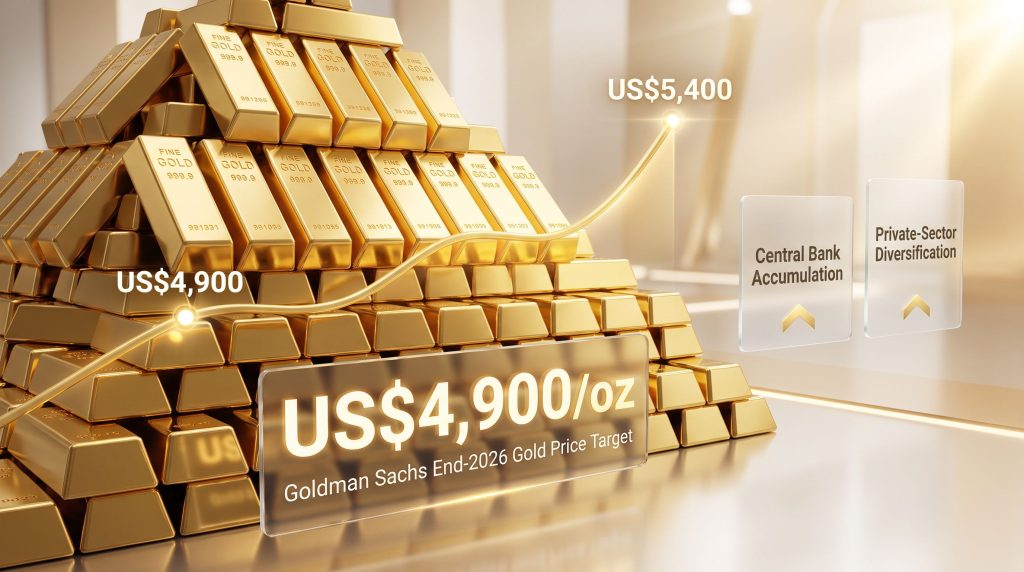
Goldman Sachs established its initial end-of-2026 gold price target of US$4,900 per ounce in late 2025. The original thesis rested on two reinforcing pillars: sustained central bank gold demand as a reserve asset, and anticipated interest rate reductions by the US Federal Reserve that would lower real yields and reduce the opportunity cost of holding a non-yielding asset like gold.
By January 2026, private-sector portfolio diversification into gold had accelerated faster than the model initially projected. Institutional and retail investors were reallocating capital toward gold at a pace that warranted a meaningful upward revision. The target moved to US$5,400/oz.
Then, in June 2026, the forecast was walked back to US$4,900/oz. The reason was specific and technical: the Federal Reserve's anticipated rate cuts did not materialise. With monetary policy expected to remain on hold through the remainder of 2026, a key input was removed from the upward scenario. The structural demand thesis, however, was not revised. Goldman simultaneously flagged that upside risk remained intact, contingent on whether private investors would re-enter the market at scale.
| Forecast Period | Goldman Target | Key Driver Change |
|---|---|---|
| Late 2025 | US$4,900/oz | Central bank demand + anticipated Fed cuts |
| January 2026 | US$5,400/oz | Private-sector diversification accelerated |
| June 2026 | US$4,900/oz | Fed rate cuts removed from base case |
| Post-June 2026 | US$4,900/oz + upside flagged | Potential private investor inflow surge |
The revision from $5,400 to $4,900 isolates a single removed variable while leaving the broader structural thesis intact. Misreading it as a bearish signal means misreading the entire analytical framework.
Why Central Bank Demand Is No Longer a Cyclical Story
One of the most underappreciated dynamics in the current gold market is the qualitative shift in who is buying gold and why. Central bank gold accumulation has historically been treated as a secondary or supplementary demand force in institutional price models. Goldman's methodology treats it as a primary driver, and the data suggests that positioning is well-founded.
Since 2022, global central banks have purchased gold at a rate not seen in over five decades, according to World Gold Council data. The pace of buying accelerated sharply following the freezing of Russian sovereign assets held in Western financial infrastructure, a development that prompted a reassessment of reserve risk among nations holding large positions in US dollar-denominated instruments.
The practical implication is significant:
- Central bank purchasing decisions are driven by reserve management mandates, not price momentum
- This means buying tends to continue even as prices rise, fundamentally altering the traditional price-suppression mechanism of rising costs deterring buyers
- Nations with large US Treasury holdings represent a substantial pool of potential future gold buyers as de-dollarisation strategies mature
- The structural nature of this demand creates a persistent baseline that was absent in prior gold bull cycles, including the 2011 peak
Furthermore, central bank gold reserves have grown consistently across emerging markets, reinforcing this structural shift. Unlike speculative demand that retreats when prices rise, central bank accumulation is largely price-insensitive. Institutions buy on mandate, not momentum, which changes the supply-demand calculus at the macro level in ways that standard commodity models do not fully capture.
This is a lesser-known nuance in how gold's demand curve is now constructed. Historically, rising gold prices eventually choked off demand by making the metal prohibitively expensive for jewellery fabrication and retail buyers. The entry of sovereign buyers who are structurally indifferent to price creates a floor dynamic that is genuinely new in modern gold market history.
How Monetary Policy Intersects With the $4,900 Target
The Federal Reserve's interest rate trajectory remains the most sensitive variable in Goldman's model. The relationship between real yields and gold prices is well-documented: when real yields fall, the relative attractiveness of non-yielding assets like gold increases, and vice versa.
| Fed Scenario | Policy Direction | Implied Gold Price Pressure |
|---|---|---|
| Rate cuts materialise in late 2026 | Dovish pivot | Upward, lower real yields reduce opportunity cost |
| Rates held steady | Neutral hold | Moderate, base case supports $4,900 |
| Rate hikes resume | Hawkish surprise | Downward pressure near-term |
| Cuts plus private inflows | Dovish with demand surge | Upside beyond $4,900 target |
The June 2026 revision removed the rate-cut scenario from the base case but did not remove it from the upside scenario. If the Federal Reserve moves toward easing in the second half of 2026, the original $5,400 target effectively re-activates as a plausible outcome. Goldman has made this scenario architecture explicit, which is analytically distinctive compared with institutional forecasts that bury upside optionality in footnotes.
The Private-Sector Wildcard Goldman Has Flagged
Central bank buying provides the structural floor. The variable with the greatest near-term price amplification potential is private-sector participation, specifically the degree to which institutional funds, pension managers, and high-net-worth investors increase their gold allocations from current positions.
A frequently overlooked data point: many institutional funds remain meaningfully underweight gold relative to historical norms and relative to optimal portfolio allocation models. Academic research into portfolio construction, including work building on Harry Markowitz's efficient frontier framework, has repeatedly shown that small gold allocations of 5% to 10% can meaningfully reduce overall portfolio volatility without proportionally sacrificing return. Despite this evidence, the majority of institutional capital globally holds gold positions well below these thresholds.
The implication for the Goldman Sachs gold forecast $4,900 is material:
- Even a modest reallocation across the global institutional capital base would translate into billions of dollars in incremental gold demand
- This demand does not require a geopolitical catalyst or a currency crisis to manifest
- It can occur through routine portfolio rebalancing decisions, particularly as gold's recent multi-year performance record attracts fresh scrutiny from asset allocators
- Exchange-traded fund (ETF) flow data serves as a leading indicator of this trend, making it one of the most important metrics to monitor in the second half of 2026
Three Scenarios That Could Push Gold Beyond $4,900
Scenario One: A Dovish Federal Reserve Pivot
If US economic data softens sufficiently to prompt the Federal Reserve to signal rate reductions, real yields would decline and gold's relative attractiveness would improve sharply. Historical data from prior Fed easing cycles, including 2019 and the post-2020 period, shows gold responding strongly to dovish pivots even before rate cuts are formally implemented. The anticipation effect alone can be significant.
Scenario Two: Accelerated De-Dollarisation
Nations holding large US dollar reserve positions continue to represent a substantial latent source of gold demand. The shift from US Treasuries to gold has been gradual but consistent. Should geopolitical or financial conditions accelerate this process, the volume of incremental central bank buying could materially exceed Goldman's base-case assumptions.
China, which has been steadily increasing disclosed gold reserves, and other emerging market central banks represent the most visible part of this dynamic. In addition, gold as a safe haven continues to attract sovereign buyers seeking to reduce exposure to dollar-denominated risk.
Scenario Three: Institutional Re-Allocation at Scale
The third pathway requires no external catalyst at all. If institutional investors, currently underweight gold by historical standards, begin normalising their allocations, the resulting demand surge could push prices well above the $4,900 base case. This is the scenario Goldman has most explicitly flagged as the primary upside risk, and it is also the one that is most difficult to time or predict.
Consequently, when evaluating options between physical gold vs ETFs, investors must consider which vehicle best captures this institutional demand dynamic.
The next major ASX story will hit our subscribers first
What Sophisticated Investors Should Actually Monitor
For those seeking to translate Goldman's institutional framework into practical decision-making, the following indicators serve as the most reliable real-time signals of which scenario is unfolding:
- Federal Reserve meeting statements and dot plot revisions: Any language shift toward easing reactivates the upside gold scenario immediately
- IMF and World Gold Council quarterly data: These reports track official sector purchasing and are the most reliable indicator of central bank demand trajectory
- Gold ETF inflows and outflows: A consistent leading indicator of private-sector sentiment and institutional participation
- US dollar index (DXY) trends: Dollar weakness historically amplifies gold price appreciation, creating a feedback loop between currency markets and the precious metals sector
- Real yield movements on US Treasury Inflation-Protected Securities (TIPS): The most direct measure of the opportunity cost of holding gold
For long-term holders and physical gold buyers, the precision of a single year-end price target matters far less than the durability of the underlying demand thesis. Goldman's framework, across all three of its 2025-2026 forecast iterations, has consistently identified structural conditions that are unlikely to reverse on a short time horizon. As noted by Kitco analysts, gold could blow past $4,900 if investors accelerate diversification buying in the coming months.
Reading the Forecast Revision Correctly
There is an important psychological dimension to how forecast revisions are received by markets and media. A downward revision carries a reflexively bearish connotation, even when the analytical substance points in a different direction. In Goldman's case, the revision from $5,400 to $4,900 was accompanied by the explicit reaffirmation of upside risk scenarios, which is an unusual step for institutional research and one that signals the bank's conviction in the broader bull thesis has not materially weakened.
Directionally, the Goldman Sachs gold forecast $4,900 has tracked upward across the entire 2025-2026 period. The end-2026 target, even after the June revision, represents a substantial premium to gold prices recorded just 18 to 24 months prior. Viewed through that lens, the revision narrative may be more constructive than the headline number suggests.
The structural forces underpinning gold's appreciation, sovereign reserve diversification, institutional underweighting, monetary policy uncertainty, and a genuine shift in how global capital allocators perceive gold as an asset class, have not changed. One variable was removed from one scenario in one model. The architecture supporting gold's multi-year trajectory remains largely intact.
Frequently Asked Questions
What is Goldman Sachs' current gold price forecast for 2026?
Goldman Sachs holds an end-of-2026 gold price target of US$4,900 per ounce, revised down from a prior target of US$5,400 following a reassessment of Federal Reserve interest rate expectations.
Why did Goldman Sachs revise the gold forecast from $5,400 to $4,900?
The revision reflects the removal of anticipated Federal Reserve rate cuts from the base-case scenario. With monetary policy expected to remain on hold through 2026, a significant upward price driver was eliminated from the model, though the structural demand thesis was left unchanged.
Does Goldman still see potential for gold to exceed $4,900?
Yes. Goldman's research explicitly identifies upside risk to the $4,900 target, primarily tied to the potential for private investors to significantly increase gold allocations from currently underweight positions.
What are the primary forces behind Goldman's bullish gold case?
Two independent demand forces anchor the forecast: sustained central bank gold accumulation as a long-term reserve management strategy, and the potential for large-scale private-sector portfolio reallocation into gold.
Is US$4,900 a price ceiling or a base case?
Goldman has framed $4,900 as a base-case target with acknowledged upside, not a ceiling. The bank's own scenario analysis identifies conditions under which gold could meaningfully exceed this level.
Disclaimer: This article is for informational purposes only and does not constitute financial advice. Gold price forecasts, including those from major investment banks, are analytical estimates and not guarantees of future performance. Readers should consult a licensed financial adviser before making investment decisions.
Want To Stay Ahead of the Next Major Mineral Discovery?
While Goldman Sachs' structural gold thesis points to sustained long-term appreciation, the sharpest gains in the sector have historically come from identifying significant discoveries early — exactly what Discovery Alert's proprietary Discovery IQ model is built for, delivering real-time ASX mineral discovery alerts to subscribers before the broader market reacts. Explore historic discovery returns on Discovery Alert's dedicated discoveries page and begin a 14-day free trial to position ahead of the next major find.