
August 11, 2026
When the Price Surge Stops at the Permit Office: Understanding Mexico's Gold Mining Bottleneck
There is a well-established pattern in commodity markets that separates price discovery from production reality. Metal prices respond within seconds to macroeconomic data, central bank signals, and geopolitical shifts. Mine output, by contrast, responds over years, filtered through geology, engineering, capital planning, and, critically, regulatory frameworks that operate on their own timelines entirely independent of spot markets. Nowhere is this divergence more starkly visible in 2026 than in Mexico, where the Mexico gold mining permitting bottleneck is generating record financial returns while its physical production pipeline contracts and its concession architecture remains frozen.
Understanding this dynamic requires looking beyond the headline profit numbers and examining the administrative machinery that ultimately determines whether a gold price rally translates into new mines or simply into larger dividends. The mining permitting realities are far more complex than most investors appreciate.
When big ASX news breaks, our subscribers know first
How Mexico's Mining Permitting System Actually Works
The path from mineral discovery to gold production in Mexico is not a single gate to pass through. It is a sequential chain of independent federal authorisations, each processed by a different agency on its own timeline, and each capable of halting an entire project independently of progress made elsewhere.
The Core Approval Architecture
| Permit Type | Issuing Authority | Function | Typical Timeline |
|---|---|---|---|
| Mining Concession | Secretaría de Economía | Rights to explore and exploit | Currently suspended for new grants |
| Environmental Impact Authorization (MIA) | SEMARNAT | Project footprint and mitigation approval | 12-24 months (compressed in select cases) |
| Water Use Concession | CONAGUA | Authorises groundwater and surface water extraction | 12-18 months, highly variable |
| Discharge Permit | CONAGUA | Authorises treated water return | Sequential to water concession |
| Social Consultation (ILO 169) | Multiple federal bodies | Required near indigenous communities | Open-ended |
A critical point that is frequently misunderstood outside the sector: a mining concession grants the legal right to extract minerals, but it does not authorise a single cubic metre of earth to be disturbed for construction or production purposes. Environmental authorisation, water extraction rights, discharge permits, and community consultation are entirely separate regulatory instruments, each processed independently.
Key Structural Insight: Failure at any single node in this permit chain halts the entire project. A company can hold a valid concession title for years while being blocked at the environmental or water permitting stage, with no mechanism to advance the two processes simultaneously in an integrated review.
The 2023 Mining Law Reform and Its Unresolved Consequences
The 2023 Mining Law reform introduced substantive changes across three dimensions: how concessions are structured and granted, how community consultation obligations are defined, and how water rights interact with mining operations under a reformed priority hierarchy. What it did not deliver, as of mid-2026, are the implementing regulations necessary to make the new framework operational.
This regulatory gap creates a compounding problem. Operators cannot structure new applications with confidence because the rules governing those applications have not been published. Legal counsel cannot advise with certainty. Financial modellers cannot quantify regulatory risk with precision. The result is a framework that reformed the rules without enabling compliance with the new ones, adding a layer of administrative paralysis on top of the pre-existing sequential permitting architecture. Consequently, these permit delays are actively threatening billions in potential investment.
Quantifying Mexico's Gold Permitting Backlog in 2026
Federal authorities have publicly acknowledged inheriting a backlog of 176 stalled mining projects across all mineral categories. The current administration committed to normalising permit processing, and progress has been measurable, though uneven.
Backlog Resolution Status (Mid-2026)
| Status | Number of Projects |
|---|---|
| Inherited backlog | 176 |
| Resolved | 110 |
| Still pending | 66 |
| Resolution rate | ~62.5% |
The resolution figure requires careful interpretation. Not every resolved case represents an approved project. Administrative closures and formal rejections are counted within the resolved category, meaning the effective approval rate for stalled projects is lower than the headline resolution rate suggests.
Where the Real Bottleneck Is Concentrated
For gold-specific development, the permitting friction is concentrated at two points in the approval sequence:
-
SEMARNAT's MIA review process — Timelines have reportedly compressed from 18-24 months to 12-15 months in selected cases. However, this improvement is selective rather than systematic. Projects situated in ecologically sensitive zones, areas proximate to federally protected natural areas, or regions with active community consultation obligations face materially longer and less predictable review cycles.
-
CONAGUA water coordination — Gold processing operations are water-intensive by nature. Cyanide leaching, heap leach operations, and flotation circuits all require substantial water inputs and generate process water that must be treated and returned under discharge authorisation. Because water extraction concessions and discharge permits are processed on separate tracks by the same agency, they can fall out of synchronisation, creating bottlenecks that extend total project timelines well beyond the published agency benchmarks.
A dimension that receives insufficient attention in mainstream coverage is the geographic overlap between Mexico's protected natural area network and its historically most productive gold and silver districts. As the regulatory stance on permits inside federally protected zones has tightened through 2026, the effective geographic universe of developable ground is narrowing, even for operators who hold existing concession portfolios in those regions.
The Fresnillo Paradox: Record Profits, Shrinking Output
No single data set illustrates the Mexico gold mining permitting bottleneck more precisely than Fresnillo's first-half 2026 results. The company is the world's largest primary silver producer and one of Mexico's dominant gold producers, making its financials a direct read on how price leverage interacts with production constraints.
Fresnillo H1 2026 Performance
| Metric | H1 2026 Result | Year-on-Year Change |
|---|---|---|
| Net profit | US$1.46 billion | +213% |
| Revenue | US$3.38 billion | +74.7% |
| Silver output | 22 Moz | -11.4% |
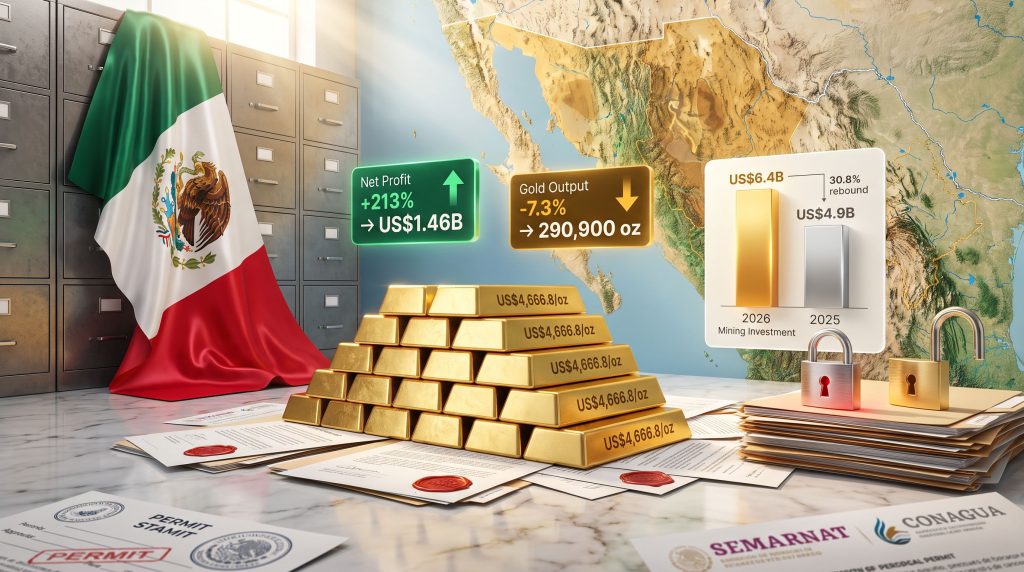
| Gold output | 290,900 oz | -7.3% |
| Realised silver price | US$78.9/oz | +134.4% |
| Realised gold price | US$4,666.8/oz | +47.3% |
| 2026 capital expenditure guidance | US$500-550 million | Trimmed |
| Exploration spend | ~US$260 million | Maintained |
| Silver production guidance | 42-46.5 Moz | Unchanged |
| Gold production guidance | 500,000-550,000 oz | Unchanged |
The numbers reveal a company whose financial performance is entirely disconnected from its operational trajectory. Profit tripled not because more gold or silver came out of the ground, but because the price of what was already coming out increased dramatically. Output declined across Saucito, Juanicipio, Fresnillo, San Julian, and Cienega due to lower grades, a geological reality that elevated prices cannot correct.
Capital Allocation Signal: Fresnillo trimmed its 2026 capital expenditure program while holding exploration spending steady. This is not a growth budget. It is a capital preservation posture calibrated to a regulatory environment where new production concessions are not being granted and the administrative pathway for new capacity is undefined.
How the Windfall Is Being Deployed Across Mexico's Mining Sector
Sectoral Revenue and Investment Trends
The broader sectoral picture reinforces Fresnillo's individual dynamic. Mexico's ten largest mining companies collectively exceeded MX$517 billion in revenue, with Peñasquito contributing MX$42.56 billion and Torex Gold's Morelos complex adding MX$20.45 billion. Grupo Mexico lifted second-quarter 2026 net profit by 90.9% to US$2.09 billion, driven primarily by metals price appreciation rather than volume growth.
CAMIMEX data provides the most revealing context for how this financial windfall is being deployed.
2026 Mexican Mining Investment Composition
| Investment Category | Estimated Allocation |
|---|---|
| Maintenance capital | US$1.11 billion |
| Expansion at existing operations | US$976 million |
| Equipment procurement | US$835 million |
| New project development | Residual and constrained |
The projected US$6.4 billion in 2026 mining investment represents a 30.8% rebound from the US$4.9 billion recorded in 2025, which itself reflected a 3.3% decline directly attributable to permitting delays. However, the composition of that investment tells the real story. Maintenance leads the allocation, followed by expansions at existing permitted facilities and equipment orders.
New project development, the category that would convert gold price gains into long-term production growth, sits in a residual and constrained position. State-level reporting from Chihuahua makes this dynamic explicit. Mining operations across the state are approaching the end of their productive life cycles, yet the reported value of production continues to rise, driven entirely by metal price appreciation and favourable peso-to-dollar exchange rate dynamics rather than any increase in physical output.
The Policy Architecture Closing the Concession Pipeline
No New Concessions: The Sheinbaum Administration's Explicit Position
The Sheinbaum administration has been unambiguous. No new mining concessions will be granted under the current policy framework. This position, applied consistently since taking office, combined with the unpublished implementing regulations of the 2023 Mining Law, has effectively closed the front end of Mexico's project development pipeline to new entrants.
The market consequence is a structural bifurcation:
-
Permitted or near-permitted assets carry a scarcity premium that is only growing as the no-new-concessions policy persists. These assets represent the only viable path to production within any foreseeable investment timeframe.
-
Greenfield exploration ground, even in geologically prospective areas with favourable grade characteristics, carries diminished near-term development value because the administrative pathway from discovery to concession to production is not currently accessible.
This bifurcation is reshaping M&A dynamics in the sector. Furthermore, the gold M&A activity in comparable jurisdictions demonstrates how brownfield consolidation accelerates when greenfield pathways close. Operators are increasingly seeking to expand resource bases within existing permitted footprints rather than pursuing new exploration ground that cannot be converted to production rights under current policy.
The next major ASX story will hit our subscribers first
The August 2026 Gold Rally: Context and Caution
Situating the Rally Within the Broader Price Cycle
The week ending August 7, 2026 saw gold mining equities deliver their strongest five-session performance in years, with GDX closing at US$89.73 after a 21.09% gain and GDXJ reaching US$116.78 following a 22.42% advance. Bullion itself reached approximately US$4,353/oz, a two-month high, triggered by a US labor market report showing an unexpected contraction of 23,000 jobs against consensus expectations of an 80,000 gain.
| Instrument | Weekly Gain | Closing Level |
|---|---|---|
| GDX (VanEck Gold Miners ETF) | +21.09% | US$89.73 |
| GDXJ (VanEck Junior Gold Miners ETF) | +22.42% | US$116.78 |
| TSX Venture Composite | +8.00% | N/A |
| Global X Copper Miners ETF | +12.00% | N/A |
Large producers with Mexican exposure participated fully. Agnico Eagle Mines gained 22.92% to C$250.17 in Toronto. Newmont advanced 20.55% to US$112.97, and Barrick Mining rose 19.22% to C$61.34. Both Newmont and Agnico carry significant Mexican exposure, through the Peñasquito complex in Zacatecas and the San Nicolas joint venture with Teck Resources in the same state respectively.
The broader gold price outlook for miners remains a critical consideration for anyone modelling Mexican project economics against current spot levels.
The Price Reference Point That Matters for Modelling
| Price Reference | Level | Context |
|---|---|---|
| January 2026 cycle peak | ~US$5,595/oz | Record high |
| Q2 2026 trough | ~28% below peak | Sector's worst quarter since 2013 |
| August 7, 2026 close | ~US$4,353/oz | Two-month high, ~22% below January peak |
Modelling Caution: Investors and analysts modelling Mexican project economics against the August 7 gold price should note that US$4,353/oz represents a recovery to a price level that Mexican operators were already budgeting against, not a new floor. Sensitivity analysis must incorporate continued price volatility, particularly given that the August rally was triggered by a single labour market datapoint that reset Federal Reserve rate expectations.
Junior Miners, Financing Windows, and the Permitting Constraint
Why Junior Outperformance in a Rally Matters for Mexico
Junior mining companies carry the greatest operational leverage to gold price movements. Their cost structures are proportionally more sensitive to metal price changes than major producers, generating amplified equity returns during bullion rallies. GDXJ outperforming GDX by approximately 130 basis points during the August rally is consistent with this structural pattern, and the TSX Venture Composite's 8% gain reflects broader risk appetite reopening for pre-production names.
Historically, junior outperformance in a gold rally signals a reopening of equity financing windows, where pre-production companies can raise capital at improved dilution levels to fund exploration and development programmes. In addition, the broader landscape of junior mining investment in 2025 demonstrated how regulatory uncertainty can suppress capital deployment even when equity markets are receptive.
In the Mexican context, however, this financing opportunity collides directly with the permitting bottleneck. Capital raised in an open financing window cannot be deployed into new project development if the regulatory pathway to production is closed. The result is that the junior financing window may open in the equity markets while remaining sealed in the regulatory framework.
What Capital Allocators Are Requiring From Mexican Projects
Industry discourse from sector forums indicates that elevated gold prices improve project economics on paper but have not reduced investor scrutiny of regulatory risk. The dominant shifts in capital allocation preferences include:
-
Streaming and royalty structures are increasingly preferred over equity dilution, offering downside protection through price retracements while maintaining upside exposure to production
-
Demonstrated permit progress is now a prerequisite for institutional capital commitment, not merely a supportive factor alongside geological results
-
Brownfield proximity to existing permitted infrastructure commands a material valuation premium as the scarcity of permitted ground becomes more widely understood
Permitting Progress for Operators Already in the System
Isolated examples confirm that the permitting environment is not uniformly frozen for operators with existing concession portfolios. Capitan Silver expanded its drill permit at the Cruz de Plata project in Durango, extending the approved programme beyond a 2.5 km strike length, indicating that drill permit expansions within already-granted exploration frameworks can advance. Fresnillo reportedly received seven concession titles during a period of faster processing at the federal level, suggesting that established operators with compliant application records are experiencing improved processing velocity.
The critical distinction is that these examples represent progress within the existing concession framework. A drill permit expansion is not a new production concession. Faster processing for established operators with existing regulatory relationships does not constitute a policy reversal on new concession issuance.
How Mexico Compares on the Global Permitting Spectrum
| Jurisdiction | New Concession Access | Environmental Timeline | Water Permitting | Regulatory Certainty |
|---|---|---|---|---|
| Mexico | Suspended (new grants) | 12-24 months | Complex, sequential | Low (2023 law unimplemented) |
| Canada (Quebec/Ontario) | Open | 18-36 months | Integrated | High |
| Australia (Western Australia) | Open | 12-24 months | Integrated | High |
| Nevada (USA) | Open | 24-48 months | Integrated | Moderate to High |
| Peru | Open (selective) | 18-30 months | Moderate complexity | Moderate |
Mexico's geological endowment as the world's largest primary silver producer and a major gold jurisdiction sits in structural tension with its position at the higher end of jurisdictional risk among comparable gold-producing nations. Furthermore, efforts toward mining permit reform in neighbouring jurisdictions highlight how the combination of suspended new concession issuance, sequential permitting, and an unresolved legislative framework represents an unusual concentration of regulatory risk factors that comparable jurisdictions do not currently share. The BNamericas mine permitting report similarly identifies permitting as the defining bottleneck constraining production growth across multiple jurisdictions globally.
What Would Actually Unlock the Permitting Logjam
Three structural changes would materially alter the production outlook for Mexico's gold sector without requiring a reversal of the administration's core policy positions:
-
Publication of 2023 Mining Law implementing regulations — This single action would allow operators to structure compliant applications, allow legal counsel to advise with certainty, and allow financial modellers to quantify regulatory risk with precision. The absence of published regulations creates uncertainty that is arguably more damaging than the regulations themselves, regardless of their content.
-
Integration of environmental, water, and social permitting review tracks — Sequential processing at SEMARNAT and CONAGUA extends total project timelines unnecessarily. A coordinated review mechanism, similar to integrated models operating in Canada and Australia, would reduce total approval timelines without requiring any reduction in environmental or social standards.
-
A transparent framework for new concession applications — Even a selective or criteria-based pathway for new concession access, with clearly defined eligibility requirements, would reactivate junior exploration investment and begin rebuilding the long-term project pipeline that is currently depleting without replacement.
Frequently Asked Questions: Mexico Gold Mining Permitting
Can a company begin gold production in Mexico with just a mining concession?
No. A mining concession grants the legal right to explore and exploit a deposit but does not authorise construction or production activities. Separate SEMARNAT environmental authorisation, CONAGUA water and discharge permits, and, where applicable, ILO 169 community consultation must all be obtained independently before any development activity can legally begin.
Is Mexico issuing new gold mining concessions in 2026?
The Sheinbaum administration has stated that no new mining concessions will be granted under the current policy framework. Projects without existing concession titles face an undefined administrative pathway, which has concentrated investment value in already-permitted assets and suppressed new exploration activity.
Why are Mexican gold producers reporting record profits while output is declining?
The margin leverage mechanism means gold price increases flow almost immediately into revenue while operating costs, including labour contracts, energy tariffs, and reagent supply agreements, adjust on longer cycles of six to eighteen months. This lag produces disproportionate profit growth even when physical volumes are flat or declining, as demonstrated precisely by Fresnillo's 213% profit increase against a 7.3% decline in gold output during the first half of 2026.
What types of gold projects are still advancing in Mexico despite the bottleneck?
Projects with existing concession titles, near-complete environmental authorisations, or established brownfield infrastructure are advancing more reliably than new entrants. Drill permit expansions within already-permitted exploration programmes have moved through the system. The common thread is administrative history: operators with established regulatory relationships and compliant application records experience materially faster processing than new market participants. The Mexico gold mining permitting bottleneck, however, continues to constrain even the most experienced operators when it comes to genuinely new production capacity.
Disclaimer: This article is for informational purposes only and does not constitute financial or investment advice. Forecasts, projections, and scenario analyses presented here involve inherent uncertainty and should not be relied upon as the basis for investment decisions. Readers should conduct their own due diligence and consult qualified financial advisors before making any investment decisions related to companies or jurisdictions discussed in this article. Past performance of gold prices or mining equities does not guarantee future results.
Want to Capitalise on the Next Major Mineral Discovery Before the Market Does?
While Mexico's permitting bottleneck highlights how regulatory delays can suppress production growth even during record gold price rallies, Discovery Alert's proprietary Discovery IQ model scans the ASX daily to deliver real-time alerts on significant mineral discoveries — turning complex data across 30+ commodities into clear, actionable insights the moment they're announced. Explore historic discovery returns on Discovery Alert's discoveries page to understand how early positioning in major finds can generate substantial returns, and begin your 14-day free trial at Discovery Alert to secure your market-leading edge.