June 20, 2026
Government Energy Market Interventions Transform Australian Industrial Policy
Contemporary industrial policy frameworks reveal complex intersections between market failures and strategic government intervention across energy-intensive manufacturing sectors. Australia offers support to Rio Tinto Tomago aluminium plant through evolving approaches that represent a fundamental shift in regulatory philosophy, moving beyond traditional market mechanisms toward direct government participation in industrial viability decisions.
Energy-intensive manufacturing industries globally face unprecedented challenges as electricity markets undergo rapid transformation driven by renewable energy integration, grid stability concerns, and carbon pricing mechanisms. These structural changes create particular vulnerabilities for aluminium smelting operations, which require consistent, low-cost electricity supply to maintain competitive production economics.
When big ASX news breaks, our subscribers know first
Understanding Australia's Strategic Metals Framework
The Role of Aluminium in National Manufacturing Security
Australia's industrial policy architecture increasingly recognises aluminium production as critical infrastructure requiring protection from market volatility. The Tomago smelter's 600,000 tonnes per annum production capacity positions it as a cornerstone of domestic manufacturing capability, supporting both regional economic stability and strategic materials security.
Manufacturing security frameworks extend beyond simple employment considerations to encompass supply chain resilience, technological capabilities, and national industrial capacity preservation. Government analysis demonstrates that large-scale aluminium facilities like Tomago create extensive economic multiplier effects through their integration with regional supply chains and service providers.
The strategic value of maintaining domestic aluminium production becomes particularly apparent when considering international supply chain vulnerabilities and the material's applications in defence, aerospace, and infrastructure sectors. Furthermore, policy makers increasingly view energy support for these facilities as investments in industrial sovereignty rather than traditional subsidies, particularly given Australia's strategic minerals reserve initiatives.
Energy-Intensive Industries Under Policy Review
Federal and state governments have initiated comprehensive reviews of energy-intensive manufacturing viability following multiple industry closure announcements throughout 2024 and 2025. Rio Tinto's October warning regarding potential Tomago closure highlighted systemic challenges affecting the entire heavy industry sector.
The company had been seeking viable energy solutions since 2022 but found existing market mechanisms inadequate for securing long-term, cost-competitive electricity contracts. This three-year search period demonstrates the depth of structural challenges facing energy-intensive manufacturers in Australia's evolving electricity market.
Historical production data reveals ongoing operational pressures, with Tomago producing 426,000 tonnes during January-September 2025, representing a 2.2% year-on-year decline. These figures reflect broader industry constraints rather than facility-specific operational issues.
Government intervention in energy-intensive industries reflects broader challenges in managing industrial transition during decarbonisation. Fixed-price agreements transfer market risk from operators to taxpayers while preserving employment and manufacturing capacity.
Federal vs State Coordination in Industrial Support
The Tomago support framework demonstrates sophisticated intergovernmental coordination between federal and New South Wales authorities. Both jurisdictions recognised that unilateral action would prove insufficient for addressing complex energy market failures affecting large industrial facilities.
Prime Minister Anthony Albanese's announcement emphasised federal commitment to preserving manufacturing capability through collaborative approaches with state governments. This coordination model represents emerging best practice for addressing industrial policy challenges that span multiple regulatory jurisdictions.
Minister Tim Ayres characterised these interventions as rational, pragmatic responses to acute economic challenges, emphasising government obligations to preserve economic conditions supporting Australian industrial workers. This framing positions industrial support within broader social and economic policy objectives.
The agreement structure includes Rio Tinto's investment commitment of A$1 billion over 10 years in facility improvements and technological upgrades, creating reciprocal obligations between government energy support and private sector capacity enhancement.
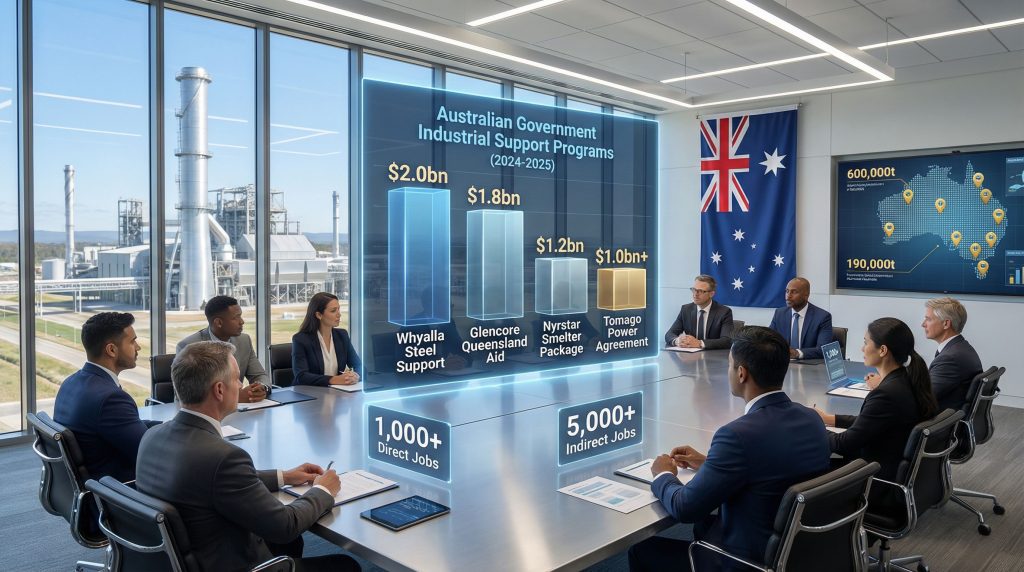
Table: Australian Government Industrial Support Programs (2024-2025)
| Program | Sector | Investment Value | Policy Objective |
|---|---|---|---|
| Whyalla Steel Support | Steel | $2.0bn | Employment preservation |
| Glencore Queensland Aid | Copper | $1.8bn | Regional economic stability |
| Nyrstar Smelter Package | Lead/Zinc | $1.2bn | Critical minerals security |
| Tomago Power Agreement | Aluminium | $1.0bn+ | Energy transition support |
What Energy Market Failures Drive Government Intervention?
Power Purchase Agreement Structures in Heavy Industry
Fixed-price power purchase agreements represent fundamental departures from traditional electricity market structures, transferring price risk from industrial operators to government entities. These arrangements acknowledge that conventional market mechanisms cannot provide the long-term price certainty required for capital-intensive industrial operations.
The Tomago agreement establishes precedents for government-backed electricity pricing that extends beyond the facility's current contract expiration at end of 2028. This timeline provides sufficient planning horizon for both operational continuity and strategic investment decisions.
Traditional electricity markets rely on short to medium-term contract structures that create significant uncertainty for facilities requiring decades-long operational planning. Heavy industrial users need predictable energy costs to justify major capital investments and maintain competitive positioning in global markets.
Government-backed PPAs enable industrial facilities to secure financing for technological upgrades and efficiency improvements that would be economically unviable under volatile market pricing. Consequently, this creates positive feedback loops between energy security and industrial modernisation.
Market Dynamics Behind Unsustainable Energy Costs
Australia's National Electricity Market transformation has created structural challenges for large industrial users requiring baseload power supply. The retirement of coal-fired generation capacity, combined with increased renewable energy penetration, has altered fundamental market dynamics affecting industrial electricity pricing.
Renewable energy intermittency requires sophisticated balancing mechanisms and backup generation capacity, costs that are ultimately reflected in industrial electricity contracts. Traditional long-term contracts that previously provided price certainty are increasingly difficult to negotiate due to regulatory uncertainty and generation portfolio changes.
Network stability concerns related to high renewable penetration create additional costs for large industrial users through system strength requirements and frequency control ancillary services. These technical requirements, while necessary for grid stability, significantly increase the total cost of electricity supply for energy-intensive operations.
Market concentration among electricity retailers has reduced competitive pressure for industrial contracts, while regulatory frameworks have not evolved to address the specific needs of energy-intensive manufacturing. This creates market failures where commercially viable electricity supply becomes unavailable despite underlying generation capacity adequacy.
Regulatory Gaps in Long-Term Energy Contracting
Existing electricity market regulations prioritise short-term efficiency over long-term industrial supply security, creating systemic barriers to the multi-decade contracts required by heavy manufacturing. National Electricity Law frameworks do not adequately account for the specialised requirements of energy-intensive industries.
Prudential requirements for electricity retailers create risk management constraints that limit their ability to offer long-term fixed-price contracts to large industrial users. These regulations, designed to prevent retailer defaults, inadvertently restrict contract terms that would benefit industrial facilities.
Environmental regulations create additional uncertainty for long-term electricity contracting as carbon pricing mechanisms, renewable energy targets, and emissions standards continue evolving. Furthermore, this regulatory uncertainty makes it difficult for both electricity suppliers and industrial users to negotiate contracts extending beyond current policy frameworks.
Financial market regulations affecting project financing and risk management also constrain the development of innovative contract structures that could bridge the gap between industrial requirements and electricity market capabilities.
How Do Fixed-Price Power Agreements Reshape Industrial Economics?
Risk Allocation Between Government and Private Operators
Government-backed fixed-price agreements fundamentally alter risk distribution in industrial energy supply by transferring market price volatility from private operators to public sector entities. This reallocation enables industrial facilities to make long-term investment commitments whilst providing taxpayers with economic benefits through preserved employment and industrial capacity.
The Tomago arrangement establishes a framework where government assumes electricity price risk in exchange for significant private sector investment commitments and operational guarantees. Rio Tinto's A$1 billion investment commitment over 10 years demonstrates how risk transfer mechanisms can leverage public support to generate substantial private sector contributions.
Risk allocation extends beyond simple price guarantees to encompass operational performance standards, employment maintenance requirements, and technological upgrade commitments. These multi-dimensional agreements create accountability mechanisms that protect public investment whilst ensuring continued industrial competitiveness.
Successful risk allocation requires sophisticated modelling of electricity market scenarios, industrial operational requirements, and macroeconomic conditions affecting both government finances and industrial profitability. This complexity necessitates expert analysis and ongoing monitoring throughout contract terms.
Precedent Analysis: International Energy Subsidy Models
International examples of government energy support for industrial facilities provide valuable insights for Australian policy development. European Union state aid frameworks permit energy-intensive industry support under specific conditions related to employment preservation, regional development, and environmental improvements.
German industrial energy policies include extensive support mechanisms for energy-intensive manufacturing, including electricity price compensation schemes and long-term contract guarantees. These programmes have successfully maintained industrial competitiveness whilst supporting broader energy transition objectives.
Canadian provincial governments have implemented similar approaches for aluminium smelting operations, particularly in Quebec where hydroelectric resources enable competitive long-term industrial contracts. However, these precedents demonstrate the importance of aligning industrial support with underlying energy resource advantages, addressing similar energy transition hurdles that Canada faces.
United States industrial energy policies increasingly incorporate national security considerations, providing frameworks for supporting strategic manufacturing capabilities through energy subsidies and preferential contract arrangements.
Long-Term Fiscal Implications for State Budgets
Fixed-price electricity agreements create contingent fiscal liabilities that require careful analysis and budgetary planning across multi-year time horizons. Government exposure to electricity market volatility must be balanced against the economic benefits of preserved industrial capacity and employment.
Fiscal modelling for these arrangements requires sophisticated scenario analysis encompassing electricity market evolution, carbon pricing developments, and broader economic conditions affecting industrial competitiveness. Budget planning must account for potential cost variations across contract terms.
Revenue optimisation strategies can include participation in industrial facility profits during favourable market conditions, creating upside sharing mechanisms that balance public risk-taking with potential returns. These arrangements require complex financial structuring and ongoing performance monitoring.
Long-term fiscal sustainability depends on maintaining industrial competitiveness and economic contribution levels that justify ongoing public support. Regular review mechanisms and performance benchmarks ensure continued alignment between public investment and economic outcomes.
What Investment Commitments Signal About Industry Confidence?
Capital Allocation Patterns in Energy-Intensive Manufacturing
Rio Tinto's substantial investment commitment reflects growing confidence in the long-term viability of Australian aluminium production under government-supported energy arrangements. The A$1 billion over 10 years commitment demonstrates strategic confidence extending well beyond immediate operational requirements.
Capital allocation patterns in energy-intensive industries typically reflect long-term market assessments and regulatory environment stability. Major investment commitments signal management confidence in sustained competitive positioning and regulatory framework durability.
Technology upgrade investments included in the Tomago commitment likely focus on energy efficiency improvements, automation enhancements, and environmental performance upgrades. These investments create positive spillover effects through technology development and skills enhancement.
Investment timing coordination with government support demonstrates sophisticated strategic planning by industrial operators who recognise opportunities to leverage public support for facility modernisation and competitive enhancement.
Technology Upgrade Requirements Under Support Agreements
Government energy support agreements increasingly incorporate technology upgrade requirements that advance broader policy objectives including energy efficiency, environmental performance, and industrial innovation. These requirements create mutual benefits for government policy goals and industrial competitiveness.
Technology upgrades in aluminium smelting operations can deliver significant energy efficiency improvements, reducing overall electricity consumption whilst maintaining or increasing production capacity. These efficiency gains benefit both facility economics and broader electricity system optimisation.
Advanced process control systems, predictive maintenance technologies, and automation upgrades enhance operational reliability whilst reducing labour requirements and operational risks. These improvements support long-term industrial viability and workforce productivity.
Environmental technology upgrades including emissions reduction systems and waste minimisation technologies align industrial operations with evolving environmental regulations whilst improving community relations and social licence to operate.
Performance Metrics and Compliance Frameworks
Government-backed industrial support requires robust performance monitoring and compliance frameworks ensuring public investment delivers anticipated economic and social benefits. These frameworks typically include employment maintenance requirements, production capacity targets, and investment milestone verification.
Employment metrics must account for both direct facility employment and broader economic multiplier effects through regional supply chains and service providers. Monitoring systems track job quality, skills development, and workforce stability alongside simple employment numbers.
Production performance standards ensure facilities maintain operational capacity justifying ongoing public support whilst allowing for reasonable operational flexibility during market downturns or maintenance periods. These standards balance accountability with operational realities.
Investment compliance verification requires detailed tracking of capital expenditures, technology upgrades, and facility improvements to ensure private sector commitments align with public support levels. Regular auditing and reporting mechanisms maintain transparency and accountability.
Why Are Multiple Aluminium Facilities Seeking Government Support?
Bell Bay Smelter: Tasmania's Low-Carbon Production Strategy
Tasmania's 190,000 tonnes per year Bell Bay smelter represents another strategic aluminium facility seeking government energy support through low-carbon production subsidies. The facility's integration with Tasmania's predominantly renewable electricity system positions it uniquely for carbon-conscious global markets.
Tasmanian government officials have advocated federal support for Bell Bay through recognition of its environmental advantages and strategic economic importance to regional development. The facility's renewable energy profile creates opportunities for premium pricing in carbon-constrained markets.
Low-carbon aluminium production capabilities align with evolving global supply chain requirements as manufacturers seek reduced-emission materials for automotive, aerospace, and construction applications. For instance, government support can accelerate market positioning for these premium products by addressing regional economic impact considerations.
The Bell Bay support requests demonstrate industry-wide recognition that government intervention may be necessary for maintaining Australian aluminium production capability across multiple facilities and regions.
Comparative Analysis of Smelter Viability Challenges
Australian aluminium smelters face common challenges including rising electricity costs, ageing infrastructure, and intensifying international competition from lower-cost producers. These systemic pressures affect facility viability regardless of individual operational efficiency or management quality.
International aluminium markets feature significant overcapacity, particularly from Chinese producers with lower input costs and different regulatory frameworks. Australian facilities require competitive energy pricing to maintain market position against these international competitors.
Infrastructure age and maintenance requirements create ongoing capital investment needs that may be difficult to justify under uncertain energy cost projections. Government support can enable facility modernisation that improves long-term competitiveness.
Geographic isolation from major export markets creates additional logistics costs for Australian producers, making energy cost competitiveness even more critical for maintaining viable operations in global markets. This challenge mirrors broader energy export challenges facing the Australian economy.
Regional Economic Impact Assessment Methodologies
Regional economic impact assessments for large industrial facilities typically employ input-output modelling to quantify direct, indirect, and induced economic effects throughout local and regional economies. These analyses inform government decision-making regarding industrial support justification.
Table: Economic Impact Metrics
| Facility | Direct Jobs | Indirect Jobs | Annual Production | Regional GDP Impact |
|---|---|---|---|---|
| Tomago Smelter | 1,000+ | 5,000+ | 600,000t | $2.5bn+ |
| Bell Bay Smelter | 600+ | 2,500+ | 190,000t | $800mn+ |
Employment multiplier effects extend through regional supply chains, professional services, and consumer spending by facility workers and contractors. These multiplier effects often exceed direct employment by factors of three to five times.
Tax revenue impacts include corporate income taxes, payroll taxes, and property taxes generated directly by facilities and indirectly through economic multiplier effects. These revenue streams help offset public support costs whilst providing ongoing fiscal benefits.
Regional development impacts encompass infrastructure investments, skills development, and industrial ecosystem preservation that create long-term economic benefits extending beyond individual facility operations.
The next major ASX story will hit our subscribers first
How Does This Support Align With Australia's Green Transition Goals?
Renewable Energy Integration in Heavy Industry
Government support for aluminium facilities increasingly incorporates renewable energy integration requirements that advance broader decarbonisation objectives whilst maintaining industrial competitiveness. These requirements create synergies between industrial preservation and environmental policy goals.
Aluminium smelting operations can provide valuable grid services including demand response, load balancing, and renewable energy absorption during periods of excess generation. These technical capabilities make industrial facilities valuable partners in grid transformation rather than simply large electricity consumers.
Energy storage integration opportunities enable industrial facilities to participate in electricity market optimisation whilst reducing their overall energy costs. Government support can facilitate these technological investments that benefit both industrial operations and broader grid stability.
Green hydrogen production integration represents emerging opportunities for industrial facilities to diversify their operations whilst supporting renewable energy utilisation. These developments align industrial support with hydrogen strategy implementation.
Carbon Intensity Reduction Pathways for Aluminium Production
Modern aluminium smelting technology enables significant carbon intensity reductions through improved energy efficiency, renewable electricity utilisation, and process optimisation. Government support can accelerate adoption of these advanced technologies through improved energy transition mechanisms.
Inert anode technology development represents revolutionary potential for eliminating direct carbon emissions from aluminium production processes. Australian facilities supported by government programmes can serve as testbeds for these breakthrough technologies.
Recycling integration and circular economy approaches reduce overall carbon intensity whilst creating additional revenue streams for aluminium facilities. Government support can facilitate investments in recycling infrastructure and technology.
Carbon capture and utilisation technologies may enable continued competitiveness for aluminium production whilst achieving carbon neutrality goals. Research and development support can accelerate these technological developments.
Green Metals Fund Implementation Strategy
Australia's Green Metals Fund provides frameworks for supporting industrial decarbonisation through technology development, infrastructure investment, and market development initiatives. Aluminium facility support aligns with these broader strategic objectives.
Technology commercialisation support enables Australian facilities to become early adopters of breakthrough technologies whilst building domestic capabilities in green industrial processes. This positioning supports both industrial competitiveness and technology export potential.
Market development initiatives help establish premium pricing for low-carbon metals whilst building supply chain relationships with environmentally conscious manufacturers. Government support facilitates market positioning for these emerging opportunities.
International cooperation frameworks enable technology sharing and joint development projects that leverage Australian industrial capabilities whilst accessing global expertise and markets for green metals technologies.
What Regulatory Precedents Does This Intervention Establish?
Criteria for Future Industrial Support Decisions
The Tomago support arrangement establishes important precedents for evaluating future industrial assistance requests based on employment impact, strategic importance, energy market failure, and private sector investment commitments. These criteria provide frameworks for consistent policy application.
Employment preservation requirements demonstrate government prioritisation of job security and regional economic stability as primary justifications for industrial intervention. Future support decisions will likely emphasise employment metrics and workforce impact assessments.
Strategic industry importance criteria encompass national security considerations, supply chain resilience, and technological capability preservation. These factors enable government support for industries deemed critical to national economic or security interests.
Market failure analysis becomes essential for justifying government intervention in competitive markets. Documentation of unsuccessful commercial solutions and regulatory barriers provides necessary foundations for public sector involvement.
Competitive Implications for Unsupported Facilities
Government support for selected facilities creates potential competitive advantages that may disadvantage unsupported operations competing in the same markets. These dynamics require careful policy design to minimise market distortions whilst achieving public policy objectives.
Level playing field considerations necessitate clear, transparent criteria for support eligibility that enable all qualifying facilities to access assistance programmes. Arbitrary or inconsistent support decisions could create unfair competitive advantages.
International trade implications include potential challenges under World Trade Organisation subsidy rules and bilateral trade agreements. Support programme design must carefully navigate international trade law requirements whilst achieving domestic policy goals.
Industry consolidation effects may result from competitive advantages created by government support, potentially reducing market competition whilst increasing industrial concentration. Policy makers must balance support objectives with competition policy considerations.
WTO Compliance and International Trade Considerations
World Trade Organisation subsidy rules require careful structuring of government industrial support to avoid prohibited trade-distorting measures whilst enabling legitimate policy objectives including employment preservation and environmental protection.
Regional development justifications provide stronger legal foundations for government support under international trade rules, particularly when assistance targets economically disadvantaged areas or addresses market failures affecting regional economic stability.
Environmental policy integration strengthens legal foundations for industrial support by linking assistance to broader policy objectives including carbon reduction, renewable energy adoption, and environmental performance improvements. These approaches receive support from government renewable energy initiatives.
Transparency and notification requirements under international trade agreements necessitate detailed documentation and reporting regarding support programme design, implementation, and economic impacts to maintain compliance with international obligations.
Employment Protection vs Market Efficiency Trade-offs
Labour Market Impact Analysis Frameworks
Government industrial support programmes require sophisticated analysis of labour market impacts extending beyond simple job preservation to encompass skills development, wage effects, and broader economic multiplier impacts throughout regional labour markets.
Skills preservation considerations recognise that industrial facility closures result in loss of specialised technical capabilities that may be difficult or impossible to reconstruct. Government support maintains these skill bases for potential future economic development opportunities.
Wage premium effects in industrial employment often exceed regional average wages significantly, creating income stability and spending power that supports broader regional economic activity. These premium wage impacts justify public support through economic multiplier analysis.
Workforce demographic analysis reveals that industrial facility closures disproportionately affect older workers who face significant barriers to re-employment in comparable positions. Support programmes provide social benefits by maintaining employment for vulnerable workforce segments.
Regional Development Policy Integration
Industrial support programmes align with broader regional development strategies by maintaining economic anchors that support service industries, retail activity, and professional services throughout regional economies. These integration benefits extend policy justification beyond individual facility considerations.
Infrastructure utilisation optimisation results from maintaining industrial operations that justify continued investment in transportation, utilities, and communications infrastructure serving regional areas. Facility closures can create stranded infrastructure investments with limited alternative uses.
Population retention benefits include maintaining demographic stability in regional areas where industrial facility closures often trigger out-migration and community decline. These social benefits justify government intervention from community development perspectives.
Economic diversification opportunities may emerge from maintaining industrial facilities that can serve as platforms for related industry development or technology commercialisation. Government support preserves options for future economic development initiatives.
Skills Transition Planning for Industrial Workers
Government support programmes increasingly incorporate workforce development components that prepare industrial workers for evolving skill requirements including technology adoption, environmental compliance, and advanced manufacturing techniques.
Cross-training opportunities enable industrial workers to develop capabilities applicable across multiple industries, reducing vulnerability to single-facility dependence whilst maintaining valuable technical skills within regional labour markets.
Technology training programmes aligned with facility modernisation investments create workforce capabilities supporting advanced manufacturing processes whilst improving individual worker employment security and advancement opportunities.
Retirement transition planning addresses demographic challenges in industrial workforces where significant portions approach retirement age, requiring succession planning and knowledge transfer initiatives to maintain operational capabilities.
Future Policy Implications for Australian Manufacturing
Scalability of Energy Support Models
The Tomago precedent establishes frameworks for potential expansion of government energy support across multiple industrial facilities and sectors facing similar electricity market challenges. Scalability analysis must consider fiscal capacity, administrative requirements, and economic impact optimisation.
Programme standardisation opportunities include developing template agreements, standardised performance metrics, and streamlined approval processes that enable efficient expansion whilst maintaining necessary oversight and accountability mechanisms.
Resource allocation frameworks require prioritisation criteria that enable government to direct limited support resources toward facilities and sectors generating maximum economic and social benefits relative to public investment levels.
Budget sustainability analysis must account for potential accumulation of contingent fiscal liabilities as multiple facilities receive energy support, requiring careful portfolio management and risk assessment across supported operations.
Integration with National Manufacturing Strategy
Industrial energy support programmes align with broader National Manufacturing Strategy objectives including supply chain resilience, technological capability development, and strategic industry preservation. This alignment strengthens policy justification whilst creating synergies across government initiatives.
Innovation ecosystem development benefits result from maintaining industrial facilities that can serve as testbeds for advanced technologies, provide practical training environments, and create market opportunities for technology developers and service providers.
Export competitiveness enhancement through energy cost management enables Australian manufacturers to compete more effectively in global markets whilst maintaining domestic production capabilities that support strategic autonomy objectives.
Research and development collaboration opportunities emerge from government-supported industrial facilities that can partner with universities, research institutions, and technology companies in developing and commercialising advanced manufacturing technologies.
Long-Term Competitiveness Considerations
Government energy support must be designed to enhance rather than undermine long-term industrial competitiveness by incentivising productivity improvements, technology adoption, and market positioning strategies that reduce dependence on ongoing public assistance.
Market transition planning requires clear timelines and performance benchmarks that enable supported facilities to achieve self-sustaining competitiveness whilst providing sufficient certainty for investment planning and operational decision-making.
Technology advancement requirements ensure that government support facilitates rather than substitutes for necessary industrial modernisation and efficiency improvements that maintain competitive positioning in evolving global markets.
Performance monitoring and evaluation systems must track progress toward competitive independence whilst maintaining accountability for public investment and ensuring continued alignment between support programmes and policy objectives.
Disclaimer: This analysis is based on publicly available information and policy frameworks current as of the publication date. Industrial support programmes involve complex economic, technical, and political considerations that may evolve significantly over time. Readers should consult current government policy documents and seek professional advice for specific business decisions related to industrial policy developments.
Ready to Capitalise on Australia's Industrial Policy Shifts?
Discovery Alert's proprietary Discovery IQ model delivers real-time alerts on significant ASX mineral discoveries, instantly empowering subscribers to identify actionable opportunities ahead of the broader market as government industrial policies reshape investment landscapes. Begin your 30-day free trial today and secure your market-leading advantage in capitalising on Australia's evolving strategic metals and manufacturing sector opportunities.