July 27, 2026
The Hidden Fragility Inside the Global Battery Anode Supply Chain
Most investors and industry observers focus on lithium when discussing battery supply chain risk. Yet the material sitting at the heart of nearly every commercial lithium-ion cell's negative electrode, graphite, carries a far more concentrated sourcing risk than lithium ever has. The global graphite shortage stems from China currently controlling an estimated 65 to 80 percent of global natural graphite processing capacity, and in spherical graphite, the refined form used directly in battery anodes, that dominance is even more pronounced. For battery manufacturers operating outside China, particularly those in Japan, South Korea, and the European Union, this concentration is no longer merely a procurement inconvenience. It has become a board-level strategic liability.
It is against this backdrop that the recently announced Letter of Intent between Talga Group and Japanese trading and industrial materials company Hanwa Co carries significance well beyond its non-binding legal status. The Talga Hanwa Sweden anode material offtake agreement to negotiate toward a long-term offtake and potential project-level investment in Talga's Vittangi Anode Project in Sweden represents a visible, commercial expression of a supply chain reorientation that has been building for several years across both European and Asian industrial policy circles.
When big ASX news breaks, our subscribers know first
Why Graphite Anode Diversification Has Become Strategically Urgent
Unlike many battery materials where processing is distributed across multiple geographies, graphite anode production has historically been dominated by Chinese producers at every stage: mining, purification, shaping, and coating. The spherical graphite used in anodes requires a multi-step transformation from raw flake material, and China built the industrial-scale infrastructure for this process well before Western or Japanese alternatives existed at commercial scale.
The consequences of this concentration are now playing out in real time across procurement teams, government ministries, and boardrooms. Furthermore, the battery raw materials market is increasingly reflecting these structural pressures:
-
Regulatory exposure: The EU's Critical Raw Materials Act formally classifies natural graphite as a strategic raw material, triggering obligations for European battery manufacturers to demonstrate supply chain diversification.
-
Customer risk management: Japanese battery manufacturers supplying into the electric vehicle sector face growing pressure from automotive OEM customers to verify the geographic provenance and carbon footprint of all upstream inputs.
-
Price and availability uncertainty: Chinese export controls on graphite, which were signalled and partially implemented in 2023, demonstrated that supply disruption risk from a single-origin dependency is not theoretical. It is operational.
Industry Context: Natural graphite and synthetic graphite serve overlapping but distinct segments of the anode market. Synthetic graphite, produced from petroleum needle coke at high temperature, offers consistent quality but carries a substantially higher carbon footprint and energy cost. Natural graphite, when processed to battery grade, can offer a lower-carbon and potentially lower-cost input, but the processing technology to achieve battery-grade purity outside China has historically been limited. This is precisely the capability gap that projects like the Vittangi Anode Project are designed to fill.
What Makes the Vittangi Resource Geologically Distinctive
Not all graphite deposits are commercially equivalent, and the geological characteristics of the Vittangi resource in northern Sweden are a meaningful part of the investment case for the project. The deposit contains a high proportion of large-flake graphite, which is the morphological category most suited to producing the spherical graphite used in battery anodes.
Larger flakes require less intensive processing to achieve the required particle size distribution and surface properties for anode applications, which has direct implications for processing yield, energy consumption, and ultimately cost per tonne of finished anode material.
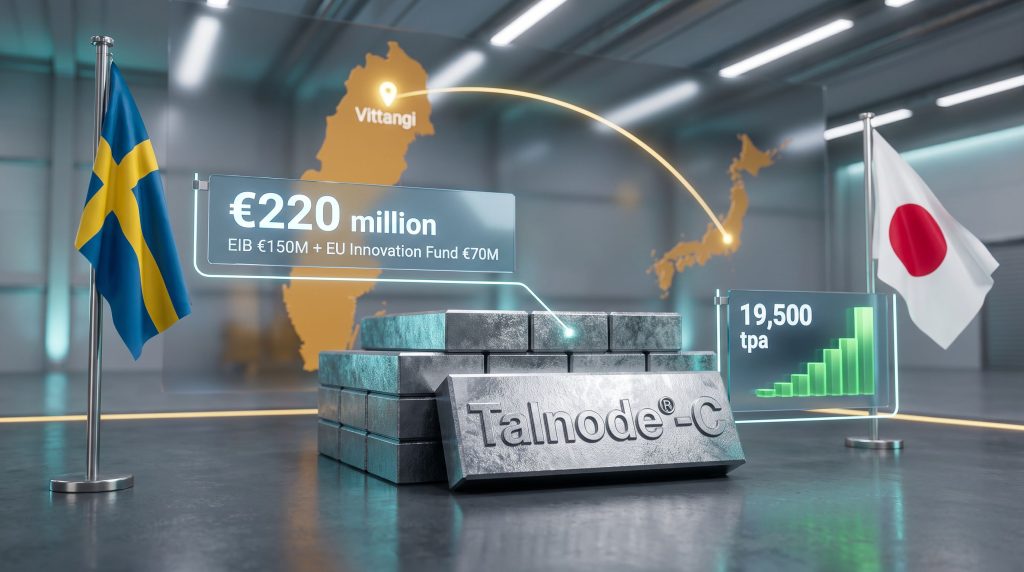
The integrated project structure, running from the Vittangi mining operation through to the Luleå Anode Refinery on Sweden's northern coast, is designed to capture the full value chain domestically within Sweden. This mine-to-anode-material model is rare outside China and is a core commercial differentiator for the project. The planned production capacity at full commercial scale is approximately 19,500 tonnes per annum of Talnode-C graphite anode material, a volume sufficient to supply meaningful portions of several gigafactory-scale battery production facilities.
Sweden's low-carbon electricity grid, predominantly sourced from hydropower and nuclear generation, provides a further structural advantage. The carbon intensity of anode material production is increasingly scrutinised under EU battery regulation lifecycle requirements, and processing graphite using low-carbon grid power translates directly into a lower-carbon product credential that commands premium positioning in procurement decisions by environmentally regulated manufacturers.
The Financial Architecture Supporting the Vittangi Anode Project
One of the less widely understood aspects of the VAP's commercial position is the degree to which its capital structure has already been partially de-risked through institutional financing commitments secured before any equity raise or strategic investment partnership is concluded.
| Financing Source | Instrument Type | Value (EUR) | AUD Equivalent |
|---|---|---|---|
| European Investment Bank | Conditional Debt Facility (Board-Approved) | €150 million | ~A$260 million |
| EU Innovation Fund | Non-Dilutive Grant | €70 million | ~A$120 million |
| Total Pre-Committed Non-Dilutive Support | €220 million | ~A$380 million |
The distinction between these two instruments matters for prospective strategic investors. The EIB facility is debt, requiring repayment but preserving equity value. The EU Innovation Fund grant is non-dilutive and non-repayable, effectively reducing the total capital requirement the project needs to source from equity or commercial debt markets.
Together, these instruments create a capital foundation that reduces the quantum a strategic investor like Hanwa would need to contribute to achieve a meaningful project-level ownership position.
Structural Insight: In capital-intensive mining and processing projects, the sequencing of financing sources is as important as the total quantum. By securing institutional debt and grant commitments before finalising equity partnerships, the VAP has positioned itself to negotiate strategic investment terms from a position of reduced dependency, a negotiating dynamic that differs markedly from projects seeking their first institutional validation.
Deconstructing the Talga Hanwa Sweden Anode Material Offtake Agreement Structure
The LoI signed between Talga and Hanwa Co establishes a framework for negotiating two distinct but interconnected definitive agreements. Understanding the architecture of this dual-track structure is important for assessing what a successful outcome would mean for both parties.
Track 1: Long-Term Binding Offtake Agreement
This component would commit Talga to supplying Talnode-C graphite anode material to Hanwa and its downstream customers on preferential commercial terms for an extended contract period. In the context of Japanese industrial procurement, long-term offtake agreements serve a function beyond simple supply security. They operate as the commercial backbone for downstream product qualification processes, where battery cell manufacturers must certify specific anode material sources through months or years of electrochemical testing. Locking in a supply origin early is therefore a prerequisite for Hanwa's customers to begin the qualification process in parallel with project development.
Track 2: Binding Project-Level Investment Agreement
This component would see Hanwa and potentially a consortium of other Japanese industrial investors take a direct equity or structured financial position in the VAP itself. The investment quantum, form, and structure remain subject to due diligence outcomes. The possibility of a broader Japanese investor consortium is explicitly contemplated, consistent with how Japanese trading houses have historically structured critical mineral investments, often co-investing with industrial partners, financial institutions, and sometimes government-affiliated entities to distribute risk and align commercial interests.
This two-track model mirrors strategies employed by Japanese trading houses in securing lithium hydroxide from Australian projects and nickel from Indonesian operations, where offtake security and equity participation are pursued simultaneously to create both supply certainty and financial upside from upstream asset appreciation.
Building a Multi-Customer Commercial Foundation
A less discussed but strategically significant aspect of the VAP's commercial development is the deliberate construction of a multi-customer offtake pipeline spanning both European and Asian demand centres. The Hanwa LoI is the most recent addition to a layered commercial structure that has been built progressively.
| Commercial Agreement | Counterparty | Nature | Volume / Scope | Current Status |
|---|---|---|---|---|
| Binding Offtake | Nyobolt | Long-term supply | ~3,000 tonnes over 4 years | Binding and Active |
| Non-Binding LoI | Hanwa Co (Japan) | Offtake + Investment | Subject to due diligence | Under Negotiation |
| Non-Binding LoI | Dainen Materials (Japan) | Strategic offtake | Long-term Talnode-C supply | Under Negotiation |
| Non-Binding Term Sheet | ACC (Automotive Cells Co) | Offtake | ~60,000 tonnes over 5 years | Prior Stage |
The Nyobolt binding agreement is commercially important for a reason beyond its volume. Nyobolt specialises in fast-charging battery technology for applications including power tools, robotics, and specialist vehicles, representing a product validation in a demanding electrochemical application where anode material performance under high charge-rate conditions is critical. A binding commercial relationship with a technology-focused battery manufacturer carries disproportionate credibility weight relative to its tonnage.
The ACC term sheet, while at an earlier negotiation stage, is notable for its implied scale. At approximately 60,000 tonnes over five years, a binding conversion of this agreement would represent volumes that substantially exceed the project's initial annual production capacity, implying either a phased supply ramp or a signal of Talga's longer-term expansion ambitions.
The presence of two separate Japanese LoI counterparties, Hanwa Co and Dainen Materials, is itself informative. It suggests that multiple actors within Japan's battery material procurement ecosystem are independently conducting preliminary diligence on the VAP as a sourcing option, rather than a single entity driving the conversation.
The next major ASX story will hit our subscribers first
The Sweden-Japan Cooperation Framework as a Commercial Enabler
In February 2026, Sweden and Japan formalised a joint statement on economic cooperation focused on three pillars: promoting dual-use technology collaboration, expanding industrial alliances between the two countries, and strengthening the resilience of global supply chains. While this framework operates at the diplomatic level, its commercial implications for private-sector transactions in critical minerals are concrete.
For Japanese companies conducting due diligence on a project in a foreign jurisdiction, the existence of a formal bilateral cooperation framework reduces several categories of non-commercial risk: political risk, regulatory uncertainty around foreign investment approvals, and the reputational risk of supply chain provenance. Sweden's membership in the EU, its established rule of law, and its position within the Critical Raw Materials Act framework collectively create a regulatory environment that is legible and predictable for Japanese industrial partners.
Consequently, Europe's critical minerals supply chain is increasingly becoming a destination of choice for Asian industrial capital seeking geographic diversification from Chinese-controlled supply chains. The critical minerals demand driving this shift is accelerating across both European and Asian demand centres as energy transition policies firm up.
Geopolitical Framing: The Sweden-Japan economic cooperation statement should be understood not as a direct enabler of any specific project, but as a trust infrastructure layer that lowers the friction cost for private companies on both sides to pursue commercial relationships. The Talga Hanwa Sweden anode material offtake agreement is an example of private capital moving within the space that diplomatic frameworks make commercially viable.
Scenario Analysis: Pathways From LoI to Final Investment Decision
Talga has indicated a target Final Investment Decision in early 2027. The pathway between the current non-binding LoI and that FID involves multiple execution dependencies. Three distinct scenarios are worth modelling:
Scenario A: Full Conversion, Offtake and Investment
Both definitive agreements are executed following due diligence. Hanwa and potentially a Japanese co-investor consortium take a project-level equity position alongside the existing EIB debt facility and EU Innovation Fund grant. The combined capital structure supports an FID in early 2027 on the originally planned timeline. This outcome would represent one of the most significant non-Chinese graphite anode project financings in recent years.
Scenario B: Offtake Only, No Investment Component
Due diligence supports a binding supply agreement but does not result in a project-level investment commitment from Hanwa. The binding offtake strengthens the project's commercial case for additional equity investors or project finance lenders but does not independently complete the capital stack. The FID timeline may extend modestly depending on how quickly an alternative equity source can be identified and structured.
Scenario C: LoI Lapses Without Binding Agreements
Due diligence identifies gaps that prevent the parties from reaching agreement on definitive terms. The LoI expires without conversion. In this scenario, the project retains its existing financing architecture and the Nyobolt binding agreement, and continues to pursue other offtake and investment counterparties. The reputational effect of a major Japanese trading house having conducted formal due diligence on the project, even without a binding outcome, would likely be viewed constructively by other prospective investors.
Key Risk Factors Investors Should Monitor
Several variables could materially affect the trajectory between the current LoI announcement and a 2027 FID. The critical minerals geopolitics unfolding globally add further complexity to an already demanding execution environment:
-
Due diligence complexity: Cross-border critical mineral investment transactions involving Japanese industrial conglomerates typically involve extensive technical, environmental, legal, and commercial due diligence processes spanning multiple months.
-
Graphite market pricing dynamics: The landed cost of Chinese spherical graphite has been under downward pressure as Chinese producers have expanded capacity. A sustained period of low Chinese graphite pricing could challenge the economics of higher-cost Western alternatives, affecting the terms on which offtake agreements can be negotiated.
-
Synthetic graphite competition: Synthetic graphite's market share in battery anodes has been growing, particularly in premium EV applications where its higher energy density is valued. A shift in customer preference toward synthetic graphite could reduce the addressable market for natural graphite anode products.
-
Swedish permitting timeline: While the VAP holds strategic project designations under EU frameworks, mine permitting and environmental approvals within Sweden's regulatory system follow their own timelines and can introduce delays independent of commercial progress.
-
Japanese capital allocation environment: Broader macroeconomic conditions affecting Japanese industrial capital deployment, including interest rate dynamics and corporate balance sheet priorities, could influence the timing and quantum of any project-level investment commitment.
Disclaimer: This article contains forward-looking analysis, scenario modelling, and investment-related observations. It is intended for informational purposes only and does not constitute financial advice. Readers should conduct their own independent research and seek professional financial guidance before making any investment decisions. All financial figures and project timelines referenced are based on publicly available company announcements and may be subject to change.
Frequently Asked Questions: Talga Hanwa Sweden Anode Material Offtake
What is the Talga-Hanwa LoI?
It is a non-binding Letter of Intent signed between Talga Group and Hanwa Co, a major Japanese trading and industrial materials company, establishing a negotiating framework for two definitive agreements: a long-term binding offtake for Talnode-C graphite anode material from the Vittangi Anode Project, and a potential project-level investment by Hanwa and potentially other Japanese co-investors.
What is Talnode-C?
Talnode-C is Talga's proprietary natural graphite battery anode material, produced from the Vittangi graphite resource in northern Sweden and processed at the Luleå Anode Refinery into battery-grade spherical graphite. It is positioned as a high-quality, low-carbon alternative to Chinese-sourced anode products.
What is the Vittangi Anode Project's planned production capacity?
The integrated project is designed to produce approximately 19,500 tonnes per annum of graphite anode material at full commercial scale.
What financing does the VAP already have in place?
The project holds a board-approved conditional debt facility of €150 million (approximately A$260 million) from the European Investment Bank and a €70 million (approximately A$120 million) grant from the EU Innovation Fund, representing approximately €220 million (approximately A$380 million) in pre-committed non-dilutive support.
When is Talga's Final Investment Decision targeted?
Talga has indicated a target FID in early 2027, subject to completion of binding commercial agreements and finalisation of the project's capital structure.
Why are Japanese companies pursuing Swedish graphite anode projects?
Japanese battery manufacturers and their supply chain partners face increasing pressure to diversify critical mineral sourcing away from Chinese-controlled supply chains. Sweden's position within the EU regulatory framework, its low-carbon energy profile, and the bilateral Sweden-Japan economic cooperation statement signed in February 2026 collectively reduce the non-commercial risk barriers for Japanese industrial investment in Swedish critical mineral projects.
Want to Track the Next Major Critical Mineral Discovery Before the Broader Market Does?
The graphite anode supply chain disruption unfolding across Europe and Asia is a reminder that the most significant investment opportunities often emerge at the intersection of geopolitical realignment and geological scarcity — and Discovery Alert's proprietary Discovery IQ model scans ASX announcements in real time to identify exactly these kinds of high-potential discoveries the moment they are made public. Explore historic returns from major mineral discoveries or start your 14-day free trial today to position yourself ahead of the market.