August 14, 2026
When Cash Flow Becomes the Story: Reading the Signals Behind Greatland's March Quarter
Gold mining's most enduring paradox is that the assets generating the most cash are often the ones investors understand the least. Open-pit polymetallic systems with long production histories tend to attract scepticism, labelled as mature or declining, even as they quietly accumulate capital at a pace that newer discoveries can rarely match. The March 2026 quarter results from Greatland Resources Ltd (ASX: GGP) offer a compelling case study in how operational leverage, disciplined capital allocation, and aggressive exploration can simultaneously redefine what a legacy asset is capable of delivering.
The Greatland Resources March quarter cash build and gold-copper resource growth story is not simply one of strong commodity prices flowing through to the bottom line. It is a story about structural free cash flow generation, a landmark mineral resource re-rating, and the early-stage construction of what could become one of Australia's most significant gold-copper production hubs over the next decade.
When big ASX news breaks, our subscribers know first
Understanding the Financial Architecture Behind the $260 Million Cash Build
To appreciate the significance of Greatland's March 2026 quarterly result, it helps to understand how operational leverage works in large-scale open-pit gold mining. When a producer's cost base is predominantly fixed, revenue increases driven by higher gold prices or volume flow disproportionately to free cash flow. This dynamic is amplified when sustaining capital requirements are modest relative to production scale.
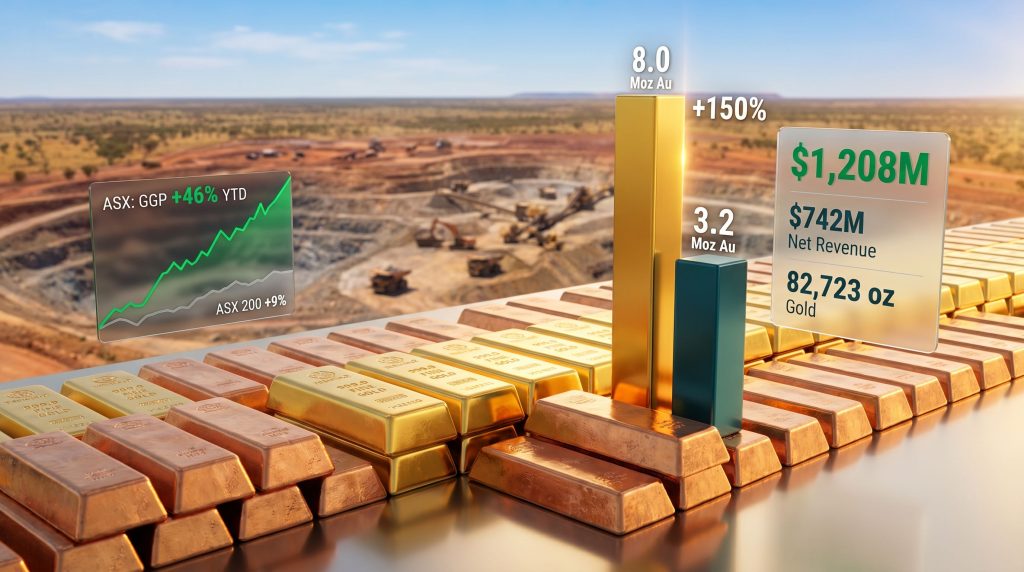
Greatland's March quarter financial outcomes reflect all of these dynamics simultaneously. Opening the period with $948 million in cash at 31 December 2025, the company closed at $1,208 million, a net increase of $260 million in a single quarter. Operating cash flow reached $453 million, a figure that underscores the earnings power of the Telfer asset base at prevailing gold prices.
Against this, the company deployed $42 million toward Telfer growth infrastructure and absorbed a $73 million tax payment, both significant outflows that were entirely absorbed within the quarterly cash generation cycle. The Greatland resource update and financial performance together tell a story of an operation firing on all cylinders.
| Financial Metric | Value |
|---|---|
| Opening Cash (31 Dec 2025) | $948 million |
| Closing Cash (31 Mar 2026) | $1,208 million |
| Net Quarterly Cash Build | $260 million |
| Operating Cash Flow | $453 million |
| Growth Capex Deployed | $42 million |
| Tax Payment | $73 million |
| Total Liquidity (incl. facility) | $1.28 billion |
| Net Debt Position | Zero |
Total liquidity reached $1.28 billion, inclusive of an undrawn $75 million working capital facility. Critically, the balance sheet carries zero debt, a position that provides full strategic flexibility for accelerated development, potential shareholder returns, or acquisition activity without the constraints that debt covenants typically impose on resource companies in growth phases.
A business generating $453 million in operating cash flow within a single quarter, while simultaneously funding material growth capital and a sizeable tax obligation, is not experiencing a transient commodity price windfall. It is demonstrating the structural earnings quality of a genuinely world-class mining operation.
What a Debt-Free, $1.2 Billion Cash Position Actually Means for Investors
For investors evaluating resource companies, the combination of zero debt and over $1.2 billion in cash is a relatively rare balance sheet configuration at this production scale. It eliminates refinancing risk entirely, removes the performance covenant pressures that can force suboptimal operational decisions during commodity price troughs, and positions management to act opportunistically without requiring external capital market access.
In the context of Australian gold mining, where development projects frequently require significant external financing, Greatland's liquidity position represents a meaningful structural advantage. Furthermore, the Havieron development, discussed in detail below, can be internally funded without diluting existing shareholders through equity raises — a path many mid-tier gold developers are forced to pursue.
Production Performance and the FY2026 Guidance Trajectory
Quarterly production figures tell part of the story, but the year-to-date trajectory against annual guidance is where the more important signal sits for investors assessing operational consistency. The gold production outlook across the sector makes Greatland's consistency all the more notable.
Greatland produced 82,723 ounces of gold and 4,128 tonnes of copper during the March quarter, contributing to a full-year FY2026 total of 249,887 ounces of gold and 11,022 tonnes of copper with one quarter remaining. Sales volumes of 97,800 ounces of gold and 4,620 tonnes of copper generated net revenue of $742 million for the period.
| Production and Sales Metric | March Quarter | Year-to-Date FY2026 |
|---|---|---|
| Gold Production | 82,723 oz | 249,887 oz |
| Copper Production | 4,128 t | 11,022 t |
| Gold Sales | 97,800 oz | Not disclosed |
| Copper Sales | 4,620 t | Not disclosed |
| Net Revenue | $742 million | Not disclosed |
| AISC | $2,056/oz | Tracking lower end of guidance |
The All-In Sustaining Cost of $2,056 per ounce is the critical margin benchmark here. AISC is the most widely used standardised cost metric in gold mining, developed by the World Gold Council, and captures not only direct mining and processing costs but also sustaining capital expenditure, royalties, and corporate overhead allocated to producing operations.
The full-year guidance range of 260,000 to 310,000 ounces of gold is now almost entirely fulfilled with one quarter remaining. Year-to-date production of 249,887 ounces positions the company at or slightly above the upper boundary of its guidance range, which management has indicated the business expects to meet or exceed. Cost performance tracking toward the lower end of the forecast range means the combination of volume outperformance and cost discipline is materialising concurrently — a rare operational outcome that speaks to the maturity and reliability of Telfer's processing systems.
The Telfer MRE Upgrade: Why a 150% Resource Growth Event Is Geologically Significant
Mineral Resource Estimates underpin virtually every valuation methodology used to assess gold mining companies, from Net Asset Value models to Enterprise Value per resource ounce comparisons. When a single MRE update expands the total inventory by 150%, the implications for every downstream valuation metric are profound.
Greatland's March 2026 Telfer MRE upgrade added 4.8 million ounces to the prior estimate, lifting the total to 8.0 million ounces of gold. The Measured and Indicated categories, which represent higher confidence resource classifications under the JORC Code 2012 framework used in Australia, grew 163% to 3.8 million ounces. This distinction matters significantly because Measured and Indicated resources are the categories from which Ore Reserves can be converted, and Ore Reserves directly underpin mine planning, project financing, and long-term production scheduling. According to Greatland's official quarterly report, these results represent a landmark achievement in the company's exploration history.
| Resource Category | Pre-Upgrade Estimate (Dec 2024) | Post-Upgrade (Mar 2026) | Change |
|---|---|---|---|
| Telfer Total MRE | ~3.2 Moz Au | 8.0 Moz Au | +150% |
| Measured and Indicated | Not disclosed | 3.8 Moz Au | +163% |
| West Dome Open Pit | Not disclosed | 4.9 Moz Au | +135% |
| West Dome Underground | N/A | 0.6 Moz Au | Maiden estimate |
| Group Total (Telfer + Havieron) | Not disclosed | 14.9 Moz Au + 645kt Cu | Combined |
The West Dome Underground Maiden Resource: What It Signals
The establishment of a maiden 0.6 million ounce West Dome Underground resource is arguably the most strategically important component of the MRE upgrade, and it is the element that receives the least immediate attention from market commentators focused on total ounce counts. Maiden underground resources at established open-pit mines represent a transition point in a deposit's geological story.
They indicate that mineralisation continues to depth below the economic pit shell, opening the possibility of a sequential underground operation following open-pit depletion, which can dramatically extend mine life without proportionate increases in surface infrastructure. The Telfer extension plans outlined by management clearly reflect this long-term strategic vision.
The highest-grade drill intercept supporting the underground resource, 55.3 metres at 7.4 grams per tonne gold and 0.43% copper, is a notable result. In underground gold-copper mining economics, grade is the primary driver of operating margin because underground extraction costs per tonne are materially higher than open-pit costs. An average intercept grade of 7.4 grams per tonne gold sits comfortably above the typical underground mining cut-off grade for Australian operations, which is generally in the range of 2.0 to 3.5 grams per tonne gold equivalent. The copper credit of 0.43% further improves the economic profile of any future underground operation.
Discovery Cost as an Efficiency Benchmark
A discovery cost of approximately $5 per ounce for the resource additions incorporated in the March 2026 MRE upgrade deserves attention as an industry benchmark. Discovery cost, calculated by dividing total exploration expenditure by the number of resource ounces added, is one of the most useful but least commonly discussed metrics for evaluating the capital efficiency of exploration programmes. Industry averages for gold discovery costs have historically ranged from $30 to over $100 per ounce depending on geological province and exploration method.
A $5 per ounce discovery cost positions Greatland's Telfer exploration programme as an exceptionally efficient capital allocator, reflecting the advantages of drilling into a well-understood geological system with existing infrastructure and accumulated geological knowledge from decades of prior production.
The Drilling Engine: Scale, Methodology, and Forward Optionality
Resource growth of this magnitude does not emerge spontaneously. It is the direct product of a sustained, large-scale drilling programs campaign. The March 2026 MRE incorporated 134,000 metres of drilling data, with a further 100,000 or more metres planned for the second half of FY2026. The full-year programme targets 240,000 metres, which would represent one of the most extensive active exploration campaigns conducted at a single Australian gold operation in recent years.
To contextualise the drilling scale, 240,000 metres of drilling is roughly equivalent to drilling 24 kilometres vertically into the earth. At Telfer and the broader Paterson Province, this density of data collection is progressively narrowing the geological uncertainty that separates Inferred resources from the higher-confidence Indicated and Measured categories. Furthermore, interpreting drill results at this scale requires sophisticated geological modelling to translate raw intercepts into resource estimates that comply with JORC standards.
The practical implications for investors are forward-looking:
- Additional resource additions remain a live probability as the H2 FY2026 drilling programme concludes and geological interpretation progresses.
- The conversion of Inferred resources to Measured and Indicated categories through infill drilling could support further Ore Reserve upgrades beyond the current 3.1 million ounce reserve base.
- Regional exploration targets within the Paterson Province land position beyond Telfer and Havieron remain active, extending the geological optionality of the portfolio beyond currently delineated systems.
Risk Management: Hedging Philosophy and Cost Exposure
Greatland's approach to commodity price risk management reflects a deliberate balance between protecting operational cash flow and preserving leverage to gold price upside. The company maintains full unhedged exposure to gold price movements for its existing production, capturing the full benefit of elevated gold markets. Simultaneously, partial downside protection through gold put options for upcoming quarters provides a floor against catastrophic price declines without capping participation in further price appreciation.
This hedging posture is distinct from the gold loan and fixed-price forward structures that cost many Australian producers significant opportunity losses during the gold bull markets of the early 2000s. The lessons of that era, during which heavily hedged producers were locked out of rising gold prices, have fundamentally shaped the hedging philosophies of the current generation of Australian gold management teams.
On the cost side, diesel remains the principal variable input cost for open-pit operations of Telfer's scale. Management has characterised this exposure as modest, with long-term supply agreements providing cost visibility and reducing the sensitivity of AISC to spot diesel price movements. This is a meaningful operational characteristic because diesel costs can represent 15% to 25% of total mining costs at large open-pit operations.
The next major ASX story will hit our subscribers first
Havieron: The Development Asset Providing Long-Term Production Architecture
While Telfer generates the cash, Havieron represents the medium-term growth catalyst that underpins the investment thesis beyond the current mine plan. The Havieron gold-copper deposit is advancing through the permitting process, with early decline tunnel construction already underway. The commencement of underground decline development is a critical de-risking milestone because it transitions the project from a purely geological and financial concept to a physical infrastructure reality.
Havieron's contribution to the combined 14.9 million ounce, 645,000 tonne copper group resource inventory, encompassing 550 million tonnes at 0.84 grams per tonne gold and 0.12% copper, positions the Paterson Province portfolio as a genuine long-life mining province. As noted in the company's investor presentation, Havieron remains central to the group's long-term production architecture.
The structural combination of Telfer's near-term cash generation and Havieron's development-stage profile creates what analysts sometimes describe as a dual-engine growth architecture, where one asset funds the development of the next without requiring external capital, cyclical equity raisings, or dilutive financing structures.
Safety Performance as an Operational Quality Indicator
Zero lost time injuries recorded during the March quarter and a 12-month moving Lost Time Injury Frequency Rate of 0.2 are figures that merit more than a passing mention. Safety performance in open-pit gold mining is not only an ethical imperative but a leading operational indicator. Operations with low injury rates tend to exhibit better equipment utilisation, more consistent process management, and lower unplanned downtime — all of which flow directly into production reliability and cost performance. An LTIFR of 0.2 is well below the benchmark rates typically observed across the broader Australian mining industry.
Share Price Context and the Resource Re-Rating Dynamic
Greatland Resources shares appreciated approximately 46% year-to-date as of late April 2026, compared to an approximate 9% gain for the S&P/ASX 200 Index over the same period. This represents outperformance of approximately 37 percentage points relative to the broader market.
Understanding why a mineral resource upgrade of 150% drives equity re-rating requires appreciating how gold companies are valued. Enterprise Value per resource ounce is one of the most commonly applied relative valuation metrics in the gold sector. When total resource inventory increases from approximately 10 million ounces to 14.9 million ounces at the group level, and when the quality of that inventory improves through growth in the Measured and Indicated categories, a mechanical re-rating of the Enterprise Value per ounce multiple is almost inevitable.
The Greatland Resources March quarter cash build and gold-copper resource growth result consequently represents more than a strong quarterly report — it marks a structural inflection point in how the market is likely to value this business going forward.
Past performance is not indicative of future returns. This article contains general information only and does not constitute financial advice. Investors should seek independent professional advice before making any investment decisions.
FAQ: Greatland Resources March Quarter 2026
What was Greatland Resources' cash position at the end of March 2026?
The company held $1,208 million in cash at 31 March 2026, up $260 million from the $948 million recorded at 31 December 2025, with total liquidity including the undrawn facility reaching $1.28 billion.
How much gold did Greatland produce in the March 2026 quarter?
Greatland produced 82,723 ounces of gold and 4,128 tonnes of copper, with year-to-date FY2026 gold production reaching 249,887 ounces.
What is Greatland's total mineral resource base?
The combined Telfer and Havieron resource stands at 14.9 million ounces of gold and 645,000 tonnes of copper across 550 million tonnes of mineralised material at 0.84 g/t gold and 0.12% copper.
Does Greatland Resources carry any debt?
No. As of 31 March 2026, Greatland carries zero debt.
What is Greatland's FY2026 gold production guidance?
Full-year guidance spans 260,000 to 310,000 ounces of gold, with year-to-date output of 249,887 ounces tracking at or above the upper end with one quarter remaining.
What is the status of the Havieron project?
Havieron is advancing through permitting with early decline tunnel construction underway, representing the primary medium-term production growth catalyst beyond Telfer's current mine plan.
What drilling programme is underway at Telfer?
A full-year drilling programme targeting 240,000 metres is active, with 134,000 metres incorporated into the March 2026 MRE and more than 100,000 additional metres planned for H2 FY2026.
Want to Catch the Next Major Gold-Copper Discovery Before the Market Does?
Discovery Alert's proprietary Discovery IQ model scans ASX announcements in real time, instantly identifying significant mineral discoveries like those reshaping Australia's gold-copper landscape — see why historic discoveries have generated extraordinary returns for early movers, and begin your 14-day free trial to ensure you're positioned ahead of the broader market.