July 7, 2026
How Sovereign Energy Export Architecture Is Reshaping the Green Hydrogen Race
The global energy transition is not simply a story about technology. It is increasingly a story about governance, and specifically about how sovereign states design the institutional frameworks that determine who gets to sell clean energy to whom, on what terms, and with what competitive advantages baked in from the outset. The architecture of green hydrogen export policy is crystallising around a model that looks far more like the structured LNG concession systems of the 1990s than the open commodity markets that idealists once imagined.
Within this context, ACWA Power awarded exclusive right to export Saudi green hydrogen marks a significant milestone in how the Kingdom is structuring its long-term clean energy trade relationships. Understanding what this designation actually means, and where its limits lie, requires moving well beyond the headline.
When big ASX news breaks, our subscribers know first
Saudi Arabia's Multi-Track Green Hydrogen Export Architecture
The Logic of Designated Export Partners in Sovereign Energy Markets
When energy-rich nations bring major new commodity streams to market, open competition is rarely the first tool deployed. The precedent set by Qatar's liquefied natural gas model is instructive: by concentrating export rights and offtake relationships through a small number of state-aligned entities, Qatar created the conditions for massive capital commitment before global LNG demand was fully established. The result was decades of supply security for buyers and revenue certainty for the Kingdom.
Saudi Arabia's resource strategy reflects a comparable logic applied to green hydrogen. Rather than allowing fragmented, project-by-project commercial arrangements to define the country's international hydrogen trade relationships, the Kingdom is channelling export activity through designated vehicles, with ACWA Power emerging as the primary commercial instrument for European-facing transactions.
Policy Insight: Export designations in sovereign energy markets rarely function as absolute exclusivity. They more commonly reflect a structured first-mover advantage designed to anchor long-term offtake agreements before broader market participants enter.
This distinction matters enormously for analysts and investors. ACWA Power has not necessarily been handed a monopoly. What it has secured, through a series of MoU-based agreements with European counterparties, is a structurally privileged position that allows it to shape the pricing, logistics, and certification standards for Saudi green hydrogen exports before competitors can establish comparable relationships.
ACWA Power's Strategic Position Within Vision 2030
ACWA Power occupies a unique institutional space within Saudi Arabia's energy economy. It is a listed private-sector company, yet its largest shareholder is the Public Investment Fund, Saudi Arabia's sovereign wealth vehicle. This means ACWA Power operates simultaneously as a commercial entity pursuing returns and as a policy instrument advancing Vision 2030's diversification objectives.
This dual identity shapes how the company sequences project development. Rather than committing capital and then seeking customers, ACWA Power has demonstrated a consistent preference for securing demand commitments first, using those offtake signals to justify financing decisions. This offtake-first, capital-second approach is not simply a corporate risk management choice. It reflects a broader Saudi fiscal philosophy: sovereign resources should not be deployed into commercial ventures until market demand is demonstrably anchored. Furthermore, Saudi exploration licences illustrate how the Kingdom structures access to its strategic assets across multiple sectors.
Export Volumes, Infrastructure, and the Yanbu Green Hydrogen Hub
Quantifying Saudi Arabia's European Hydrogen Ambition
The scale of Saudi Arabia's green hydrogen export targets is substantial, though it should be assessed against the backdrop of what currently exists versus what is planned.
| Export Metric | Confirmed Target |
|---|---|
| Annual export volume to Europe | 200,000 tonnes/year by 2030 |
| Primary production hub | Yanbu Green Hydrogen Hub |
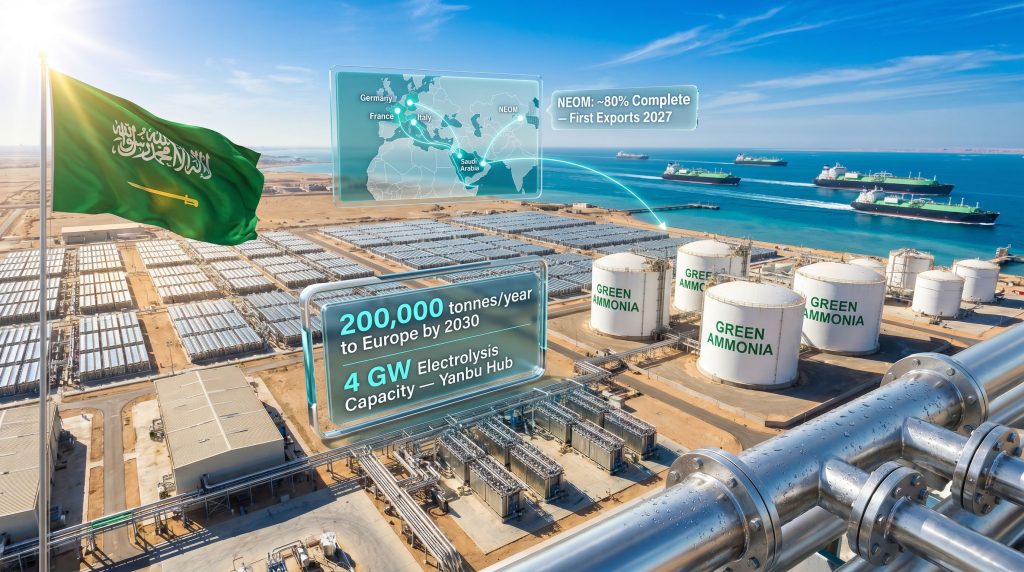
| Electrolysis capacity (Yanbu) | 4 GW |
| Total hydrogen output target (Yanbu) | 400,000 tonnes/year |
| NEOM project completion (mid-2026) | Approximately 80% |
| First NEOM commercial exports | 2027 (targeted) |
| Export transport form | Green ammonia |
The Yanbu Green Hydrogen Hub's 4 GW electrolysis capacity target implies a domestic renewable energy buildout of considerable scale. Electrolysers at this capacity require dedicated, highly reliable renewable power input. For Saudi Arabia, which has abundant solar irradiance but is still expanding its utility-scale solar fleet, meeting the additionality requirements that will be demanded by European certification frameworks represents a genuine infrastructure challenge, not just a paperwork exercise.
Why Ammonia Is the Carrier of Choice, and What That Means Operationally
Green hydrogen cannot be economically transported in gaseous form over intercontinental distances. The energy density is too low and the cryogenic infrastructure required for liquid hydrogen shipping is extraordinarily expensive. Converting hydrogen into ammonia resolves both problems simultaneously.
Ammonia (NH₃) can be stored and transported using infrastructure that closely resembles existing liquefied petroleum gas systems. This significantly reduces port modification costs at both origin and destination. Saudi Arabia's proximity to Red Sea shipping lanes means Yanbu-produced green ammonia can reach European terminals within approximately two weeks via established maritime routes.
The reconversion step, cracking ammonia back into hydrogen at the destination for applications that require pure hydrogen rather than ammonia itself, carries an energy penalty of roughly 20 to 30 percent depending on the catalytic process used. This reconversion efficiency loss is a critical variable in the landed cost economics of Saudi green hydrogen competing with domestically produced European hydrogen. In addition, renewable energy solutions are rapidly evolving to address these cost and efficiency pressures across the broader energy sector.
Technical Note: Not all end-use applications require hydrogen reconversion. Ammonia itself is directly usable as a zero-carbon maritime fuel and as a feedstock for fertiliser production, meaning a significant portion of Saudi green ammonia exports may never need to be cracked at all.
European Offtake Partnerships and What They Actually Commit To
The MoU Landscape: Mapping Intent Against Obligation
ACWA Power has assembled a portfolio of European MoUs that collectively represent substantial import volume commitments. The key counterparties as currently understood include:
- SEFE Energy Company (Germany): MoU signed February 2025 for approximately 200,000 tonnes per year delivery intent
- EnBW (Germany): Strategic alignment consistent with Germany's national hydrogen import framework
- TotalEnergies (France): Positioning within France's hydrogen diversification and decarbonisation strategy
- Edison (Italy): Development of a southern European import corridor
Risk Flag: MoU-stage commitments carry intent, not obligation. Analysts and investors assessing Saudi green hydrogen export progress should carefully distinguish between signed memoranda of understanding and financially closed, legally binding offtake contracts. The gap between these two categories is where most hydrogen projects have historically stalled.
Germany's involvement through multiple counterparties reflects the country's acute need for hydrogen import diversification following its 2022 to 2023 energy shock. The H2Global mechanism, a German federal instrument that bridges the cost gap between green hydrogen production and market prices through double auction contracts, is designed to create the financial scaffolding that converts MoU-level intent into bankable supply agreements. Whether Saudi volumes will ultimately flow through H2Global or through direct bilateral structures remains an open structural question.
The NEOM Joint Venture and Air Products' Parallel Export Track
A Three-Party Structure With Distinct Commercial Logic
The NEOM Green Hydrogen Project operates under a joint venture structure involving ACWA Power, the NEOM development authority, and Air Products as co-developers. Understanding this structure is critical to correctly interpreting ACWA Power's broader export mandate. Notably, ACWA Power has been granted an exclusive government mandate to export green hydrogen and develop renewable electricity export projects, a designation that shapes how its role differs from Air Products' position within NEOM.
Air Products holds a 30-year exclusive ammonia offtake agreement covering the entire output of the NEOM project. This means ACWA Power's role within NEOM is as a developer and equity participant, not as the export channel. The export function at NEOM runs through Air Products' commercial distribution network, which is entirely separate from ACWA Power's independent MoU-based European partnerships.
With the NEOM project approximately 80 percent complete as of mid-2026, first commercial ammonia exports are targeted for 2027. When these volumes begin flowing, they will add to Saudi Arabia's green hydrogen export profile without passing through ACWA Power's designated export mandate framework.
Saudi Arabia is therefore not running a single, unified green hydrogen export strategy. It is running parallel commercial tracks that serve different purposes:
- The NEOM/Air Products track delivers early first-mover volumes through an established industrial gas distributor with existing customer relationships across Asia and Europe.
- The ACWA Power MoU track builds longer-term sovereign-to-sovereign energy relationships that align more directly with Vision 2030's geopolitical objectives.
Regional Competition: MENA as an Emerging Green Hydrogen Corridor
How Saudi Arabia's Neighbours Are Positioning for the Same European Market
Saudi Arabia is not operating in a regional vacuum. Several MENA neighbours are pursuing comparable green hydrogen export ambitions, often targeting the same European utility customers. Furthermore, the EU's green hydrogen backing for projects in South Africa illustrates just how geographically broad the competition for European offtake relationships has become.
| Country | Green Hydrogen Export Target | Primary Markets |
|---|---|---|
| Saudi Arabia | 200,000+ tonnes/year to Europe by 2030 | Germany, France, Italy |
| Oman | ~1 million tonnes/year by 2030 | Asia-Pacific, Europe |
| Egypt | 2.2 million tonnes/year by 2040 | Europe (Mediterranean corridor) |
| UAE | 1.4 million tonnes/year by 2031 | Asia, Europe |
The competitive dynamics within this table carry a subtle risk that European policymakers have begun to identify. If the continent concentrates its green hydrogen imports from a geographically concentrated cluster of Gulf and North African producers, it risks replicating the structural dependency that made the 2022 gas supply crisis so damaging. The REPowerEU framework nominally targets geographic diversification of clean energy imports, but commercial and logistical realities are pushing European utilities toward the lowest-cost, highest-reliability suppliers, which currently means the MENA corridor.
The next major ASX story will hit our subscribers first
EU Certification: The Regulatory Barrier That Could Reshape Saudi Supply Economics
What RED III Actually Requires From Non-EU Green Hydrogen Producers
The European Union's Renewable Energy Directive, known as RED III, establishes a demanding certification regime for green hydrogen qualifying for European incentive frameworks and carbon accounting systems. The three principal requirements are:
- Additionality: The renewable electricity powering electrolysis must come from newly built renewable capacity, not existing grid supplies.
- Temporal correlation: Renewable electricity consumption must be matched to hydrogen production on an hourly basis, not simply on an annual average.
- Geographic correlation: The renewable generation and the electrolysis facility must be located in the same bidding zone or grid area.
For Saudi producers, the geographic correlation requirement is the least problematic, given that production hubs are being collocated with dedicated solar and wind installations. However, the hourly temporal correlation requirement is a genuine operational constraint. Solar power is intermittent. An electrolyser drawing from a solar farm will face periods of zero or near-zero input, requiring either battery storage, grid backup, or curtailment. Each of these solutions adds cost. Consequently, the sourcing of green transition materials for battery storage and electrolyser manufacturing is becoming an increasingly strategic concern for producers seeking RED III compliance.
The third-party certification infrastructure required to verify these standards within Saudi Arabia is also still being established. The Saudi Hydrogen Center and the National Hydrogen Strategy provide the domestic governance framework, but internationally recognised certification bodies with in-country operations capable of issuing EU Guarantees of Origin are not yet fully operational as of mid-2026.
Certification Watch: Green hydrogen exported to the EU must comply with the Guarantees of Origin framework under RED III. Saudi producers require certified third-party verifiers operating within the Kingdom, a regulatory infrastructure that remains under development.
Frequently Asked Questions: ACWA Power and Saudi Green Hydrogen Exports
What does it mean that ACWA Power was awarded exclusive rights to export Saudi green hydrogen?
ACWA Power has been designated as a preferred commercial vehicle for Saudi Arabia's international green hydrogen trade, particularly toward European markets. The practical effect is a structurally advantaged position in securing offtake agreements and MoU partnerships ahead of other potential export entities. Whether this constitutes a formal regulatory monopoly or a preferred partner arrangement under Saudi policy frameworks requires further clarification from Saudi authorities.
Is the NEOM project covered by ACWA Power's export mandate?
No. The NEOM Green Hydrogen Project operates as a three-party joint venture with Air Products holding a 30-year exclusive ammonia offtake agreement covering NEOM output. ACWA Power's independent export mandate applies to its separate project pipeline, including the Yanbu Green Hydrogen Hub. For further context, Hysata and ACWA Power have also signed a significant deal to deploy world-leading high-efficiency electrolysers across Saudi Arabia and the Gulf, which will further strengthen ACWA Power's independent production capacity.
When are Saudi green hydrogen exports realistically expected to begin?
The NEOM project, approximately 80 percent complete as of mid-2026, is targeting first commercial ammonia shipments in 2027. Yanbu Hub volumes are planned to scale toward 200,000 tonnes per year for European delivery by 2030, contingent on certification compliance and offtake contract finalisation.
Can Saudi green hydrogen meet EU certification requirements?
This remains the most significant unresolved regulatory question. Meeting RED III's additionality, temporal correlation, and Guarantees of Origin requirements will necessitate both dedicated renewable infrastructure and functioning in-country certification systems. Both are progressing but neither is fully operational at commercial scale as of mid-2026.
Disclaimer: This article is intended for informational purposes only and does not constitute financial or investment advice. Forward-looking statements regarding export timelines, offtake volumes, and regulatory outcomes involve material uncertainty and should not be relied upon as confirmed projections. Readers are encouraged to consult independent professional advice before making investment decisions.
Want to Stay Ahead of the Next Major Energy and Resources Discovery?
Discovery Alert's proprietary Discovery IQ model scans ASX announcements in real time, instantly identifying significant mineral discoveries across the commodities driving the green energy transition — from the critical materials underpinning hydrogen infrastructure to the metals powering renewable buildouts. Explore historic discoveries and their exceptional market returns, then begin your 14-day free trial to position yourself ahead of the broader market.