August 24, 2026
The Industrial Logic Behind Green Hydrogen: Why the Molecule Is Only the Beginning
The global energy transition is often framed as a story about replacing fossil fuels with cleaner alternatives. But for resource-rich economies sitting at the intersection of exceptional renewable endowments and critical mineral reserves, that framing misses the more consequential opportunity. Green hydrogen industrialisation in South Africa is not simply about producing a cleaner fuel source. It represents a potential anchor for an entirely new industrial order, one capable of spawning green steel mills, chemical manufacturing complexes, ammonia export facilities, and advanced mobility infrastructure on a scale that no single energy policy could deliver alone.
Understanding why requires stepping back from the molecule itself and examining what it can catalyse downstream. The Southern African Institute of Mining and Metallurgy has articulated this reframe clearly, with its president Gary Lane noting that the real prize embedded within South Africa's green hydrogen ambitions is not the hydrogen itself but the industrialisation it can trigger, provided the country successfully aligns infrastructure investment and skills development at the required pace and scale.
When big ASX news breaks, our subscribers know first
Green Hydrogen Industrialisation in South Africa: The Policy Architecture That Makes It Possible
South Africa's approach to green hydrogen industrialisation is underpinned by a layered policy framework built over several years. The Hydrogen Society Roadmap established the long-term directional targets. Cabinet's approval of the Green Hydrogen Commercialisation Strategy in October 2023 represented a pivotal shift from aspiration to structured implementation. Furthermore, the Renewable Energy Masterplan, approved in April 2025, added a critical enabling layer by addressing the renewable generation capacity needed to power electrolysis at scale.
The most significant near-term instrument, however, is the Power-to-X Project Development Standard, officially launched in May 2026 at the World Hydrogen Summit in Rotterdam by Trade, Industry and Competition Minister Parks Tau and Electricity and Energy Deputy Minister Samantha Graham-Maré. This framework introduces a structured, transparent assessment process through which green hydrogen project developers can demonstrate readiness across technical, commercial, financial, and operational dimensions using a standardised platform aligned with the expectations of investors and development finance institutions.
The PtX Project Development Standard addresses one of the most persistent barriers to green hydrogen project progression: the gap between policy intent and investment-grade project credibility. By standardising how readiness is demonstrated and assessed, it creates a common language between developers and capital providers.
The Just Energy Transition Implementation Plan Programme Management Office plays a coordination role across these instruments, with stakeholder specialists describing the PtX standard as a meaningful step toward building a credible and investable project pipeline in South Africa.
Production Targets, Cost Trajectories, and the $1.60/kg Threshold
The quantitative ambition behind green hydrogen industrialisation in South Africa is substantial. A 2021 feasibility study identified nine pilot projects spanning the mobility, industrial, and buildings sectors as the initial commercialisation testing ground. Beyond pilots, the national targets are considerably more expansive.
| Target Metric | Figure | Timeframe |
|---|---|---|
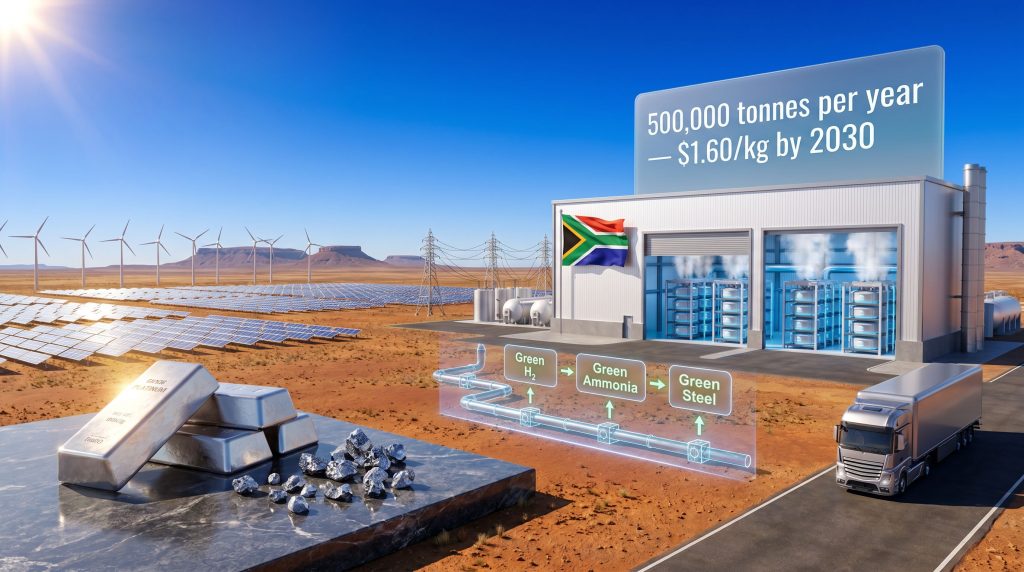
| Green hydrogen production target | 500,000 tonnes per year | By 2030 |
| Electrolysis capacity (Northern Cape) | 10 GW | By 2030 |
| Electrolysis capacity (Northern Cape) | 15 GW | By 2040 |
| Projected production cost | ~$1.60/kg | By 2030 |
| Pilot projects identified | 9 projects | Initial phase |
The $1.60/kg projected production cost by 2030 is particularly significant in a global context. European green hydrogen production costs remain considerably higher due to less favourable renewable resource profiles and higher infrastructure costs. South Africa's Northern Cape province offers world-class solar irradiance and strong wind resources, creating a natural cost advantage that, when combined with concessional financing to bridge current and target costs, positions the country among the most competitive potential producers globally.
Critically, domestic demand parity is not expected in the near term. Policy architecture explicitly acknowledges that export markets must lead the initial revenue pathway, with green ammonia, green chemicals, and sustainable aviation fuel identified as priority commodities for international off-take. According to research on green hydrogen development in South Africa and Namibia, both nations hold significant but distinct competitive advantages that will shape how their export strategies diverge over time.
PGMs: The Technical Bridge Between South Africa's Mining Sector and the Hydrogen Economy
One of the least appreciated structural advantages South Africa holds in the global green hydrogen race is its platinum group metal endowment. PGMs are not peripheral to the hydrogen economy; they are technically essential to its core infrastructure. In addition, the growing critical minerals demand linked to the energy transition further reinforces the strategic value of South Africa's resource base.
Proton exchange membrane electrolysers, the technology of choice for variable renewable energy integration, rely on platinum and iridium as catalysts. These metals cannot currently be substituted at commercial scale. The same PGMs that enable hydrogen production through electrolysis also power fuel cells that convert hydrogen back into electricity for applications ranging from green iron production to data centre backup power and commercial vehicle propulsion.
Southern Africa holds the world's dominant PGM reserve base, positioning the region as structurally critical to global electrolyser and fuel cell deployment. This is not a theoretical advantage. The 200 MW Air Liquide ELYgator installation at the Port of Rotterdam, where the first PEM electrolyser arrays have now been positioned on their foundations, illustrates the scale at which PGMs are being consumed. Designed to produce 23,000 tonnes of renewable hydrogen annually while avoiding up to 300,000 tonnes of CO₂ per year, the project represents a direct demand signal for PGM inputs. Air Liquide will invest more than €500-million to build, own, and operate the facility, with operations targeting commencement by end of 2027.
The AI Demand Vector: A Dual Growth Driver for PGMs
A less widely recognised dynamic is emerging at the intersection of PGM demand and artificial intelligence infrastructure expansion. Platinum-rhodium bushings are used in fibreglass production to draw molten glass into fine fibres at extremely high temperatures. The resulting electrical-grade fibreglass, known as E-glass, is a foundational component of printed circuit boards.
AI servers and data centre equipment are entirely dependent on PCBs. As AI workload intensity increases, PCB designs are evolving to support higher speeds and frequencies, driving demand for higher-value fibreglass applications. Platinum glass demand is forecast to increase by 83% year-on-year to 377,000 oz in 2026, driven by renewed fibreglass capacity additions and stronger demand from AI-linked end-uses.
This creates an unusual situation where South Africa's PGM sector is simultaneously exposed to two distinct and growing demand streams: the green hydrogen economy and the AI-driven electronics manufacturing expansion. Both trajectories are expected to strengthen materially through 2030.
What Industrial Sectors Can Green Hydrogen Unlock?
The downstream industrial opportunity anchored by green hydrogen spans multiple sectors, each with different maturity timelines and capital requirements.
Green Iron and Green Steel represent the highest-value long-term opportunity. Hydrogen-based direct reduction of iron ore eliminates the need for coking coal in steelmaking, a process known as DRI-H₂. Furthermore, green iron manufacturing initiatives globally demonstrate that South Africa's existing iron ore resources and established steel industry infrastructure provide a foundation that reduces the greenfield risk of this transition, though the capital investment requirements remain substantial.
Green Ammonia and Fertiliser Manufacturing offer the most commercially viable near-term export pathway. Ammonia is the most straightforward hydrogen derivative to ship at scale, and international demand for green ammonia as both a fertiliser feedstock and a shipping fuel is growing rapidly. Kenya's parallel strategy provides a useful regional reference point: the East African country has approved 15 projects targeting a combined 5 GW of captive renewable energy generation, focused specifically on green ammonia, zero-emission fertilisers, sustainable aviation fuel, methanol, and hydrogen-based green steel. Kenya's energy mix already derives over 90% of its power from renewable sources, giving it a different but complementary competitive profile to South Africa.
Mobility and Transport Decarbonisation is anchored by significant private sector investment. Toyota South Africa has announced a R10.4-billion investment in KwaZulu-Natal manufacturing to strengthen local production for a more sustainable future. Globally, Toyota North America plans to deploy hydrogen fuel cell-powered Class 8 trucks in commercial logistics fleets by early 2027, with an Air Liquide hydrogen supply agreement already in place.
The technology benchmarks for hydrogen mobility are advancing rapidly. China's 49-tonne Dongfeng hydrogen truck operates on a 400 kW fuel cell platform, achieves a range of 1,060 miles, and refuels in just 15 minutes. The World Platinum Investment Council has also highlighted HyKit's mobile hydrogen refuelling system, which offers a 10-15 minute turnaround, a total capacity of 75 kg, and the ability to support up to seven vehicles simultaneously, pointing to the growing practicality of distributed hydrogen infrastructure.
Geographic Hubs and Infrastructure Requirements
South Africa's green hydrogen industrialisation is not evenly distributed geographically. The Hydrogen Valley feasibility study identified industrial hub opportunities centred on Johannesburg, Durban, and Mokopane/Limpopo, while the Northern Cape functions as the primary production zone given its exceptional renewable resource profile. The Nelson Mandela Bay green hydrogen-ammonia project, which advanced in May 2026, represents a concrete pipeline signal for the coastal export logistics dimension of this strategy.
However, significant infrastructure gaps must be resolved before any of these ambitions can be realised at scale.
| Infrastructure Category | Current Gap | Required Action |
|---|---|---|
| Electricity transmission | Constrained grid capacity | New transmission lines to renewable zones |
| Water supply | Limited in high-irradiance areas | Desalination or water recycling systems |
| Port facilities | Not configured for hydrogen export | Repurposing and new terminal development |
| Storage and distribution | No commercial-scale H₂ storage | Purpose-built storage infrastructure |
| Transport logistics | No H₂ pipeline network | Phased pipeline or trucking solutions |
The next major ASX story will hit our subscribers first
The Barriers: Financing, Manufacturing Capability, and Domestic Demand
The central challenge facing green hydrogen industrialisation in South Africa is not resource endowment. It is the simultaneous resolution of three interdependent constraints.
The financing gap is the most immediate. Concessional debt, grants, and contracts for difference are not optional instruments for early-stage projects; they are structural necessities to bridge the gap between current green hydrogen production costs and commercially viable levels. The PtX Project Development Standard directly addresses this by creating a due diligence framework that development finance institutions and private investors can work with, reducing transaction costs and uncertainty.
The manufacturing capability deficit is a longer-term structural challenge. South Africa currently lacks commercial-scale electrolyser or fuel cell manufacturing. The gap between stated localisation targets and existing industrial capability is significant, and establishing a domestic electrolyser manufacturing industry would require sustained policy support, technology transfer partnerships, and patient capital over an extended period.
The domestic demand problem means that project economics cannot be justified by internal consumption in the near term. This creates a dependency on European and Asian export markets that introduces its own risks, including the potential impact of the European Carbon Border Adjustment Mechanism on South African green hydrogen export competitiveness, which could cut both ways depending on how the mechanism is structured and applied.
How South Africa Compares Globally
South Africa's green hydrogen programme is developing within a rapidly evolving global competitive landscape.
| Country/Region | Key Metric | Status |
|---|---|---|
| China | Over 1 million tonnes/year production capacity | Installed or under construction |
| Netherlands (Air Liquide ELYgator) | 200 MW PEM electrolyser, 23,000 t/year H₂ | Targeting operational by end of 2027 |
| Denmark (Everfuel Project Frigg) | 200 MW electrolyser; €244.9M at €0.98/kg support | European Hydrogen Bank approved |
| Oman (Al Duqm) | Liquid hydrogen export to Europe (Kawasaki/Ecolog) | Under development |
| South Africa | 10 GW electrolysis target; $1.60/kg projected cost | Policy approved; early project pipeline |
| Kenya | 15 projects; 5 GW captive renewable generation | Approved |
China's position warrants particular attention. With more than one million tonnes per year of green hydrogen production capacity already installed or under construction, roughly double Europe's total, China's manufacturing scale is directly influencing global electrolyser pricing. Its 15th Five-Year Plan sets ambitious hydrogen expansion targets through 2030, with all 31 mainland provinces having published individual hydrogen strategies. This trajectory will compress electrolyser costs globally, which benefits South African project economics on one hand while intensifying export market competition on the other.
The strategic window for South Africa to establish durable export market relationships before competing producers in Namibia, Kenya, the Middle East, and China consolidate their own positions is real but time-limited. Consequently, the energy transition minerals advantage that South Africa currently holds must be leveraged decisively within this narrowing window.
Namibia's Hyphen Hydrogen Energy project offers an instructive parallel, having launched an enterprise and supplier development programme specifically tailored to building local industrial capability within its emerging hydrogen industry. The model provides a replicable framework for how resource-rich African nations can ensure that hydrogen-led industrialisation creates domestic value rather than simply exporting a commodity.
Broader perspectives on this dynamic are explored in green hydrogen and African industrialisation literature, which highlights how the continent's competitive positioning depends heavily on translating resource advantages into downstream manufacturing capability.
A Phased Pathway to Industrial Scale
A credible green hydrogen industrialisation pathway for South Africa unfolds across three broad phases:
Phase 1 (2023–2027): Policy Consolidation and Pilot Execution
- PtX Project Development Standard implementation and early project assessment
- Execution of nine identified pilot projects across mobility, industrial, and buildings sectors
- Development of export partnership frameworks with European and Asian off-take markets
- Port infrastructure feasibility and early planning
Phase 2 (2027–2030): Export Infrastructure and First Commercial Projects
- First commercial-scale green ammonia facilities becoming operational
- Port infrastructure development configured for hydrogen derivative exports
- Electrolyser manufacturing localisation programme initiated
- Transmission infrastructure expansion to Northern Cape renewable zones
Phase 3 (2030–2040): Industrial Scale and Value Chain Deepening
- 10 GW electrolysis capacity operational in the Northern Cape
- Green steel and green chemicals industries reaching commercial scale
- Domestic fuel cell and electrolyser manufacturing established
- 500,000 tonnes per year green hydrogen production target achieved
Each phase depends on the preceding one delivering its foundational outputs. Infrastructure, investment, and skills development are co-dependencies: the failure of any single pillar creates systemic risk for the others. This interdependency is precisely what the JET IP coordination mechanism is designed to manage, though the execution challenge should not be understated.
South Africa's structural differentiation from most other emerging hydrogen economies rests on three converging factors: world-class renewable resources concentrated in the Northern Cape, globally dominant PGM reserves that are technically essential to the electrolyser and fuel cell value chain, and an existing industrial base including Fischer-Tropsch process expertise that reduces the greenfield risk of building new chemical and energy industries from scratch. Whether those advantages translate into first-mover export market positioning before competing producers consolidate their own will depend on the speed and coherence with which infrastructure, financing, and human capital are mobilised in the years immediately ahead.
This article contains forward-looking statements and projections regarding South Africa's green hydrogen sector, production costs, and industrial targets. These represent policy objectives and analytical estimates rather than guaranteed outcomes. Investors and stakeholders should conduct independent due diligence before making decisions based on this analysis.
Want to Track the ASX Mineral Discoveries Powering the Green Energy Revolution?
Discovery Alert's proprietary Discovery IQ model delivers real-time alerts on significant ASX mineral discoveries — including the platinum group metals essential to green hydrogen electrolysers and fuel cells — ensuring subscribers can identify actionable opportunities ahead of the broader market. Explore historic mineral discoveries and their market returns on Discovery Alert's dedicated discoveries page, and begin your 14-day free trial today to position yourself ahead of the next major find.