August 5, 2026
Grid Infrastructure Transformation Drives Energy Storage Market Evolution
The global energy sector is experiencing a fundamental structural shift as utilities worldwide grapple with unprecedented challenges from data center expansion, renewable energy integration complexity, and aging grid infrastructure. Against this backdrop, energy storage technologies have emerged as critical minerals for energy transition, enabling grid modernisation and stability. This transformation represents far more than incremental market growth—it signals a strategic realignment of how energy companies allocate capital and position themselves for long-term competitiveness.
Energy storage deployment has reached an inflection point where demand fundamentals operate independently from traditional renewable energy cycles. The convergence of artificial intelligence computing requirements, electric grid reliability mandates, and policy incentive structures creates sustained market opportunities that extend well beyond conventional battery applications.
When big ASX news breaks, our subscribers know first
Tesla's Strategic Portfolio Diversification Through Record Storage Performance
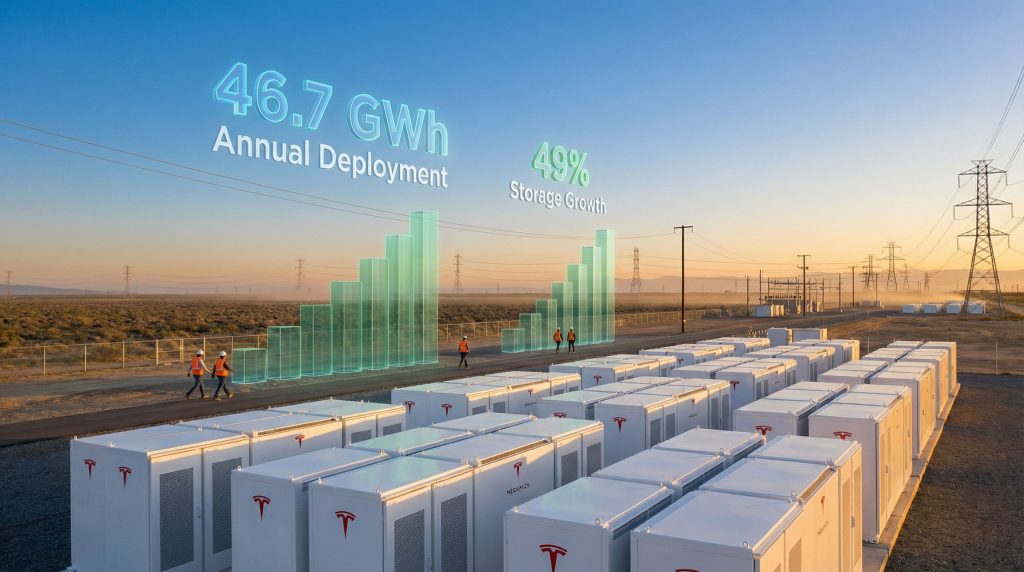
Tesla's energy storage division achieved remarkable performance metrics during 2025, with quarterly deployments reaching 14.2 GWh in Q4 and annual installations totaling 46.7 GWh—representing a substantial 49% year-over-year growth. This exceptional Tesla battery storage deployment record occurred simultaneously with a 16% decline in electric vehicle deliveries during the same quarter, demonstrating the strategic value of business portfolio diversification.
The company's energy segment generated $3.37 billion in quarterly revenue during Q4 2025, contributing to annual energy revenue of $12.8 billion. Perhaps more significantly, Tesla maintained gross profit margins of 29.8% while achieving record profitability for five consecutive quarters, indicating both operational scaling efficiency and pricing power within competitive markets.
Tesla CEO Elon Musk expressed confidence in the energy division's trajectory, stating that the business would maintain very high growth for the foreseeable future. This perspective reflects management's assessment that stationary storage demand operates on fundamentally different cycles compared to vehicle sales, creating natural portfolio balance during periods of automotive market volatility.
| Performance Metric | Q4 2025 | Annual 2025 | Growth Rate |
|---|---|---|---|
| Storage Deployment | 14.2 GWh | 46.7 GWh | +49% YoY |
| Energy Revenue | $3.37B | $12.8B | +26.6% YoY |
| Gross Margin | 29.8% | Record High | 5 consecutive quarters |
The contrast between Tesla's energy storage success and electric vehicle performance challenges illustrates broader market dynamics affecting technology companies. North American EV sales experienced a 46% decline from Q3 to Q4 2025 following the expiration of consumer tax credits, while global EV sales maintained approximately 20% growth throughout 2025, according to industry data from Cox Automotive and Benchmark Minerals.
Market Forces Accelerating Storage Adoption Across Multiple Sectors
Data Center Infrastructure Driving Utility-Scale Demand
Technology companies' massive investments in data center construction represent a primary structural driver for utility-scale battery storage systems. These facilities create concentrated electricity load requirements that benefit from on-site or nearby storage for power quality, reliability, and peak demand management applications.
Furthermore, the data center boom creates fundamentally different storage demand characteristics compared to traditional renewable energy integration applications:
- Continuous baseline load requirements necessitating consistent power availability
- Premium willingness to pay for power reliability services during grid disruptions
- Geographic concentration in technology hubs creating regional storage deployment clusters
- Long-term contract structures providing revenue visibility for storage project financing
Policy Framework Support and Tax Credit Optimisation
The U.S. Investment Tax Credit (ITC) maintains a 30% credit value for energy storage projects, creating favourable project economics even as consumer EV tax credits expired in late 2025. This differential policy treatment establishes structural advantages for stationary storage compared to transportation electrification applications. Moreover, lithium industry tax incentives continue to support the supply chain for these critical components.
Korean battery manufacturers LG Energy Solution and Samsung SDI both emphasised that U.S. tax credits for manufacturing and deployment drive their business projections for 2026. LG Energy Solution projects that global energy storage production growth will outpace EV production by a 4:1 ratio in 2026, targeting 90 GWh in stationary storage orders with over 60 GWh of production capacity concentrated primarily in North America.
Energy storage represents approximately half of total North American battery demand when accounting for technology company data center investments and policy support structures.
Grid Modernisation Requirements and Renewable Integration
Utility operators face increasing complexity as renewable energy capacity additions accelerate across regions. In addition, renewable energy solutions for mining operations require sophisticated storage systems to address intermittency challenges. Solar and wind generation intermittency creates grid stability challenges that storage systems address through:
- Peak demand management avoiding expensive peaking plant construction
- Renewable energy capacity factor optimisation enabling higher solar/wind utilisation
- Grid services revenue streams through frequency regulation and voltage support
- Transmission congestion relief reducing infrastructure upgrade requirements
Product Segmentation Strategy: Megapack Versus Powerwall Market Positioning
Utility-Scale Megapack Production Expansion
Tesla operates Megapack manufacturing facilities across three strategic locations: Fremont California (original production facility), Shanghai China (Asia-Pacific supply hub), and a new Houston Texas facility designed to produce 50 GWh annually of Megapack 3 systems beginning in 2026. The combined global production capacity approaches 133 GWh annually, providing geographic distribution advantages for regional market service.
However, the Megapack 3 incorporates several technological enhancements over previous generations:
- Enhanced energy density reducing installation footprint per unit of capacity
- Streamlined deployment processes accelerating project commissioning timelines
- Improved safety systems including upgraded thermal management and fire suppression
- Grid integration software enabling automated market participation through Autobidder platform
Residential Powerwall Market Penetration
Tesla's Powerwall systems target residential customers through integrated home energy management capabilities combining battery storage with sophisticated software controls. The product addresses multiple customer value propositions:
- Peak rate optimisation reducing electricity costs during high-price periods
- Backup power reliability maintaining service during grid outages
- Virtual power plant participation aggregating distributed storage for grid services
- Solar PV integration maximising renewable energy utilisation and independence
Tesla CFO Vaibhav Taneja indicated that both Powerwall and Megapack products experienced strong demand across all regions during Q4 2025, suggesting geographic diversification beyond historical concentration in specific markets like California.
Competitive Landscape Evolution and Manufacturing Scale Advantages
Vertical Integration and Supply Chain Control
Tesla's comprehensive battery production capabilities create competitive advantages through control over multiple value chain components. Consequently, the company's vertical integration extends from battery cell chemistry optimisation through pack assembly processes and quality assurance procedures.
Key competitive differentiators include:
- Direct supplier relationships for lithium, cobalt, and battery materials
- Manufacturing learning curves reducing per-unit costs through production experience
- Rapid technology iteration capabilities for product enhancement and customisation
- Quality control consistency across global production facilities
Software Platform and Grid Services Monetisation
Tesla's Autobidder software platform enables automated participation in electricity market mechanisms, optimising charge and discharge cycles based on real-time price signals, weather forecasting, and grid condition analytics. This functionality generates additional revenue streams beyond basic energy arbitrage:
- Frequency regulation services providing grid stability support
- Voltage support capabilities maintaining power quality standards
- Peak capacity provision reducing utility infrastructure investment requirements
- Demand response participation earning compensation for load flexibility
The company's large installed base of storage systems provides training data for machine learning models that continuously improve forecasting accuracy and operational efficiency. This creates competitive advantages where larger deployment scales enable superior predictive analytics capabilities.
Korean Manufacturer Strategic Response
LG Energy Solution and Samsung SDI have repositioned their business strategies to emphasise stationary storage as a hedge against North American EV market volatility. Both companies cite energy storage demand as helping offset broader weakness in transportation electrification applications.
LG Energy Solution's strategic focus includes:
- Long-term utility contracts providing revenue predictability
- Energy storage developer partnerships expanding market reach
- North American manufacturing expansion capturing domestic production incentives
- Technology company relationships serving data center infrastructure requirements
Samsung SDI emphasises manufacturing tax credits and trade policy considerations as key variables influencing North American investment decisions, highlighting ongoing uncertainty around tariff policies affecting battery material costs.
Financial Performance Metrics and Profitability Analysis
Tesla's energy division achieved record gross margins of 29.8% during Q4 2025, marking the fifth consecutive quarter of record profitability. This margin expansion occurred alongside 49% deployment volume growth, indicating that the company achieved operational leverage rather than margin compression typical of high-growth businesses.
The $12.8 billion in annual 2025 energy revenue represents a 26.6% year-over-year increase, demonstrating that the business has achieved material scale within Tesla's consolidated operations. The energy segment now represents a meaningful contributor to overall corporate profitability independent of automotive performance.
Revenue diversification benefits include:
- Reduced correlation with consumer vehicle purchase cycles
- Policy support insulation from EV tax credit expiration impacts
- Geographic revenue balance across residential and utility customer segments
- Long-term contract visibility providing predictable cash flow streams
The next major ASX story will hit our subscribers first
Solar Market Dynamics and Integrated System Opportunities
Industry analysts project U.S. solar installations will decline from approximately 40 GW in 2025 to around 30 GW annually from 2028-2030, according to Wood Mackenzie forecasts. This projected decline results from several regulatory and supply chain factors:
- Foreign sourcing restrictions creating component supply constraints
- Federal and local permitting delays extending project development timelines
- Accelerated tax credit phase-downs reducing project economic returns
- Grid interconnection bottlenecks limiting deployment capacity
Despite these headwinds, Tesla management expressed confidence in solar PV market opportunities. Musk indicated that Tesla would work toward achieving 100 GW annually of solar cell production with full supply chain integration from raw materials through finished panels, though no specific timeline was provided for this ambitious target.
Storage-Solar Integration Value Proposition
Tesla's integrated approach combining solar PV systems with battery storage creates enhanced customer value propositions:
- Improved project economics through bundled system installations
- Higher capacity factors for solar generation through storage optimisation
- Complete energy independence solutions for residential and commercial customers
- Grid export optimisation maximising revenue from excess renewable generation
The integration of storage with solar installations enables customers to capture time-of-use rate arbitrage opportunities while providing backup power capabilities during extreme weather events or grid outages.
Manufacturing Capacity Scaling and Technology Evolution
Tesla's global manufacturing footprint expansion supports sustained growth trajectory projections across multiple regions. The Houston facility represents the company's third major production location, providing 50 GWh additional annual capacity specifically for Megapack 3 systems.
Production Facility Geographic Distribution
| Location | Product Focus | Annual Capacity | Market Coverage |
|---|---|---|---|
| Fremont, CA | Original Megapack | 40 GWh | North America |
| Shanghai, China | Asia-Pacific Supply | 40 GWh | Global Markets |
| Houston, TX | Megapack 3 Systems | 50 GWh | Americas |
| Combined Total | All Products | 130 GWh | Global Coverage |
Technology Development and Cost Reduction Initiatives
The Megapack 3 design incorporates multiple enhancements over previous product generations, focusing on deployment efficiency and total system cost reduction:
- Reduced physical footprint per unit of energy capacity
- Faster installation processes minimising project commissioning time
- Enhanced thermal management improving system safety and longevity
- Simplified maintenance procedures reducing operational costs over system lifetime
These technological improvements directly translate to improved project economics for utility and commercial customers while strengthening Tesla's competitive positioning against alternative suppliers. Furthermore, battery-grade lithium supply advancements support these manufacturing capabilities.
Policy Uncertainty and Strategic Risk Factors
Tesla executives acknowledged ongoing uncertainty regarding U.S. tariff policies and their potential impact on battery material costs. This uncertainty creates both risks and opportunities for domestic manufacturing operations:
Tariff Policy Implications
- Import cost increases for battery materials and components from affected countries
- Domestic production advantages through relative cost competitiveness
- Supply chain reshoring incentives driving vertical integration strategies
- Long-term investment decisions influenced by trade policy stability
Korean manufacturers similarly highlighted trade policy as a key variable in North American investment decisions, indicating that policy uncertainty affects industry-wide capacity planning and geographic allocation decisions.
Tax Credit and Incentive Framework Evolution
The differential treatment between expired consumer EV tax credits and continuing production/investment tax credits for energy storage creates temporary market advantages. However, potential future policy changes represent ongoing risks requiring strategic adaptation:
- Investment Tax Credit (ITC) phase-down schedules affecting project economics
- Production Tax Credit continuation supporting domestic manufacturing
- State-level policy variations creating geographic deployment preferences
- Regulatory framework evolution influencing grid integration requirements
Future Market Scenarios and Strategic Implications
Accelerated Grid Modernisation Scenario
Rapid utility infrastructure investment driven by federal grid resilience funding and state renewable energy mandates could propel Tesla's storage deployments beyond 100 GWh annually by 2028. This scenario assumes sustained policy support and continued data center expansion driving utility-scale demand.
Competitive Intensification Scenario
Increased market entry from Chinese manufacturers and established industrial companies could pressure margins while expanding total market size. This scenario would require Tesla to emphasise software capabilities and service differentiation rather than competing primarily on manufacturing cost. Additionally, advancements in battery recycling breakthrough technologies could reshape supply chain dynamics.
Technology Disruption and Innovation Cycles
Emerging battery technologies, alternative storage approaches, and grid management innovations could alter competitive dynamics and customer requirements. Tesla's vertical integration and software platform advantages provide some protection against technological disruption while enabling rapid adaptation to market changes.
Broader Energy Transition Acceleration Effects
Tesla's storage deployment success validates the business case for large-scale grid battery integration, potentially accelerating utility renewable energy procurement timelines and fossil fuel plant retirement schedules. This creates positive feedback loops throughout the clean energy industry. According to Tesla's quarterly report, the energy storage business is growing faster than any other part of the company.
The company's achievement of sustained profitability in energy storage encourages additional private investment in battery manufacturing and grid infrastructure modernisation. This industry-wide capital allocation shift supports broader energy transition objectives while creating new competitive dynamics. According to industry analysis, Tesla's 2025 energy storage deployments hit an all-time high of 46.7 GWh.
Tesla's Tesla battery storage deployment record demonstrates that stationary applications can achieve commercial viability independent of transportation electrification markets, providing strategic diversification opportunities for energy companies and technology manufacturers seeking growth beyond traditional automotive applications.
Investment Disclaimer: This analysis contains forward-looking projections and market scenarios that involve substantial uncertainty and risk. Energy storage market dynamics, policy frameworks, and competitive landscapes may evolve differently than anticipated. Investors should conduct independent research and consider multiple scenarios when evaluating investment opportunities in the energy storage sector.
Ready to Capitalise on Energy Storage Opportunities?
Discovery Alert's proprietary Discovery IQ model delivers real-time alerts on significant mineral discoveries across energy storage supply chains, instantly empowering subscribers to identify actionable opportunities ahead of the broader market. Begin your 14-day free trial today and secure your market-leading advantage in this rapidly evolving sector.