June 29, 2026
The Hidden Economics of Gold: Why Refining Is Where the Real Money Is
For decades, the global gold trade has operated on a simple but deeply unequal principle: resource-rich nations dig the metal out of the ground, while wealthier processing economies transform it into the refined bullion that commands premium prices on international markets. The gap between raw doré and a London Good Delivery bar is not merely technical. It represents employment, foreign exchange retention, financial services development, and compound economic value that has historically flowed away from producing nations the moment ore leaves their borders.
This structural imbalance is now being challenged with increasing sophistication across sub-Saharan Africa. Consequently, nowhere is that challenge more precisely engineered than in Guinea, where a newly constructed refinery, a presidential export ban, and a broader industrialisation strategy are converging into what could become the continent's most consequential gold value-chain pivot. The gold price record highs of recent years have only intensified the urgency of this transformation.
When big ASX news breaks, our subscribers know first
Why Retaining Less Than 1% Is No Longer Acceptable
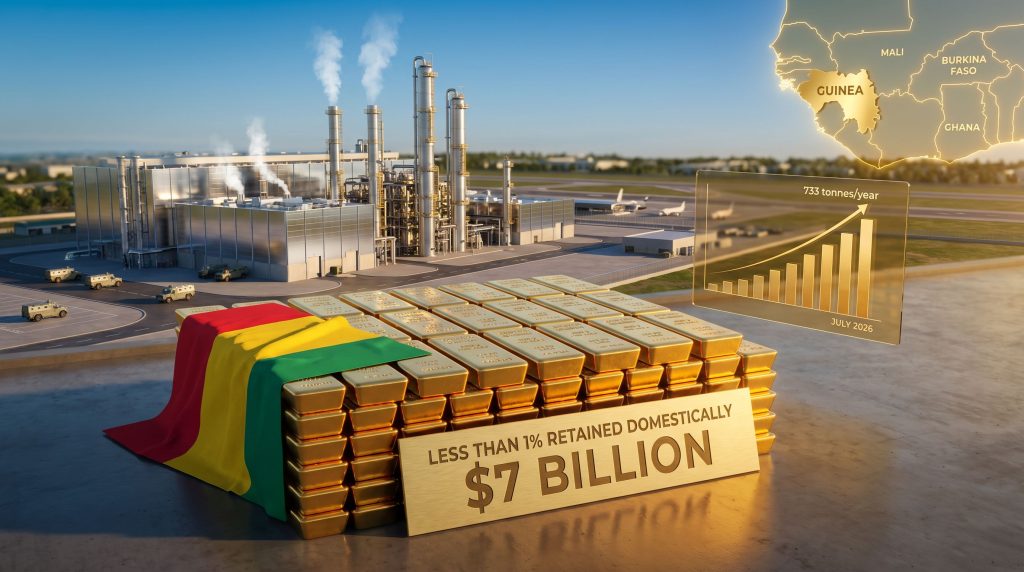
Guinea's situation crystallises a paradox that has frustrated resource economists for generations. The country produces approximately 2.32 million ounces of gold annually, a volume worth roughly $7 billion at current market prices, with gold futures trading above $4,700 per troy ounce. Yet Guinea retains less than 1% of that total value domestically once the gold leaves its borders in raw form.
The mathematics of value leakage are stark. Raw doré, the semi-pure gold-silver alloy produced at mine sites, trades at a discount to refined bullion. That discount reflects the cost and profit margin of whoever does the refining. When that refining happens in Dubai, Switzerland, or London, the economic multipliers, including wages, certification fees, logistics profits, and financial services revenue, all accrue to those economies rather than to Guinea.
Elevated gold prices have made this gap even more expensive to ignore. When bullion trades at multi-year highs, every percentage point of value that leaks out of the country is worth more in absolute dollar terms than it was when gold traded at lower levels. The policy urgency Guinea's government now feels is not incidental. It is arithmetically driven.
At historically elevated gold prices, the absolute dollar value embedded in each tonne of unrefined doré is larger than at any prior point in the commodity cycle, making the case for domestic refining economically irresistible for producer nations with the infrastructure capacity to act.
The Architecture of Guinea's Domestic Processing Strategy
Guinea's approach to closing the value gap is notable for its layered design. Rather than simply announcing an export restriction and hoping the private sector adapts, the government has constructed a multi-component framework that addresses enforcement, infrastructure, and feedstock supply simultaneously.
President Mamady Doumbouya enacted a ban on raw gold exports with immediate effect, requiring all extracted gold to be processed domestically before it can leave the country. The enforcement mechanism has real teeth: more than 100 mining permits have been revoked since 2024 for non-compliance with local refining obligations. For international mining operators currently structured around exporting raw production to Middle Eastern or European refineries, the compliance requirement is not theoretical. It is a condition of continued operation.
The Nimba Gold Refinery: Facility Specifications at a Glance
The physical centrepiece of Guinea's strategy is the Nimba Gold Refinery (NGR), a $30 million facility built in the Gbessia district near Conakry International Airport. The airport-proximate location is a deliberate logistical decision. Refined bullion requires secure, rapid transport to international markets, and proximity to an international airport eliminates a critical vulnerability in the supply chain.
| Specification | Detail |
|---|---|
| Facility Name | Nimba Gold Refinery (NGR) |
| Location | Gbessia district, near Conakry International Airport |
| Initial Processing Capacity | 530 metric tonnes per year (~17 million ounces) |
| Full Capacity Target | 733 metric tonnes per year |
| Capital Investment | $30 million USD |
| Ownership Structure | Public-private partnership with Guinean Ministry of Mines |
| Technology Partner | Emirates Minting |
| Commercial Operations Target | July 2026 (pending final regulatory approvals) |
Emirates Minting's involvement as the technology partner carries strategic significance beyond pure engineering capability. The UAE's gold refining sector is one of the most sophisticated in the world, having built processing infrastructure that handles gold from across Africa, Asia, and the Middle East despite producing no gold domestically. Guinea's Mines Minister has explicitly cited the UAE model as the blueprint Conakry is attempting to replicate: building refining capacity as an economic multiplier independent of raw production volumes, and positioning the Guinea gold refining hub as a regional processing destination that attracts gold from neighbouring producing nations. You can learn more about the Nimba refinery project and its planned infrastructure directly from the developers.
The West African Refining Race: Who Is Actually Ahead?
Guinea is not the only West African nation with domestic refining ambitions. Ghana, Mali, and Burkina Faso are all pursuing similar objectives, motivated by the same structural logic: West Africa produced approximately 11 million ounces of gold in 2025, yet the vast majority of that output was refined outside the continent.
| Country | Refining Status | Key Development |
|---|---|---|
| Guinea | Near-operational (July 2026 target) | NGR facility constructed, raw export ban enacted and enforced |
| Ghana | Development phase | Africa's largest gold producer, domestic refining hub aspirational |
| Mali | Development phase | Domestic refining push within broader resource nationalism trend |
| Burkina Faso | Development phase | Refining capacity development ongoing |
What distinguishes Guinea from its neighbours is the enforcement-first sequencing. The export ban is already active and being actively enforced through permit revocations, while the refinery is simultaneously coming online. This contrasts with a more common pattern across the region where policy intent precedes infrastructure readiness by years, creating enforcement credibility gaps.
Guinea's Mines Minister, Bouna Sylla, has articulated a notably non-zero-sum view of the regional competition. His position is that multiple West African refineries can coexist because market economics will determine which facilities are competitive, not political decisions. This framing is strategically important because it signals that Guinea's hub ambitions extend beyond its own production. The country is positioning the NGR as a facility capable of processing gold from across the sub-region, which would require attracting feedstock from Mali, Côte d'Ivoire, Sierra Leone, and potentially others.
Feedstock: The Variable That Determines Whether the Hub Vision Works
Formalising Artisanal Production: The Critical Missing Piece
At 733 tonnes of annual capacity, the NGR would be processing more gold than Guinea currently produces at industrial scale. Reaching anything close to that utilisation rate requires integrating the country's substantial artisanal and small-scale mining (ASM) sector into a formal, traceable supply chain.
The Kankan Gold Buying Centre has been established specifically to aggregate ASM production into the formal sector. Without this integration, artisanal gold that currently flows through informal channels into neighbouring countries or directly to unlicensed traders would remain outside the refinery's feedstock pool. Guinea's government has announced regulatory reforms targeting 2026 to formalise artisanal operators under a certified production framework, but the scale of Guinea's informal gold sector means this is a multi-year institutional challenge rather than an administrative formality.
The economic incentive structure matters here. Artisanal miners will route their production through formal channels when doing so offers better pricing, payment security, and legal protection than informal alternatives. Creating those conditions requires not just regulation but functioning market infrastructure, and the buying centre model is designed to provide it.
Industrial Mining Operators: Compelled Participants
Guinea's industrial gold production is dominated by major international operators, including AngloGold Ashanti (NYSE: AU) and Nordgold. These companies have historically been structured to export raw production to external refining destinations. The raw export ban directly compels them to reconfigure their operational and logistical arrangements to route production through the NGR.
This is where the permit revocation enforcement mechanism becomes critical. Mining companies operating under Guinean licences cannot simply absorb the regulatory requirement as a theoretical compliance risk. With over 100 permits already revoked for non-compliance since 2024, the enforcement signal is credible and consequential.
The Economic Multiplier Case: Beyond Refining Margins
The value Guinea is attempting to capture is not limited to the price differential between doré and refined bullion, though that differential is significant. Furthermore, the broader economic multiplier argument encompasses several interconnected benefits:
- Direct refining employment: Skilled technical positions in assaying, metallurgy, quality control, and facility management
- Certification and standards infrastructure: Building domestic capability in London Good Delivery bar accreditation and international bullion market compliance
- Logistics ecosystem: Security transport, warehousing, and freight services that develop around a major refining facility
- Financial services: Trade finance, bullion banking, and foreign exchange retention that flows from keeping export proceeds within the Guinean banking system
- Downstream industrialisation: Precedent-setting for other sectors, mirroring Guinea's existing push to add value to its dominant bauxite production
The refinery is not an isolated infrastructure project. It is the anchor asset in a deliberate attempt to replicate at the national level what the UAE achieved at the regional level: becoming a gold trading and processing hub that generates economic activity disproportionate to its own raw production base.
The next major ASX story will hit our subscribers first
Key Risks That Could Undermine the Hub Vision
The strategic logic of the Guinea gold refining hub is compelling; however, several structural risks could constrain its execution:
-
Throughput risk: If ASM formalisation proceeds slower than projected, the NGR may operate well below its 733-tonne capacity for an extended period, straining the economics of the $30 million investment.
-
International accreditation risk: Achieving recognition under LBMA gold markets Good Delivery standards is a prerequisite for selling refined bars at premium prices on international markets. This accreditation process is rigorous and not guaranteed.
-
Competitive displacement risk: If Ghana or another West African nation builds a technically superior or better-accredited refinery, Guinea's ambition to attract regional feedstock faces a credible competitive threat.
-
Regulatory capacity risk: Enforcing a complex, multi-operator export ban across a diverse mining sector with both large industrial operators and thousands of artisanal miners requires sustained institutional capability.
-
Infrastructure risk: Industrial refining at scale demands reliable power supply and logistics connectivity that must be verified and maintained in Conakry's operational environment.
A Blueprint for African Resource Sovereignty?
Guinea's approach sits at the more sophisticated end of the resource nationalism spectrum. The critical distinction is between punitive export bans implemented without processing alternatives, which historically damage investor confidence and reduce production, and constructive industrial policy that pairs export restrictions with functional domestic infrastructure built before or simultaneously with enforcement.
The DRC's cobalt processing mandates and Zimbabwe's lithium export restrictions represent earlier iterations of this impulse, with varying degrees of infrastructure readiness. Guinea's simultaneous construction of the NGR and enactment of the export ban represents a more integrated policy architecture, one where the enforcement mechanism and the processing solution arrive together rather than sequentially. In addition, central bank gold demand globally continues to reinforce the strategic value of domestic gold processing capabilities for producing nations.
Whether the Guinea gold refining hub achieves its full regional ambitions will depend significantly on whether the LBMA accreditation pathway is secured, whether ASM formalisation delivers the feedstock volumes the facility requires, and whether competing West African refineries emerge with sufficient capacity to dilute Guinea's first-mover positioning. Consequently, the broader gold market outlook for 2025 and beyond will heavily influence how international capital responds to Guinea's industrialisation push. What is already established, however, is that Guinea has moved from aspiration to enforcement, a transition that most of its regional competitors have not yet made.
The dynamics unfolding in Conakry have significant implications for how London gold vaults and other established refining centres adapt to a world where more producing nations are claiming a greater share of the value chain.
Guinea's Gold Refining Pivot: Key Metrics at a Glance
| Metric | Data Point |
|---|---|
| Annual gold production (Guinea) | ~2.32 million ounces |
| Estimated annual production value | ~$7 billion USD |
| Value currently retained domestically | Less than 1% |
| NGR initial processing capacity | 530 metric tonnes/year (~17 million oz) |
| NGR full capacity target | 733 metric tonnes/year |
| Capital investment | $30 million USD |
| Permits revoked for non-compliance | 100+ since 2024 |
| West Africa regional output (2025) | ~11 million ounces |
| Commercial launch target | July 2026 |
| Gold futures price (current) | Above $4,700/ozt |
Disclaimer: This article contains forward-looking statements and projections based on publicly available information. Commodity price forecasts, refinery capacity targets, and timelines are subject to material change based on market conditions, regulatory outcomes, and operational factors. This content does not constitute financial or investment advice.
Want to Catch the Next Major ASX Gold Discovery Before the Broader Market Does?
Guinea's refining pivot underscores how rapidly value dynamics in the gold sector can shift — and for ASX-focused investors, staying ahead of significant mineral discoveries requires equally fast intelligence. Discovery Alert's proprietary Discovery IQ model scans ASX announcements in real time, instantly translating complex gold and multi-commodity data into actionable insights for both traders and long-term investors. Explore historic discovery returns on Discovery Alert's dedicated discoveries page to see why early positioning matters, then start your 14-day free trial at Discovery Alert to gain a genuine market-leading edge.