July 30, 2026
The Underground Bet: How Gulf Coast Salt Geology Became the Backbone of America's Energy Storage Ambitions
Long before the first LNG tanker loaded its cargo at a Gulf Coast terminal, the ground beneath Louisiana and Texas was already doing quiet, essential work. Dissolved by water, hollowed by pressure, and sealed by geology, underground salt formations along the Gulf of Mexico coastline have stored hydrocarbons for decades. Gulf Coast salt cavern gas storage projects have changed dramatically in scale and ambition, driven by economic forces demanding expansion at a pace the industry has never previously attempted.
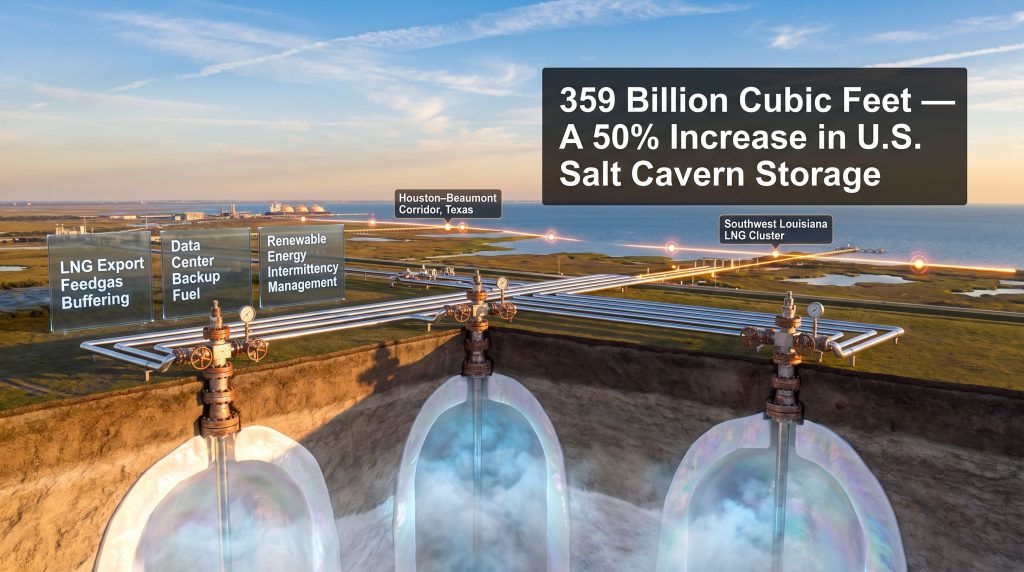
A wave of 16 proposed projects spanning Texas, Louisiana, and Mississippi is now moving through regulatory pipelines, open seasons, and engineering feasibility stages simultaneously. The combined proposed capacity across these projects reaches approximately 359 billion cubic feet of natural gas storage, a volume roughly equivalent to the carrying capacity of 65 LNG tanker vessels. More striking still, that figure represents a 50% increase over the total salt cavern storage capacity currently available across the entire United States, according to data tracked in the Oil & Gas Watch database.
Understanding why this is happening, and what it means for energy markets, environmental risk, and long-term capital allocation, requires looking beyond any single project announcement.
When big ASX news breaks, our subscribers know first
How Salt Geology Makes Gulf Coast Caverns the Preferred Storage Format
The Gulf Coast's geological inheritance is unusual. Beneath Texas and Louisiana lie vast salt dome formations, the product of ancient sea evaporation and millions of years of sedimentary pressure. These salt structures are geologically stable, naturally impermeable, and capable of withstanding the pressures required to store natural gas at commercially useful densities.
The engineering process that converts these formations into functional storage assets is known as solution mining. Water is injected under controlled pressure into the salt body, dissolving the mineral and producing concentrated brine. That brine is extracted and typically disposed of through permitted injection wells or industrial processes, leaving behind a sealed underground void. Once tested for structural integrity, the cavern is pressurised and filled with natural gas, ready to deliver supply on short notice.
This process has been in commercial use since the 1950s, but its advantages over alternative storage formats have become increasingly apparent as energy markets demand faster, more flexible supply management. According to the Pipeline and Hazardous Materials Safety Administration, underground natural gas storage is a critical component of the U.S. energy infrastructure, enabling seasonal balancing and emergency supply security.
Comparison Table: Salt Cavern Storage vs. Other Underground Storage Types
| Storage Type | Injection Speed | Withdrawal Speed | Typical Use Case | Gulf Coast Prevalence |
|---|---|---|---|---|
| Salt Caverns | Very High | Very High | LNG feedgas, peak power, trading | Dominant |
| Depleted Reservoirs | Moderate | Moderate | Seasonal balancing | Common nationally |
| Aquifer Storage | Low to Moderate | Low to Moderate | Long-term baseload | Limited |
The high cycle capability of salt caverns is their defining commercial advantage. Unlike depleted reservoir storage, which requires weeks to adjust injection and withdrawal volumes, salt caverns can shift between full injection and maximum withdrawal within hours. For LNG terminals needing to buffer sudden feedgas demand, and for grid operators managing renewable intermittency, that speed is not a luxury but a functional necessity.
Which Projects Are Leading the Gulf Coast Build-Out
The 16-project pipeline includes five entirely new cavern construction projects and eleven expansions of existing facilities. While the full portfolio spans three states, two geographic clusters account for the majority of proposed capacity.
Major Gulf Coast Salt Cavern Projects Overview
| Project Name | Location | Planned Capacity | Regulatory Status | Expected Timeline |
|---|---|---|---|---|
| Vinton Dome Gas Storage Hub | SW of Lake Charles, Louisiana | 44.5 Bcf | Proposed | TBD |
| Black Bayou Gas Storage Energy Hub | Cameron and Calcasieu Parishes, Louisiana | 34.7 Bcf | FERC certificate received | Caverns 1-2 operational 2028; full buildout 2030 |
| NeuVentus TRU Hub | Liberty County, Texas (Moss Bluff dome) | Up to 96 Bcf total; 20 Bcf initial phase | Texas state approval received; open season planned | Phase 1 advancing |
| Golden Triangle Storage (Spindletop Expansion) | Beaumont, Texas | 30 Bcf additional (60+ Bcf total) | FERC certificate granted 2026 | Phased through 2026-2027 |
| Tres Palacios Expansion | Matagorda County, Texas | 25 Bcf | Sanctioned 2026 | Service 2028-2030 |
| FRESSH (Freeport Energy Storage Hub) | Fort Bend County, Texas | 18.6 million Dth initial phase | Texas permit filed | First phase targeting 2027 |
| Hackberry Storage Project | Louisiana Gulf Coast | ~20 Bcf | FERC proposed | Status under review |
State-by-State Distribution of Proposed Projects
| State | Number of Projects | Notable Characteristics |
|---|---|---|
| Texas | 8 | Concentrated along Houston to Beaumont corridor and East Texas salt domes |
| Louisiana | 5 | Clustered near southwest LNG export and industrial demand centers |
| Mississippi | 3 | Supporting regional pipeline connectivity |
The Houston-to-Beaumont corridor in East Texas has emerged as the most active single zone for new storage development, driven by its proximity to the Spindletop salt dome system and existing pipeline interconnections. Southwest Louisiana represents the second major cluster, directly adjacent to one of the most concentrated groupings of active and proposed LNG export terminal projects anywhere in the world.
What Is Driving Demand: Four Simultaneous Pressures
The scale of this build-out cannot be explained by any single market force. Four distinct demand drivers are converging at the same time, creating an unusually strong investment case for Gulf Coast salt cavern gas storage projects.
LNG Export Growth and Feedgas Buffering
The expansion of U.S. LNG export capacity is the foundational demand driver. As new liquefaction terminals come online along the Gulf Coast, each requires a reliable, flexible supply of feedgas that can be adjusted based on shipping schedules, cargo nominations, and spot market conditions. Understanding these natural gas market implications is essential for anyone tracking U.S. energy infrastructure investment.
Harold "Skip" York, a nonresident fellow in energy and global oil at the Rice University Baker Institute Centre for Energy Studies, has described this logistical reality clearly. The construction of long-haul pipelines from Permian Basin production regions to Gulf Coast terminals creates an inherent need for terminal-side storage capacity. Without that buffer, pipeline operators face line-pack imbalances and LNG terminals face feedgas shortfalls precisely when operational reliability matters most.
Data Centre Backup Fuel Requirements
The rapid expansion of AI-driven data centre infrastructure across the Gulf South has introduced a new and largely unanticipated class of storage customer. These facilities require firm, dispatchable backup fuel that can be accessed within minutes, not hours.
Enbridge CEO Greg Ebel has publicly stated that the company's gas distribution operations are currently advancing more than $4 billion in data centre and power generation opportunities. This figure illustrates the degree to which hyperscale computing infrastructure has become a meaningful driver of gas infrastructure investment, a dynamic that was largely absent from energy market planning models as recently as five years ago.
Renewable Energy Intermittency Management
The renewable energy buildout of wind and solar generation capacity across Texas and the broader Gulf region has introduced structural volatility into power dispatch schedules. Natural gas storage functions as the physical hedge against renewable output gaps, providing grid operators with the ability to call on gas-fired generation precisely when solar irradiance drops or wind speeds fall below turbine operating thresholds.
According to RBN Energy analysts, multiple converging pressures are simultaneously elevating the strategic value of storage assets across Texas, Louisiana, Mississippi, and Alabama. These include rising production volumes, weather-driven demand spikes, new LNG export capacity additions, and planned gas-fired power generation investments. The cumulative effect is a storage market that is tightening from multiple directions at once.
Pipeline Infrastructure Buildout from Producing Basins
New long-haul pipeline capacity connecting West Texas production to Gulf Coast demand centres is creating structural pressure to develop terminal storage capacity at the receiving end. This infrastructure sequencing logic means storage development is not optional for corridor operators seeking to maximise utilisation rates on expensive pipeline assets. Furthermore, natural gas price trends in 2025 have reinforced the commercial urgency of securing flexible storage access ahead of anticipated demand peaks.
Environmental Risks and Community Opposition
The scale of the proposed build-out has generated significant concern among environmental groups, community organisations, and regulatory observers.
Luke Metzger, Executive Director of Environment Texas, has characterised the inherent risk profile of high-pressure underground methane storage as a serious regulatory concern. His position is that the pace and volume of these projects demands rigorous, mandatory safety evaluations and continuous emissions monitoring as conditions of approval, particularly given the current policy imperative to reduce methane pollution from fossil fuel infrastructure.
Community opposition in Louisiana has been particularly organised. Fishing communities, coastal advocacy groups, and environmental justice organisations have formally submitted concerns to the Federal Energy Regulatory Commission. The Vessel Project of Louisiana has specifically called for comprehensive environmental and community impact assessments before any final project approvals are granted, citing risks including:
- Potential contamination of local groundwater and surface water sources
- Disruption of ecologically sensitive coastal habitats
- Pollution impacts associated with construction and ongoing operational activities
- Long-term risks from high-pressure methane storage in geologically active coastal environments
The historical record on underground gas storage incidents provides context for these concerns. While salt cavern storage has a relatively strong safety record compared to depleted reservoir storage, high-profile incidents in similar geological settings have demonstrated that failure consequences can be severe and difficult to remediate quickly. Research published in ScienceDirect highlights the importance of rigorous structural monitoring protocols for underground energy storage facilities of this type.
A less commonly discussed technical risk in solution-mined caverns is the phenomenon known as cavern convergence, where geological creep in the surrounding salt formation gradually reduces cavern volume over time. This requires ongoing pressure management and can complicate long-term storage capacity guarantees, particularly in deeper formations where overburden pressure is higher.
The Regulatory Pathway: FERC, State Agencies, and Approval Complexity
Gulf Coast salt cavern gas storage projects navigate a dual regulatory framework that varies significantly depending on whether a facility falls under federal or state jurisdiction.
Projects that connect to interstate pipeline systems typically require a Certificate of Public Convenience and Necessity from the Federal Energy Regulatory Commission. This process involves environmental review under the National Environmental Policy Act, public comment periods, and demonstration of market need. A FERC certificate is generally considered the most significant regulatory milestone for interstate-connected facilities, as it establishes the legal right to operate and provides a degree of investor certainty.
Projects serving intrastate pipelines or operating entirely within state borders may proceed through state-level permitting processes, which vary considerably in their environmental review requirements and timeline predictability. Texas handles intrastate gas storage permitting through the Railroad Commission, while Louisiana projects touching state waterways or wetlands may require additional approvals from environmental agencies.
This regulatory bifurcation creates an uneven landscape for project developers. Operators with established relationships with state regulators may find faster pathways for intrastate projects, while interstate projects face longer federal timelines but benefit from stronger legal protections once certified.
The next major ASX story will hit our subscribers first
The Long-Term Question: Stranded Asset Risk and the Energy Transition
Perhaps the most consequential analytical question surrounding Gulf Coast salt cavern gas storage projects is not whether they can be built, but whether the commercial assumptions underpinning their economics will hold across the 20 to 30-year asset lives typical of this infrastructure class.
Paasha Mahdavi, Professor and Director of the Energy Governance and Political Economy Lab at the University of California Santa Barbara, has raised substantive concerns about the concentration of capital in LNG-oriented infrastructure. His analysis points to a fundamental structural risk: a significant portion of Gulf Coast LNG export capacity has been developed on the assumption of sustained European demand, driven by the disruption of Russian pipeline gas supplies following the Ukraine conflict. Consequently, questions around energy transition and energy security have become central to evaluating these long-term infrastructure bets.
Strategic Scenario Table: Three Possible Futures for Gulf Coast Salt Storage
| Scenario | Key Assumptions | Implications for Storage Asset Value |
|---|---|---|
| Sustained LNG Supercycle | European demand persists; Asia absorbs excess; U.S. gas production grows | High utilisation; strong returns; further expansion likely |
| Partial Demand Erosion | Europe transitions partially; Asia demand mixed; renewable buildout accelerates | Moderate utilisation; some assets underperform; selective write-downs |
| Accelerated Energy Transition | Rapid electrification; LNG demand collapses; carbon policy tightens | Significant stranded asset risk; regulatory and financial exposure |
The central concern is that European nations, having experienced firsthand the geopolitical vulnerability of fossil fuel dependence, are likely to accelerate domestic energy transition programmes rather than extend long-term LNG import commitments indefinitely. If that trajectory materialises faster than current market pricing assumes, the commercial rationale for storage assets built specifically to serve export terminals weakens substantially.
What makes this risk particularly difficult to hedge is the mismatch between infrastructure investment timelines and energy transition timelines. A salt cavern storage facility sanctioned in 2026 is expected to generate returns through the 2040s and beyond. The pace of electrification, battery storage development, and hydrogen infrastructure buildout over that period remains genuinely uncertain. Furthermore, energy trade and geopolitics continue to reshape the assumptions underpinning long-term infrastructure investment across the Gulf Coast region.
Frequently Asked Questions: Gulf Coast Salt Cavern Gas Storage
What is a salt cavern and how is it used to store natural gas?
A salt cavern is an underground void created by injecting water into a naturally occurring salt formation, dissolving the mineral, and removing the resulting brine. The remaining sealed cavity is pressurised and filled with natural gas, which can be withdrawn rapidly on demand.
How much new storage capacity is being added along the Gulf Coast?
The 16 proposed projects collectively plan to add approximately 359 billion cubic feet of salt cavern storage capacity, representing a 50% increase over current U.S. salt cavern storage availability.
Which states have the most planned salt cavern storage projects?
Texas leads with eight proposed projects, followed by Louisiana with five and Mississippi with three.
Why are data centres driving demand for underground gas storage?
Data centres require firm, rapidly accessible backup fuel supplies. Unlike seasonal gas customers, these facilities operate continuously and need storage assets capable of fast withdrawal cycles on short notice.
What environmental risks do salt cavern gas storage projects pose?
Primary risks include methane leakage from pressurised storage volumes, potential groundwater contamination from brine disposal, habitat disruption during construction, and the long-term risk of cavern structural failure under sustained pressure cycles.
How long have salt caverns been used for natural gas storage?
Commercial use of salt caverns for natural gas storage dates to the 1950s, making it a proven but now rapidly scaling technology.
What happens to these investments if LNG demand declines?
If European LNG import demand weakens significantly as energy transition programmes accelerate, storage facilities built specifically to serve export terminals face meaningful stranded asset risk, with long-term utilisation and revenue assumptions potentially undermined.
Who regulates underground natural gas storage in the United States?
Interstate-connected facilities fall primarily under FERC jurisdiction, while intrastate facilities are regulated by state agencies such as the Texas Railroad Commission.
Key Takeaways
- Sixteen projects across Texas, Louisiana, and Mississippi propose to add approximately 359 billion cubic feet of salt cavern storage capacity, a 50% increase over current U.S. availability
- Demand is being simultaneously pulled by LNG feedgas buffering, data centre backup fuel requirements, renewable energy intermittency management, and pipeline infrastructure buildout from producing basins
- The Houston-to-Beaumont corridor and southwest Louisiana represent the two highest-concentration development zones
- Environmental and community opposition is most pronounced in Louisiana, where formal FERC submissions have raised concerns about water contamination, habitat disruption, and methane leakage
- Long-term asset viability remains contingent on the durability of European LNG import demand and the broader pace of energy transition, factors that introduce genuine stranded asset risk across the project portfolio
- The dual regulatory pathway — FERC for interstate projects and state agencies for intrastate facilities — creates uneven review standards and timeline predictability across the project pipeline
- A lesser-discussed technical consideration is the geological phenomenon of cavern convergence, where salt creep gradually reduces storage volume over time, requiring ongoing pressure management and careful long-term capacity planning
Disclaimer: This article contains forward-looking statements and scenario projections based on publicly available information and cited expert perspectives. These projections involve inherent uncertainty and should not be construed as financial advice or investment recommendations. Readers should conduct independent research before making any investment or policy-related decisions.
Further project tracking and publicly sourced facility records for Gulf Coast energy infrastructure are available through the Oil & Gas Watch database at oilandgaswatch.org.
Want To Stay Ahead of the Next Major Energy and Resources Discovery?
Discovery Alert's proprietary Discovery IQ model scans ASX announcements in real time, instantly identifying significant mineral discoveries across the commodities powering the global energy transition — from the natural gas infrastructure reshaping Gulf Coast markets to the critical minerals driving the shift to cleaner energy. Explore how historic ASX discoveries have delivered substantial returns on Discovery Alert's dedicated discoveries page, and begin your 14-day free trial today to position yourself ahead of the broader market.