August 24, 2026
When Integrated Energy Models Face Their Biggest Test
Every few years, global energy markets encounter a stress event severe enough to separate genuinely resilient business models from those that simply benefit from rising commodity prices. The 2022 Russia-Ukraine conflict was one such test. The disruption to the Strait of Hormuz in early 2026 is another — and arguably more structurally complex, given its simultaneous impact on crude oil price trends, LNG supply chains, and physical infrastructure owned by major energy companies.
For investors trying to interpret Shell's Q2 2026 results through a capital allocation lens, the question is not simply whether earnings were strong. The more revealing question is: what does the composition of those earnings tell us about the durability of Shell's business architecture when the world's most critical energy chokepoint is effectively closed?
When big ASX news breaks, our subscribers know first
Shell Share Buyback and Profit Surge: What the Numbers Actually Reveal
Reading Beyond the Headline Earnings Figure
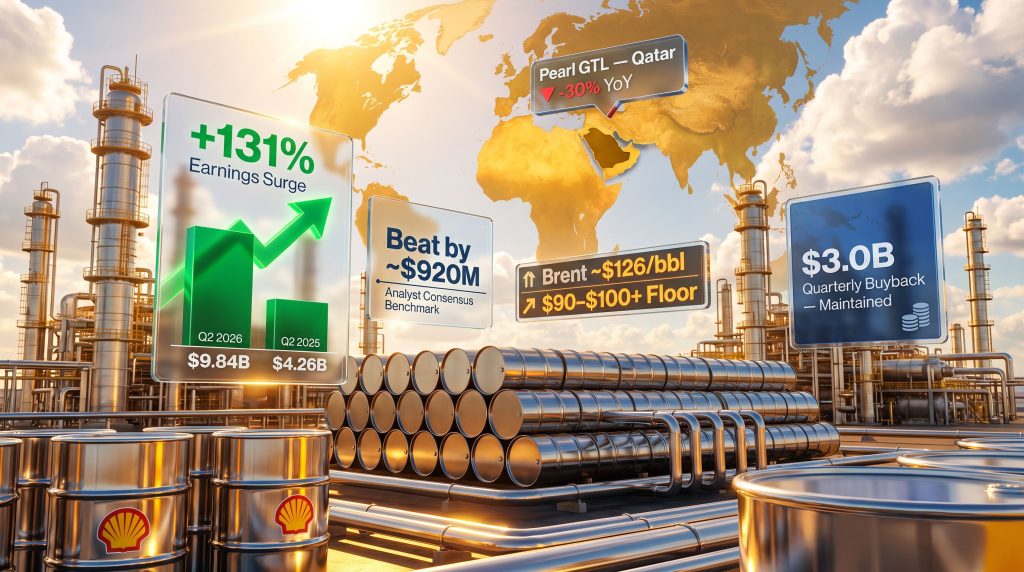
Shell's adjusted earnings of $9.84 billion for the second quarter of 2026 represent more than a strong result on paper. They reflect a near-doubling of year-on-year profitability from the $4.26 billion recorded in Q2 2025 — a period that itself was not particularly weak by historical standards.
Analyst consensus had forecast $8.92 billion, meaning Shell exceeded market expectations by approximately $920 million. That scale of outperformance is not explained by commodity prices alone. It points to genuine operational execution across multiple divisions simultaneously.
| Metric | Q2 2026 | Q2 2025 | Change |
|---|---|---|---|
| Adjusted Earnings | $9.84 billion | $4.26 billion | +131% |
| Analyst Consensus | $8.92 billion | — | Beat by ~$920M |
| Quarterly Share Buyback | $3.0 billion | — | Maintained |
| Brent Crude Peak (April 2026) | ~$126/bbl | — | Multi-year high |
| Brent Crude Post-Talks Floor | $90–$100+/bbl | — | Elevated |
| Integrated Gas Production Change | -30% YoY | — | Disruption-driven |
The Shell share buyback and profit surge was not a one-dimensional commodity story. Stronger LNG trading performance, improved chemicals margins, and active oil trading contributed independently — suggesting Shell's diversified revenue architecture is functioning precisely as intended under genuine stress conditions.
What Drove the Outperformance
The composition of Shell's Q2 2026 result matters as much as the total figure. Analysts and investors focused purely on Brent crude price movements risk missing the multi-layered nature of the earnings beat.
Primary earnings contributors in Q2 2026:
- Elevated crude oil and gas benchmark prices across all upstream production assets
- Expanded LNG trading margins as supply route disruption created significant arbitrage opportunities
- Wider refining and chemicals product spreads, driven by constrained middle distillate supply
- Active oil trading positioning that capitalised on price volatility and regional price dislocations
One factor rarely highlighted in mainstream coverage is the role of contango structures in the oil futures market during periods of supply uncertainty. When near-term supply is disrupted but long-dated futures remain lower, integrated energy traders with large storage infrastructure can capture the spread between current physical prices and deferred delivery contracts. Shell's commodities trading division is one of the largest in the world, giving the company a structural edge in capturing these dynamics. Furthermore, the commodities trade and market volatility environment of 2025–2026 created additional opportunities for well-positioned traders.
How the Strait of Hormuz Closure Reshaped Shell's Revenue Architecture
The Chokepoint That Changed the Pricing Landscape
The Strait of Hormuz is approximately 21 miles wide at its narrowest navigable point and serves as the transit corridor for roughly 20% of global oil trade and a significant share of the world's LNG exports, according to the US Energy Information Administration. Its effective closure following the outbreak of conflict involving Iran in late February 2026 represented the most severe disruption to global energy supply routes since the Arab oil embargo of the 1970s.
Brent crude surged to approximately $126 per barrel by late April 2026 as markets priced in both the immediate supply shortfall and the long-term uncertainty surrounding route restoration. Even after some diplomatic activity reduced the intensity of conflict, Brent continued trading above the $90 per barrel level following the breakdown of US-Iran peace negotiations — establishing a materially higher price floor than the pre-conflict environment. The trade war's impact on oil markets in 2025 had already set the stage for this elevated sensitivity to supply disruptions.
The Two-Sided Impact on Shell's Operations
Shell's Q2 2026 experience illustrates a counterintuitive dynamic that investors in integrated energy majors should understand clearly: geopolitical disruption of this scale can simultaneously generate earnings windfalls and create significant operational impairments, often within the same company.
Positive contributions from the conflict environment:
- All upstream production assets benefited from structurally higher benchmark prices
- Trading margins expanded as regional supply dislocations created pricing inefficiencies
- Refining margins widened as middle distillate supply tightened across import-dependent markets
- LNG spot prices surged as alternative supply sources competed for rerouted cargoes
Negative operational impacts from the same conflict:
- Shell's Pearl gas-to-liquids facility in Qatar — one of the largest single-train GTL operations on earth — ceased production in March 2026 following missile strikes and had not resumed as of the Q2 reporting date
- Qatari LNG facilities in which Shell holds partial ownership interests were also disrupted by conflict activity
- Integrated gas division output fell approximately 30% year-on-year, a severe volume reduction for a division central to Shell's long-term strategy
The net earnings result was strongly positive despite the Qatar production losses. This raises a question that has not been widely explored: how much additional earnings potential remains locked out while the Pearl GTL site stays offline? If commodity prices remain elevated when Pearl eventually restarts, the combined effect of volume recovery and high pricing could produce an unusually strong earnings quarter.
Understanding Shell's Pearl GTL Facility and What Its Loss Means
A Unique Industrial Asset That Cannot Be Quickly Replaced
The Pearl gas-to-liquids facility deserves more attention than it typically receives in mainstream earnings coverage. GTL technology converts natural gas feedstock into high-quality synthetic liquid fuels, lubricants, and chemical feedstocks through the Fischer-Tropsch process — a technology originally developed in Germany in the 1920s and refined over decades of industrial application.
Pearl is significant for several reasons that compound its importance beyond simple production volume:
- Product quality premium: GTL-derived products are ultra-low in sulphur and aromatic compounds, commanding a price premium over conventional petroleum products in certain markets
- Feedstock diversity: GTL allows natural gas reserves that would otherwise be stranded or flared to be converted into transportable, high-value liquid products
- Irreplaceability in the short term: There is no equivalent spare GTL capacity sitting idle globally that Shell or any operator could activate to compensate for Pearl's output gap
- Long restart timeline: Complex industrial facilities that have sustained missile strike damage require extensive assessment, repair, and controlled recommissioning before production can resume safely
The cessation of Pearl's output since March 2026 represents not just a volume gap but a product mix gap that affects the quality and diversification of Shell's overall production portfolio.
Geographic Concentration Risk: A Lesson for Energy Investors
Shell's simultaneous exposure to GTL production losses and LNG facility disruption from a single geographic conflict in Qatar illustrates a risk management dimension that is often underweighted in energy sector valuations. In addition, the broader LNG supply outlook highlights how concentrated exposure to key producing regions can amplify both gains and losses during disruption events.
Risk Framework: Integrated energy majors with significant asset concentration in geopolitically sensitive regions face an asymmetric risk profile. During periods of elevated commodity prices, the price tailwind can fully offset and even exceed operational losses. However, if commodity prices were to normalise simultaneously with continued production disruptions, the earnings impact would compound rather than offset. Investors should assess geographic concentration risk independently of near-term commodity price outlooks.
This dynamic is not unique to Shell. TotalEnergies, BP, and Eni all maintain material exposure to Middle Eastern and North African production assets. The Q2 2026 environment provides a live case study in why portfolio diversification across geographies — not only across energy types — is a critical factor in assessing the long-term resilience of major energy company earnings.
Decoding the $3 Billion Share Buyback Decision
What Capital Allocation Signals Tell Markets
The Shell share buyback and profit surge in Q2 2026 are connected in a way that goes beyond simple financial mechanics. Shell's decision to maintain its $3.0 billion quarterly buyback programme — rather than pause, reduce, or redirect capital toward debt reduction or incremental investment — functions as a deliberate market communication. According to Shell's investor relations, the buyback programme has been a consistent feature of their capital allocation strategy.
When companies of Shell's scale maintain or increase buyback programmes during periods of geopolitical uncertainty, they are signalling several things simultaneously:
- Free cash flow confidence: Management believes cash generation is sufficiently robust to sustain both reinvestment and shareholder returns without balance sheet strain
- Commodity price durability: Implicit in the continued buyback is a management view that the elevated price environment is expected to persist for at least the near term
- Capital discipline: A maintained buyback rather than an expanded one signals disciplined capital allocation rather than opportunistic excess distribution
How Share Buybacks Work: When a company repurchases its own shares on the open market and then cancels them, the total number of shares outstanding decreases. This mechanically increases earnings per share and the proportional ownership stake of remaining shareholders without requiring a dividend payment. For Shell, a $3 billion quarterly buyback represents a significant and compounding reduction in share count over time, amplifying per-share value if earnings remain at elevated levels.
Shell's Buyback in Peer Context
| Company | Recent Quarterly Buyback | Context |
|---|---|---|
| Shell | $3.0 billion (maintained) | $9.84B Q2 2026 adjusted earnings |
| TotalEnergies | Increasing buyback activity | Benefiting from similar price environment |
| Eni | Increasing 2026 buybacks | Production growth accelerating |
| BP | Under strategic review | Facing separate financial pressures |
Note: Peer figures based on publicly available reporting as of July 2026. Individual company strategies and financial positions vary materially.
Shell's Earnings in Historical Conflict-Driven Price Cycles
Contextualising the Q2 2026 Result
Shell's Q2 2026 result is best understood within the historical pattern of how conflict-driven oil price spikes translate into integrated energy company earnings. The 2022 post-Ukraine invasion period provides the most instructive parallel, given that it similarly combined a sudden commodity price surge with genuine physical infrastructure risk across global supply chains.
| Period | Triggering Event | Brent Price Range | Shell Earnings Context |
|---|---|---|---|
| 2022 (Q2-Q3) | Russia-Ukraine War | $100-$130/bbl | Record-level quarterly earnings |
| 2023-2024 | Post-conflict normalisation | $75-$90/bbl | Earnings moderation cycle |
| Q2 2026 | Iran conflict / Hormuz disruption | $90-$126/bbl | Near-record quarterly result |
What is notably different about Q2 2026 compared to the 2022 cycle is that Shell is simultaneously experiencing production volume losses from physical infrastructure damage. In 2022, Shell's production base remained broadly intact while prices rose. In 2026, the company is delivering near-record earnings while absorbing a 30% integrated gas production decline — which arguably makes the underlying earnings quality of the current result more impressive, not less. As reported by Investing.com, Shell's Q2 profit surged past forecasts, reinforcing confidence in the company's trading and operational resilience.
The next major ASX story will hit our subscribers first
Three Scenarios for Shell's Earnings Trajectory in H2 2026
Mapping the Possible Paths Forward
The range of plausible outcomes for Shell's second-half 2026 performance is unusually wide given the number of unresolved variables. Investors should consider at least three distinct scenarios when forming a view.
Scenario 1: Sustained Geopolitical Tension (Elevated Base Case)
- Brent crude remains above $90/bbl as Hormuz disruption persists
- Pearl GTL site remains offline throughout the remainder of 2026
- Buyback programme continues at $3 billion per quarter
- Trading margins remain elevated but begin normalising from Q2 peaks
- Earnings remain strong but below the exceptional Q2 2026 level
Scenario 2: Partial Conflict Resolution
- Diplomatic progress eases Hormuz disruption; crude prices retreat toward the $75-$85/bbl range
- Trading margins compress as market volatility reduces arbitrage opportunities
- Pearl GTL site begins phased assessment and eventual restart preparation
- Earnings moderate meaningfully, but integrated gas volumes begin recovering
Scenario 3: Escalation or New Supply Disruptions
- Additional infrastructure attacks or new conflict fronts emerge in the Middle East
- Crude prices retest or exceed the $126/bbl level established in April 2026
- Shell's trading division captures outsized margins; refining spreads expand further
- Capital allocation decisions face intensified scrutiny from ESG-focused institutional investors
The scenarios above represent analytical possibilities and should not be treated as forecasts or investment advice. Commodity price and geopolitical outcomes are inherently unpredictable.
Is Shell Built to Thrive Through Volatility or Simply Benefiting From It?
Testing the Strategic Thesis
Shell's leadership under CEO Wael Sawan has consistently articulated a specific strategic objective: building an organisation capable of generating strong returns across commodity price cycles rather than only during price spikes. This is not merely a marketing narrative — it represents a genuine shift in how the company has structured its trading, refining, and LNG portfolio over the past several years.
Q2 2026 provides the most rigorous empirical test of this thesis to date. The quarter combined:
- Extreme crude oil price volatility reaching multi-year highs
- Physical infrastructure damage to core production assets
- Sustained geopolitical uncertainty with no clear resolution timeline
- Simultaneous disruption across oil, LNG, and GTL production streams
Against this backdrop, earnings came in at $9.84 billion — above analyst expectations and more than double the prior year. That outcome does lend credibility to the diversified volatility-as-opportunity thesis. However, the financial markets reset that characterised broader market conditions in 2025 also created a more complex backdrop against which to assess Shell's performance.
However, the 30% integrated gas volume decline introduces a genuine counterargument. Geographic concentration in Qatar created a compounded impairment that was masked by commodity price elevation rather than resolved by business model diversification. If prices had been lower, the same volume losses would have produced a very different earnings outcome.
Three Structural Takeaways for Energy Sector Investors
- Geopolitical risk premiums have become structurally embedded in oil pricing. The sustained elevation of Brent above $90/bbl despite intermittent diplomatic activity suggests markets are permanently repricing the risk of Middle Eastern supply route disruption — not treating it as a temporary spike.
- Integrated business models demonstrably outperform pure-play producers in volatile environments. Shell's trading and refining divisions provided earnings diversification that partially cushioned the Qatar production impact, validating the integrated model over pure upstream exposure.
- Shareholder return programmes function as confidence signals in uncertain markets. The maintained $3 billion quarterly buyback communicates management conviction in cash generation durability more clearly than any verbal guidance statement could.
FAQ: Shell Share Buyback and Profit Surge
What were Shell's Q2 2026 adjusted earnings?
Shell reported adjusted earnings of $9.84 billion for the second quarter of 2026, more than double the $4.26 billion recorded in the same period of 2025 and approximately $920 million above analyst consensus of $8.92 billion.
Why did Shell's profits surge in Q2 2026?
The primary drivers included elevated crude oil and natural gas prices following disruption to the Strait of Hormuz, stronger LNG and oil trading performance, and improved chemicals and refining margins. These gains more than offset a 30% decline in integrated gas production volumes caused by damage to Shell's Qatari facilities.
What is Shell's current share buyback programme?
Shell is maintaining a $3.0 billion quarterly share buyback programme. Repurchased shares are cancelled, reducing the total share count and increasing the proportional value of remaining shareholder stakes.
What happened to Shell's Qatar operations?
Shell's Pearl gas-to-liquids facility ceased production in March 2026 following missile strikes. LNG facilities in Qatar in which Shell holds partial ownership were also disrupted. The Pearl site had not resumed production as of the Q2 2026 reporting date.
What is the Pearl GTL facility and why does it matter?
The Pearl facility converts natural gas into high-quality synthetic liquid fuels and chemicals through the Fischer-Tropsch process. It is one of the world's largest single-train GTL operations and produces premium-grade products that command a market price above conventional petroleum equivalents. Its extended closure represents both a volume gap and a product quality gap in Shell's portfolio that cannot be quickly substituted from other assets.
How does the current Brent price environment compare to 2022?
Brent crude reached a peak of approximately $126 per barrel in late April 2026, comparable in magnitude to the 2022 post-Ukraine invasion spike. A key difference is that the current disruption involves simultaneous physical infrastructure damage to Shell's own production assets, whereas the 2022 price surge affected broader market supply without directly impairing Shell's operational base to the same degree.
This article is for informational purposes only and does not constitute financial or investment advice. Past performance and historical earnings patterns are not reliable indicators of future results. Commodity prices and geopolitical conditions are subject to rapid and unpredictable change.
Want to Spot the Next Major Resource Discovery Before the Market Does?
Discovery Alert's proprietary Discovery IQ model delivers real-time alerts on significant ASX mineral discoveries, transforming complex geological data into actionable investment insights — explore the historic returns major discoveries have generated and begin your 14-day free trial to position yourself ahead of the market.