August 24, 2026
When a Commodity Transition Reshapes a Mining Giant's Identity
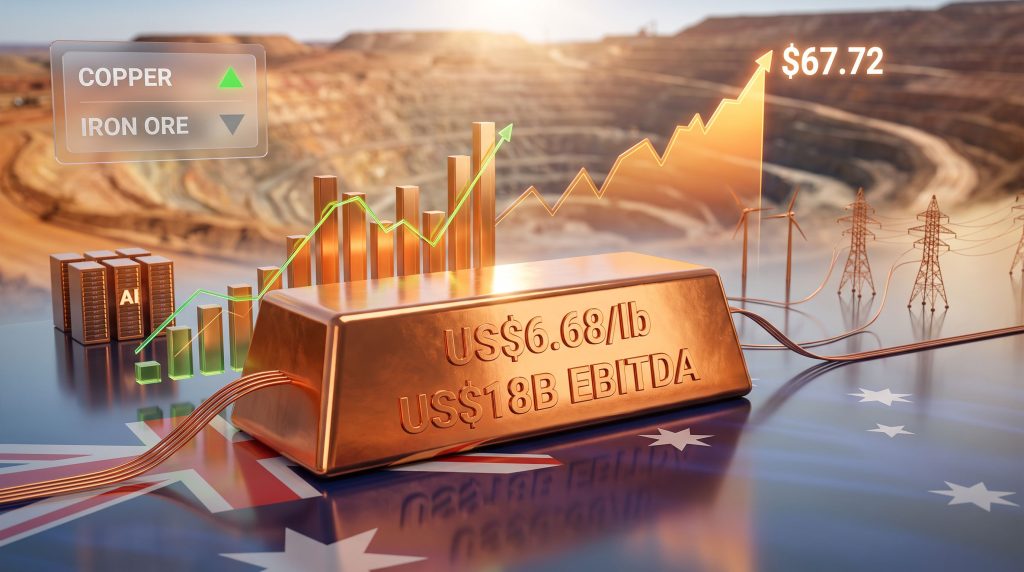
BHP shares hit record territory on Monday 24 August 2026, reaching an intraday high of $67.72, a rise of approximately 3.9% from Friday's close of $65.16. While the immediate catalyst was a copper price surge to US$6.68 per pound in US trading, the deeper story is structural rather than cyclical. Understanding that distinction is essential for any investor assessing whether this rally has legs or represents a sentiment-driven overshoot.
The mining industry has long operated in cycles, but occasionally something more permanent occurs beneath the surface of commodity price movements. When a diversified miner's dominant earnings source shifts from one commodity to another, it is not merely a financial rearrangement. It signals a fundamental reorientation of how the company should be understood, valued, and positioned within a portfolio. That is precisely the inflection point BHP Group Ltd (ASX: BHP) has now reached, and the market's response has been unambiguous.
When big ASX news breaks, our subscribers know first
The Earnings Architecture Has Changed, Not Just the Commodity Price
For most of BHP's recent history, iron ore was the undisputed engine of group profitability. Iron ore's torrid margins, driven by Chinese steel demand and the company's low-cost Pilbara operations, delivered extraordinary returns through much of the 2010s and early 2020s. That era has not ended, but it has been definitively superseded.
BHP's FY26 results confirmed that copper has overtaken iron ore as the company's single largest earnings contributor for the first time. The numbers are striking:
- Net profit increased by 9% to US$9.83 billion
- Copper generated approximately US$18 billion in underlying EBITDA, accounting for more than half of group underlying earnings
- Iron ore, while still a significant contributor, has been displaced from its long-held position at the top of BHP's earnings hierarchy
This transition matters beyond the headline figures. When institutional investors observe that a major diversified miner's primary earnings driver has shifted toward a commodity with stronger structural demand fundamentals, the market typically applies a sustained valuation premium rather than treating the development as a temporary cyclical tailwind. Furthermore, the BHP strategic pivot toward copper-weighted earnings has been years in the making, and the FY26 results confirm that the strategy is now delivering tangible financial results.
Copper vs. Iron Ore: The Commodity Divergence Driving a Sector Repricing
The contrast between copper and iron ore's outlook is not simply a matter of recent price performance. It reflects diverging demand architectures rooted in fundamentally different end-use markets.
| Metric | Copper | Iron Ore |
|---|---|---|
| Recent Price Direction | Rising, multi-year highs | Softening amid China concerns |
| Primary Demand Driver | AI infrastructure, EVs, electrification | Chinese steel production and construction |
| Supply Outlook | Structurally constrained | Expanding via new and expanded projects |
| BHP Revenue Contribution (FY26) | Majority of group EBITDA | Secondary contributor |
| Price Sensitivity for BHP | High and growing | Declining relative importance |
Iron ore's demand profile is heavily dependent on the China steel and iron ore market, including steel output, both of which face structural headwinds as China's property sector continues to rebalance. Copper, by contrast, is experiencing demand acceleration from entirely different sources: the buildout of AI data centre infrastructure, electricity grid expansion, electric vehicle adoption, and renewable energy generation capacity.
The distinction between speculative positioning and genuine physical market tightness is critical here. Copper's current strength is being driven by real inventory drawdowns at exchange warehouses, not just financial market momentum. That physical tightness is a more durable price support mechanism than derivatives-driven speculation.
What Is Driving Copper to Multi-Year Highs?
The copper market is facing a supply-demand imbalance that most commodity analysts regard as structural rather than transient. Several reinforcing factors are converging simultaneously. In addition, the copper supply crunch is being intensified by declining ore grades and extended project development timelines that are limiting the industry's ability to respond to rising demand.
On the supply side:
- Global copper ore grades have been declining for decades. The average grade of copper ore mined globally has fallen from roughly 1.5% in the early 2000s to below 0.6% in many major producing regions, meaning more rock must be processed per tonne of refined copper produced
- Project development timelines remain extended, with the average new copper mine requiring 10 to 16 years from discovery to first production
- Geopolitical complexity in Chile and Peru, which together account for approximately 40% of global copper mine supply, continues to introduce permitting, labour, and regulatory uncertainty
- Community opposition and water access constraints in copper-rich regions are increasingly delaying or cancelling planned expansions
On the demand side, three structural forces are converging:
- AI data centre buildout: A large-scale hyperscale data centre requires substantial copper for power distribution, cooling systems, server interconnects, and building wiring. As AI compute requirements scale exponentially, so does the copper intensity of the digital economy
- Electricity grid expansion: Ageing transmission infrastructure across developed economies requires wholesale copper-intensive upgrades, independent of any energy transition
- Renewable energy and EV adoption: Wind turbines, solar farms, and electric vehicles all require significantly more copper per unit of energy output or transport distance than their fossil-fuel equivalents
The timeline mismatch between this accelerating demand and the industry's inability to bring new mine supply online quickly is the fundamental driver of price strength. New discoveries must clear environmental approvals, community consultation processes, and capital allocation hurdles before a single tonne of copper reaches a smelter.
BHP's Production Strategy Under CEO Brandon Craig
BHP's approach to capitalising on copper's structural moment is deliberately measured. Rather than committing immediately to capital-intensive greenfield projects, the company under CEO Brandon Craig is prioritising volume growth from within its existing copper asset base.
This strategy carries a compelling capital efficiency logic. Expanding production from known, operating deposits carries lower geological, permitting, and execution risk than developing entirely new mines in frontier jurisdictions. BHP's existing copper operations, including its South Australian assets and its stake in the Escondida mine in Chile, already rank among the world's largest producing copper assets.
Unlocking incremental volume from these operations represents a lower-risk path to earnings growth than the industry average. The copper price growth drivers underpinning BHP's strategy are supported by the company's expectation that copper consumption will increase substantially over coming decades as data centres, renewable energy infrastructure, and electricity networks require ever-increasing volumes of the metal.
Scenario Analysis: Three Pathways for BHP's Share Price from Here
Scenario 1: The Copper Structural Cycle Sustains
If copper prices remain above US$6.00 per pound, BHP's earnings mix stays copper-dominant and the company's valuation premium relative to iron ore-heavy peers is likely to persist. Under this scenario, institutional capital continues rotating toward BHP as the most liquid large-cap ASX vehicle for copper exposure. The risk here is that elevated prices eventually incentivise supply responses that took over a decade to develop, eventually normalising the market.
Scenario 2: Copper Corrects, but the Structural Thesis Remains Intact
Commodity markets rarely move in straight lines. A correction in copper prices, driven by short-term demand concerns or profit-taking in financial markets, would not necessarily invalidate the structural case. Given BHP's exposure to long-duration copper demand from electrification and AI infrastructure, price dips within a broader uptrend are more likely to attract institutional accumulation than trigger rotation out of the sector.
Scenario 3: Iron Ore Rebounds, Complicating the Narrative
Chinese stimulus measures targeting infrastructure or property could reinvigorate iron ore demand, presenting BHP with a dual-commodity earnings recovery. While this would further support cash generation and dividend capacity, it would also reintroduce valuation complexity by diluting the clarity of the copper-driven earnings story that is currently attracting premium pricing.
Across all three scenarios, copper exposure functions as the primary valuation anchor for BHP. The record share price reflects institutional confidence in scenario durability rather than a single session of momentum trading.
The next major ASX story will hit our subscribers first
Risk Factors That Could Interrupt the Rally
| Risk Factor | Probability Assessment | Potential Market Impact |
|---|---|---|
| US-China trade policy escalation | Moderate | Demand-side pressure on copper pricing |
| Rapid new mine supply additions | Low (10-16 year lead times) | Limited near-term price threat |
| Global recession reducing industrial demand | Low to moderate | Temporary correction, not structural reversal |
| AUD/USD currency appreciation | Moderate | Margin compression for ASX-reporting miners |
| Regulatory changes in key copper jurisdictions | Low | Project-specific, not systemic |
How BHP Compares to ASX Mining Peers on Copper Exposure
Among ASX-listed large-cap miners, BHP currently offers the most direct and scalable exposure to the copper structural demand thesis. A comparison with key peers illustrates why:
- Rio Tinto (ASX: RIO): The Rio Tinto copper expansion through the Oyu Tolgoi underground development in Mongolia is expected to become one of the world's top copper producing operations. However, Rio remains predominantly weighted toward iron ore by earnings contribution, meaning copper upside is more optionality than primary driver
- South32 (ASX: S32): Provides diversified base metals exposure including commodities that benefit from similar electrification tailwinds, though its copper exposure is indirect relative to BHP's concentrated asset base
- Mineral Resources (ASX: MIN): Focused primarily on lithium and iron ore, with copper exposure minimal and an entirely different commodity cycle sensitivity
The scarcity of large-cap, liquid, copper-weighted ASX mining equities is itself a structural support for BHP's premium valuation. Institutional investors seeking meaningful copper exposure at scale within the ASX universe have limited alternatives.
The Geological Reality Behind the Supply Constraint
One aspect of the copper market that is frequently underappreciated by generalist investors is the geological dimension of supply constraint. Declining ore grades are not merely a cost problem but a long-term physical reality.
As higher-grade copper deposits are progressively depleted, the industry is increasingly reliant on lower-grade porphyry copper deposits, which require significantly higher energy inputs, greater water consumption, and more complex processing chemistry to extract the same amount of refined metal. This grade decline is effectively a hidden cost escalator that undermines new supply economics even when copper prices are elevated.
Additionally, the geographic concentration of remaining high-quality copper reserves in Chile, Peru, and the Democratic Republic of Congo introduces jurisdictional risk that cannot be diversified away at the project level. Community relations, water rights disputes, and tax regime changes in these countries have historically caused production disruptions that contributed to physical market tightness.
What the Dividend Signal Communicates to Professional Investors
BHP's increased dividend alongside its FY26 results is not merely a shareholder return mechanism. For institutional investors conducting forward earnings analysis, the payout level communicates management's confidence in the durability of the cash flow stream underpinning it.
Mining companies with high earnings variability typically maintain conservative payout ratios to preserve balance sheet flexibility through commodity downturns. A larger dividend therefore signals that management views the current earnings trajectory as sufficiently stable to justify distribution at elevated levels. In a sector where commodity price volatility is endemic, that kind of cash flow confidence is itself a valuation input. According to analysis from the Wall Street Journal, BHP's profit trajectory reflects the broader repricing of copper-exposed mining equities at the institutional level.
Frequently Asked Questions: BHP Shares and the Copper Rally
Why did BHP shares hit a record high?
BHP's ASX-listed shares reached a record intraday level of $67.72, rising approximately 3.9% from Friday's closing price of $65.16, driven by surging copper prices and strong FY26 earnings that confirmed copper had overtaken iron ore as the company's largest earnings contributor for the first time.
What is copper trading at and why does it matter for BHP?
Copper reached US$6.68 per pound in recent US trading, supported by tight physical supply and accelerating structural demand from AI infrastructure, renewable energy, and electrification. As BHP's primary earnings driver, copper price movements now have a direct and amplified effect on the company's profitability and share price trajectory.
What were BHP's key FY26 financial results?
BHP reported a 9% increase in net profit to US$9.83 billion for FY26, with copper generating approximately US$18 billion in underlying EBITDA, representing more than half of total group earnings for the first time in the company's history.
Is BHP's share price rally sustainable?
Sustainability depends on whether copper's structural demand drivers continue to outpace constrained mine supply over a multi-year horizon. The structural case for elevated copper demand from electrification, AI data centre infrastructure, and EV adoption is broadly viewed as durable, though near-term price volatility remains a constant feature of commodity markets. Reporting from Investor Daily confirms that BHP shares hit record levels as copper's rally powers miners higher, reinforcing the structural nature of this repricing.
What risks could reverse the rally?
Key risks include deterioration in US-China trade relations, an unexpected global economic slowdown reducing industrial demand, AUD appreciation compressing ASX-reported margins, or faster-than-anticipated increases in new copper mine supply. The last risk is structurally limited by the 10 to 16-year development timeline characteristic of the copper mining industry.
Strategic Takeaways for ASX Investors
The significance of BHP shares hitting a record high extends beyond a single company's performance. It represents a market-wide signal that the commodities landscape is being structurally reweighted toward electrification metals, with copper at the centre of that repositioning.
Several implications follow for investors assessing the ASX mining sector:
- The transition from iron ore to copper as BHP's dominant earnings source is a permanent architectural shift, not a cyclical anomaly
- BHP's record share price reflects institutional repricing of long-term earnings quality, not momentum speculation
- The scarcity of large-cap, copper-weighted ASX equities creates a structural premium for BHP that may persist independent of short-term price movements
- Declining ore grades globally and extended mine development timelines provide a durable floor under the copper supply constraint thesis
- For investors evaluating which ASX miners are best positioned for the electrification decade ahead, copper exposure at scale, operational efficiency, and balance sheet strength are the defining selection criteria
This article is intended for informational purposes only and does not constitute financial advice. Commodity prices, company earnings, and share valuations are subject to change and may differ materially from projections. Readers should conduct independent research and seek professional financial advice before making investment decisions.
Want to Catch the Next Major ASX Copper Discovery Before the Market Does?
Discovery Alert's proprietary Discovery IQ model delivers real-time alerts on significant ASX mineral discoveries — including copper — instantly transforming complex geological data into actionable investment insights for both short-term traders and long-term investors. Explore historic examples of exceptional discovery returns and begin your 14-day free trial today to position yourself ahead of the market.