August 24, 2026
Commodity Cycles, Currency Traps, and the Hidden Complexity Behind Mining Earnings
South African mining earnings rarely tell a simple story. Beneath the headline numbers lies a web of interacting forces: commodity price cycles moving in different directions simultaneously, currency dynamics that can neutralise hard-won gains, and non-recurring accounting events that can inflate reported profits far beyond what operations actually generated. For investors attempting to read the underlying health of a diversified miner, the ability to decompose these layers is not optional. It is essential.
African Rainbow Minerals (ARM) has delivered a textbook example of this complexity through its FY2026 full-year earnings guidance, where the African Rainbow Minerals headline earnings boost of 12% to 22% year-on-year coexists with a basic earnings figure that surged by more than 1,100%. Understanding why these two numbers diverge so dramatically is the starting point for any serious analysis of ARM's current earnings quality and forward outlook.
When big ASX news breaks, our subscribers know first
Why PGM Prices Are the Central Variable in ARM's Earnings Equation
The platinum group metals market operates on fundamentally different demand drivers than most industrial commodities. Platinum, palladium, and rhodium are consumed primarily through autocatalytic converters in internal combustion engine vehicles, with secondary demand from industrial processes, jewellery, and an emerging role in hydrogen fuel cell technology. This demand profile creates a complex and often volatile pricing environment that bears little resemblance to the more China-driven cycles governing iron ore or the energy-market dynamics behind coal.
For ARM, PGM basket price recovery has been the dominant earnings catalyst across both its interim and full-year reporting periods in FY2026. Its two principal platinum operations, Two Rivers and Modikwa, sit in the eastern limb of the Bushveld Igneous Complex, one of the world's most geologically significant mineral provinces. Furthermore, PGM supply constraints have added another dimension to how these operations are positioned within global markets.
Understanding ARM's PGM Operations and Their Earnings Leverage
The Two Rivers Platinum Mine, a joint venture in which ARM holds a majority interest, processes ore primarily from the UG2 Reef. The UG2 Reef is notable for its relatively higher concentration of rhodium and palladium compared to platinum, which makes its basket price particularly sensitive to palladium and rhodium spot movements. Rhodium prices, while notoriously volatile, can act as a significant earnings amplifier when markets tighten.
Modikwa, operated jointly with Anglo Platinum, accesses both the Merensky and UG2 reefs. This dual-reef access provides some grade blending flexibility, though it also means the operation's basket price composition shifts depending on which reef dominates production in any given period.
The recovery in US dollar PGM basket prices in FY2026 was the primary mechanism behind ARM's African Rainbow Minerals headline earnings boost, partially offset by the translation effect of a stronger rand.
The Rand's Double-Edged Role in ARM's Revenue Reality
South African mining companies face a structural paradox that is rarely fully appreciated outside specialist investment circles. All major export commodities, including PGMs, iron ore, and manganese, are priced globally in US dollars. However, the costs of South African mining operations, including labour, electricity, reagents, and capital expenditure, are denominated in rand. This creates a natural operational hedge: when the rand weakens, costs in dollar terms fall, improving margins even if commodity prices stagnate.
The reverse, however, also applies. When the rand strengthens against the dollar, rand-denominated revenues from commodity exports compress, even if the underlying USD commodity price is rising. This is precisely the dynamic ARM experienced in FY2026, where PGM price gains in hard currency were partially absorbed by rand appreciation when translated back into reporting currency.
Iron Ore: Where Currency Compression Hit Hardest
The currency effect was most acute in ARM's iron ore segment. The Khumani iron ore mine, ARM's flagship ferrous asset located in the Northern Cape's John Taolo Gaetsewe District Municipality, exports into seaborne markets where prices are benchmarked in US dollars. Consequently, when the rand strengthens, every tonne exported generates fewer rand, creating a direct compression of rand-denominated revenue that cannot be offset by operational efficiencies alone.
Beyond currency, iron ore price trends faced further headwinds during the reporting period, with the China steel demand outlook and elevated port inventories weighing on seaborne benchmark prices. The combination of softer USD iron ore prices and an appreciating rand created a double compression on Khumani's earnings contribution, reinforcing the divergence between PGM performance and ferrous underperformance.
ARM's manganese and coal segments also delivered softer contributions, reinforcing the pattern of PGMs carrying a disproportionately large share of the earnings burden.
| Segment | Primary Driver | FY2026 Earnings Trend |
|---|---|---|
| PGMs (Two Rivers, Modikwa) | USD basket price recovery | Positive, primary contributor |
| Iron Ore (Khumani) | Lower rand-realised prices | Negative, currency-compressed |
| Manganese | Weaker market conditions | Soft contribution |
| Coal | Market softness | Reduced contribution |
Decomposing the 1,100% Basic Earnings Surge
The extraordinary surge in basic earnings, exceeding 1,100% year-on-year, is perhaps the most attention-grabbing figure in ARM's FY2026 trading update. Yet it is also the figure investors should be most cautious about anchoring their analysis to.
Basic earnings in South African corporate reporting include all gains and losses, regardless of whether they are recurring or one-off in nature. Two specific non-recurring items drove the bulk of this extraordinary movement:
- R241 million profit recognised on the disposal of ARM's investment in the Sakura ferroalloys business
- R462 million gain arising from the remeasurement of ARM's pre-existing 50% interest in the Nkomati operation
These two items combined contributed approximately R703 million in non-operational gains, inflating basic earnings to between R3.98 billion and R4.01 billion against a headline earnings range of R3.02 billion to R3.29 billion.
What the Nkomati Remeasurement Actually Means
The remeasurement gain on Nkomati is a particularly technical item that warrants explanation. When a company acquires additional interest in a joint venture or partnership, accounting standards under IFRS 3 require the pre-existing interest to be remeasured to fair value at the date of the transaction. Any difference between the carrying value and the new fair value is recognised immediately in profit or loss, creating a non-cash gain or loss that has no relationship to operational performance.
In addition, mining joint ventures and asset sales of this nature are a standard feature of the sector and should be treated as balance sheet adjustments rather than indicators of cash-generative capacity.
Non-cash accounting remeasurements of this kind do not reflect underlying operational improvement and should be carefully excluded when assessing sustainable profitability.
This distinction matters enormously for dividend forecasting and valuation. Headline earnings, which strip out these non-recurring items, provide a far more reliable basis for assessing sustainable profitability and estimating future distributions. For broader context, commodity prices and mining earnings interact in ways that can further complicate year-on-year comparisons.
Headline vs Basic Earnings: ARM's FY2026 Profit Metrics
| Metric | FY2026 Guidance Range | Year-on-Year Change |
|---|---|---|
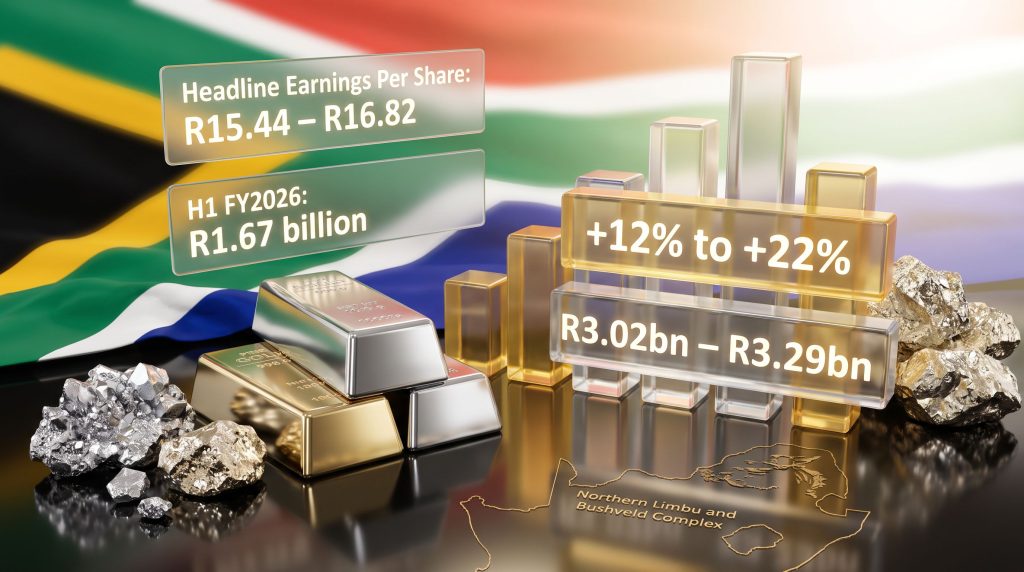
| Headline Earnings | R3.02bn to R3.29bn | +12% to +22% |
| Headline Earnings Per Share | R15.44 to R16.82 | +12% to +22% |
| Basic Earnings | R3.98bn to R4.01bn | +1,105% to +1,115% |
| Basic Earnings Per Share | R20.62 to R20.79 | +1,120% to +1,130% |
Reading ARM's Half-Year Trajectory and What It Implies for the Second Half
For the six months ending December 31, 2025, ARM reported interim headline earnings of approximately R1.67 billion, representing a roughly 10% increase compared to the R1.52 billion recorded in the prior corresponding period. This result landed within the company's own interim guidance range of R1.596 billion to R1.748 billion.
The full-year guidance of R3.02 billion to R3.29 billion, when set against the R1.67 billion reported in the first half, implies an implied second-half headline earnings contribution of between approximately R1.35 billion and R1.62 billion. This creates an interesting picture of how earnings momentum evolved across the financial year.
| Period | Headline Earnings | YoY Change |
|---|---|---|
| H1 FY2026 (Dec 2025) | R1.67 billion | ~+10% |
| Full Year FY2026 (June 2026) | R3.02bn to R3.29bn | +12% to +22% |
| Implied H2 FY2026 | R1.35bn to R1.62bn | Variable |
The implied second-half range is wide, reflecting the genuine uncertainty in final price realisations and cost settlements that ARM acknowledges ahead of its September 4, 2026 results publication.
The Structural Tension in Diversified Mining: Diversification Dividend or Earnings Complexity?
ARM's FY2026 earnings profile raises a broader strategic question relevant to all diversified miners: does commodity diversification genuinely protect earnings, or does it primarily add complexity and analytical noise?
In theory, holding exposure across multiple commodity cycles should smooth earnings over time. When PGMs underperform, iron ore or manganese might compensate, and vice versa. In practice, however, commodity cycles are increasingly correlated during periods of macroeconomic stress or broad US dollar strength, which tends to compress all commodity prices simultaneously in local currency terms.
PGM Dependency as a Concentration Risk in Disguise
ARM's FY2026 experience illustrates a subtler risk: even within a diversified portfolio, earnings can become heavily concentrated in a single commodity segment when other segments underperform concurrently. With iron ore, manganese, and coal all delivering softer contributions in the same period, PGMs moved from being one earnings driver among several to being the overwhelming determinant of full-year performance.
This de facto concentration creates sensitivity to PGM basket price trajectory that investors in ARM should monitor closely. Key variables include:
- Palladium and rhodium demand from the global automotive sector
- The pace of electric vehicle penetration, which could gradually erode autocatalyst demand over a multi-year horizon
- South African electricity supply reliability, which directly affects PGM processing throughput
- Labour relations at Two Rivers and Modikwa, particularly given the history of industrial action across the South African platinum belt
- The rand/USD exchange rate, which determines the translation of any USD price gains into rand revenues
The next major ASX story will hit our subscribers first
What Investors Should Monitor Before the September 4 Results
The R270 million spread in ARM's headline earnings guidance, representing the difference between the R3.02 billion floor and R3.29 billion ceiling, is a normal feature of South African mining trading statements issued two to four weeks ahead of formal results publication. At this stage, commodity price mark-to-market adjustments and final audit reconciliations remain outstanding.
Several variables will determine where within that range the final headline earnings figure lands:
- Final PGM basket price realisations for the fourth quarter of FY2026, particularly any closing movements in palladium and rhodium spot prices
- The rand/USD exchange rate at or near the June 30, 2026 period-end and its effect on iron ore revenue translation
- Operational cost performance at Khumani, Two Rivers, and Modikwa, including energy costs and labour settlements
- Any further portfolio transactions or accounting events not already disclosed in the trading update
Investors building valuation models on ARM should anchor their earnings base to headline earnings of R3.02 billion to R3.29 billion and apply appropriate discount rates to reflect PGM price volatility and currency uncertainty, rather than extrapolating from the 1,100%+ basic earnings movement.
Frequently Asked Questions: African Rainbow Minerals Headline Earnings
What drove the African Rainbow Minerals headline earnings boost in FY2026?
The primary driver of the African Rainbow Minerals headline earnings boost was the recovery in US dollar PGM basket prices, which lifted revenue from Two Rivers and Modikwa. This was partially offset by lower rand-realised iron ore prices caused by rand appreciation against the US dollar.
Why did ARM's basic earnings increase by over 1,100%?
The extraordinary surge in basic earnings reflects two non-recurring items: a R241 million disposal gain on ARM's exit from the Sakura ferroalloys investment, and a R462 million IFRS remeasurement gain on its pre-existing 50% interest in the Nkomati operation. These are non-cash, non-recurring items that do not reflect underlying operational improvement.
When will ARM publish its full FY2026 financial results?
ARM is scheduled to release its full financial year results on September 4, 2026.
What is the difference between headline and basic earnings in South African mining reporting?
Headline earnings exclude non-recurring items such as asset disposal gains and accounting remeasurements, providing a cleaner view of ongoing operational performance. Basic earnings include all items. South African investors and analysts typically weight headline earnings more heavily for valuation and dividend analysis.
What is ARM's full-year headline earnings guidance for FY2026?
ARM has guided for headline earnings of between R3.02 billion and R3.29 billion, representing a 12% to 22% year-on-year increase. Headline earnings per share are expected to range between R15.44 and R16.82.
Key Takeaways: ARM's Earnings Outlook in Context
- The 12% to 22% headline earnings growth in FY2026 is operationally credible and driven by genuine PGM basket price recovery at Two Rivers and Modikwa
- The rand's appreciation against the US dollar acted as a meaningful earnings moderator, limiting the full benefit of higher commodity prices in rand-denominated terms
- Two non-recurring items totalling approximately R703 million inflated basic earnings to more than 1,100% above the prior year, a figure that should be discounted when assessing sustainable profitability
- ARM's diversified portfolio provided conceptual resilience but limited practical protection in FY2026, given concurrent softness across iron ore, manganese, and coal
- The R270 million guidance spread reflects genuine uncertainty ahead of final price realisations and audit completion, with definitive clarity due on September 4, 2026
- PGM basket price movements, particularly palladium and rhodium, should be treated as the primary leading indicator for ARM's near-term earnings trajectory
Readers seeking broader context on South African diversified mining earnings dynamics and PGM market fundamentals can explore related industry coverage through Mining Weekly at miningweekly.com, which provides ongoing reporting on ARM and the broader South African resources sector.
This article contains forward-looking statements and financial projections based on ARM's published trading update guidance. Actual results may differ materially. This content is intended for informational purposes only and does not constitute financial advice. Investors should conduct their own due diligence before making investment decisions.
Want to Identify the Next Major Mineral Discovery Before the Broader Market?
Discovery Alert's proprietary Discovery IQ model delivers real-time alerts on significant ASX mineral discoveries, transforming complex commodity data across more than 30 minerals into clear, actionable insights for both short-term traders and long-term investors. Explore how historic discoveries have generated substantial returns by visiting Discovery Alert's dedicated discoveries page, and begin your 14-day free trial today to position yourself ahead of the market.