
August 24, 2026
When Geology Outpaces Finance: The Structural Tension at the Heart of African Bauxite Development
There is a recurring pattern in frontier mineral development where the quality of the ore body is never the limiting factor. World-class deposits sit atop some of the least-developed regions on earth, and the gap between geological potential and bankable production is filled not by drilling programmes or feasibility studies, but by the architecture of project finance, the risk appetite of development lenders, and the timing of corporate events that have nothing to do with what lies beneath the ground.
The Canyon Resources Minim Martap funding pause is a textbook illustration of this tension. It is not a story about bauxite quality. The ore metrics at Minim Martap are exceptional by any global standard. It is a story about how lender review clauses, equity market restrictions, and competing corporate events can converge to create financing friction at precisely the moment operational momentum is building.
Understanding what is actually happening at Minim Martap, and what it means for the broader bauxite supply chain, requires looking past the headline and into the mechanics of project finance, the realities of ASX-listed junior mining, and the long-term demand fundamentals that make this deposit strategically significant regardless of near-term delays.
When big ASX news breaks, our subscribers know first
The Minim Martap Asset: What the Numbers Actually Mean
Before examining the financing mechanics, it is worth anchoring the analysis in the geological reality of Minim Martap, because the ore quality is central to understanding why this project continues to attract institutional attention despite its current headwinds. Furthermore, understanding these fundamentals provides critical context for the financing challenges discussed below.
| Metric | Value |
|---|---|
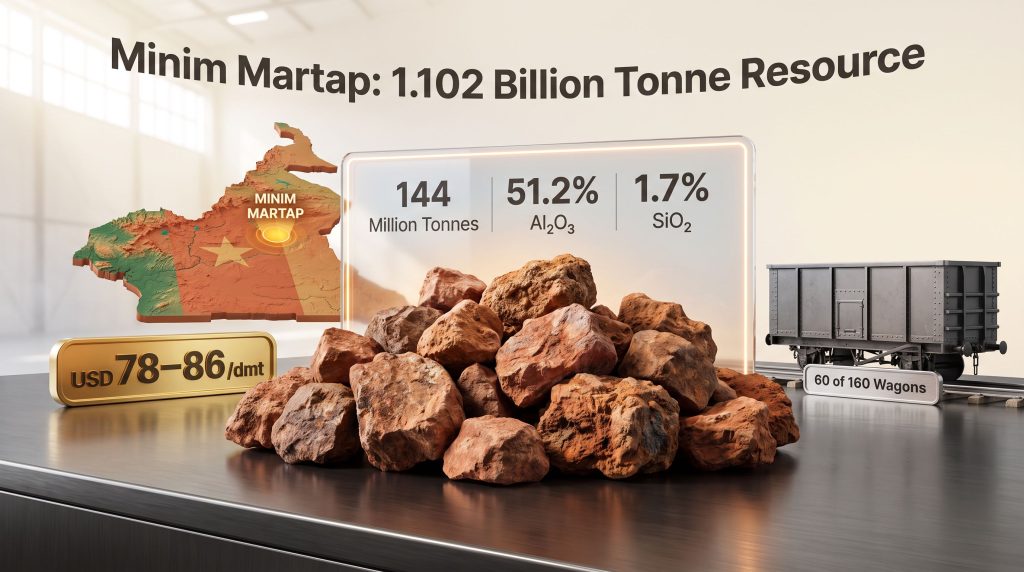
| Ore Reserve | 144 million tonnes |
| Reserve Grade (Al₂O₃) | 51.2% |
| Reserve Silica (SiO₂) | 1.7% |
| Mineral Resource | 1.102 billion tonnes |
| Resource Grade (Al₂O₃) | 45.3% |
| Target Production Rate | 2 million tonnes per year |
| CM Group Price Range (Aug 2026) | USD 78-86 per dry metric tonne |
The two figures that matter most to alumina refiners are alumina content and reactive silica. High alumina content directly determines how much aluminium can be extracted per tonne of ore processed. Low silica, particularly low reactive silica, reduces the volume of caustic soda consumed during the Bayer refining process, which is the dominant cost variable in alumina production.
Minim Martap's reserve grade of 51.2% Al₂O₃ places it firmly in the upper tier of global bauxite deposits. Its silica content of 1.7% SiO₂ is well below the thresholds that trigger caustic consumption penalties for refinery buyers. This combination is not common. Most high-volume bauxite exporters, including those from West Africa and Australia, produce material that requires blending or carries higher silica penalties. For broader context on how these benchmarks compare internationally, global bauxite production data illustrates just how rare this grade combination is.
Why Low Silica Is a Refinery Economic Variable, Not Just a Grade Metric
What makes the silica specification particularly valuable is the cost arithmetic at the refinery gate. In the Bayer process, reactive silica forms sodalite compounds that permanently consume caustic soda during digestion, a cost that cannot be recovered. Every percentage point of reactive silica reduction in feedstock translates directly into lower operating costs per tonne of alumina produced.
For refinery operators managing thin margins under volatile aluminium prices, a consistent supply of sub-2% silica bauxite is not merely preferable — it is a procurement priority that commands a measurable price premium. This is precisely the economic logic underpinning the CM Group independent price validation of USD 78-86 per dry metric tonne for Minim Martap's product specification.
The CM Group price range represents independent third-party validation of Minim Martap's market positioning, based on a product specification of 51% total alumina and no more than 2% total silica. This is not a company estimate but an externally commissioned market review completed in August 2026.
Decoding the AFG Bank Cameroon Drawdown Suspension
The Canyon Resources Minim Martap funding pause originated when Camalco Cameroon, the company's Cameroon-based subsidiary, received formal notification from AFG Bank Cameroon that further disbursements under the existing loan facility would be suspended pending a lender review.
This is a procedural financing event, not a credit default. The distinction matters enormously for how investors and analysts should interpret the situation.
How Project Finance Drawdown Suspensions Work
In project finance structures, particularly those arranged for frontier market mining developments, lenders typically retain contractual rights to conduct periodic reviews before releasing subsequent tranches of an approved facility. These review mechanisms serve several purposes:
- They allow the lender to verify that the project is progressing in line with the approved development schedule
- They enable a reassessment of the financial model as cost inputs, commodity prices, and logistics timelines evolve
- They provide an opportunity to conduct physical site visits before committing additional capital
- They protect the lender's security position in the event of material changes to project assumptions
The key distinction is between a drawdown suspension — which is a temporary hold pending review — and a loan default or facility cancellation, which would represent a fundamental breakdown of the lending relationship. The AFG Bank action falls into the former category. The lender has not withdrawn the facility. It has paused disbursements while it completes a review of the development schedule, financial model, and other financial inputs, and undertakes a site visit.
The Three Conditions for Resuming Drawdowns
Based on available information, three conditions need to be satisfied before AFG Bank Cameroon will resume disbursements under the facility:
- Completion of the lender's review of the Minim Martap project development schedule
- A satisfactory reassessment of the project's financial model and related financial inputs
- Completion of a physical site visit to the Minim Martap project area
Until these conditions are met, access to the undrawn balance of the US$140 million facility remains on hold. This directly affects the near-term liquidity position and explains why Canyon has simultaneously initiated capital management measures to reduce cash expenditure. Canyon Resources' mine-to-port logistics strategy provides further detail on how the company has structured its operational roadmap to manage these pressures.
The Two-Stage Funding Architecture and What It Reveals
The financing structure at Minim Martap is split across two distinct development stages, and the current situation affects them differently.
Stage 1: Constrained but Not Collapsed
Stage 1 was previously characterised as fully funded through a combination of approximately AUD 31 million in cash as of 31 July 2026 and the remaining undrawn capacity of the AFG Bank facility. The drawdown suspension has not eliminated Stage 1 funding, but it has placed the undrawn portion in a conditional holding pattern.
The practical implication is that Canyon must now manage its existing cash reserves carefully while the lender review is resolved. Capital management measures have been activated to extend the runway of available liquidity.
Stage 2: The Larger Strategic Challenge
The more structurally significant financing gap lies in Stage 2. An estimated additional US$160 million is required to advance Minim Martap to its full production target of 2 million tonnes per year. Without this capital, monthly production is expected to remain constrained at approximately 35,000 wet metric tonnes per month, a fraction of the project's full-scale potential.
This gap was a pre-existing challenge before the AFG Bank suspension. The failed A$100 million Eagle Eye placement, which was rejected by shareholders, removed one potential equity pathway. The takeover bid by A2MP Investments FZCO has further complicated the options. Broader discussions at events such as the bauxite and alumina conference have highlighted how increasingly common these structural financing challenges are across the industry.
How the A2MP Takeover Bid Restricts Funding Options
When a listed company becomes the subject of a takeover bid, ASX Listing Rules impose specific constraints on the target's ability to conduct new equity capital raisings without prior shareholder approval. This is designed to prevent the target board from diluting the bidder's position or altering the company's capital structure in ways that could affect the bid's outcome.
For Canyon Resources, this means that conventional equity raising mechanisms, including placements and rights issues, are effectively off the table for the duration of the bid period without additional shareholder approval. This structurally narrows the funding toolkit at precisely the moment when capital is most needed.
When a company faces simultaneous pressure from a lender review suspension and equity market restrictions linked to a takeover bid, the financing problem is not additive — it is multiplicative. Each constraint amplifies the other.
The company, working alongside financial adviser Jefferies, is actively pursuing alternative funding structures. These include:
- Offtake-linked financing: Arrangements where debt is secured against committed future revenue from bauxite sales agreements
- Prepayment structures: Upfront capital provided by offtake counterparties in exchange for discounted future supply at agreed volumes and prices
- Strategic funding alternatives: Potential capital participation from sovereign entities, institutional investors, or industry partners with a strategic interest in securing premium bauxite supply
Infrastructure Progress Continues Despite the Financing Review
One of the more counterintuitive aspects of the current situation is that physical development at Minim Martap has not stopped. On-the-ground infrastructure activity has continued during the financing review period, as confirmed in Canyon Resources' latest project update.
| Variable | Current Status |
|---|---|
| AFG Bank Drawdown Approval | Pending lender review and site visit |
| Stage 2 Financing | Being pursued; not yet secured |
| Rail Wagon Delivery | First 60 of 160 units arriving within 8 weeks |
| Locomotive and Wagon Trials | Planned for Q4 2026 |
| Haulage Road | Nearing completion; final works in Q4 2026 |
| Transhipping Arrangements | Under negotiation; not yet confirmed |
| First Shipment Target | Withdrawn pending resolution of above |
The first 60 rail wagons, out of a total order of 160 units, are scheduled to arrive at the Port of Douala within approximately eight weeks. Trials involving seven locomotives and the initial wagon batch are planned for the fourth quarter of 2026. The haulage road connecting the mine site to the rail terminal is approaching completion, with remaining construction works also expected to be finalised during Q4 2026.
This continued operational activity is significant because it demonstrates that the physical development trajectory has not been derailed by the financing review. The lender's site visit, when it occurs, will find an active development site, not a stalled one.
The Transhipping Complication
One variable that receives less attention than the financing situation but is equally critical to the first shipment timeline is transhipping. Because Minim Martap's bauxite will be exported through the Port of Douala, the logistics chain requires a transhipping arrangement that allows bulk bauxite cargo to be transferred between vessels at an intermediate port or offshore anchorage to accommodate larger oceangoing vessels.
Canyon has identified the confirmation of transhipping arrangements as one of two prerequisites for announcing a revised first-shipment date. The other is resolution of the AFG Bank drawdown suspension. Both conditions must be satisfied before a new timeline can be credibly communicated to the market.
The next major ASX story will hit our subscribers first
What This Situation Reveals About African Critical Mineral Finance
The Canyon Resources Minim Martap funding pause is not an isolated corporate event. It reflects a structural dynamic that recurs across frontier mineral development in sub-Saharan Africa, where geological quality and financial market conditions frequently operate in opposite directions. In addition, projects such as the Niagara bauxite project illustrate how even well-credentialled deposits can face similar financing headwinds in different regional contexts.
Several broader lessons emerge from the Minim Martap situation:
- Lender review clauses carry timing risk. In frontier market project finance, lenders have more discretion over disbursement timing than in conventional corporate lending. A review clause can introduce months of delay even when the underlying project is performing adequately.
- Junior mining companies are structurally exposed to equity market events. The combination of a failed placement and a concurrent takeover bid illustrates how quickly the equity funding toolkit can be constrained for ASX-listed juniors.
- Ore quality does not insulate a project from capital market friction. Minim Martap's geological credentials are not in dispute. The challenges it faces are entirely financial and logistical, not geological.
- Offtake and prepayment structures are becoming the primary financing mechanism for African mineral projects. As conventional debt and equity pathways face constraints, revenue-backed and supply-linked structures are filling the gap, but they typically come at a higher economic cost to the project developer.
The gap between a world-class ore body and a producing mine is increasingly defined not by what is in the ground but by the sophistication of the financing architecture assembled around it. This is the central challenge of frontier mineral development in the current capital environment.
Key Variables Investors and Industry Observers Should Monitor
For those tracking the Minim Martap situation, the following variables represent the most material near-term indicators of project trajectory. Consequently, these indicators should be revisited as conditions evolve:
- AFG Bank review outcome and the timeline for resuming drawdowns under the US$140 million facility
- Transhipping arrangement confirmation as a logistics prerequisite for any revised shipment schedule
- A2MP takeover bid resolution and its implications for Canyon's strategic control and funding flexibility
- Stage 2 capital formation progress through offtake-linked, prepayment, or strategic investor structures
- Infrastructure completion milestones, particularly locomotive and wagon trials in Q4 2026
- Bauxite market fundamentals, where the CM Group price validation of USD 78-86 per dry metric tonne provides durable economic justification for the project
However, for investors seeking a broader industry perspective, tracking how leading aluminium mining companies are navigating similar capital market pressures can provide useful comparative context. Furthermore, monitoring the Minim Martap project announcements through dedicated industry coverage will remain essential for those with a close interest in the project's development trajectory.
Disclaimer: This article is intended for informational purposes only and does not constitute financial advice or a recommendation to buy or sell any securities. Readers should conduct their own independent research and consult a licensed financial adviser before making any investment decisions. Forward-looking statements and timelines discussed in this article are subject to material risk and uncertainty.
For further context on global bauxite and alumina market dynamics, readers can explore related industry coverage at AL Circle, which tracks developments across the bauxite supply chain from mine to market.
Want to Stay Ahead of the Next Major ASX Mineral Discovery?
Discovery Alert's proprietary Discovery IQ model delivers real-time alerts on significant ASX mineral discoveries, cutting through complex data to surface actionable opportunities the moment they are announced — explore historic discoveries and the returns they generated, then start your 14-day free trial to position yourself ahead of the broader market.