June 2, 2026
Gulf oil output recovery after Hormuz reopening demonstrates the multifaceted nature of supply restoration following major disruptions in modern commodity markets. These interconnected systems reveal vulnerabilities that extend far beyond immediate production facilities, where disruptions cascade through multiple layers of infrastructure. Understanding how energy networks respond to major supply chain interruptions provides critical insights into market resilience, recovery dynamics, and the complex interplay between physical assets and financial mechanisms that govern global trade flows.
The Mechanics of Energy Infrastructure Recovery
Production systems require careful orchestration across upstream wells, midstream processing facilities, and downstream transportation networks to achieve full operational capacity. Furthermore, recovery timelines depend on several interconnected factors that extend beyond simple restart procedures, including oil price movements that influence investment priorities during restoration phases.
Physical infrastructure assessment forms the foundation of any restoration effort, requiring comprehensive evaluation of wellhead integrity, pipeline systems, and processing facility conditions following extended shutdowns. However, the OPEC production impact on global supply balance significantly affects recovery planning and resource allocation decisions.
Technical Recovery Phases:
- Safety and Integrity Assessment (Days 1-14): Comprehensive inspection of all production assets
- Gradual Production Restart (Weeks 2-6): Systematic restoration of well production rates
- Transportation Coordination (Weeks 4-12): Alignment of shipping capacity with production schedules
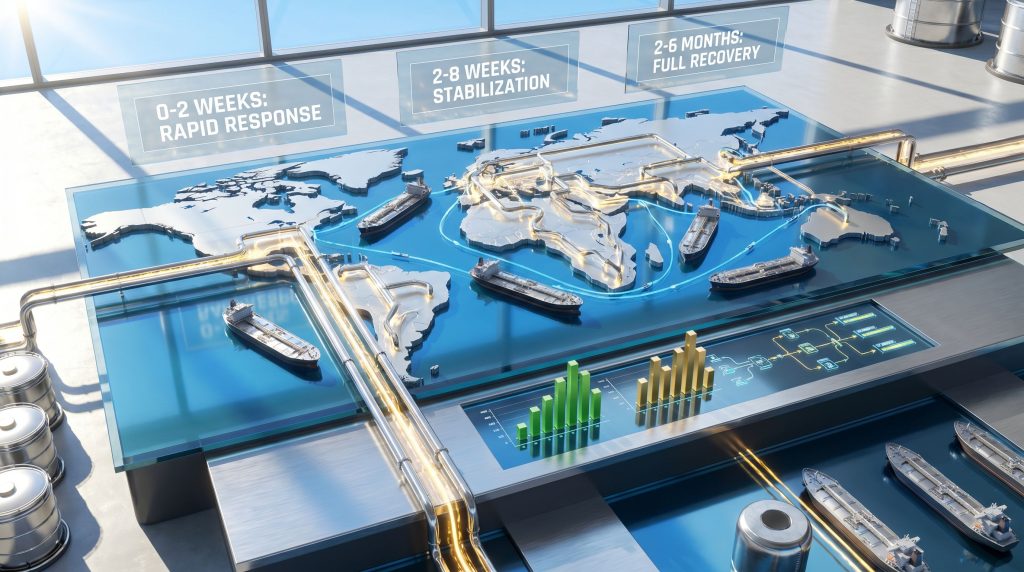
- Market Normalization (Months 3-6): Full integration of restored supply into global trade flows
Recent analysis from Goldman Sachs indicates that 14.5 million barrels per day of Gulf crude output was offline during April 2026, representing approximately 57% of pre-conflict supply levels. This massive supply disruption highlighted the critical importance of coordination between production facilities and transportation infrastructure during recovery phases.
Reservoir Engineering and Well Performance Dynamics
Extended production shutdowns create unique technical challenges for oil and gas reservoirs, particularly in mature fields where pressure maintenance systems require careful management. Reservoir pressure dynamics change significantly during prolonged closures, affecting both restart procedures and long-term production capacity.
Lower-pressure reservoirs face heightened risks during extended shutdowns, as natural pressure decline can reduce flow rates upon restart. This phenomenon requires specialized workover operations to restore optimal production levels, adding both time and cost to recovery efforts.
Critical Engineering Considerations:
- Well integrity testing following pressure system changes
- Reservoir pressure rebalancing across interconnected field networks
- Coordination of artificial lift systems with natural reservoir energy
- Integration of enhanced oil recovery techniques during restart phases
The technical complexity of restart operations varies significantly across different field types and geological formations. Offshore platforms face additional challenges related to marine logistics and safety protocols, while onshore facilities may deal with pipeline system complications and storage infrastructure limitations.
When big ASX news breaks, our subscribers know first
Maritime Logistics and Tanker Fleet Coordination
The global tanker fleet represents a critical component of energy infrastructure, functioning as both transportation and floating storage capacity during supply disruptions. Available empty tanker capacity in the Gulf region dropped by approximately 130 million barrels, representing a 50% reduction during recent disruptions, according to Goldman Sachs research.
Tanker repositioning creates complex logistical challenges that persist throughout recovery periods. In addition, vessels must be strategically relocated to loading terminals while maintaining optimal scheduling coordination with production facilities and downstream refineries.
Fleet Management Complexities:
- Vessel Positioning: Strategic relocation of empty tankers to priority loading terminals
- Loading Coordination: Synchronization of tanker arrival schedules with production capacity
- Route Optimization: Selection of alternative shipping lanes during partial reopening phases
- Insurance Assessment: Risk evaluation and coverage adjustment for vessels entering previously restricted zones
The relationship between tanker availability and production recovery rates demonstrates the interconnected nature of energy supply chains. Even when production facilities achieve full operational capacity, transportation bottlenecks can significantly constrain the speed at which supply reaches global markets.
Storage infrastructure plays a complementary role in managing the transition between disrupted and normalized supply patterns. Commercial storage facilities serve as critical buffers, allowing producers to maintain operations even when shipping capacity remains constrained.
Port Infrastructure and Terminal Capacity
Loading terminal capacity represents another potential bottleneck in supply restoration efforts. Major oil ports require careful coordination of berthing schedules, pipeline allocation, and quality control procedures to maximize throughput during recovery periods.
Terminal Operations Optimization:
- Berth allocation prioritization based on cargo urgency and destination markets
- Pipeline system management to balance multiple grade requirements
- Quality control procedures to ensure cargo specifications meet international standards
- Coordination with customs and regulatory authorities for expedited clearance processes
The efficiency of port operations directly influences the speed at which restored production capacity translates into available supply for global markets. Advanced scheduling systems and real-time coordination between producers, shippers, and terminal operators become critical during high-stress recovery periods.
Market Response Mechanisms and Price Discovery
Energy markets demonstrate remarkable adaptability during supply disruptions, with sophisticated price discovery mechanisms coordinating complex global supply chains. Futures market adjustments reflect both current supply constraints and expectations regarding recovery timelines.
Price signals serve as coordination mechanisms, directing available supply toward highest-value applications while encouraging demand adjustment in price-sensitive sectors. Furthermore, the interaction between physical supply availability and financial market expectations creates dynamic pricing patterns that influence recovery investment priorities, potentially leading to oil price stagnation in certain market conditions.
Market Coordination Elements:
- Futures curve adjustments reflecting supply restoration expectations
- Regional price differentials during varying recovery speeds across producing areas
- Strategic reserve utilization patterns based on government policy responses
- Consumer demand elasticity responses to sustained price volatility
Regional price variations become particularly pronounced during recovery periods, as different producing areas achieve restoration at varying speeds. These price differentials create arbitrage opportunities that help optimize global supply distribution during transition periods.
Strategic Buyer Behavior and Procurement Adaptation
Major energy consumers adjust procurement strategies during supply disruptions, creating lasting changes in trade patterns that extend beyond immediate crisis periods. Asian refiners particularly demonstrate sophisticated adaptation mechanisms, maintaining supply security through diversified sourcing arrangements.
Long-term contract structures evolve in response to supply reliability concerns, with buyers increasingly valuing flexible delivery terms and alternative sourcing options. These contractual adaptations influence both immediate recovery patterns and longer-term market structure.
Procurement Strategy Evolution:
- Supply source diversification to reduce dependency on individual producing regions
- Flexible delivery arrangements accommodating transportation route variations
- Strategic inventory management balancing storage costs with supply security
- Alternative transportation development including pipeline and rail infrastructure investment
The sophistication of buyer response strategies demonstrates the learning capacity of global energy markets, with each major disruption contributing to enhanced resilience frameworks and improved crisis management capabilities.
Regional Production Advantages and Recovery Speed Variations
Different producing regions face varying challenges during recovery scenarios based on infrastructure maturity, geological characteristics, and institutional capabilities. Consequently, the Saudi Arabia recovery maintains significant advantages in recovery speed due to substantial spare production capacity and advanced infrastructure systems.
Regional Recovery Factors:
| Region | Spare Capacity | Infrastructure Quality | Recovery Speed |
|---|---|---|---|
| Saudi Arabia | High | Advanced | Fast |
| UAE | Moderate | Advanced | Moderate-Fast |
| Iraq | Limited | Developing | Moderate |
| Iran | Variable | Mixed | Slow-Moderate |
Production system design significantly influences recovery capabilities. Fields equipped with advanced pressure maintenance systems and redundant infrastructure demonstrate superior restart performance compared to aging facilities with limited backup systems.
Technical Infrastructure Advantages:
- Modern wellhead equipment with remote monitoring capabilities
- Redundant pipeline systems providing alternative flow paths
- Advanced processing facilities with flexible throughput management
- Integrated digital control systems enabling rapid response coordination
Workforce availability and technical expertise represent critical factors in recovery speed. Regions with established technical training programs and experienced operational teams achieve faster restoration compared to areas facing skill shortages or training gaps.
Investment Priorities and Capital Allocation During Recovery
Energy companies face complex decisions regarding resource allocation during recovery periods, balancing immediate production restoration with long-term infrastructure improvement. Maintenance backlog prioritization becomes critical when limited resources must address multiple competing needs.
The balance between repair and replacement decisions significantly influences both recovery speed and future operational reliability. Companies must evaluate whether temporary fixes enable faster restart or whether comprehensive upgrades provide superior long-term value.
Capital Allocation Framework:
- Immediate safety requirements taking absolute priority over production considerations
- High-impact production restoration focusing on maximum barrel recovery per dollar invested
- Infrastructure modernization balancing current needs with future resilience enhancement
- Technology integration incorporating digital systems for improved crisis response capabilities
Market price expectations influence investment timing decisions, with companies weighing the value of rapid restart against the cost of comprehensive infrastructure improvement. Sustained high prices may justify premium expenditure on permanent solutions rather than temporary fixes.
Technology Integration and Digital Coordination Systems
Modern energy systems increasingly rely on digital technologies for coordination and optimization, particularly during complex recovery scenarios where multiple variables require simultaneous management. Real-time monitoring systems enable operators to track production, transportation, and storage status across integrated networks.
Advanced analytics platforms support decision-making during recovery periods by processing vast amounts of operational data and providing optimization recommendations. However, these systems become particularly valuable when traditional operational patterns are disrupted and new coordination approaches are required, incorporating predictive maintenance insights for enhanced operational efficiency.
Technology Integration Areas:
- Production optimization systems coordinating well performance across multiple fields
- Transportation management platforms tracking vessel positions and cargo scheduling
- Inventory management systems monitoring storage levels and quality specifications
- Predictive maintenance algorithms identifying equipment requiring attention before failure occurs
Communication systems play a critical role in coordinating recovery efforts across multiple companies and jurisdictions. Standardized data sharing protocols enable real-time coordination between producers, transporters, and buyers during high-stress operational periods.
Emergency Response Protocol Development
The lessons learned from major supply disruptions inform development of enhanced emergency response protocols, creating frameworks for faster and more effective crisis management. Interagency coordination mechanisms prove particularly valuable when disruptions affect multiple producing regions simultaneously.
Cross-border infrastructure cooperation becomes essential during regional disruptions, requiring diplomatic coordination alongside technical collaboration. These relationships must be established and tested before crisis situations arise to ensure effective implementation when needed.
Protocol Development Components:
- Pre-positioned response resources strategically located for rapid deployment
- Communication network redundancy ensuring coordination capability during infrastructure damage
- Alternative transportation routing with pre-approved regulatory frameworks
- International cooperation agreements facilitating cross-border resource sharing
Regular testing and updating of emergency protocols ensures their effectiveness when actual disruptions occur. Simulation exercises involving multiple stakeholders help identify coordination gaps and refine response procedures before real-world implementation becomes necessary.
The next major ASX story will hit our subscribers first
Future Implications and Strategic Planning Evolution
Major supply disruptions catalyse lasting changes in global energy trade patterns, infrastructure investment priorities, and strategic planning approaches. The Gulf oil output recovery after Hormuz reopening provided valuable insights into system resilience and adaptation mechanisms.
Goldman Sachs analysis suggests that producers could recover approximately 70% of lost output within three months and 88% within six months following safe reopening of critical shipping routes. These recovery projections depend heavily on coordination effectiveness and infrastructure condition.
Long-term Strategic Shifts:
- Infrastructure redundancy investment creating alternative production and transportation pathways
- Digital integration acceleration improving coordination and response capabilities
- Regional cooperation enhancement strengthening cross-border infrastructure and emergency response
- Technology adoption prioritization focusing on systems that improve crisis resilience
The evolution of energy security planning reflects growing recognition that supply chain resilience requires systematic investment in both physical infrastructure and coordination capabilities. Future planning frameworks increasingly emphasise adaptive capacity rather than simply protecting existing systems.
Investment Framework Evolution for Enhanced Resilience
Private investment decisions increasingly incorporate resilience considerations alongside traditional economic metrics. Infrastructure redundancy projects receive enhanced evaluation as companies recognise the value of maintaining operational flexibility during crisis periods.
Policy frameworks evolve to support resilience investment through regulatory incentives and coordination mechanisms. Governments recognise that energy security requires private sector investment in capabilities that extend beyond normal commercial requirements.
Policy Support Mechanisms:
- Strategic infrastructure designation providing enhanced regulatory support for critical projects
- International cooperation frameworks facilitating cross-border investment in resilience infrastructure
- Technology development incentives supporting innovation in crisis response and coordination systems
- Emergency response coordination protocols integrating private sector capabilities with government resources
The integration of resilience considerations into standard business planning represents a fundamental shift in how energy companies approach infrastructure investment and operational planning. This evolution reflects recognition that supply chain robustness provides competitive advantages during both normal operations and crisis periods.
Understanding these complex dynamics enables better preparation for future disruptions while supporting the development of more resilient global energy systems. The lessons learned from Gulf oil output recovery after Hormuz reopening continue to inform strategic planning and investment decisions across the global energy sector.
Disclaimer: This analysis is based on publicly available information and industry reports. Recovery timelines and production capacity estimates may vary significantly based on actual conditions during specific disruption scenarios. Readers should consult multiple sources and professional advisors when making investment or operational decisions related to energy infrastructure and supply chain management.
Ready to Capitalise on Energy Market Disruptions?
Discovery Alert's proprietary Discovery IQ model delivers real-time alerts on significant ASX mineral discoveries, instantly empowering subscribers to identify actionable opportunities ahead of the broader market during volatile commodity periods. Begin your 14-day free trial today and secure your market-leading advantage in energy and resource investments.