June 30, 2026
The Engineering Behind Low-Carbon Aluminium: Why Pot Technology Defines the Industry's Future
Primary aluminium smelting is one of the most energy-intensive industrial processes on Earth. Every tonne of metal produced through conventional electrolysis demands roughly 13 to 15 megawatt-hours of electricity, and when that power comes from coal-fired grids, the resulting carbon footprint is severe. The Rio Tinto Quebec aluminium expansion at Complexe Arvida demonstrates how advanced pot technology and hydroelectric power together represent the clearest pathway the industry currently has toward genuinely low-carbon primary metal production.
When big ASX news breaks, our subscribers know first
What Is AP60 Technology and How Does It Differ From Legacy Smelting?
At the core of any aluminium smelter are electrolytic reduction cells, known in the industry as pots. These vessels hold molten cryolite bath, into which alumina is dissolved and then reduced via direct electrical current, separating aluminium metal from oxygen. The carbon anodes consumed in this process are the primary source of CO₂ emissions in conventional smelting, releasing carbon dioxide as they react with the liberated oxygen.
AP60 is a high-amperage potline technology developed through decades of incremental engineering refinement. The designation refers to an operating amperage in the range of 600 kiloamperes, substantially above the 150 to 300 kA range typical of older cell designs. Higher amperage translates directly into greater metal output per cell, but the engineering challenge is maintaining thermal and chemical stability at these intensities.
AP60 achieves this through precision anode geometry, optimised bath chemistry control, and advanced pot shell design that distributes magnetic field forces more evenly across the cell. The practical consequences of this engineering are significant:
- Higher productivity per unit of floor space, reducing the capital cost per tonne of installed capacity over time.
- Lower specific energy consumption compared to older generation cells, meaning fewer kilowatt-hours are required per tonne of aluminium produced.
- Reduced fluoride emissions and more stable operating conditions, which improve both environmental compliance and worker exposure profiles.
- Better process consistency, which matters for downstream aluminium quality specifications in aerospace and automotive applications.
How Hydroelectric Power Multiplies the Carbon Advantage
The energy source feeding a smelter is as important as the pot technology itself when calculating lifecycle carbon intensity. Quebec's hydroelectric grid, operated predominantly by Hydro-Québec, delivers some of the cleanest electricity of any industrial jurisdiction in the world. The province's installed hydropower capacity exceeds 40 gigawatts, and its grid emission intensity is among the lowest in North America.
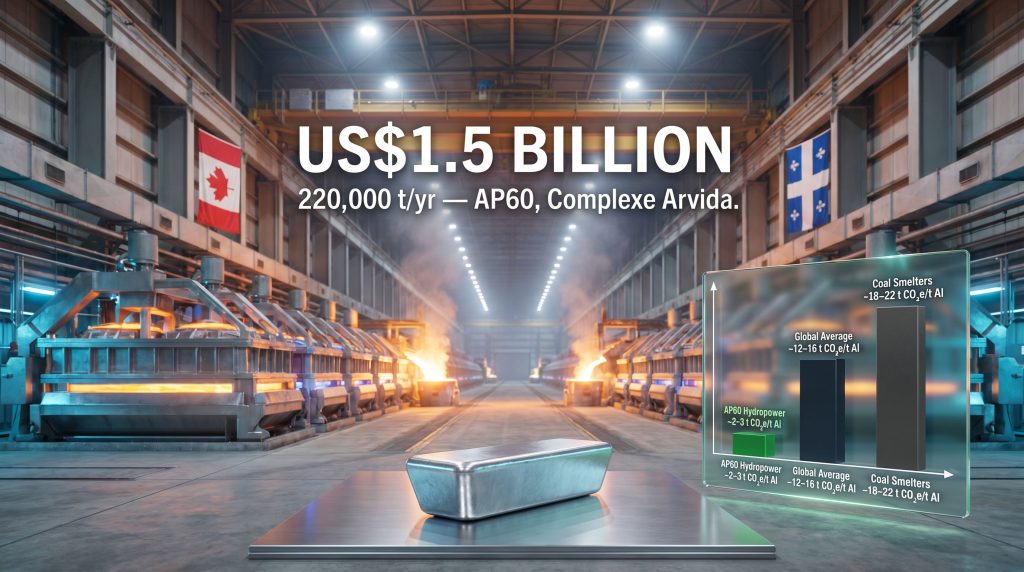
When AP60 technology is supplied with this hydroelectric power, the resulting carbon footprint per tonne of aluminium drops dramatically below global benchmarks. Industry estimates suggest Rio Tinto's Quebec AP60 operations produce in the range of 2 to 3 tonnes of CO₂-equivalent per tonne of aluminium, compared to a global industry average of 12 to 16 tonnes, and 18 to 22 tonnes for Chinese smelters operating on coal-heavy grids.
| Producer Configuration | Primary Energy Source | Est. Carbon Intensity (CO₂e/t Al) |
|---|---|---|
| Rio Tinto Quebec AP60 | Hydropower | ~2–3 t CO₂e/t Al |
| Legacy Arvida Technology | Hydropower (older process) | ~4–6 t CO₂e/t Al |
| Global Industry Average | Mixed (coal-heavy) | ~12–16 t CO₂e/t Al |
| Chinese Coal-Grid Smelters | Coal | ~18–22 t CO₂e/t Al |
Note: Figures are indicative estimates based on publicly available industry benchmarks. Precise operational data should be verified against Rio Tinto's published sustainability disclosures.
The carbon intensity differential between hydropower-based AP60 operations and global coal-dependent smelting is not marginal. It represents a structural quality gap that is increasingly priced into procurement decisions across automotive, packaging, and aerospace supply chains.
Scale of the Rio Tinto Quebec Aluminium Expansion: Capacity, Cost, and Timeline
The Complexe Arvida expansion represents a US$1.5 billion capital commitment to commission 96 new AP60 electrolytic reduction cells. Commissioning of the new potline began in March 2026, with full operational capacity across all 96 pots targeted before the end of 2026. The phased activation sequence, standard practice in large smelter builds, allows operators to manage thermal ramp-up carefully and avoid bath chemistry instability.
The production impact is substantial:
| Metric | Detail |
|---|---|
| Total Capital Investment | US$1.5 billion |
| New Pots Commissioned | 96 |
| New Annual Capacity Added | ~160,000 metric tonnes |
| Total AP60 Output (Post-Expansion) | ~220,000 metric tonnes/year |
| Commissioning Start | March 2026 |
| Full Operational Target | End of 2026 |
| Peak Construction Employment | ~1,500 workers |
| Permanent Operational Roles | ~100 positions |
Adding approximately 160,000 metric tonnes per year of primary aluminium capacity in a single smelter expansion is a meaningful contribution to Western Hemisphere supply. The global aluminium market trades around 70 million tonnes annually, and while this addition represents a fraction of that total, its significance lies less in raw volume and more in the certified low-carbon character of the metal produced.
Supply of credibly documented, low-carbon primary aluminium remains meaningfully constrained relative to the demand signals emerging from downstream manufacturers. Furthermore, among the aluminium industry leaders, few have committed capital at this scale to certified low-carbon primary production in a single project.
Why Retiring Legacy Potrooms Is as Important as Adding New Ones
The expansion does not operate in isolation from the rest of Complexe Arvida. The closure of older Arvida potrooms, expected to be completed by June 2026, is a deliberate and strategically coordinated element of the overall programme. Running legacy and AP60 infrastructure simultaneously would impose operational complexity, and more critically, would leave Rio Tinto reporting a combined emissions footprint that dilutes the environmental performance gains of the new technology.
The environmental arithmetic of this transition is striking. The shift from legacy potroom technology to AP60 is projected to reduce fine particulate matter emissions at the site by up to 90%. Particulate emissions from older Soderberg or prebake cell designs of earlier generations are a chronic air quality concern in smelter communities. The Saguenay region's population, which has lived alongside aluminium smelting for generations, stands to benefit materially from this improvement.
From an ESG reporting perspective, the simultaneous retirement of high-emission assets and commissioning of lower-emission capacity allows Rio Tinto to demonstrate an absolute reduction in its Canadian aluminium emissions footprint, not merely an intensity improvement. This distinction matters increasingly to institutional investors applying scope 1 and scope 2 emissions screening.
Rio Tinto's Multi-Horizon Decarbonisation Architecture in Quebec
The AP60 expansion sits within a broader strategic framework that encompasses multiple concurrent investments in Quebec's aluminium industrial cluster. Understanding these layers adds important context to what the Arvida commissioning represents within Rio Tinto's longer-term planning. In addition, Rio Tinto's aluminium decarbonisation efforts extend well beyond Quebec, reflecting a globally coordinated strategy.
The Aluminium Recycling Centre
A planned aluminium recycling facility at Arvida is being developed alongside the primary smelting expansion. Secondary aluminium production, which re-melts post-consumer and post-industrial scrap, requires only around 5% of the energy consumed in primary smelting. Co-locating recycling capacity within the same industrial complex creates logistical efficiencies and strengthens Rio Tinto's ability to offer customers blended primary and secondary aluminium products with precisely tracked emissions profiles. This matters for customers seeking to meet their own Scope 3 reduction targets.
ELYSIS: The Technology Horizon Beyond AP60
Perhaps the least widely understood element of Rio Tinto's Quebec aluminium strategy is its involvement in the ELYSIS joint venture with Alcoa. ELYSIS is developing inert anode technology, a fundamental departure from conventional carbon anode smelting. Instead of consuming carbon anodes and releasing CO₂, inert anodes are chemically stable during electrolysis, releasing pure oxygen gas rather than carbon dioxide.
Alcoa's low-carbon aluminium research, consequently, runs parallel to Rio Tinto's own ELYSIS commitments, with both companies investing in the technology's commercial viability. If commercialised at scale, this would reduce direct smelting emissions to effectively zero.
ELYSIS technology development work is centred in Quebec, making it geographically and operationally adjacent to the AP60 expansion. The current AP60 programme and the ELYSIS research effort are best understood as sequential stages of a decarbonisation roadmap, not competing approaches.
A less commonly appreciated technical point: inert anode smelting changes the anode replacement cycle entirely. Carbon anodes in conventional smelting are consumed continuously and must be replaced regularly, creating significant logistical and cost overhead. Inert anodes, by contrast, have extended service lifetimes, which could meaningfully reduce both operating costs and the carbon footprint associated with anode manufacturing.
The Competitive Dynamics of Low-Carbon Aluminium in Global Markets
The Rio Tinto Quebec aluminium expansion is being executed against a backdrop of accelerating demand-side pressure for certified low-carbon metal. Several forces are converging to reshape the competitive landscape of primary aluminium production:
-
Carbon Border Adjustment Mechanisms (CBAMs): The European Union's CBAM, which is being phased in across energy-intensive industries including aluminium, imposes a carbon price on imports based on their production emissions intensity. The broader EU industrial metals policy framework reinforces this direction, creating direct financial rewards for low-carbon producers.
-
Automotive sector procurement policies: Major vehicle manufacturers, particularly those scaling electric vehicle production, face intense pressure to reduce supply chain emissions. Aluminium is a primary structural material in EV platforms, and procurement teams are increasingly specifying maximum allowable carbon intensity thresholds for aluminium inputs.
-
Aluminium Stewardship Initiative (ASI) certification: Third-party frameworks like ASI provide chain-of-custody certification for responsibly produced aluminium. Certified material commands pricing premiums and preferred supplier status with buyers who have made public sustainability commitments.
-
Supply concentration risk: The majority of the world's lowest-carbon primary aluminium comes from a small number of hydropower-endowed jurisdictions, including Quebec, Iceland, Norway, and parts of Brazil. Adding certified capacity at Arvida directly addresses a genuine supply constraint, particularly as green transition materials face intensifying competition across multiple industries.
The pricing premium for certified low-carbon aluminium over standard primary metal has been documented at varying levels depending on buyer specifications and contract structures. However, the directional trend is clear: carbon intensity is becoming a pricing variable, not just a reporting metric.
The next major ASX story will hit our subscribers first
Workforce and Regional Economic Significance
The Saguenay-Lac-Saint-Jean region's economic identity has been intertwined with aluminium smelting for the better part of a century. The AP60 expansion generated peak construction employment exceeding 1,500 workers, representing a significant injection of skilled trades activity into the regional economy. The permanent operational workforce supported by the expanded facility adds approximately 100 roles to Rio Tinto's existing employment base in the region.
The economic multiplier effect of large-scale industrial investment extends well beyond direct employment. Procurement of construction materials, contractor services, specialist equipment, and ongoing operational inputs circulates through regional supply chains. For communities whose industrial base has been subject to rationalisation pressures across multiple resource sectors, the commitment represented by a US$1.5 billion smelter investment carries significance beyond the headline job numbers.
Frequently Asked Questions: Rio Tinto AP60 Expansion at Complexe Arvida
What makes AP60 technology different from earlier aluminium smelting processes?
AP60 operates at significantly higher amperages than older cell designs, typically around 600 kiloamperes, which delivers greater metal output per cell with lower specific energy consumption. The technology also incorporates more precise pot control systems, reducing operational variability and improving both productivity and emissions consistency.
How much new production capacity does the expansion add?
The 96 new AP60 pots are designed to add approximately 160,000 metric tonnes per year of primary aluminium capacity, bringing total AP60 output at Complexe Arvida to around 220,000 metric tonnes annually.
When will commissioning be complete?
Pot commissioning began in March 2026 and is targeted for full completion across all 96 units by the end of 2026.
What happens to the older Arvida potrooms?
Legacy Arvida potrooms are being decommissioned and are expected to be fully closed by June 2026. This retirement is coordinated with the AP60 expansion so that new capacity more than offsets the volume lost while simultaneously delivering large improvements in emissions performance.
How does this connect to ELYSIS technology?
ELYSIS, the Rio Tinto and Alcoa joint venture developing carbon-free inert anode smelting technology, is based in Quebec and represents the next stage beyond current AP60 improvements. The two programmes are sequential elements of a long-term decarbonisation strategy rather than alternatives to one another.
Key Structural Takeaways for Industry Observers
The Arvida AP60 commissioning programme illustrates several dynamics that extend beyond a single capital project:
- Carbon intensity is becoming a structural competitive variable in primary aluminium markets, not merely a sustainability reporting consideration.
- The gap between coal-grid and hydropower smelters is widening in economic terms as CBAM-style mechanisms proliferate globally.
- Simultaneous retirement of legacy assets alongside new capacity commissioning is increasingly the model for credible industrial decarbonisation, distinguishing genuine emissions reduction from volume-growth accounting.
- Quebec's hydroelectric endowment creates a durable structural advantage for aluminium producers operating in the province, one that cannot be easily replicated in jurisdictions without comparable renewable electricity infrastructure.
- ELYSIS inert anode technology, if successfully commercialised, would represent the most significant process change in aluminium smelting since the Hall-Heroult process was established in the 1880s, and Rio Tinto's Quebec operations are positioned at the centre of that development pathway.
Disclaimer: This article contains forward-looking statements, capacity estimates, and carbon intensity figures drawn from publicly available industry benchmarks and company disclosures. These figures are indicative and subject to change. Nothing in this article constitutes financial or investment advice. Readers should consult primary source disclosures and independent professional advice before making investment decisions.
Want to Capitalise on the Commodities Driving the Clean Energy Transition?
Discovery Alert's proprietary Discovery IQ model delivers real-time alerts on significant ASX mineral discoveries — including those tied to aluminium, bauxite, and the broader suite of materials underpinning industrial decarbonisation — instantly empowering subscribers to identify actionable opportunities ahead of the broader market. Explore how historic mineral discoveries have generated substantial returns on Discovery Alert's dedicated discoveries page, and begin your 14-day free trial today to position yourself ahead of the market.