June 6, 2026
The modern energy landscape witnesses profound shifts as technological breakthroughs redefine global petroleum markets. Advanced seismic imaging and deepwater extraction capabilities have unlocked previously inaccessible hydrocarbon reserves, fundamentally altering supply dynamics across key producing regions. This technological revolution creates new market participants while reshaping established energy security frameworks.
Within this context, the Guyana oil boom represents a paradigmatic transformation of how emerging producers can rapidly ascend to global significance through strategic resource development and favourable geological conditions.
Regional Energy Security Through Petroleum Independence
The emergence of non-traditional oil producers has created new pathways for energy diversification across the Western Hemisphere. Caribbean and South American nations historically dependent on imported fuel face unprecedented opportunities to reduce external energy reliance through regional supply development.
Furthermore, the recent oil price rally has demonstrated how supply disruptions can significantly impact global markets, making regional production capabilities increasingly valuable for energy security.
Current Production Landscape:
| Country | Current Production (bpd) | 2030 Projection (bpd) | Growth Trajectory |
|---|---|---|---|
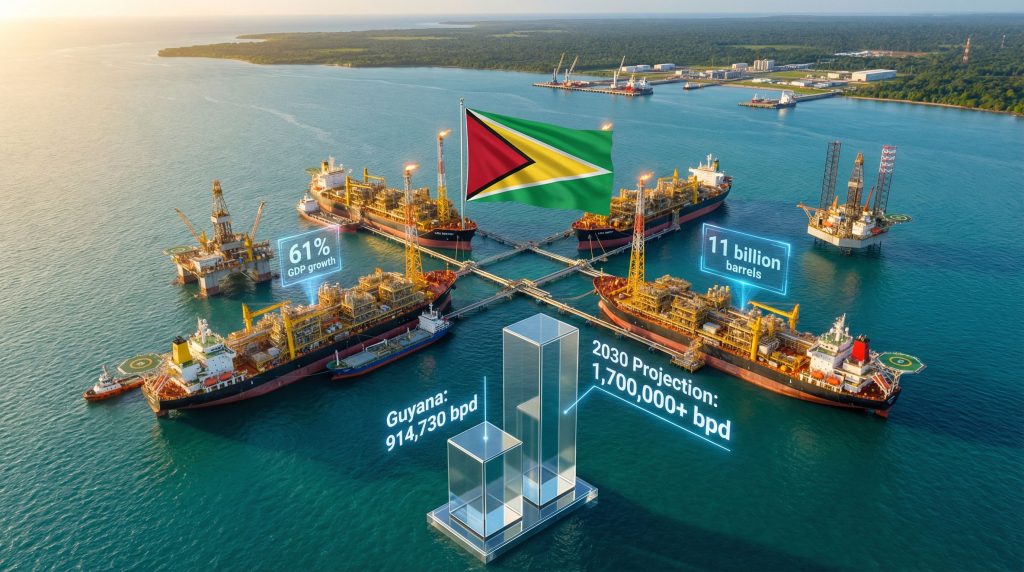
| Guyana | 914,730 | 1,550,000+ | 69% increase |
| Venezuela | 800,000 | Uncertain | Declining capacity |
| Colombia | 750,000 | 800,000 | Modest expansion |
| Brazil | 3,200,000 | 3,500,000 | Steady growth |
The 914,730 barrels per day currently extracted from Guyana's offshore territories represents entirely new supply capacity developed within the past decade. This production volume, derived exclusively from the Stabroek Block operations, demonstrates how concentrated geological formations can rapidly transform national economic profiles.
Infrastructure Development Supporting Energy Operations
Floating Production, Storage, and Offloading (FPSO) vessel deployment has enabled rapid production scaling without massive fixed infrastructure investments. These technological solutions allow operators to:
- Deploy production capacity in ultra-deepwater environments
- Maintain operational flexibility during geological uncertainty
- Reduce initial capital requirements compared to fixed platforms
- Enable modular capacity expansion based on reservoir performance
The 6.6 million acre Stabroek Block operates through a consortium structure where ExxonMobil maintains operational control with a 45% stake, while Chevron Corporation holds 30% and China National Offshore Oil Corporation controls the remaining 25%. This partnership model distributes both risk and expertise across multiple international entities.
Strategic Investment in Port Infrastructure
Georgetown's commitment to supporting offshore operations includes the $21.5 million transformation of Parika Stelling port into an international facility. Located on the west bank of the Essequibo River, this infrastructure project serves multiple strategic functions:
Critical Infrastructure Requirements:
- Support vessels and supply chain logistics for offshore operations
- Export terminal capacity for refined products and crude oil
- Regional transportation hub connecting interior regions to coastal facilities
- Economic development catalyst for surrounding communities
When big ASX news breaks, our subscribers know first
Geological Discovery Revolution in Deepwater Basins
The contrast between historical geological assessments and actual discovered resources illustrates how exploration technology advancement can fundamentally challenge established subsurface models. The United States Geological Survey's 2001 assessment projected only 15.2 million barrels of undiscovered oil resources across the entire Guyana-Suriname Basin.
Current estimates suggest the Stabroek Block alone contains 11 billion barrels of oil equivalent, representing a 724-fold increase over the original basin projection. This discrepancy highlights several critical factors in modern exploration.
Advanced Seismic Imaging Capabilities
Modern three-dimensional seismic surveys enable precise reservoir geometry mapping in deepwater settings where previous technology provided insufficient resolution. High-resolution imaging allows operators to:
- Identify subtle structural traps previously undetectable
- Map reservoir connectivity across multiple geological formations
- Optimise well placement for maximum recovery efficiency
- Reduce exploration risk through improved subsurface understanding
However, global oil production trends indicate that traditional producing regions face declining output, making new discoveries like those in Guyana increasingly important for meeting global demand.
Multi-Phase Development Timeline
Planned Facility Expansions:
Phase 1 (2025-2026): Uaru facility addition
- Production capacity: 250,000 barrels per day
- Current status: Imminent operational startup
- Technology: Advanced FPSO vessel deployment
Phase 2 (2027): Whiptail project deployment
- Production capacity: 250,000 barrels per day
- Development status: Active construction phase
- Integration: Connected to existing infrastructure network
Phase 3 (2029): Hammerhead development
- Production capacity: 150,000 barrels per day
- Project status: Engineering and procurement phase
- Timeline: Production commencement targeted for 2029
Phase 4 (2030): Longtail natural gas development
- Natural gas output: 1.5 billion cubic feet per day
- Condensate production: 290,000 barrels per day
- Final investment decision: Expected end of 2026
- Regulatory status: Currently under government review
Regional Geological Prospectivity
Adjacent discoveries in offshore Suriname's Block 58 demonstrate broader basin potential beyond current producing areas. TotalEnergies and APA Corporation have identified five discoveries targeting the 760-million barrel GranMorgu project reservoir through a $10.5 billion development investment.
These contiguous discoveries suggest significant remaining undiscovered resource potential within the broader geological basin, attracting international exploration investment across multiple offshore blocks.
Economic Transformation Through Petroleum Wealth
The International Monetary Fund ranks Guyana as the world's seventh-wealthiest nation by gross domestic product per capita, positioning it ahead of developed economies including Norway. This dramatic economic reordering stems from petroleum revenues concentrated across a population of less than one million residents.
Projected GDP Expansion (2025-2030):
- Starting GDP: $25 billion USD
- Projected GDP: $40 billion USD
- Total growth: 61% expansion
- Annual growth rate: Approximately 10.1% compound
Infrastructure Investment Priorities
Petroleum revenue allocation focuses on addressing historical infrastructure deficits while building capacity to support continued energy sector growth:
Transportation Network Modernisation:
- Community road construction connecting interior regions
- Highway development linking coastal economic centres
- Bridge infrastructure spanning major river systems
- Airport expansion supporting international commerce
Educational Infrastructure Development:
- Technical training programmes for petroleum sector employment
- University partnerships with international institutions
- Professional development in engineering and project management
- Leadership development for public sector governance
Healthcare System Enhancement:
- Medical facility construction in underserved regions
- Specialised healthcare services for industrial workforce
- Public health infrastructure supporting population growth
- Medical equipment procurement and technology upgrades
Sovereign Wealth Management Framework
Guyana's Natural Resource Fund operates under parliamentary oversight designed to prevent resource curse scenarios common among developing petrostates. Key governance mechanisms include:
- Transparency Requirements: Public reporting of all revenue flows and expenditures
- Investment Guidelines: Diversified portfolio management across asset classes
- Withdrawal Limits: Restrictions on annual fund utilisation for current expenditure
- Intergenerational Equity: Preservation of petroleum wealth for future generations
For investors seeking broader exposure to these developments, comprehensive investment strategy insights can help guide allocation decisions in emerging energy markets.
Geopolitical Stability and Regional Security
The resolution of territorial disputes with Venezuela has eliminated significant operational threats to offshore petroleum development. Historical tensions over the Essequibo region, which comprises two-thirds of Guyana's territory and contains the prolific Stabroek Block, previously created investment uncertainty.
In addition, understanding how Guyana's oil boom will reshape energy security provides crucial context for regional geopolitical implications.
Strategic Partnership Development
Enhanced cooperation with United States energy security objectives has strengthened bilateral relations while providing Georgetown with security guarantees supporting long-term investment planning. This partnership enables:
Operational Continuity: Protection of offshore installations from external threats
Investment Security: International backing for multi-billion dollar development projects
Technology Transfer: Access to advanced exploration and production technologies
Market Access: Preferential trading relationships with major consuming nations
Caribbean Community Energy Integration
Guyana's natural gas development potential offers opportunities for regional energy cooperation across Caribbean Community (CARICOM) nations. The estimated 16 trillion cubic feet of natural gas reserves could significantly reduce regional dependence on imported fuel oil, where some Caribbean countries currently spend up to 15% of GDP on energy imports.
Regional Integration Benefits:
- Reduced electricity generation costs through natural gas substitution
- Enhanced energy security through supply diversification
- Economic development opportunities in gas processing and distribution
- Environmental benefits from cleaner-burning fuel substitution
Investment Opportunities in Energy Sector Expansion
The success of Stabroek Block development has attracted international attention to Guyana's broader offshore potential, creating opportunities across multiple industry segments. Consequently, global oil price movements increasingly reflect the strategic importance of new production capacity.
Upstream Development Prospects
Additional exploration blocks offer potential for new discoveries and production expansion beyond current operations. Key investment areas include:
Exploration Block Acquisition: International oil companies seeking acreage positions in underexplored areas
Seismic Data Acquisition: Advanced imaging surveys supporting exploration planning
Drilling Services: Specialised deepwater drilling capabilities and equipment
Geological Consulting: Expertise in basin modelling and prospect evaluation
Service Sector Development Requirements
Rapid petroleum industry growth creates substantial demand for specialised support services:
Marine Logistics and Supply:
- Offshore supply vessel operations
- Marine transportation and positioning services
- Subsea installation and maintenance capabilities
- Emergency response and safety services
Engineering and Construction:
- FPSO vessel modification and installation
- Subsea infrastructure development
- Onshore processing facility construction
- Pipeline design and installation
Professional Services:
- Environmental monitoring and compliance
- Financial services supporting energy transactions
- Legal services for complex international agreements
- Insurance and risk management services
Technology Innovation and Transfer
Deployment of cutting-edge offshore extraction technologies contributes to broader industry advancement with potential applications in similar geological environments worldwide. Innovation areas include:
- Enhanced Recovery Techniques: Maximising production from complex reservoir geometries
- Environmental Protection Systems: Minimising ecological impact of offshore operations
- Automation Technologies: Reducing operational costs through digital optimisation
- Carbon Management: Integrating environmental considerations into development planning
Long-Term Sustainability Beyond Petroleum Dependence
While petroleum revenues drive current economic growth, sustainable development requires strategic diversification across multiple economic sectors. For instance, detailed analysis of the Guyana oil boom's broader implications reveals both opportunities and challenges for sustainable development.
Economic Diversification Strategy
Agricultural Modernisation:
- Food security enhancement through improved crop yields
- Export agriculture development targeting regional markets
- Sustainable farming practices reducing environmental impact
- Value-added processing capabilities for agricultural products
Tourism Infrastructure Development:
- Eco-tourism promoting biodiversity conservation
- Cultural tourism showcasing indigenous heritage
- Adventure tourism utilising natural geographic features
- Hospitality industry development supporting visitor growth
Manufacturing Capabilities:
- Regional assembly operations serving CARICOM markets
- Petroleum-based petrochemical industry development
- Construction materials production supporting infrastructure growth
- Technology assembly and distribution facilities
Environmental Stewardship Integration
Balancing rapid petroleum development with environmental protection requires comprehensive monitoring and mitigation frameworks:
Marine Ecosystem Protection:
- Continuous monitoring of water quality and marine life
- Spill prevention and response capabilities
- Protected area designation and management
- Sustainable fishing industry support
Carbon Footprint Management:
- Renewable energy integration for domestic consumption
- Natural gas utilisation reducing greenhouse gas emissions
- Carbon capture and storage technology evaluation
- International climate commitment fulfillment
Biodiversity Conservation:
- Rainforest protection and sustainable management
- Endangered species protection programmes
- Community-based conservation initiatives
- Scientific research supporting conservation planning
The next major ASX story will hit our subscribers first
Global Energy Market Implications
Guyana's emergence as a major non-OPEC producer provides consuming nations with enhanced supply diversification options, reducing structural dependence on traditional Middle Eastern and African exporters. By 2030, production capacity exceeding 1.8 million barrels per day will position Guyana among the world's top 15 oil producers.
Moreover, OPEC market influence faces increasing challenges as non-OPEC producers like Guyana expand their market share and provide alternative supply sources.
Supply Chain Diversification Benefits
Western Hemisphere consumers gain access to geographically proximate crude oil supplies with favourable transportation economics and reduced geopolitical risk premiums. This proximity advantage includes:
- Lower Transportation Costs: Reduced shipping distances to major refining centres
- Supply Security: Decreased exposure to Middle Eastern political instability
- Strategic Flexibility: Alternative supply sources during market disruptions
- Economic Integration: Strengthened hemispheric energy cooperation
Market Psychology and Investment Sentiment
The sustained success of Guyana's petroleum development influences broader investor confidence in frontier exploration opportunities. This demonstration effect encourages:
- Technology Investment: Continued advancement in deepwater exploration capabilities
- Risk Assessment Evolution: Improved understanding of frontier basin potential
- Capital Allocation Shifts: Increased investment in underexplored regions
- Strategic Partnership Development: Enhanced cooperation between international energy companies
The Guyana oil boom represents more than a single nation's economic transformation. It illustrates how technological advancement, geological discovery, and strategic resource management can rapidly reshape global energy dynamics while creating sustainable pathways for long-term prosperity in developing nations.
Disclaimer: This analysis contains forward-looking projections based on current industry data and government announcements. Actual production levels, economic outcomes, and development timelines may vary significantly due to market conditions, regulatory changes, technical challenges, or geopolitical developments. Readers should conduct independent research before making investment decisions related to energy sector opportunities.
Looking to Capitalise on Emerging Energy Market Opportunities?
Discovery Alert's proprietary Discovery IQ model delivers real-time alerts on significant ASX mineral and energy-related discoveries, instantly empowering subscribers to identify actionable opportunities ahead of the broader market. Begin your 14-day free trial today and secure your market-leading advantage whilst emerging energy markets create new investment landscapes.