July 18, 2026
When Engineering Meets Industrial Ambition: The Architecture of a Generational Mining Partnership
The global race to secure reliable supplies of aluminium, alumina, and battery-critical minerals has fundamentally altered how large-scale mining programmes are structured and delivered. Across the world's most resource-rich jurisdictions, the traditional model of awarding discrete engineering contracts to rotating vendors is giving way to something more sophisticated: long-term, embedded partnerships where technical expertise becomes part of the owner's own project delivery capability. This structural evolution is nowhere more visible than in the Middle East, where Saudi Arabia's mining sector is undergoing what could fairly be described as a generational transformation.
The formal agreement between Canadian engineering firm Hatch and the Saudi Arabian Mining Company (Maaden), executed on July 13, 2026, is a tangible expression of this shift. The Hatch and Maaden partnership for aluminium and mining projects is noteworthy not simply for its scale, but for the model it represents and what it reveals about the future of capital programme delivery in emerging mining economies.
When big ASX news breaks, our subscribers know first
What the Hatch and Maaden Partnership Actually Involves
From Forum Handshake to Binding Agreement
The relationship between Hatch and Maaden formalised incrementally. An initial memorandum of understanding was signed in January 2026 at the Future Minerals Forum in Riyadh, establishing the intent for deeper collaboration. Six months later, that intent was converted into a binding strategic delivery owner-partnership, signed in the presence of Canadian Prime Minister Mark Carney, Saudi Arabia's Minister of Investment Fahad bin Abduljalil Al-Saif, Hatch Vice-Chair Joe Lombard, and Maaden Senior Vice President of Project Development and Engineering Abdulrahman As-Sadlan.
The presence of heads of state and senior ministers at the signing of what is technically a private-sector engineering agreement reflects the bilateral strategic weight both governments attach to the arrangement. Canada has a significant interest in positioning its engineering and technical services sector within the global energy transition economy, while Saudi Arabia's industrial ambitions require world-class technical partners capable of operating at programme scale.
Defining the Owner-Partner Model
The distinction between a conventional engineering contractor and an integrated owner-partner is worth unpacking carefully, because it has material implications for how projects are delivered and what risks are managed at the programme level.
| Delivery Model | Traditional EPC Contractor | Integrated Owner-Partner |
|---|---|---|
| Relationship to client | External vendor | Embedded programme partner |
| Project scope | Single project | Multi-asset programme |
| Procurement role | Contractor-managed | Jointly coordinated |
| Knowledge retention | Exits post-completion | Continuous and cumulative |
| Workforce development | Minimal obligation | Explicit strategic commitment |
| Risk profile | Contractor bears delivery risk | Shared risk and accountability |
Under this structure, Hatch is embedded within Maaden's own project delivery teams rather than operating as an outside service provider. The scope extends across study phases, front-end engineering, detailed design, brownfield debottlenecking work, contractor prequalification, procurement strategy, and cross-site interface coordination. This is not a project-by-project arrangement; it is a programmatic integration designed to endure across a decade-long capital investment cycle.
"The owner-partner model positions a technical firm as a structural extension of the client's capital delivery function. This eliminates the knowledge gaps, ramp-up delays, and interface failures that typically occur when separate contractors are engaged across different phases of a large programme."
The Scale of Maaden's Capital Programme
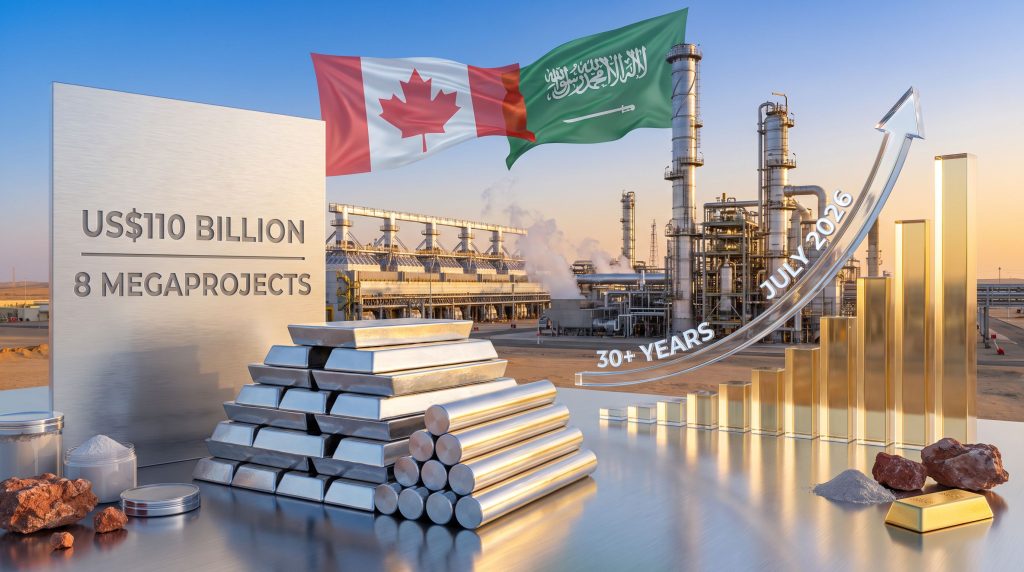
A US$110 Billion Pipeline Across Eight Megaprojects
To appreciate why the Hatch and Maaden partnership for aluminium and mining projects carries such significance, the scale of Maaden's planned investment must be understood in context.
| Metric | Detail |
|---|---|
| Total planned capital expenditure | Approximately US$110 billion over the next decade |
| Number of anchor megaprojects | Eight major developments |
| Commodity sectors covered | Aluminium, alumina, bauxite, gold, phosphate, battery materials |
| Formal partnership commencement | July 2026 |
| Hatch's in-kingdom engagement history | More than 30 years |
This scale of capital deployment places Maaden among the most ambitious mining investment programmes anywhere in the world. Very few individual mining companies have announced sustained decade-long capital programmes of this magnitude. The eight anchor megaprojects span a diverse commodity base, which reflects an important strategic logic: Saudi Arabia is not simply seeking to expand aluminium output.
Furthermore, it is constructing an integrated minerals industrial base designed to reduce hydrocarbon dependency and capture value across multiple global supply chains simultaneously. The rising critical minerals demand driven by the energy transition has made this diversification strategy particularly timely.
Aluminium at the Core: What the Value Chain Looks Like
Aluminium sits at the centre of the programme for well-understood structural reasons. Maaden's aluminium operations already span the full vertical chain, from bauxite extraction through alumina refining to primary smelting and downstream rolling. The partnership with Hatch is designed to accelerate and de-risk the expansion of each link in this chain.
Hatch's history with Maaden's aluminium assets is instructive. The firm developed a patented multi-cell jacketed pipe-heater technology for the digestion plant at the Ma'aden Alumina Refinery, a technically demanding assignment that required proprietary process innovation rather than off-the-shelf engineering solutions. In 2013, Hatch delivered a contract for the Ras Al-Zour aluminium facility, a project targeting 1.8 million tonnes per year of alumina production capacity valued at approximately US$65 million.
These prior engagements are not merely historical footnotes; they establish the technical foundation and organisational trust upon which the current, far larger programme rests. Battery materials and phosphate round out the commodity coverage, reflecting growing recognition that Saudi Arabia's mineral endowment extends well beyond aluminium.
Three Decades of In-Kingdom Technical Depth
Why Engineering History Matters at Programme Scale
Hatch's more than 30-year continuous presence in Saudi Arabia across gold, phosphate, aluminium, and alumina operations is a more significant competitive differentiator than it might initially appear. Large-scale mining programme delivery is deeply contextual. Regulatory environments, local supply chain capabilities, workforce characteristics, climate and geological conditions, and government stakeholder expectations all vary significantly between jurisdictions.
Firms that have operated continuously within a country accumulate institutional knowledge that cannot be replicated quickly by incoming competitors. This accumulated expertise reduces the knowledge transfer burden that typically consumes substantial time and budget during the early phases of new engineering engagements. When executing a US$110 billion programme under compressed timelines, this reduction in ramp-up friction translates into a meaningful operational advantage.
Technical Capabilities Aligned to Megaproject Requirements
The breadth of Hatch's technical capability is directly relevant to the scope of what Maaden requires. Key areas of competency include:
- Front-end feasibility and pre-FEED study support across diverse commodity assets
- Detailed engineering design for both greenfield developments and brownfield capacity expansions
- Proprietary process technology development and application in alumina refinery operations
- Procurement strategy and contractor interface management at programme scale
- Mine design integration with downstream processing facilities
The ability to apply proprietary process technology, as demonstrated through the digestion plant pipe-heater innovation, is particularly relevant in alumina refining, where the Bayer process presents specific engineering optimisation challenges at scale. Standard engineering approaches often leave meaningful efficiency gains untapped; firms capable of developing tailored solutions can deliver measurable reductions in energy consumption and processing costs.
Saudi Arabia's Industrial Vision and the Mining Sector's Central Role
Mining as the Third Pillar
Saudi Vision 2030 explicitly identifies mining as one of the primary levers for economic diversification beyond hydrocarbons. The Kingdom's National Mining Strategy articulates an ambition to position mining as a major contributor to GDP, drawing on an estimated US$1.3 trillion in untapped mineral wealth that spans phosphate, gold, copper, zinc, and bauxite deposits distributed across the Arabian Shield geological formation.
The Arabian Shield geochemical survey represents one of the world's more underexplored Precambrian geological terranes. Its structural complexity has historically limited systematic resource characterisation, but advances in geophysical surveying, remote sensing, and deep drilling technology are progressively improving the accuracy of resource estimates. This geological context underscores why Maaden's capital programme extends beyond existing assets into genuinely new territory.
"Saudi Arabia's estimated US$1.3 trillion in untapped mineral wealth is largely concentrated in the Arabian Shield, a Precambrian geological formation that remains comparatively underexplored relative to analogous terranes in Australia, Canada, and West Africa."
Workforce Localisation as a Strategic Deliverable
A dimension of the Hatch and Maaden partnership for aluminium and mining projects that deserves more attention is the explicit commitment to developing Saudi national workforce capabilities in engineering and project management. This aligns directly with Vision 2030's Saudisation objectives across technical and industrial sectors, but it also has a longer-term strategic implication that goes beyond compliance with localisation targets.
A mining and metals sector that can self-deliver complex capital programmes reduces its dependence on imported technical expertise and retains a greater share of project value within the domestic economy. Building that capability requires deliberate investment over multiple project cycles, which is precisely what a decade-long embedded partnership is structured to enable. The workforce development component should therefore be understood not as a social obligation, but as a central strategic deliverable in its own right.
Canada-Saudi Arabia: Engineering Diplomacy in Practice
The bilateral dimension of this agreement is increasingly relevant in a world where resource-rich nations and capital-rich nations are actively constructing industrial relationships to manage supply chain risk. Canada's engineering and technical services sector has world-class capability across mining, metals processing, and energy transition technologies. Saudi Arabia has capital, mineral resources, and a well-articulated industrial strategy.
In addition, the Kingdom has actively expanded its Saudi Arabia exploration licences to attract international partners, reinforcing the structural conditions that make long-term engineering partnerships commercially viable. The Hatch-Maaden agreement is one concrete expression of how these complementary national positions can be converted into durable economic cooperation.
How Programme-Level Integration Reduces Execution Risk
Structural Advantages of a Unified Delivery Framework
Executing eight major megaprojects concurrently across multiple commodity sectors introduces coordination complexity that cannot be managed effectively through separate contractor relationships. The integrated owner-partner model addresses this through several structural mechanisms:
- Consolidated contractor prequalification across all project sites, reducing duplication and ensuring consistent quality standards
- Unified interface management to prevent the coordination failures that commonly occur when parallel workstreams lack a central integration function
- Standardised engineering and procurement frameworks applied consistently across the full programme, reducing rework and scope ambiguity
- Early-stage study involvement that embeds engineering knowledge into project scope definition before costly design commitments are made
- Continuous knowledge accumulation that improves delivery efficiency across successive projects within the programme
Each of these mechanisms addresses a specific failure mode that has historically undermined large-scale mining capital programmes in complex jurisdictions. The cumulative effect is a meaningful reduction in the probability of schedule overruns, cost blowouts, and scope creep.
The next major ASX story will hit our subscribers first
Implications for Global Aluminium Supply Chains
Saudi Arabia's Emerging Production Position
If Maaden successfully executes a substantial portion of its US$110 billion capital programme over the next decade, the implications for global aluminium supply chains are significant. Primary aluminium production is currently concentrated in China, Russia, Canada, the United Arab Emirates, and Australia. The aluminium mining leaders in these regions currently dominate global supply, but a large-scale capacity expansion in Saudi Arabia would introduce a new, material source of primary supply into the global market.
The downstream effects extend to aluminium rolling and fabrication capacity, which supports regional supply to Middle Eastern construction, automotive, and packaging markets currently served by imports. An integrated domestic supply chain, consequently, reduces exposure to global price volatility and freight costs, strengthening the competitiveness of Saudi-manufactured aluminium products in regional and export markets.
Bauxite and Alumina: Upstream Trade Flow Dynamics
Saudi Arabia's ability to expand domestic alumina refining capacity has direct implications for global bauxite and alumina trade flows. Markets currently dependent on Australian, Guinean, and Indonesian bauxite supply could face a structurally altered competitive landscape as Middle Eastern refining capacity grows.
The Bayer process economics at large-scale refineries are heavily influenced by energy costs, where Saudi Arabia's position as a hydrocarbon-rich producer confers a structural cost advantage that could prove durable even as energy transition pressures reshape the broader economy. The expansion of Saudi mining licences across bauxite-bearing regions further strengthens the upstream resource base underpinning Maaden's refining ambitions.
"As global aluminium demand accelerates, driven by electric vehicle production, renewable energy infrastructure buildout, and urbanisation in developing economies, new primary production capacity in the Middle East could meaningfully shift the geographic balance of global aluminium supply over the coming decade."
Disclaimer: Forward-looking statements regarding Maaden's capital programme, production targets, and Saudi Arabia's position in global aluminium supply chains involve inherent uncertainty. Actual outcomes will depend on execution timelines, commodity price trajectories, regulatory developments, and broader macroeconomic conditions. This article is intended for informational purposes and does not constitute financial or investment advice.
Frequently Asked Questions: Hatch and Maaden Partnership
What is the Hatch and Maaden partnership agreement?
The Hatch and Maaden partnership for aluminium and mining projects is a strategic delivery owner-partnership in which Canadian engineering firm Hatch is embedded within Maaden's project delivery organisation to provide engineering, procurement, and programme management support across the Saudi Arabian Mining Company's full project pipeline, encompassing aluminium, alumina, bauxite, gold, phosphate, and battery materials assets within a planned capital programme of approximately US$110 billion.
How long has Hatch worked with Maaden in Saudi Arabia?
Hatch has maintained a continuous working relationship with Maaden for more than 30 years, spanning project delivery across gold, phosphate, aluminium, and alumina operations throughout the Kingdom, including the development of proprietary process technology for the Ma'aden Alumina Refinery digestion plant.
What aluminium projects are covered under the partnership?
The agreement covers Maaden's full aluminium value chain, including bauxite mining, alumina refining, primary smelting, and downstream rolling operations. Prior project experience includes the Ras Al-Zour aluminium facility, which targeted 1.8 million tonnes per year of alumina capacity. For broader context on how the industry is evolving, the World Aluminium organisation provides detailed data on global production trends and sustainability benchmarks.
What is Maaden's total planned capital investment?
Maaden has outlined a planned capital expenditure programme of approximately US$110 billion over the next decade, anchored by eight major megaprojects spanning its full commodity portfolio.
What does strategic delivery owner-partner mean in practice?
Rather than functioning as an external contractor engaged on a project-by-project basis, Hatch operates as an embedded partner within Maaden's project delivery organisation, managing engineering, procurement coordination, and contractor interfaces across multiple sites and project phases simultaneously. The International Council on Mining and Metals has published frameworks that inform how such integrated delivery models are structured within responsible mining programmes.
Why were government officials present at the signing?
The involvement of the Canadian Prime Minister and Saudi Arabia's Minister of Investment reflects the bilateral strategic significance of the arrangement, positioning it within the broader context of Canada-Saudi Arabia industrial and economic cooperation as both nations navigate the global energy transition.
Want to Track the Next Major Mineral Discovery Before the Market Moves?
Discovery Alert's proprietary Discovery IQ model delivers real-time alerts on significant ASX mineral discoveries, transforming complex mineral data into actionable insights for investors at every level — explore historic discoveries that have generated extraordinary returns, then begin your 14-day free trial at Discovery Alert to position yourself ahead of the broader market.