June 5, 2026
The Technical Architecture of a Modern Heap-Leach Gold Project: What Cerro Caliche Reveals About Junior Mining Economics
Heap-leach gold processing represents one of the most consequential technological shifts in modern mining economics. Unlike conventional milling, which demands complex grinding circuits and chemical flotation infrastructure, heap-leach operations extract gold through a comparatively elegant mechanism: crushed ore is stacked on lined pads, and a cyanide or alkaline solution percolates through the material, dissolving and recovering gold at a fraction of the capital cost. This processing architecture fundamentally changed who could build a gold mine, lowering the entry threshold and enabling a generation of junior developers to advance bulk-tonnage, lower-grade deposits that would never survive a conventional mill economics test. Understanding this processing logic is essential context for evaluating where the Sonoro Cerro Caliche drilling in Mexico currently stands, and what its outcomes could mean for the project's development trajectory.
When big ASX news breaks, our subscribers know first
Cerro Caliche: A Technical Profile of Sonoro's Sonora Flagship
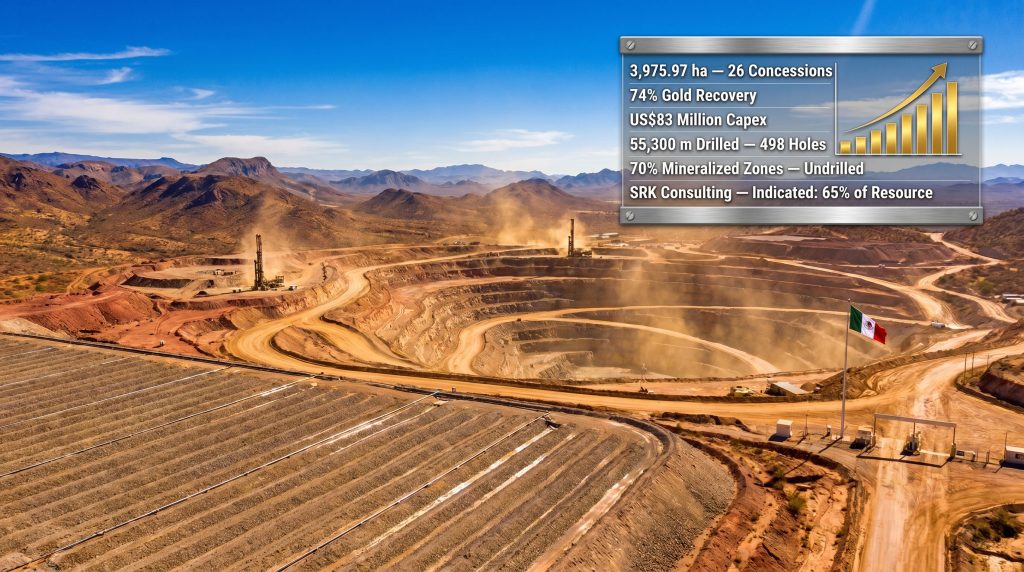
Located within Sonora State, Mexico, the Cerro Caliche gold and silver project operates within one of Latin America's most mineralogically productive corridors. The project spans 3,975.97 hectares across 26 contiguous mining concessions, occupying a geological setting shaped by northwest-trending epithermal mineralised corridors characteristic of the broader Sierra Madre Occidental belt.
Epithermal gold-silver systems of this type form at relatively shallow crustal depths, typically within 1,500 metres of the surface, where hydrothermal fluids cool and deposit precious metals in structurally controlled veins and disseminations. The Sierra Madre belt hosts a well-documented history of epithermal deposits, and Sonora State specifically has produced a substantial volume of Mexico's national gold output over decades of continuous mining activity.
The presence of established contractor networks, experienced workforces, and existing processing infrastructure in the region represents a meaningful operational advantage for projects at the development stage. Furthermore, the Cerro Caliche project page provides additional geological context for investors seeking to understand the deposit's full technical scope.
How Cerro Caliche Compares Against Comparable Sonora Projects
Contextualising Cerro Caliche against the broader junior project landscape in Sonora clarifies its relative scale and positioning:
| Feature | Cerro Caliche (Sonoro Gold) | Typical Sonora Junior Project |
|---|---|---|
| Total Concessions | 26 contiguous | Often fragmented |
| Total Hectares | 3,975.97 ha | 500 to 2,500 ha (approximate) |
| Processing Method | Open-pit, heap-leach | Open-pit or underground |
| Initial Capex | US$83 million | US$30M to US$200M range |
| Mine Life (Minimum) | 7 years | 5 to 10 years |
| Gold Recovery Rate | 74% (metallurgical testing) | 60% to 80% (heap-leach range) |
The contiguous nature of the 26-concession package is particularly significant. Fragmented land positions introduce access and operational risk when mineralisation trends across multiple tenement boundaries, potentially requiring third-party agreements or creating geological gaps in the resource model. A fully contiguous footprint of nearly 4,000 hectares removes that constraint entirely.
Drilling at Scale: The 50,000-Metre Campaign in Context
The current Sonoro Cerro Caliche drilling in Mexico represents a deliberate escalation in exploration intensity relative to the project's historical pace. Cumulative drilling prior to the current campaign had reached over 55,300 metres across 498 drill holes, supported by 9,739 surface samples collected across the property. These are substantial foundational datasets by junior project standards.
Yet the most critical statistic framing the current campaign is not what has been drilled, but what has not: only 30% of the project's identified mineralised zones have been drilled and assayed to date. This figure positions the 50,000-metre program as a first-principles geological inquiry into the deposit's true extent, rather than a routine resource confirmation exercise. Understanding drilling program economics is consequently essential when evaluating why Sonoro has committed to such an ambitious campaign at this stage.
"The gap between identified mineralisation and tested mineralisation is where exploration value is created or destroyed. A project with 70% of its geological footprint still open to drilling carries a fundamentally different risk-reward profile than one where the resource boundaries are largely defined."
The Three Drilling Targets and Their Strategic Roles
The program addresses three distinct priority areas, each contributing a different type of value to the overall development thesis:
1. Western Zones: High-Grade Ore Shoot Testing
- Previously identified high-grade intercepts anchor the western drilling focus
- Step-out and infill drilling tests lateral and vertical continuity of ore shoots
- Within a heap-leach operation, higher-grade feed zones can meaningfully reduce the cost per ounce of gold produced by improving the overall average grade processed
- High-grade sub-domains within bulk-tonnage deposits are sometimes excluded from initial resource estimates until continuity is established
2. Northern Zones: Resource Category Conversion
- The primary objective here is converting inferred material to the indicated classification
- This distinction matters enormously to project financing: most senior lenders and streaming counterparties require a minimum proportion of indicated resources before advancing capital
- Northern strike extensions remain largely open, meaning the total resource tonnage could grow materially from this zone alone
3. Central Zones: Pit Geometry and Strip Ratio Optimisation
- Engineering-focused drilling refines the open-pit shell design
- The strip ratio, which measures the volume of waste rock that must be moved to access each tonne of ore, directly determines operating cost per tonne mined
- Reducing the strip ratio through better geological definition of ore contacts can lower all-in sustaining costs meaningfully over the project's mine life
- Central zone assay results feed directly into the pit optimisation models used in pre-feasibility and feasibility engineering
The SRK Resource Estimate: What the Numbers Actually Mean
The March 2023 Mineral Resource Estimate prepared by SRK Consulting forms the quantitative foundation of Cerro Caliche's economic narrative. SRK Consulting is widely recognised within the mining industry as one of the leading independent resource estimation and geotechnical consultancies globally, lending technical credibility to the estimate's findings.
| Resource Metric | Reported Figure |
|---|---|
| Combined Resource Tonnage | 15 to 22 million tonnes |
| Indicated Category Share | 65% of total tonnage |
| Inferred Category Share | 35% of total tonnage |
| Coverage Area | Drilled areas only |
The 65% indicated classification is a threshold figure in project finance. Lenders evaluating construction financing for mining projects generally require resource confidence levels that allow meaningful economic modelling with acceptable uncertainty tolerances. A majority-indicated resource position moves a project from the exploration conversation into the financing conversation, a distinction that fundamentally changes the nature of investor discussions.
Equally important is what the resource estimate does not cover: because the estimate applies only to drilled areas, and only 30% of identified mineralised zones have been tested, the current 15 to 22 million tonne figure represents a floor estimate of geological potential rather than a ceiling. Investors focused on interpreting drill results will recognise how significantly additional drilling could reshape this picture.
Why 74% Gold Recovery Places Cerro Caliche in a Competitive Metallurgical Position
Metallurgical performance is often underweighted by investors relative to resource size, yet recovery rate directly determines how much of the contained metal in the ground translates into revenue. Heap-leach gold recovery across operating projects typically spans a wide range, from approximately 55% at the lower end to 85% at the upper end, influenced by ore mineralogy, crush size, leach pad design, and solution application rates.
Cerro Caliche's demonstrated 74% recovery rate positions the project in the upper-middle tier of that performance band. For a bulk-tonnage operation processing 12,000 tonnes per day, the difference between a 65% recovery rate and a 74% recovery rate across a 7-year mine life represents a substantial volume of additional gold ounces recovered, directly improving project economics without any change to the underlying resource.
"In heap-leach economics, metallurgical recovery is a multiplier on everything else. A project that recovers 74% of contained gold from a 20-million-tonne resource is not just 9 percentage points better than a 65% recovery project. It is a fundamentally different economic proposition over the full mine life."
The Diana Concession: A US$600,000 Land Package Expansion With Outsized Geological Implications
In April 2026, Sonoro completed the acquisition of the Diana mineral concession for US$600,000, expanding the total project footprint to the current 26-concession configuration. Evaluated in isolation, US$600,000 is a modest expenditure. Evaluated in the context of the project's US$83 million capital profile, it represents a strategic investment of less than 0.75% of total planned capital to address a potentially material geological question.
The primary technical rationale for the Diana acquisition centres on the northwest-trending structural corridors that define the main Cerro Caliche mineralised system. These corridors do not terminate at arbitrary property boundaries, and the working hypothesis is that they extend into the Diana ground. Without owning the Diana concession, any drilling program designed to test that extension would require third-party access agreements or would simply leave the structural question unanswered.
The satellite deposit optionality embedded in the Diana acquisition also carries long-term operational significance. In heap-leach mining, the ability to source ore from multiple nearby deposits and route it to a single central processing facility is a well-established strategy for extending mine life beyond the initial resource base. An initial 7-year mine life supported solely by the defined Cerro Caliche resource could be extended meaningfully if Diana proves to host additional mineralised material, improving the long-term return on the US$83 million capital investment.
Project Economics: Building the Investment Case for an US$83 Million Heap-Leach Operation
The economic architecture of Cerro Caliche follows the established template of low-to-medium grade bulk tonnage heap-leach development, where capital efficiency and operating simplicity compensate for moderate head grades:
| Operating Parameter | Specification |
|---|---|
| Mining Method | Open-pit |
| Processing Method | Heap-leach |
| Throughput Rate | 12,000 tonnes per day |
| Initial Capital Expenditure | US$83 million |
| Minimum Mine Life | 7 years |
| Gold Recovery Rate | 74% |
The US$83 million capex figure places Cerro Caliche in a range that is accessible to mid-tier mining company acquisition interest, as well as to streaming and royalty financing structures, both of which have been active funding mechanisms for Sonoran heap-leach projects in recent years. This capital threshold is meaningfully lower than the US$200 million to US$500 million range typical of conventional milling operations at comparable throughput rates.
Operating costs for Sonoran heap-leach operations have historically ranged from approximately US$600 to US$900 per ounce on an all-in sustaining cost basis, though project-specific figures depend heavily on labour rates, reagent pricing, fuel costs, and the strip ratio achieved during mining. Finalised feasibility work at Cerro Caliche will refine these estimates, but the regional precedent suggests a cost profile that remains viable across a wide range of gold price environments. In addition, record gold prices through 2025 and 2026 have substantially improved the economic case for projects previously considered marginal.
The Permitting Gateway: Environmental Impact Statement Progress
As of 2026, the project is at the final permitting stage, with Environmental Impact Statement approval targeted during the year. EIS approval represents the critical regulatory milestone that separates a development-stage project from a construction-ready project, and its completion is the gating item before construction financing discussions can advance to binding terms.
Understanding permitting and grade trade-offs is particularly relevant here, as the project's bulk-tonnage, lower-grade profile makes regulatory approvals especially pivotal to its economic viability. Sonora State's well-established regulatory framework for open-pit heap-leach operations provides a degree of procedural precedent that reduces permitting uncertainty relative to jurisdictions where this type of project would be navigating novel regulatory territory.
The next major ASX story will hit our subscribers first
What the Exploration Gap Means for the Cerro Caliche Investment Thesis
The investment case for the current phase of Sonoro Cerro Caliche drilling in Mexico rests substantially on the geometry of what remains untested. With 70% of identified mineralised zones yet to be drilled, the 50,000-metre program operates against a backdrop of meaningful geological optionality. Proactive Investors recently reported on the commencement of this campaign, underscoring the market attention this scale of drilling has attracted.
Each phase of the current campaign has a distinct role in reshaping the project's economics:
- Western zone high-grade results could improve the average feed grade processed, reducing cost per ounce and improving project margins
- Northern zone resource additions could expand the total resource tonnage and improve the indicated-to-inferred ratio, strengthening the bankability narrative
- Central zone pit geometry refinement could reduce the strip ratio, lowering operating costs across the full mine life
The cumulative effect of positive drilling outcomes across all three target areas would be a fundamentally stronger feasibility study input set. A robust definitive feasibility study in turn supports more favourable terms in any financing or transaction discussions.
Sonora's Broader Role in Mexico's Gold Production Landscape
Mexico consistently ranks among the top ten gold-producing nations globally, and Sonora State accounts for a disproportionate share of that national output. The state hosts multiple operating open-pit and underground gold operations, establishing an extensive contractor ecosystem, reagent supply infrastructure, and experienced workforce that junior developers can access without building from scratch.
The combination of established infrastructure, geological prospectivity across the Sierra Madre epithermal belt, and well-understood regulatory processes makes Sonora one of the more attractive jurisdictions in Latin America for heap-leach gold development. Furthermore, BNAmericas has noted that the restart of the US$83 million Cerro Caliche drilling campaign signals renewed confidence in the region's development outlook, particularly as improving gold prices continue to enhance project economics across Sonora.
Disclaimer: This article contains forward-looking statements and analytical commentary regarding exploration outcomes, project economics, and development timelines. These statements involve inherent uncertainty and should not be interpreted as financial advice. Mineral resource estimates, capital cost projections, and recovery rates are based on information disclosed by the company and independent technical reports. Actual outcomes may differ materially from those described. Readers should conduct their own due diligence before making any investment decisions.
Want to Be First When the Next Major ASX Mineral Discovery Hits the Market?
Discovery Alert's proprietary Discovery IQ model scans ASX announcements in real time, instantly identifying significant mineral discoveries and turning complex geological data into actionable investment insights — the kind of edge that matters when exploration campaigns like Cerro Caliche's 50,000-metre program begin delivering results. Explore how historic discoveries have generated substantial returns on Discovery Alert's dedicated discoveries page, and begin your 14-day free trial today to position yourself ahead of the broader market.