June 5, 2026
When Price Becomes a Psychological Barrier: Why India's Gold Buyers Are Stepping Back
Across the long arc of commodity market history, few relationships between a nation and a single asset have proven as enduring or as emotionally complex as India's bond with gold. For centuries, bullion has functioned simultaneously as currency, dowry, religious offering, and wealth storage for hundreds of millions of Indian households. Yet even the most deeply ingrained cultural behaviours have pressure points, and the convergence of volatile international prices, elevated domestic tax burdens, and shifting consumer psychology has created precisely those conditions in mid-2026. Understanding why India gold demand subdued amid volatile prices requires examining not just current market data, but the layered structural forces reshaping how India's largest consumer segments think about buying gold today.
When big ASX news breaks, our subscribers know first
What the Data Actually Shows: A Market Splitting at the Seams
The raw numbers tell a striking story, but context transforms them from alarming headlines into a more nuanced market picture.
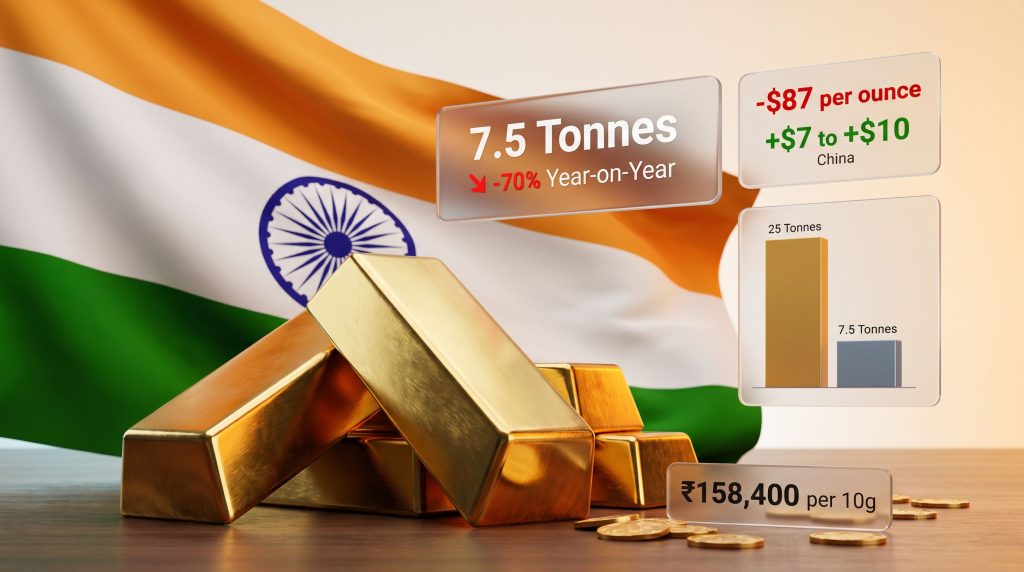
In the fortnight ending May 27, 2026, Indian gold demand contracted to approximately 7.5 tonnes, compared to nearly 25 tonnes during the equivalent period a year earlier. That represents a decline of roughly 70% year-on-year for that specific window, an extraordinary compression by any measure. Yet zoom out to the quarterly view, and a different picture emerges.
Q1 2026 at a Glance: Aggregate Growth Masking Structural Divergence
| Metric | Q1 2026 | Year-on-Year Change |
|---|---|---|
| Total Indian Gold Demand | 151 tonnes | +10% |
| Jewellery Volume | Declined | -19% |
| Investment Demand | Increased | Positive |
| Gold ETF Monthly Flow (May) | Net Outflow | First in 12 months |
Total demand grew 10% year-on-year in Q1 2026 to 151 tonnes, which sounds encouraging until the composition is examined. That aggregate growth was driven entirely by investment products such as coins, bars, and ETFs. Jewellery volumes, which represent the largest and most culturally embedded segment of Indian gold demand, fell 19% over the same period.
This bifurcation is not a minor technical detail. It signals a fundamental shift in how different segments of the Indian population are engaging with gold. Wealthier, financially literate investors continue to accumulate gold as an inflation hedge within their portfolios, while the broader mass market, particularly middle-income households that drive jewellery purchases, is visibly pulling back.
The divergence between investment demand and jewellery consumption is arguably the most structurally significant development in India's gold market right now. Headline demand figures can obscure whether a market is genuinely healthy or simply bifurcated.
Four Converging Forces Suppressing Indian Gold Demand
Price Volatility as a Behavioural Brake
Domestic gold prices in India were trading around ₹158,400 per 10 grams in early June 2026, levels that would have been unthinkable for most retail buyers even three years ago. Sharp and unpredictable price swings have triggered a pronounced wait-and-see posture among retail buyers, who typically purchase gold for weddings and gifting events where budgets are pre-determined.
The depth of market hesitancy is visible in wholesale pricing dynamics. Dealers were quoting discounts of up to $87 per ounce over official domestic prices during the week ending May 27, inclusive of applicable import and sales levies. That figure had itself narrowed from discounts of up to $106 per ounce the prior week, suggesting tentative improvement but still reflecting deeply subdued conditions. When dealers are forced to offer such steep discounts simply to move inventory, it confirms that buying appetite has materially contracted at the street level.
A marketing executive at a prominent Indian bullion and jewellery firm noted publicly that the market had been operating at a deep discount for several consecutive weeks, with older gold inventory being liquidated in cash transactions at even steeper haircuts than standard dealer quotes would suggest. This dynamic, where existing stock is sold down rather than fresh imports being absorbed, is a classic indicator of demand-side weakness rather than supply disruption. Furthermore, reports of subdued Indian gold demand confirm that buyer caution amid volatile prices has become a defining market characteristic.
The Import Duty Shock and Its Compound Effects
India raised gold import tariffs from 6% to 15% last month, combined with a 3% goods and services levy, as part of a broader effort to reduce foreign exchange pressure stemming from elevated oil import costs. The combined tax burden of 18% on imported gold has structurally elevated the domestic price floor, compressing affordability for price-sensitive buyers.
The duty hike also triggered a chain reaction in the investment segment. The resulting price spike prompted profit-taking among existing gold ETF holders, producing the first net monthly outflow from physically backed gold ETFs in 12 months in May 2026. This is a particularly telling data point, because Indian gold ETF investors tend to be relatively long-term in orientation. The fact that even this cohort chose to exit positions signals how significant the price dislocation became following the tariff adjustment.
For historical perspective, India implemented a similar duty cycle in 2013 when tariffs were raised aggressively to manage a widening current account deficit. The aftermath of that episode demonstrated clearly that duty-driven demand suppression tends to be acute in the short term but can generate powerful pent-up demand rebounds once prices stabilise or tariffs are adjusted downward. The current situation echoes that pattern closely.
Seasonal Timing: The Wedding Season Wind-Down
India's wedding calendar is the single most powerful recurring driver of physical gold jewellery purchases. The peak wedding season, which runs broadly from late autumn through spring, generates enormous demand for gold jewellery as both bridal adornment and gifting. As the season draws to a close in late May and June, demand naturally enters a trough.
A bullion dealer affiliated with a major private bank in Mumbai confirmed that retail demand had continued to moderate as the wedding season concluded, with jewellery stores across the country reporting meaningfully lower foot traffic. This seasonal lull compounds the price-driven hesitancy already weighing on the market, creating a dual-pressure environment where neither discretionary nor ceremonial demand is providing offsetting support.
The seasonal dimension matters for interpreting current data correctly. The extraordinarily weak fortnight demand figure of 7.5 tonnes reflects a confluence of the seasonal trough with price volatility, not a permanent structural collapse. However, the recovery pace when the next wedding and festival cycle begins will be a critical test of whether India gold demand subdued amid volatile prices represents a temporary or lasting trend.
Household Budget Compression
Elevated food and fuel costs have been compressing discretionary spending across Indian households throughout 2025 and into 2026. For middle-income families who represent the backbone of jewellery demand, gold competes with essential expenditures rather than operating as a freely chosen discretionary purchase.
This cost-of-living pressure is producing an observable behavioural adaptation: consumers are not abandoning gold entirely but are gravitating toward lighter, lower-carat jewellery that preserves cultural participation while reducing the total outlay. This represents a value-preserving compromise rather than a wholesale retreat from gold, but it does compress the revenue and volume numbers that dealers and manufacturers report.
How India's Discount Compares Across Asia
One of the most revealing ways to contextualise India's current market conditions is through regional premium and discount data, which provides a real-time measure of physical demand intensity across Asia's major gold markets.
Asia-Pacific Regional Gold Market Snapshot (June 2026)
| Market | Premium / Discount vs. Global Benchmark | Market Sentiment |
|---|---|---|
| China | +$7 to +$10 per ounce | Subdued but cautiously optimistic |
| Hong Kong | Par to +$2 per ounce | Neutral |
| Singapore | -$0.50 to +$3 per ounce | Mixed |
| Japan | -$0.25 per ounce | Slight discount |
| India | Up to -$87 per ounce | Significantly suppressed |
The contrast is stark. While China trades at modest premiums of $7 to $10 per ounce over the global benchmark, India is trading at discounts of up to $87 per ounce, reflecting demand suppression of an entirely different order of magnitude. Hong Kong sits at near-parity, Singapore trades in a narrow band either side of benchmark, and Japan shows only marginal discounting.
India's outlier status within this regional comparison underscores that the forces at work are largely domestic and structural rather than reflecting a broad Asia-wide retreat from physical gold. The import duty regime, the wedding season calendar, and the specific dynamics of India's price-sensitive jewellery market are creating conditions that are largely specific to that market.
China's Demand Picture: A Different Set of Pressures
China's gold market is experiencing its own form of softness, though the drivers differ substantially from India's. Bernard Sin, Regional Director for Greater China at MKS PAMP, has indicated that physical demand in China has been somewhat restrained, with anxiety around potential interest rate increases and the impact of rising bond yields weighing on investor appetite.
Sin has also noted, however, that market participants retain a degree of optimism that progress toward resolving geopolitical tensions could ease inflationary pressures. In addition, the broader gold market outlook suggests that any reduction in rate expectations may stabilise and support demand going forward.
This framing reveals a key difference between the Indian and Chinese demand dynamics. China's softness is primarily driven by macro-financial uncertainty affecting investor sentiment, while India's suppression is more directly linked to a domestic policy intervention layered on top of seasonal and price factors.
Temporary Correction or Structural Realignment? The Critical Question for 2026
The Case for Demand Recovery
Historical precedent is one of the strongest arguments for viewing current Indian gold demand weakness as cyclical rather than structural. India's gold market has demonstrated a consistent pattern of sharp demand recovery following periods of price-driven suppression. When prices stabilise or consolidate within a predictable range, deferred demand from wedding and gifting cycles typically re-enters the market with considerable force.
Key factors supporting a recovery thesis include:
- The wedding and festival season will resume in Q3 and Q4, historically generating a powerful demand rebound
- Ceremonial and gifting demand is deferred rather than eliminated, creating latent purchasing intent
- Any stabilisation of global gold prices would remove the primary psychological barrier currently preventing retail buyers from committing
- Historical precedent from the 2013 duty cycle demonstrates that demand rebounds strongly once conditions normalise
The Case for Structural Behavioural Change
Counterbalancing the recovery argument are several signals suggesting some degree of permanent behavioural shift is underway. Furthermore, the role of central bank influence on gold pricing continues to amplify market uncertainty for retail participants:
- The pivot toward lighter, lower-carat jewellery may represent a lasting recalibration of consumer expectations rather than a temporary compromise
- The 12-month net ETF outflow in May suggests even investment-oriented buyers are reassessing positioning rather than simply accumulating
- Persistent import duty elevation at 18% combined may permanently reset the domestic price floor, creating a new affordability ceiling for mass-market buyers
- Younger Indian consumers are demonstrably more open to gold alternatives and investment substitutes than previous generations
The truth likely lies between these scenarios. India's cultural relationship with gold is too deeply embedded to permit a fundamental abandonment of the asset. However, the composition of demand, the product mix consumers choose, and the price thresholds at which they engage are all evolving in ways that market participants cannot afford to ignore.
Three Scenarios for India's Gold Demand in H2 2026
Scenario 1: Price Stabilisation Triggers Pent-Up Demand Release
If international gold prices consolidate within a predictable range through Q3 2026, deferred demand from the concluded wedding season and upcoming Diwali festival cycle could generate a sharp demand rebound. The prior-year comparative of nearly 25 tonnes per fortnight provides a rough ceiling for what recovery could look like if conditions normalise meaningfully.
Scenario 2: Prolonged Volatility Extends the Demand Trough
Continued price swings above ₹150,000 per 10 grams could extend the current demand weakness deep into Q3. Under this scenario, jewellers would likely accelerate discounting of older inventory, compressing margins further and potentially triggering consolidation among smaller dealers operating on thin capital buffers.
Scenario 3: Policy Reversal on Import Duties
Any downward revision to the 15% import tariff would immediately lower the domestic price floor and act as a demand catalyst. The 2013 duty cycle provides a clear historical template: when tariffs were eventually eased, demand surged sharply. Geopolitical de-escalation, currency stabilisation, or improvement in foreign exchange reserve adequacy could all provide the political conditions for a tariff adjustment.
The next major ASX story will hit our subscribers first
Frequently Asked Questions: India's Gold Market in 2026
Why is India's gold demand subdued right now?
Demand has weakened due to a combination of volatile global gold prices, a sharp increase in import duties from 6% to 15% (plus 3% sales levy), the conclusion of the peak wedding season, and broader household budget pressures from elevated food and fuel costs compressing discretionary spending.
How much has Indian gold demand fallen in recent weeks?
In the fortnight ending May 27, 2026, demand fell to approximately 7.5 tonnes, compared to nearly 25 tonnes during the same period a year earlier, representing a decline of roughly 70% for that specific window. Consequently, India gold demand subdued amid volatile prices has become one of the most closely watched developments in global precious metals markets.
Did India's overall gold demand actually grow in 2026?
Total demand rose 10% year-on-year in Q1 2026 to 151 tonnes, but the growth was entirely investment-driven. Jewellery volumes, the largest component of Indian gold demand, fell 19% due to record prices reducing affordability for mainstream buyers. In addition, the divergence between physical gold vs ETFs demand has become increasingly pronounced within the Indian market.
What is happening with India's gold ETF market?
India's physically backed gold ETFs recorded their first net monthly outflow in 12 months in May 2026, as investors booked profits following the price spike triggered by the import duty increase. According to Economic Times BFSI, India's gold demand dip reflects the compound impact of price volatility and rising import duties acting simultaneously on consumer behaviour.
How does India's market compare to China right now?
China is trading at modest premiums of $7 to $10 per ounce over global benchmark prices, while India is trading at discounts of up to $87 per ounce, reflecting far deeper demand suppression in the Indian market.
Will Indian gold demand recover in H2 2026?
Most market participants expect a seasonal recovery as the Diwali and next wedding cycle approaches. However, the structural shift toward lighter jewellery and investment products is likely to persist regardless of price movements, permanently altering the composition if not the volume of demand. The broader context of safe-haven gold demand globally suggests that fundamental interest in gold as an asset class remains robust even as near-term Indian consumption falters.
The Global Implications of India's Demand Pause
India's role as the world's second-largest gold consumer means its demand patterns carry meaningful weight for global physical markets. The current combination of domestic discounts as steep as $87 per ounce and import duties creating an 18% cost barrier effectively signals to global suppliers that Indian absorption capacity is materially reduced.
This demand suppression creates potential arbitrage dynamics: deep domestic discounts relative to international benchmarks can attract grey-market flows or accelerate the liquidation of existing domestic inventory rather than driving fresh import demand, further depressing the signals that normally guide global supply allocation decisions.
Three variables will ultimately determine whether India's gold market recovers meaningfully in H2 2026: the trajectory of global gold prices and whether they stabilise enough to restore retail buying confidence; the government's willingness to revisit the import duty structure if foreign exchange pressures ease; and the strength of the upcoming Diwali and wedding season demand cycle, which historically functions as the most reliable reset mechanism for Indian gold consumption patterns.
What the current episode confirms is that even the world's most culturally committed gold market has a price point and a policy threshold beyond which demand contracts sharply. The depth of the current discount, the ETF outflow data, and the shift toward lighter jewellery are not noise. They are early signals of a market in structural transition, one where the fundamentals of India gold demand subdued amid volatile prices remain a critical watchpoint for global precious metals participants navigating an uncertain second half of 2026.
This article is intended for informational purposes only and does not constitute financial, investment, or commodity trading advice. All market data, demand figures, and price references reflect conditions as of early June 2026 and are subject to change. Readers should conduct independent research and consult qualified financial professionals before making investment decisions related to gold or precious metals markets.
Want to Stay Ahead of the Next Major Precious Metals Discovery?
While shifting gold demand patterns reshape global markets, Discovery Alert's proprietary Discovery IQ model scans ASX announcements in real time, instantly identifying significant mineral discoveries across gold and 30-plus commodities before the broader market reacts — explore historic discovery returns or start your 14-day free trial today to secure an immediate market-leading edge.