August 6, 2026

Understanding the Technical Crisis Behind Heavy Crude Shortages
The global refining industry faces an unprecedented challenge as specialised processing facilities confront the sudden unavailability of their primary feedstock sources. Complex refineries across Asia, engineered specifically for heavy sour crude processing, now operate under severe constraints as Middle Eastern supply chains experience catastrophic disruption.
The disappearance of Arab heavy and medium crude represents more than a supply shortage—it exposes fundamental vulnerabilities in the technical architecture of international petroleum refining. When geopolitical events eliminate access to specific crude grades, the ripple effects extend far beyond simple volume replacement calculations.
Asian refineries invested billions of dollars in hydrocracking units, coking facilities, and desulphurisation systems calibrated for crude oil with particular viscosity and sulphur characteristics. These installations cannot simply switch to alternative feedstocks without experiencing significant operational penalties and reduced profitability.
The Scale of Current Supply Disruption
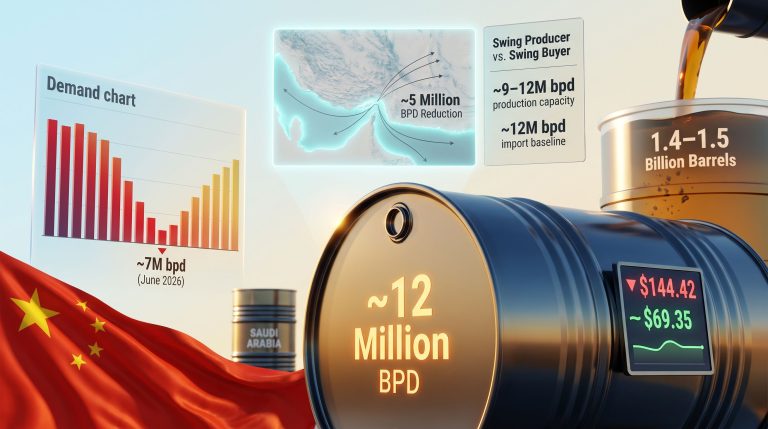
Analysis from energy consulting sources reveals that more than 12 million barrels of oil equivalent per day of Middle Eastern production has been taken offline within a two-week period. This figure includes 7 million barrels per day of crude supply, representing approximately 7% of total global liquids demand.
Iraq has experienced the most severe impact, with over 60% of its pre-conflict production volume currently curtailed. However, industry experts warn that current conditions may deteriorate further, with worst-case scenarios projecting Middle Eastern crude output falling to approximately 6 million bpd—a regional reduction of 70% from pre-conflict baseline levels.
Current Supply Status:
- Pre-conflict baseline: 21 million bpd (excluding Iran)
- Current operational capacity: 14 million bpd
- Overall reduction: 33% decline within one week
- At-risk supply categories: 8 million bpd facing potential further curtailment
Furthermore, the US oil production challenges compound the global supply pressure, whilst trade war oil movements continue to create additional market volatility.
When big ASX news breaks, our subscribers know first
What Makes Arab Heavy and Medium Crude Irreplaceable?
The technical specifications of Middle Eastern crude grades create unique processing advantages for certain refinery configurations. Arab Heavy and Arab Medium crude oils possess specific API gravity and sulphur content combinations that optimise performance in complex refining systems.
API Gravity and Sulphur Content Analysis
Critical Technical Specifications:
| Crude Grade | API Gravity | Sulphur Content | Processing Advantage |
|---|---|---|---|
| Arab Heavy | 27-28° | 2.8-3.0% | Maximises coking unit efficiency |
| Arab Medium | 31-32° | 2.5-2.7% | Optimal FCC unit performance |
| Arab Light | 33-34° | 1.8-2.0% | General refining flexibility |
These specifications matter because Asian refineries calibrated their fluid catalytic cracking (FCC) units and hydrocracking complexes to achieve peak yields when processing crude with API gravities between 27-32 degrees and sulphur content exceeding 2.5%.
Refinery Configuration Dependencies
Complex refineries in China, India, and South Korea constructed their operational frameworks around consistent heavy sour crude availability. Their processing units achieve optimal performance when fed crude oils matching specific viscosity and chemical composition parameters.
Equipment Optimisation Factors:
- Vacuum distillation efficiency: Heavy crude maximises valuable residue processing
- Coking unit productivity: Higher API gravity crude produces optimal coke quality
- Hydrotreating capacity: Heavy sour crude utilises full desulphurisation potential
- Product yield distribution: Balanced petrol-to-diesel production ratios
Current market conditions have eliminated Arab Medium crude from spot tender offerings, while Arab Light and Extra Light grades remain available through alternative export routes. This grade-specific unavailability creates substitution challenges that extend beyond simple volume replacement.
Infrastructure Vulnerability and Production Asset Status
The current crisis affects specific offshore production facilities that historically supplied the majority of Arab Heavy and Arab Medium crude to international markets. These assets represent critical nodes in global supply chains serving Asian refining centres.
Affected Production Assets
Major Field Capacities:
| Production Asset | Design Capacity | Primary Grade | Current Status |
|---|---|---|---|
| Safaniya Field | 1.2 million bpd | Arab Heavy | Offline |
| Zuluf Field | 500,000 bpd | Arab Medium | Partially curtailed |
| Marjan Field | 300,000 bpd | Arab Medium | Export constrained |
| Abu Safa Field | 200,000 bpd | Arab Medium blend | Storage limited |
Total affected capacity: Approximately 2.2 million barrels per day
These offshore installations face distinct operational challenges beyond typical field shutdown procedures. Subsea production systems require comprehensive integrity assessments, wellhead evaluations, and pipeline pressure testing before full restoration becomes possible.
Transportation Infrastructure Constraints
Saudi Arabia's East-West Pipeline system, with its 5 million bpd theoretical capacity, continues operating but faces practical limitations for heavy crude transportation. According to Saudi Arabia's oil production cuts, the system prioritises lighter grades due to several technical factors.
Operational Limitations:
- Pumping efficiency: Longer pipeline distances favour lower-viscosity crude
- Terminal specifications: Yanbu facilities optimised for light crude handling
- Storage configurations: Tank systems designed for specific gravity ranges
- Loading capabilities: Marine terminal equipment calibrated for lighter grades
The UAE's ADCOP pipeline to Fujairah provides additional bypass capacity but operates under similar technical constraints regarding heavy crude handling efficiency.
How Asian Refineries Are Responding Technically
Refining facilities across Asia face immediate operational decisions as their primary feedstock sources disappear from international markets. The technical response strategies vary based on each facility's processing configuration and flexibility limitations.
Feedstock Dependency Analysis
Refinery Response Capabilities:
| Configuration Type | Heavy Crude Dependency | Substitution Difficulty | Expected Yield Impact |
|---|---|---|---|
| Complex Coking Units | 70-80% heavy feeds | Extremely challenging | 15-20% reduction |
| Integrated FCC Systems | 50-60% heavy feeds | Moderately difficult | 8-12% reduction |
| Hydrocracking Complexes | 60-70% heavy feeds | Very challenging | 12-18% reduction |
Note: These figures represent industry estimates and may vary by individual facility specifications.
Immediate Technical Adaptations
Short-term Response Strategies:
-
Crude Slate Optimisation
- Blending light crudes with available heavy alternatives
- Adjusting feed ratios to maintain process stability
- Managing storage tank inventory levels
-
Process Unit Reconfiguration
- Modifying operating parameters for lighter feedstocks
- Adjusting catalyst systems for different crude characteristics
- Rebalancing heat integration systems
-
Product Yield Optimisation
- Shifting production emphasis toward petrol over diesel
- Maximising high-value product recovery rates
- Adapting to altered product slate economics
Alternative Supply Source Evaluation
Asian refineries now compete for limited heavy crude alternatives from distant production regions, adding significant logistical complexity and cost burdens to their operations.
Potential Replacement Sources:
| Supply Region | Available Grade | Estimated Capacity | Technical Compatibility | Freight Cost Impact |
|---|---|---|---|---|
| Russia | Urals Heavy | 200,000-300,000 bpd | 85% compatible | +$6-8 per barrel |
| West Africa | Various blends | 150,000-250,000 bpd | 75-80% compatible | +$6-9 per barrel |
| Americas | Heavy Canadian/Venezuelan | 180,000-220,000 bpd | 70-75% compatible | +$8-12 per barrel |
| Brazil | Marlim Blend | 180,000 bpd | 80% compatible | +$8-11 per barrel |
These alternative sources face significant limitations in total available volumes and present substantially higher transportation costs compared to traditional Middle Eastern supply routes. Consequently, many refineries are evaluating oil price crash overview scenarios to understand market implications.
Recovery Timeline and Infrastructure Restoration Challenges
The restoration of full Middle Eastern heavy crude production involves complex technical procedures that extend far beyond simple field restart operations. Offshore infrastructure requires comprehensive evaluation and systematic recommissioning processes.
Technical Recovery Phases
Restoration Timeline Analysis:
Phase 1 (0-3 months): Emergency Assessment
- Wellhead integrity evaluations
- Subsea equipment damage assessment
- Pipeline pressure testing procedures
- Storage facility capacity verification
Phase 2 (3-6 months): Systematic Restart
- Graduated production rate increases
- Process facility recommissioning
- Safety protocol implementation
- Export system restoration
Phase 3 (6-12 months): Full Capacity Recovery
- Complete production optimisation
- Infrastructure redundancy improvements
- Enhanced monitoring system installation
- Preventive maintenance schedule implementation
Phase 4 (12+ months): Strategic Upgrades
- Capacity expansion considerations
- Alternative export route development
- Enhanced security system integration
- Long-term resilience planning
Storage and Processing Constraints
Current operational challenges extend beyond production field restoration to encompass storage and processing limitations across the entire supply chain.
Critical Constraint Analysis:
Kuwait Operations:
- Refinery capacity: 1.42 million bpd combined
- Domestic consumption: 360,000 bpd
- Export route status: Currently unavailable
- Storage limitation: Rapid inventory accumulation
Iraqi Production:
- Pre-conflict output: Significant export volumes
- Current constraint: Limited domestic refining capacity
- Storage challenge: Tank farm capacity limitations
- Production floor: Declining due to storage saturation
These storage constraints create dynamic operational floors that continue declining as inventory management becomes increasingly challenging. Meanwhile, the OPEC production impact continues to influence global supply decisions.
The next major ASX story will hit our subscribers first
Long-term Industry Implications and Strategic Considerations
The current crisis demonstrates fundamental vulnerabilities in global refining infrastructure that may accelerate strategic changes in facility design and crude sourcing strategies.
Refinery Investment Recalibration
Strategic Response Areas:
- Feedstock Flexibility Enhancement: Upgrading processing units to handle broader crude slate variations
- Storage Capacity Expansion: Increasing inventory management capabilities for multiple crude grades
- Transportation Redundancy: Developing alternative supply route capabilities
- Processing Technology Advancement: Implementing more adaptable refining technologies
Supply Chain Resilience Measures
Risk Mitigation Strategies:
-
Diversified Sourcing Agreements
- Long-term contracts with multiple supply regions
- Flexible volume adjustment mechanisms
- Grade substitution provisions
-
Strategic Reserve Expansion
- Increased emergency inventory levels
- Specialised heavy crude storage capabilities
- Coordinated regional reserve sharing
-
Infrastructure Redundancy Development
- Alternative pipeline route construction
- Enhanced marine terminal capabilities
- Improved inter-regional connectivity
-
Technical Capability Enhancement
- Advanced crude oil blending technologies
- Improved process flexibility systems
- Enhanced product yield optimisation
Market Psychology and Investment Implications
The disappearance of Arab heavy and medium crude creates psychological impacts that extend beyond immediate supply and demand calculations. Energy markets now recognise the systemic risks associated with concentrated supply sources and specialised infrastructure dependencies.
Furthermore, analysts examining the oil price rally analysis suggest that these structural changes may permanently alter global pricing dynamics.
Investment Considerations:
- Refinery modernisation projects emphasising feedstock flexibility
- Alternative crude development in previously marginal regions
- Transportation infrastructure serving non-traditional supply routes
- Storage and terminal facilities designed for diverse crude grades
This crisis reveals how specialised refinery configurations create systemic vulnerabilities worth hundreds of billions in capital investment. Recovery requires comprehensive coordination between production restoration, transportation system rehabilitation, and refinery operational adaptation across multiple geographic regions and technical disciplines.
The technical lessons learned from this supply disruption will likely influence global energy infrastructure planning for decades, as industry participants recognise the strategic importance of operational flexibility in an increasingly uncertain geopolitical environment.
Want to Capitalise on Energy Market Volatility?
Discovery Alert's proprietary Discovery IQ model delivers real-time alerts on significant ASX mineral discoveries, including energy sector opportunities that emerge during periods of global supply disruption and market uncertainty. Stay ahead of volatile commodity markets by accessing Discovery Alert's comprehensive discoveries page to see how major mineral finds have historically generated substantial returns, then begin your 14-day free trial to position yourself strategically in today's dynamic energy landscape.