July 24, 2026
The Invisible Commodity That Modern Civilisation Cannot Function Without
The global commodity conversation has long been dominated by oil, natural gas, and increasingly, the battery metals powering the energy transition. Yet there exists a resource so fundamentally irreplaceable, so physically unique, and so dangerously concentrated in one of the world's most geopolitically volatile regions, that its vulnerability represents a systemic risk that transcends conventional supply chain analysis. That resource is helium, and the helium supply crisis in the Strait of Hormuz is not a theoretical future scenario. It is already unfolding.
Understanding why this matters requires stepping back from the headlines and examining what helium actually is, where it comes from, and why losing access to it is categorically different from any other commodity disruption the modern economy has experienced. Furthermore, the broader helium supply crisis is deeply intertwined with wider questions about how the world secures access to irreplaceable industrial inputs.
When big ASX news breaks, our subscribers know first
What Makes Helium Irreplaceable in Ways No Other Resource Is
A Resource Formed Over Geological Time
Helium does not exist in mineable ore bodies the way copper or lithium does. It accumulates deep within geological formations through the radioactive decay of uranium and thorium, a process that unfolds across millions of years. This means the helium reserves accessible today represent an essentially fixed planetary inventory accumulated over timescales that make human industrial history appear instantaneous by comparison.
The physical consequences of this are severe. Once helium escapes containment and enters the atmosphere, it is not merely dispersed. Its extraordinarily low atomic mass means it reaches Earth's escape velocity and exits the atmosphere entirely, making every molecule lost to venting or accident a permanent reduction in the total accessible supply. There is no geological recycling mechanism, no production ramp-up, and no synthetic pathway that changes this arithmetic.
Why Substitution Fails Across Every Critical Application
The industries that depend on helium are not merely accustomed to it out of habit. They rely on physical and chemical properties that no commercially available alternative replicates:
-
Medical imaging: Superconducting MRI magnets operate at temperatures approaching absolute zero (-269°C). Liquid helium is the only substance capable of maintaining these temperatures in clinical settings. Without continuous helium supply, MRI machines simply stop functioning.
-
Semiconductor fabrication: Advanced chip manufacturing requires ultra-pure inert atmospheres during wafer etching processes. The thermal conductivity, molecular size, and chemical inertness of helium at the purity levels required for sub-nanometre node fabrication cannot be replicated by nitrogen or argon.
-
Aerospace and launch systems: Helium is used to pressurise rocket fuel tanks, purge propellant lines, and perform leak detection on propulsion systems. No operationally proven alternative exists that meets equivalent safety and performance thresholds.
-
Saturation diving: At significant depths, nitrogen in breathing gas mixtures causes narcosis. Helium-based mixtures such as heliox and trimix are physiological necessities for human survival during deep commercial or scientific diving operations.
-
Fibre optics manufacturing: Helium is used in the fibre drawing process to control the thermal environment around the preform as it is pulled into continuous optical fibre.
The breadth of this dependency list is what distinguishes helium from every other critical mineral. Lithium substitution research is active and advancing. Rare earth alternatives are under development. For helium in its core applications, however, the physical laws that make it necessary also make substitution research largely futile. This reality feeds directly into the growing debate around critical minerals demand as the global economy undergoes structural transformation.
How Geographic Concentration Created a Single Point of Global Failure
The Production Landscape in 2025-2026
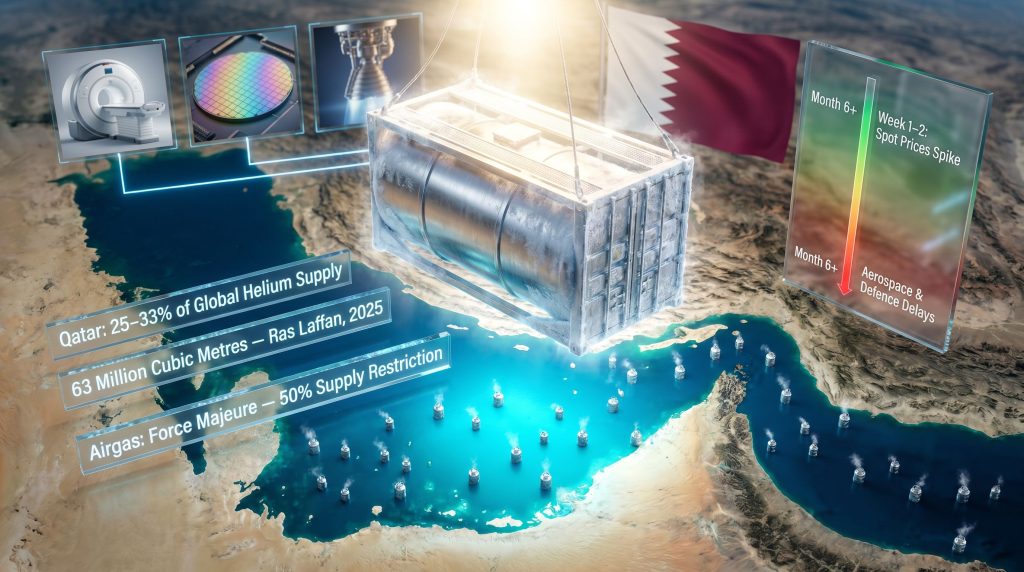
Global helium production is far more concentrated than most commodity analysts recognise. The United States holds the largest single-country share, accounting for roughly 40 to 45 percent of global supply, distributed across several facilities primarily in Texas, Kansas, and Wyoming. Qatar ranks as the world's second-largest producer, responsible for approximately 25 to 30 percent of globally traded helium, with all of that production flowing through a single export complex.
| Producer | Approximate Global Share | Hormuz Transit Dependency |
|---|---|---|
| United States | ~40-45% | None |
| Qatar | ~25-30% | 100% |
| Russia | ~8-10% | None |
| Algeria | ~5-8% | None |
| Other producers | Remainder | Varies |
Russia holds substantial reserves, particularly concentrated in the Amur region of Siberia, but geopolitical constraints and limited export infrastructure have structurally reduced its availability to Western markets. Algeria contributes meaningfully to global supply but at volumes insufficient to offset a major disruption elsewhere.
Ras Laffan: One Facility, One Waterway, No Redundancy
Qatar's entire helium export programme operates through Ras Laffan Industrial City, a facility that integrates helium extraction directly with LNG processing infrastructure. This integration creates an important cascade vulnerability: any disruption to the broader energy and industrial complex at Ras Laffan does not merely affect helium in isolation. It simultaneously affects the natural gas processing upon which helium extraction depends.
Every tonne of helium leaving Qatar must transit the Strait of Hormuz, a waterway approximately 33 kilometres wide at its narrowest navigable point. There is no pipeline alternative, no overland route, and no bypass. The strait is not merely a chokepoint in the energy sense. For helium specifically, it is the only exit from the world's second-largest production hub.
The structural vulnerability this creates is categorically different from oil disruptions. A temporary oil blockade can be partially offset through strategic petroleum reserves, alternative routing, or demand-side reduction. For helium, none of these buffers exist at meaningful scale.
Consequently, the geopolitical mining risks that analysts have long applied to metals and energy commodities must now be applied with equal rigour to industrial gases. According to research from the Centre for Critical Minerals and Resources, helium's exposure to Strait of Hormuz disruption represents one of the most structurally underappreciated raw material vulnerabilities in the global economy.
The Physical Reality of Helium Logistics Under a Blockade
Why Stranded Containers Represent Permanent Loss
Helium is not shipped as a compressed gas at ambient temperature. It is transported in a liquefied state at cryogenic temperatures, carried in highly specialised ISO containers whose insulation systems maintain the cargo in liquid form. These containers are not standard shipping equipment. They are precision cryogenic vessels valued at approximately one million dollars each, and the global fleet of such containers is finite and difficult to expand rapidly.
The critical vulnerability in this system is a physical property called boil-off. Even in the most advanced insulated containers currently available, liquid helium continuously evaporates. This is not a design flaw that engineering can eliminate. It is a consequence of the thermodynamic properties of a substance with the lowest boiling point of any known element. Containers stranded in transit do not merely represent delayed delivery. They represent cargo that is actively diminishing in volume every day it sits in place.
Following the disruption to shipping through the Strait of Hormuz in early 2026, an estimated 300 or more specialised helium containers were rendered immobile in the affected region. With complete product loss occurring within roughly five to seven weeks of stranding, the financial and supply consequences were immediate and severe. The 2026 Strait of Hormuz crisis has since been widely recognised as a watershed moment in global commodity security planning.
From Disruption to Industrial Crisis: The Timeline
The cascade from supply disruption to industrial consequence moves faster for helium than for any other critical mineral:
-
Weeks one and two: Spot market prices surge as distributors activate emergency allocation protocols and assess inventory positions.
-
Weeks three and four: Major industrial gas distributors begin issuing force majeure declarations, restricting customers to reduced percentages of contracted volumes.
-
Weeks five and six: Hospitals lacking adequate reserve dewars begin rationing MRI operational hours. Semiconductor fabrication facilities reduce throughput or substitute less demanding processes.
-
Months two and three: Chip production shortfalls begin propagating through electronics supply chains. Medical diagnostic backlogs expand measurably.
-
Month six onward: Structural supply deficits trigger contract renegotiations, procurement reviews, and the beginning of longer-term supply diversification discussions that should have occurred years earlier.
The distributor Airgas has already declared force majeure following the 2026 Strait disruption, restricting customers to 50 percent of their contracted supply volumes. Spot market prices for helium more than doubled in the immediate aftermath, with surcharges reaching levels that have made helium uneconomical for lower-priority industrial applications, effectively forcing demand-side rationing by price.
Which Economies and Sectors Face the Sharpest Exposure
Sector-Level Vulnerability Assessment
| Industry | Helium Function | Crisis Impact Pathway |
|---|---|---|
| Medical Imaging | Superconducting magnet cooling | Diagnostic shutdowns within weeks |
| Semiconductor Manufacturing | Inert atmosphere and process cooling | Chip output reductions amplify existing shortages |
| Aerospace and Defence | Fuel system pressurisation and purging | Launch delays and procurement disruptions |
| Fibre Optics | Atmosphere control in fibre drawing | Telecommunications infrastructure slowdowns |
| Deep-Sea Operations | Breathing gas mixtures for saturation diving | Direct operational safety risk at depth |
| Research and Science | NMR spectroscopy, physics experiments | Long-term research programme interruptions |
National Exposure: The Countries Most at Risk
The countries with the highest structural exposure are those combining heavy Qatar supply dependency with large helium-intensive industrial bases:
-
South Korea sourced approximately 64.7 percent of its helium from Qatar as of 2025. With domestic semiconductor producers operating on an estimated six months of reserve inventory, this represents one of the most acute near-term risk profiles of any major economy globally.
-
Taiwan faces comparable dependency ratios with an industrial base heavily weighted toward high-volume chip fabrication, creating equivalent systemic exposure.
-
Germany and broader Europe have formally identified supply bottleneck risks. Germany's exposure extends beyond helium, with approximately 10 percent of crude oil and 14 percent of petroleum products consumed by Europe transiting the Strait of Hormuz via major import hubs including Rotterdam.
-
Japan carries significant downstream sensitivity through its advanced electronics manufacturing and medical device production sectors.
The semiconductor industry has been operating under chronic capacity constraints since 2020. A sustained reduction in helium availability does not add pressure to a stable system. It adds pressure to a system that was already stretched, with consequences for everything from consumer electronics to defence electronics procurement.
Why Alternative Supply Cannot Bridge the Gap
The Uncomfortable Arithmetic of Substitution
The instinctive response to any supply disruption is to ask whether alternative sources can compensate. For helium, the honest answer is: not quickly, not fully, and not without significant capital investment with multi-year lead times.
US production infrastructure is already operating near practical capacity. Meaningful volume expansion would require new field development, processing facility construction, and regulatory approval, all of which unfold over years rather than months. Russian helium reserves are substantial but face export infrastructure limitations and geopolitical constraints that effectively exclude them from Western market consideration under current conditions.
Byproduct vs. Primary Helium: A Critical Distinction That Most Analysts Miss
One of the least-understood dynamics in the helium market is the structural difference between byproduct helium and primary helium production:
-
Byproduct helium is extracted as a co-product of natural gas processing. It represents the majority of global supply. Crucially, output is determined by natural gas economics rather than helium market conditions. When gas production slows for any reason, helium supply contracts automatically, regardless of how high the helium price climbs.
-
Primary helium projects target helium as the principal commercial product. Because the business case is built around helium specifically, these operations can respond directly to helium demand signals and scale production based on helium market conditions rather than being constrained by gas market dynamics.
This distinction matters enormously during supply crises. A byproduct-dependent supply chain offers limited flexibility precisely when flexibility is most needed. In addition, critical minerals supply chains that rely on single-geography byproduct extraction are increasingly viewed as structurally inadequate for modern industrial security requirements.
Emerging Supply Geographies Worth Monitoring
| Region | Project Type | Stage | Notes |
|---|---|---|---|
| Minnesota, USA | Primary helium extraction | Advanced exploration | Direct helium target; not gas-production dependent |
| Tanzania | Primary helium fields | Early stage | Large resource potential identified in Rift Valley geology |
| Canada | Primary and secondary | Various | Proximity to North American industrial demand centres |
| South Africa | Primary helium | Exploration | Emerging producer geography with growing interest |
The Minnesota example is particularly notable from a supply security perspective. Primary helium projects in politically stable jurisdictions with established regulatory frameworks represent a qualitatively different supply proposition from byproduct facilities tied to hydrocarbon production economics in distant geographies. The strategic supply chain importance of geographically diversified production has never been more clearly demonstrated than by the events of 2026.
The next major ASX story will hit our subscribers first
The Long-Term Dimension: Scarcity That Compounds Over Time
Finite Reserves and Irreversible Losses
The 2026 Strait disruption has not merely created a temporary supply gap. Through container boil-off losses alone, it has permanently destroyed a measurable volume of a resource that took millions of years to form and cannot be replenished on any timescale relevant to human civilisation. This is the dimension that distinguishes the helium supply crisis in the Strait of Hormuz from conventional commodity cycle analysis.
Every unit vented to atmosphere, whether through industrial waste, container boil-off during transport disruptions, or infrastructure damage, represents a permanent subtraction from accessible global reserves. The cumulative effect of repeated supply crises, each involving large-scale container stranding and boil-off loss, is not merely economic damage. It is an accelerating depletion of a non-renewable planetary resource.
Policy Tools That Could Reduce Long-Term Vulnerability
The frameworks most likely to reduce systemic exposure include:
-
Strategic helium reserves: Most major consuming nations currently hold no government helium stockpiles analogous to strategic petroleum reserves. Establishing such reserves would provide a buffer against acute supply shocks.
-
Mandatory recovery and recycling infrastructure: MRI facilities and semiconductor fabrication plants currently vent significant volumes of helium that could theoretically be captured and reused. Closed-loop recovery systems could reduce demand by an estimated 20 to 30 percent at current adoption scales. Widespread deployment requires capital investment, but the economics become increasingly compelling as spot prices rise.
-
Technology transition incentives: Research into next-generation MRI systems using high-temperature superconductors, which operate at temperatures achievable with liquid nitrogen rather than liquid helium, could reduce medical sector dependency over a ten to fifteen year horizon.
-
Procurement diversification requirements: Industrial policy frameworks requiring buyers to maintain multi-source supply agreements, similar to rare earth diversification mandates, would distribute supply chain risk more effectively.
The World Economic Forum has formally identified helium as one of several critical non-oil commodities with direct, unhedged exposure to Strait of Hormuz disruption risk, placing it alongside aluminium precursors and specialty chemicals in a category requiring systemic policy responses rather than reactive crisis management.
FAQ: Helium Supply, Logistics, and the Strait of Hormuz Crisis
Why Is Long-Term Helium Storage So Difficult?
The continuous boil-off that makes container stranding so damaging also makes long-term strategic stockpiling technically constrained. Even the most advanced insulated storage systems experience ongoing product loss. This physical reality makes supply continuity a more viable resilience mechanism than large-scale stockpiling, though modest strategic reserves remain worth pursuing for acute crisis buffering.
How Quickly Would Hospitals Experience Operational Impacts?
Hospitals without dedicated reserve dewars of meaningful capacity would begin experiencing MRI operational constraints within two to four weeks of supply interruption. Facilities with larger reserves might sustain normal operations for up to three months. A sustained blockade would ultimately force diagnostic rationing across most healthcare systems with high Qatar supply dependency.
Is Helium Recycling a Realistic Near-Term Solution?
Recovery and recycling technology is proven and already in use at large research institutions and some industrial facilities. However, the capital investment required for widespread deployment is substantial. At current adoption rates, recycling capacity cannot offset a sudden 25 to 30 percent reduction in global supply within any operationally meaningful timeframe. It remains a medium to long-term mitigation tool rather than an emergency response mechanism.
Why Can't Chip Manufacturers Switch to Alternative Process Gases?
The physical properties of helium, particularly its thermal conductivity, molecular size, and chemical inertness at the purity levels required for advanced node fabrication, are not replicated by any commercially available alternative. Substitution would require fundamental redesign of manufacturing processes developed and refined over multiple decades, representing investment and lead time measured in years, not months.
What Advantage Does a Primary Helium Project Offer Over Byproduct Production?
A primary helium project treats helium as its core commercial product, allowing production decisions to respond directly to helium market conditions. Byproduct producers cannot increase helium output independently of natural gas production economics. During a helium-specific demand shock, this distinction becomes the difference between a supplier that can respond to market signals and one that structurally cannot.
The Strategic Assessment: A Risk Category Without Parallel
The helium supply crisis in the Strait of Hormuz exposes a category of systemic risk for which conventional commodity frameworks are genuinely inadequate. The resource cannot be substituted in its most critical applications. It cannot be recycled at scale under existing infrastructure. It cannot be expanded through intensified production in the short to medium term. And every disruption event permanently reduces the total planetary inventory.
When these characteristics are combined with a production geography that routes over a quarter of global supply through a single waterway in one of the world's most contested regions, the result is a vulnerability profile that is structurally different from anything the industrial world has previously been required to manage.
The practical implications for different stakeholders are clear:
-
For policymakers: The absence of strategic helium reserve programmes in most major consuming nations represents a policy gap that the 2026 disruption has rendered impossible to ignore.
-
For industrial procurement teams: Single-source supply strategies dependent on Qatari exports carry risks that have now been empirically demonstrated. Multi-source procurement frameworks are a necessity, not a preference.
-
For capital allocators: Primary helium production assets located in geopolitically stable jurisdictions represent a supply security proposition with structural differentiation from the byproduct-dependent majority of global supply. As the market increasingly prices in supply concentration risk, that differentiation carries investment significance.
The lightest industrially significant element on the periodic table now carries some of the heaviest strategic implications of any commodity on Earth. Treating that as a niche concern, rather than a systemic priority, is a risk that the evidence of 2026 no longer supports.
This article is provided for informational purposes only and does not constitute financial advice or a recommendation to buy or sell any securities. Commodity markets involve significant risk, and past supply disruptions are not necessarily indicative of future market conditions. Readers should conduct their own due diligence before making any investment decisions.
Want to Stay Ahead of Critical Mineral Discoveries Before the Market Catches On?
Discovery Alert's proprietary Discovery IQ model delivers real-time alerts on significant ASX mineral discoveries — including emerging opportunities in critical and industrial commodities like helium — transforming complex geological data into actionable investment insights for both short-term traders and long-term investors. Explore how historic discoveries have generated substantial returns on Discovery Alert's dedicated discoveries page, and begin your 14-day free trial today to position yourself ahead of the broader market.