
June 10, 2026
The Commodity Most Critical Industries Cannot Replace Is Now in Short Supply
Across the global economy, certain materials occupy a category of their own: inputs so technically specific, so physically irreplaceable, and so structurally embedded in modern manufacturing that no alternative exists. Helium is one of those materials. It does not behave like oil, copper, or lithium. It cannot be synthesised at industrial scale. Once it escapes into the atmosphere, Earth's gravitational pull is insufficient to retain it, meaning it is permanently lost. The global helium supply crisis is unlike virtually every other commodity facing a supply disruption, as helium production cannot simply be ramped up in response to higher prices because more than 95% of the world's helium emerges as a byproduct of natural gas processing, tethered entirely to gas economics rather than helium demand.
This structural reality makes the current moment in the helium market genuinely unusual. The forces compressing supply are geopolitical, physical, and regulatory simultaneously, and the industries depending on a reliable helium stream include semiconductor fabrication, MRI medical imaging, space launch systems, and the emerging quantum computing sector. Understanding what is happening to helium supply, and why the Pulsar Helium Topaz project in Minnesota sits at a particularly consequential intersection of those forces, requires starting with the supply architecture itself.
When big ASX news breaks, our subscribers know first
Why Helium Supply Cannot Self-Correct the Way Other Commodities Can
Most industrial commodities respond to price signals through expanded production. When copper prices rise, miners accelerate extraction. When lithium demand surges, new brine operations are commissioned. Helium does not follow this logic.
Because the overwhelming majority of global helium is separated from natural gas streams whose extraction is driven entirely by gas demand and gas pricing, helium output is essentially a passive derivative of decisions made for completely different economic reasons. When gas production slows, helium output falls regardless of what helium commands in the market. There is no mechanism by which elevated helium prices can directly incentivise more helium production from byproduct sources.
This creates a structural asymmetry that makes supply shocks in helium far more durable than in most other commodities. Furthermore, the current disruption illustrates exactly that dynamic.
The Two Events That Removed 45% of Global Supply
Two geopolitical developments have converged to create the most severe helium supply dislocation in recent history:
-
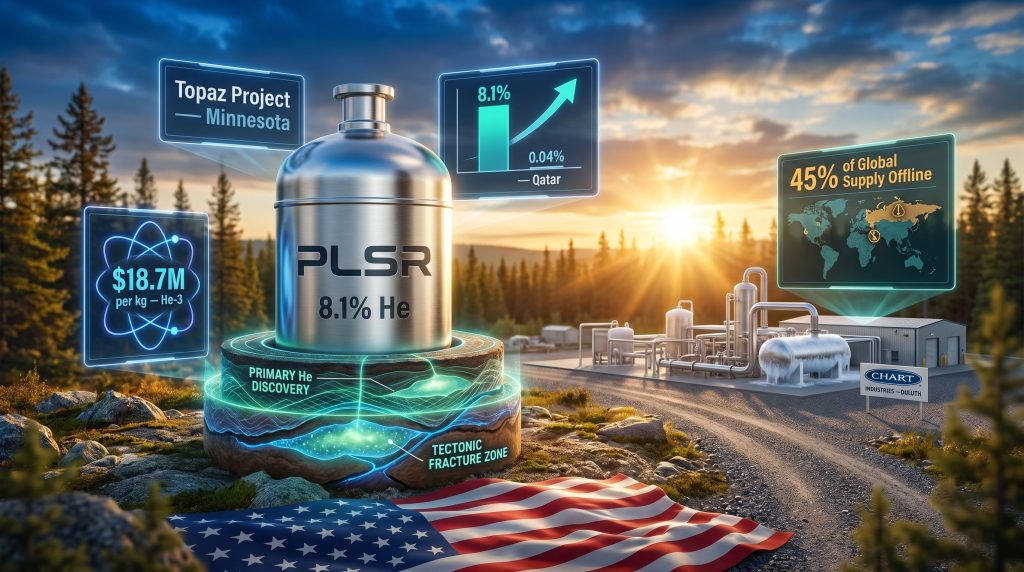
Qatar's export route severed: Qatar has historically supplied approximately 35% of global helium. The closure of the Strait of Hormuz to container shipping cut off the country's primary helium export corridor. QatarEnergy's leadership has indicated the production facility could require between three and five years to return to full operation, according to reporting by S&P Global Commodity Insights.
-
Russia's export controls: Russia contributes approximately 10% of global helium output. The introduction of export restrictions has further reduced the volume available to Western industrial consumers.
Together, these two developments mean roughly 45% of the world's helium supply is currently offline, with no short-cycle mechanism to replace it.
The practical consequence is already materialising at the end-user level. US industrial customers are reportedly receiving allocations of approximately 50% of their typical helium orders, with premiums being charged on top of those constrained volumes. Semiconductor fabrication facilities in Taiwan, South Korea, and Japan appear to be absorbing a disproportionate share of available supply, amplifying the shortfall experienced by domestic US consumers.
The Demand Side Is Moving in the Opposite Direction
While supply contracts, demand is structurally expanding. Global helium consumption is projected to approximately double by 2035, driven primarily by growth in advanced semiconductor manufacturing capacity and the build-out of high-performance computing and quantum computing infrastructure. This mirrors the broader critical minerals demand surge reshaping global supply chains. This is not speculative demand growth tied to economic cycles — these are capital-intensive sectors with multi-decade facility lifespans and no technical pathway to substitute helium out of their processes.
| Application | Why Helium Is Non-Substitutable |
|---|---|
| Semiconductor fabrication | Required for purging and cooling during wafer production |
| MRI imaging | Liquid helium is the only practical coolant for superconducting magnets |
| Space launch systems | Used to pressurise fuel tanks and purge systems during launch |
| Quantum computing | Provides the sub-Kelvin cooling environments required for qubit stability |
What Is the Topaz Project and Why Does Its Grade Matter So Much
The Topaz helium project, located in Lake County near the town of Babbitt in northern Minnesota, is 100% owned by Pulsar Helium (TSXV: PLSR). The project was not the result of targeted helium exploration. It originated from an accidental gas encounter during nickel and copper exploration drilling, when a drill hole intercepted a gas stream registering helium concentrations between 10% and 12%, among the highest ever recorded in North America. Pulsar Helium was founded on the basis of that discovery and completed its IPO in the third quarter of 2023.
Grade in Context: Why 8.1% Changes the Commercial Equation
Since that initial discovery, the company has drilled seven wells across the Topaz project area. Every single well has encountered gas, representing a 100% geological success rate across a programme that has stepped out in multiple directions over several miles. The programme average across all seven wells stands at 8.1% helium concentration.
To understand what that figure means commercially, comparison is essential:
| Reference Point | Helium Concentration | Notes |
|---|---|---|
| Topaz project average | 8.1% | Across seven drilled wells |
| Standard economic threshold | ~0.3% | Widely cited industry minimum |
| Qatar's world-leading operations | ~0.04% | Processing enormous gas volumes |
| Topaz vs. Qatar | ~200x higher | Standalone extraction viable |
| Topaz vs. economic threshold | ~27x higher | Significant commercial headroom |
The Jetstream #1 well recorded 8.1% helium on flow testing, while Jetstream #2 returned 5.6%. Even at the lower end of the programme's results, the concentration sits orders of magnitude above the economic threshold for standalone helium extraction. This is the fundamental commercial distinction between primary and byproduct helium production.
The Primary vs. Byproduct Structural Advantage
At Topaz, helium is the economic purpose of the operation. There is no requirement for natural gas volumes to justify extraction costs, no dependency on gas pricing cycles, and no structural ceiling imposed by gas production decisions made for unrelated reasons. A primary helium producer can respond directly to helium market conditions in ways that the vast majority of global supply simply cannot.
Fewer than a handful of projects worldwide can claim primary helium status at commercially meaningful concentration levels. This scarcity of comparable assets, combined with the current supply dislocation, underpins the strategic positioning of the Pulsar Helium Topaz project in Minnesota.
The Helium-3 Discovery: Rare Isotope, Long-Term Optionality
A development that distinguishes Topaz from virtually any other helium project globally is the confirmed presence of Helium-3 (³He) within the project's gas stream. Laboratory analysis, including independent verification conducted by two US federal government laboratories, has confirmed the isotope's presence.
What Makes Helium-3 So Unusual
Helium-3 is extraordinarily rare on Earth. Its primary terrestrial source has historically been tritium decay within nuclear weapons programmes. Its applications are technically specific and high-value:
- Quantum computing: Helium-3 can achieve temperatures below what conventional Helium-4 can reach, enabling greater processing stability in dilution refrigerators used for qubit operation.
- Fusion energy research: It functions as a theorised fuel source for advanced fusion reactions, producing fewer high-energy neutrons than deuterium-tritium reactions.
- Neutron detection: Critical for homeland security and nuclear non-proliferation monitoring applications.
The current inter-agency transfer price for Helium-3 sits at approximately $18.7 million per kilogram. It is critical to understand that this figure does not represent a true traded market price; no functioning commercial market for Helium-3 currently exists. The price reflects government-to-government transfer values in the absence of any open market mechanism.
Six separation processes for isolating Helium-3 from Helium-4 are known at laboratory scale. None have been demonstrated commercially to date. The US Department of Energy has begun funding research into Helium-3 extraction technologies, including programmes exploring lunar extraction, which underscores the strategic interest in identifying terrestrial alternatives.
Pulsar's leadership has been measured in framing Helium-3's role in the project's development timeline. The company's stated position is that Helium-4 production represents the primary operational and commercial priority, with Helium-3 representing unquantified long-term optionality rather than near-term revenue. It is not incorporated into any current economic assessment for the project, and prospective investors should evaluate it accordingly.
Minnesota's Regulatory Journey: From Blank Slate to Defined Pathway
One of the less-examined risks in developing resource projects is regulatory uncertainty. For a jurisdiction with no prior history of gas production, that uncertainty is not abstract. When Pulsar began advancing Topaz, Minnesota had no legislative framework governing helium as a produced commodity and no operational regulations for its extraction.
That situation has now been resolved through a deliberate two-stage process:
- 2024: Minnesota legislated that helium is a commodity subject to state regulatory oversight, establishing the legal foundation necessary for operational rules to be built upon.
- June 2026: Minnesota finalised the associated operational regulations, creating a complete and functional regulatory pathway to helium production for the first time.
The framework was developed substantially on the basis of technical data and work conducted by Pulsar at the Topaz site. This is a notable dynamic: a junior explorer's field programme effectively provided the technical foundation for an entirely new state-level regulatory regime.
The finalisation of these regulations represents a concrete de-risking event. Non-geological risks, including regulatory uncertainty, can be as consequential to a project's development timeline as subsurface uncertainty. Their removal from Topaz's risk profile meaningfully advances the project's readiness for production planning and financing discussions.
Engineering Infrastructure: Chart Industries and the Production-Ready Well Programme
Pulsar has engaged Chart Industries, a multi-billion-dollar engineering company specialising in industrial gas facility design and cryogenic applications, to analyse Topaz's gas composition and downhole data and begin designing a project-specific helium processing facility.
The geographical alignment here carries practical significance. Chart Industries operates a major fabrication facility in Minnesota, in close proximity to the Topaz project site. This reduces construction logistics complexity and cost compared to projects dependent on fabricators located in distant jurisdictions or offshore.
Existing Infrastructure Reduces Capital Requirements
Topaz benefits from a set of site-level infrastructure advantages that reduce the capital intensity of the transition from exploration to production:
- Road access connecting the site to regional transport networks is already in place.
- Grid power is available at the site, eliminating the capital requirement for standalone generation.
- Skilled labour and local services exist within the regional economy.
- The regulatory framework, as noted above, is now complete.
These factors collectively reduce the capital intensity and timeline risk of the production development phase relative to a greenfield remote project starting from a bare site.
What Production-Ready Wells Actually Mean
Starting in September 2026, Pulsar plans to drill between two and four production-ready wells. This terminology matters. The five exploration and appraisal wells completed to date were designed to establish geological presence and resource continuity. Production-ready wells are engineered to be directly integrated into a processing facility and will generate the flow rate, pressure, composition, and sustainability data required to underpin economic assessments and financing conversations.
This transition from exploration-phase to production-phase drilling is a meaningful inflection point in the company's development arc. In addition, it mirrors the kind of inflection commonly observed in defence critical minerals supply chains, where the move from appraisal to defined production readiness signals a step-change in strategic credibility.
The next major ASX story will hit our subscribers first
The Road to 2027: Key Milestones and What They Mean
| Milestone | Target Timing | Commercial Significance |
|---|---|---|
| Production-ready well drilling commences | September 2026 | Generates facility-integration data |
| Independent resource update completion | 2026 | Supports formal resource classification |
| Chart Industries facility design progress | Ongoing 2026 | Informs capital cost estimates |
| Economic assessment completion | 2026-2027 | Enables production guidance and financing |
| Concrete production guidance issued | Target 2027 | Transition to production planning narrative |
The company's stated intention is that by 2027, the project narrative will have shifted away from exploration and derisking toward defined production timelines and guidance. Independent analyses have noted that depending on study completion schedules, fabrication lead times, and commissioning requirements, first production could extend into late 2027 or early 2028. A completed definitive feasibility study will be central to unlocking that next stage of financing and project credibility.
Investor Considerations: Strengths, Risks, and the Balanced Picture
What Makes the Investment Case Structurally Differentiated
- Primary resource economics: At 8.1% average grade, Topaz is economically viable as a standalone helium operation, independent of gas market dynamics.
- Supply deficit duration: With a three-to-five-year recovery horizon for Qatar's infrastructure, the current supply dislocation is not a transient event. Investors should assess Pulsar against a sustained period of elevated helium prices and constrained global supply.
- US jurisdiction: Domestic production eliminates transit losses inherent in liquid helium shipping, removes exposure to container integrity risks, and avoids the long-term take-or-pay contract structures that reduce flexibility for international supply arrangements.
- Geological confidence: A 100% well success rate across a geographically diverse, multi-directional drill programme provides meaningful statistical confidence in resource continuity.
- Helium-3 optionality: The confirmed isotope presence represents potential additional value not captured in any current economic assessment.
Risk Factors Investors Should Weigh
- Execution timeline: Fabrication lead times, study completion schedules, and financing arrangements could extend first production into late 2027 or early 2028. Junior developers regularly encounter timeline slippage.
- Helium-3 commercial uncertainty: Separation processes exist only at laboratory scale. The commercial pathway remains unproven.
- Supply restoration horizon: Qatar's infrastructure will eventually be repaired. While the three-to-five-year timeline is significant, investors should model what the helium market looks like once conventional supply nodes are restored.
- Junior developer risk profile: As a pre-production TSXV-listed company, Pulsar carries the capital access and liquidity risks characteristic of the junior resource sector. However, understanding the full spectrum of junior mining risks and rewards is essential before committing capital to any project at this stage.
The Topaz project occupies a rare position: a high-grade primary helium resource in a stable US jurisdiction, advancing through the final stages of derisking at the precise moment the global helium supply chain is under its most severe stress in modern history. The convergence of project-level progress and macro-level urgency is not manufactured. It reflects the timing of geological discovery, regulatory process, and geopolitical disruption intersecting simultaneously.
The helium market's current dislocation is structural rather than cyclical, driven by forces that operate on multi-year timescales. For the semiconductor facilities, MRI manufacturers, space launch providers, and quantum computing researchers who depend on reliable helium access, the development of domestic primary supply is becoming less a strategic preference and more an operational imperative. The Pulsar Helium Topaz project in Minnesota is, at present, the most advanced primary helium development in the United States working toward that objective.
This article is intended for informational purposes only and does not constitute financial advice. Investing in junior resource companies involves significant risk, including the potential loss of capital. Readers should conduct their own due diligence and consult a qualified financial adviser before making investment decisions. Forward-looking statements regarding timelines, production targets, and market conditions are subject to material risks and uncertainties.
Want to Stay Ahead of the Next Major Resource Discovery on the ASX?
Discovery Alert's proprietary Discovery IQ model delivers real-time alerts on significant ASX mineral discoveries across more than 30 commodities — including critical and emerging resources like helium — instantly translating complex data into actionable investment insights for both short-term traders and long-term investors. Begin your 14-day free trial today and explore Discovery Alert's dedicated discoveries page to understand how historic mineral discoveries have generated substantial market returns.