
May 23, 2026
When Strong Revenue Means Nothing: The Hidden Risk in Industrial Metals Earnings
There is a widely held assumption in commodity investing that rising metal prices translate directly into rising profits. The logic seems intuitive: higher aluminum prices should mean better margins, stronger cash flow, and earnings beats. However, this assumption collapses the moment a single high-capacity facility goes offline unexpectedly. The Q4 FY2026 results from one of Asia's largest integrated metals producers offer a masterclass in why operational risk, not commodity exposure, is increasingly the decisive variable — and precisely why Hindalco misses profit estimates as Novelis disruptions weigh on consolidated earnings.
When big ASX news breaks, our subscribers know first
Why Hindalco Missed Profit Estimates: The Structural Breakdown
The Gap Between Revenue Growth and Profit Delivery
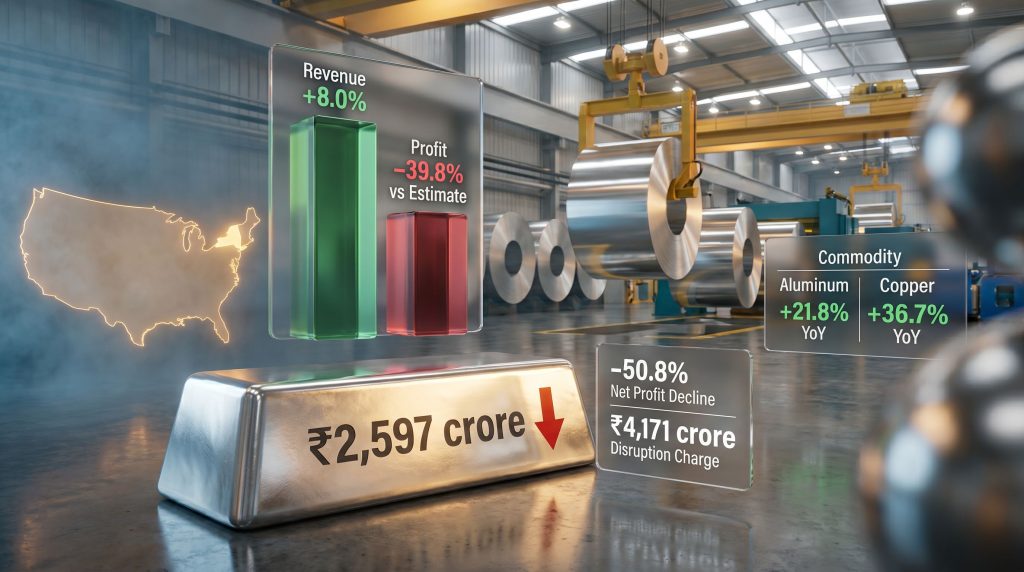
A company reporting 20.4% revenue growth while simultaneously posting a 50.8% decline in net profit is not a contradiction you see often. Yet that is precisely what Hindalco Industries delivered in the quarter ended March 31, 2026. Revenue from operations reached ₹78,133 crore, comfortably exceeding analyst consensus of ₹72,396 crore. On the profit line, however, the result was dramatically different: consolidated net profit came in at ₹2,597 crore (approximately $271 million USD), against analyst expectations of ₹4,312 crore, representing a miss of nearly 40%.
This divergence between top-line strength and bottom-line weakness is not merely a statistical quirk. It reveals a structural fragility that diversified industrial conglomerates with high-revenue subsidiaries must confront: when a dominant subsidiary absorbs a large one-time charge, no amount of commodity tailwind at the group level is sufficient to restore headline profitability. For a broader perspective on how commodity prices and earnings interact across mining companies, this dynamic is increasingly common.
Key Financial Metrics at a Glance
| Metric | Reported Figure | Analyst Estimate | Variance |
|---|---|---|---|
| Consolidated Net Profit | ₹2,597 crore (~$271M) | ₹4,312 crore | -39.8% miss |
| Revenue from Operations | ₹78,133 crore | ₹72,396 crore | +8.0% beat |
| Novelis Revenue Growth | +10.3% YoY | — | — |
| Novelis Disruption Charge | ₹4,171 crore | — | — |
| Net Profit Decline (YoY) | -50.8% | — | — |
The Q4 FY2026 result marks the second consecutive quarter of year-on-year profit decline for Hindalco, a pattern that warrants closer scrutiny from investors who may have previously attributed earnings softness to transient factors.
What Happened at Novelis? Understanding the Oswego Plant Disruptions
Fire Incidents, Production Halts, and the Timeline of Damage
The root cause of Hindalco's earnings collapse lies approximately 14,000 kilometres from its Mumbai headquarters, at the Novelis rolling mill in Oswego, New York. The facility suffered fire-related incidents in September and November 2025, triggering production interruptions that cascaded through the fourth quarter of the fiscal year. While the fires themselves were discrete events, their financial consequences accumulated across multiple reporting periods, ultimately crystallising into a ₹4,171 crore charge recognised in Q4 FY2026.
This charge is not simply a repair bill. It encompasses a combination of:
- Lost production volumes and the associated revenue foregone
- Insurance-related provisioning and claim processing costs
- Remediation and plant rehabilitation expenditure
- Disruption to customer supply chains, particularly in the beverage can segment
Management indicated that the Oswego facility is expected to resume operations within weeks of the earnings announcement, though investors will be watching closely to see whether that timeline holds.
Why Novelis Carries Disproportionate Weight in Hindalco's Earnings Architecture
To understand why a single plant in upstate New York could derail the consolidated results of an Indian metals giant, it is necessary to appreciate just how central Novelis is to Hindalco's financial structure. The US-based subsidiary contributes approximately 60% of Hindalco's total consolidated revenue, a concentration level that creates an inherent asymmetry: any material operational disruption at Novelis has an outsized impact on the parent company's reported earnings, regardless of how well the India business performs.
Novelis is not simply a subsidiary. It is the primary earnings engine of the Hindalco group, which means that plant uptime at major Novelis facilities functions effectively as a macro-level risk factor for the entire consolidated entity.
The ₹4,171 Crore Charge: What It Includes and Why It Matters
For context, the ₹4,171 crore charge recognised in Q4 FY2026 is roughly 1.6 times the total net profit Hindalco reported for the same quarter. This ratio alone illustrates the severity of the disruption. In practical terms, absent this charge, Hindalco's net profit would have been materially closer to analyst expectations, potentially even ahead of consensus given the strength of underlying commodity prices and India operations. Instead, the charge transformed what would have been a strong result into the company's worst quarterly profit performance in recent memory.
How Commodity Price Tailwinds Interact With Operational Risk
Aluminum and Copper Price Movements in Q4 FY2026
The commodity price environment during the quarter was genuinely favourable. Benchmark three-month aluminum prices rose 21.8% year-on-year, while copper surged 36.7% over the same period. By any historical measure, these are significant commodity tailwinds that would normally translate into meaningful earnings expansion for an integrated producer of Hindalco's scale.
| Metal | YoY Price Change (Q4 FY2026) |
|---|---|
| Benchmark 3-Month Aluminum | +21.8% |
| Benchmark 3-Month Copper | +36.7% |
When Rising Prices Are Not Enough: The Limits of Commodity Exposure
The conventional wisdom in metals investing holds that commodity price appreciation is the primary lever for earnings expansion among mining and processing companies. Hindalco's Q4 result challenges this assumption directly. Despite both of its core metals trading significantly higher on a year-on-year basis, consolidated profitability collapsed. The implication for investors is significant: commodity price exposure is a necessary but not sufficient condition for earnings delivery in businesses with complex operational footprints.
This dynamic is particularly acute for Novelis, which operates as an aluminium rolling and recycling business rather than a primary smelter. Novelis' margins are sensitive not just to aluminium prices but to the spread between primary aluminium costs and aluminium scrap prices, a metric known as the metal benefit or scrap spread. When scrap spreads compress, Novelis' profitability faces pressure independent of what benchmark aluminium prices are doing. This is a subtlety that many equity analysts focused purely on headline metal prices tend to underweight. Furthermore, shifts in the broader aluminum and alumina markets can compound these pressures unpredictably.
Margin Compression Despite Revenue Expansion: A Paradox Explained
The apparent paradox of expanding revenue and collapsing margins resolves when you disaggregate the P&L. Novelis reported a 10.3% rise in revenue driven by higher average aluminium prices, yet the business simultaneously absorbed a charge that dwarfed its incremental revenue gains. This is the accounting manifestation of what insurers and industrial risk managers call a severity event: an incident where the magnitude of the financial impact in a single period exceeds the cumulative benefit of favourable operating conditions over multiple periods.
What Is Novelis and Why Is It Central to Hindalco's Global Strategy?
Novelis' Role in the Beverage Can and Automotive Supply Chain
Novelis is one of the world's largest aluminium rolling companies, supplying flat-rolled aluminium products to two of the most volume-intensive end markets in the global economy: beverage can manufacturing and automotive body sheet production. The company operates recycling and rolling facilities across North America, South America, Europe, and Asia, with the Oswego plant serving as a critical node in its North American supply network.
The strategic importance of the recycled aluminium business model should not be underestimated. Producing aluminium from recycled scrap requires approximately 95% less energy than primary smelting, giving recycling-focused operators like Novelis a structural cost advantage and an increasingly compelling sustainability narrative for customers under pressure to reduce Scope 3 emissions.
Geographic Revenue Diversification and the US Growth Engine
For Hindalco, the acquisition and continued development of Novelis represents a deliberate strategy of geographic and end-market diversification. The US operations provide exposure to dollar-denominated revenue streams, insulating a portion of the group's earnings from Indian rupee volatility. They also provide access to premium end markets where value-added aluminium products command significantly higher margins than commodity-grade primary aluminium.
This strategic logic remains intact even after the Oswego disruptions. The question for investors is not whether the Novelis strategy is sound, but rather how quickly the subsidiary can restore production to pre-incident levels and whether the insurance recovery process will offset a meaningful portion of the recognised charge.
How Did Hindalco's India Business Perform During the Same Period?
Record Output Across Aluminum Upstream, Downstream, and Copper Segments
Against the backdrop of the Novelis disruption, Hindalco's India operations delivered what management described as a record performance across all three domestic business segments: aluminium upstream, aluminium downstream, and copper. This is a genuine operational achievement, particularly given that Q4 in India is seasonally the strongest quarter for metals demand. The broader India metals market outlook suggests continued structural demand growth underpinning domestic operations.
The India business benefited from the same commodity price tailwinds that were insufficient to offset the Novelis charge at the consolidated level. Higher copper prices were particularly meaningful for the domestic copper segment, given the 36.7% year-on-year increase in benchmark copper prices during the quarter.
What Record Performance Means in the Context of the Consolidated Miss
The India performance data illustrates a concept that investors in large conglomerates with dominant subsidiaries must internalise: subsidiary concentration risk can entirely mask strong underlying performance in other parts of the business. If Hindalco operated purely as an India-focused metals company, its Q4 FY2026 result would likely have been celebrated as a strong beat. Instead, the scale of the Novelis charge rendered that domestic strength largely invisible at the headline level.
When a subsidiary contributes 60% of consolidated revenue, its operational challenges effectively become the group's operational challenges. The parent's diversification narrative provides limited earnings protection in a severity event.
The next major ASX story will hit our subscribers first
Is This a One-Off Event or a Systemic Risk Signal?
Assessing the Probability of Recurrence
The fire incidents at Oswego were discrete physical events rather than symptoms of a systemic operational failure, and on that basis there is reasonable grounds for treating the Q4 FY2026 charge as largely non-recurring. Industrial facilities of Novelis' scale typically operate comprehensive insurance programmes covering property damage and business interruption, which means a portion of the recognised charge may be partially offset through insurance recoveries in subsequent periods.
However, the episode does raise legitimate questions about:
- The adequacy of fire suppression and safety infrastructure at ageing aluminium rolling facilities
- The concentration of production capacity in single facilities within regional supply networks
- The speed at which business interruption insurance can be processed and converted into cash recoveries
- Whether the restart timeline communicated by management will hold, or whether further delays are possible
The Second Consecutive Quarter of Profit Decline: Pattern or Coincidence?
The Q4 FY2026 result represents Hindalco's second consecutive quarter of year-on-year profit decline. While the immediate cause in Q4 was clearly the Novelis charge, investors should examine whether broader structural pressures — including scrap spread compression, rising input costs at Novelis, or softening volumes in the automotive segment — are creating a more persistent earnings headwind. Consequently, market volatility risks related to tariffs and macroeconomic uncertainty could further complicate the recovery trajectory.
Analyst revisions following the result have focused heavily on EBITDA trajectory at Novelis, with firms including JPMorgan reassessing their forward estimates to account for both the delayed restart and the potential for scrap spread normalisation to take longer than previously modelled.
What Does This Mean for Investors Watching Hindalco?
Three Scenarios for the Next Two Quarters
| Scenario | Key Assumption | Earnings Implication |
|---|---|---|
| Bull Case | Oswego restarts on schedule; scrap spreads normalise | Profit recovery; consensus upgrades likely |
| Base Case | Partial restart; aluminium prices hold current levels | Modest recovery; earnings remain below prior year |
| Bear Case | Extended restart delays; commodity softening | Further EBITDA compression; downgrade risk elevated |
Scrap Spreads: The Underappreciated Variable
Arguably the most technically nuanced risk facing Novelis, and by extension Hindalco, is the trajectory of aluminium scrap spreads. Novelis' recycling-based model is highly sensitive to the differential between the price of primary aluminium and the cost of purchasing recycled scrap. When this spread widens, Novelis' input cost advantage expands and margins improve. When it compresses, the economics of the recycling model deteriorate even if benchmark aluminium prices remain elevated.
Scrap availability and pricing are influenced by a range of factors that are difficult to forecast with precision, including used beverage can collection rates, automotive scrap flows, and regional logistics costs. This makes scrap spread normalisation a more uncertain variable than it might initially appear to investors focused solely on LME aluminium prices.
How to Monitor Hindalco's Recovery
Investors tracking Hindalco's earnings recovery should prioritise the following indicators:
- Confirmation and timing of the Oswego plant restart
- Novelis quarterly EBITDA per tonne, which captures both pricing and cost dynamics more accurately than revenue
- Insurance recovery disclosures in subsequent quarterly filings
- Aluminium scrap spread data from North American recycling markets
- India segment volumes as a leading indicator of domestic demand conditions
Operational Resilience as a Valuation Driver in Industrial Metals
Why Plant Uptime Is Becoming a Primary Metric
The Hindalco episode is part of a broader trend in industrial metals investing where operational resilience, rather than commodity price beta, is increasingly driving valuation differentials between comparable companies. As aluminium and copper markets have become more structurally tight, the penalty for unplanned production losses has grown proportionally larger. Investors are beginning to price plant reliability more explicitly into their EBITDA multiples.
This shift has practical implications for how analysts model industrial metals companies. Historically, earnings models for aluminium producers focused primarily on:
- LME price assumptions
- Cost curve positioning
- Volume capacity utilisation
Increasingly, a fourth variable is being added: unplanned downtime probability, expressed either as a scenario discount or a volatility premium applied to the EBITDA multiple. In addition, recognising management red flags around operational risk disclosure has become an equally important part of the due diligence process.
Supply-Chain Resilience as a Competitive Moat
For Novelis' customers in the beverage can and automotive segments, supply security is not a peripheral concern. Major beverage companies operate on multi-year supply agreements with tight volume commitments, and any disruption to aluminium can sheet supply can trigger costly reformulation of procurement strategies. This creates a reputational and commercial dimension to operational reliability that extends beyond the immediate financial charge and into long-term customer relationship management.
Frequently Asked Questions
Why did Hindalco miss profit estimates despite strong revenue growth?
A ₹4,171 crore charge related to fire-related disruptions at the Novelis Oswego plant in New York absorbed the benefit of strong commodity prices and record India operations, resulting in a consolidated net profit that was nearly 40% below analyst consensus despite a significant revenue beat.
What caused the Novelis plant disruption in Oswego, New York?
The Oswego facility experienced fire-related incidents in September and November 2025, which caused production interruptions that extended into the Q4 FY2026 reporting period.
How much did the Novelis disruption cost Hindalco in Q4 FY2026?
The company recognised a charge of ₹4,171 crore in the fourth quarter directly attributable to the Oswego incidents, a figure that exceeded the total consolidated net profit reported for the same period.
When is the Novelis Oswego plant expected to restart?
Management communicated at the time of the Q4 FY2026 results that they expected the plant to resume operations within a few weeks, though investors should monitor official company updates for confirmation of the timeline.
Does Hindalco's India business continue to perform well?
Yes. The India operations delivered record performance across aluminium upstream, aluminium downstream, and copper segments in Q4 FY2026, supported by strong commodity prices and seasonally elevated domestic demand.
How are analysts revising forecasts following the Q4 results?
Analysts including those at JPMorgan have revised their EBITDA estimates for Novelis downward, reflecting both the restart uncertainty and the potential for scrap spread normalisation to weigh on margins beyond the immediate disruption period.
What percentage of Hindalco's revenue does Novelis contribute?
Novelis contributes approximately 60% of Hindalco's total consolidated revenue, making it the dominant earnings driver within the group structure.
Key Takeaways: What the Hindalco Earnings Miss Tells Us About Modern Industrial Risk
-
Operational disruption at a single high-volume facility can outweigh the benefit of double-digit commodity price gains, as demonstrated by the Q4 FY2026 result
-
Revenue growth is not a reliable proxy for profitability when large one-time charges are present in the income statement
-
Subsidiary concentration risk is a structural vulnerability for diversified conglomerates where a single entity contributes the majority of consolidated revenue
-
Scrap spreads, not just LME prices, are the critical margin variable for Novelis, and investors tracking recovery should monitor this metric closely
-
The fact that Hindalco misses profit estimates as Novelis disruptions weigh on results underscores that the path to earnings recovery depends on Oswego restart speed, scrap spread normalisation, insurance recovery timing, and continued strength in India operations
-
EBITDA per tonne at Novelis is a more reliable indicator of underlying business health than headline consolidated net profit, which can be significantly distorted by one-time charges
This article is intended for informational purposes only and does not constitute financial advice. Forward-looking statements and scenario analysis involve uncertainty, and actual outcomes may differ materially from those described. Readers should conduct their own due diligence and consult a qualified financial adviser before making investment decisions.
Want to Stay Ahead of the Next Major Mineral Discovery on the ASX?
While Hindalco's earnings miss illustrates how swiftly operational disruptions can overwhelm even strong commodity tailwinds, Discovery Alert's proprietary Discovery IQ model cuts through the complexity by delivering real-time alerts on significant ASX mineral discoveries — translating over 30 commodities into one clear, actionable metric — so both short-term traders and long-term investors can act on high-potential opportunities the moment they emerge. Explore how historic discoveries have generated substantial market returns on Discovery Alert's dedicated discoveries page, and begin your 14-day free trial today to secure a genuine market-leading edge.