
June 12, 2026
Why Zinc Sits at the Heart of the World's Sustainability Push
The materials underpinning industrial civilisation are not fixed. Each new energy transition reshuffles the deck, elevating certain metals from industrial commodities to strategic necessities. Zinc is one such metal undergoing exactly this revaluation, quietly moving from a corrosion-proofing staple to a linchpin of the low-carbon economy. Galvanised steel, which relies on zinc coating to protect structural components from corrosion, extends infrastructure lifespans by 50 to 100 years compared to untreated alternatives, generating lifecycle carbon savings that compound across entire cities.
Meanwhile, the emerging commercialisation of zinc-ion battery technology positions the metal as a potential challenger to lithium-ion in stationary energy storage, with the International Energy Agency projecting possible growth in zinc-ion's share of global storage capacity from under 0.5% today toward 3–5% by 2030 as the technology matures. Understanding global zinc production trends helps contextualise why producers are racing to align with this shift.
Within this shifting landscape, the Hindustan Zinc digital sustainability journey represents more than one company's operational evolution. It offers a case study in how a major global producer can structurally align digital transformation with measurable environmental progress, at a scale and speed that is beginning to draw attention across the global mining industry.
When big ASX news breaks, our subscribers know first
India's Mining Sector as the Backdrop
India's mining sector is larger and more diverse than most observers appreciate. The country extracts nearly 95 different minerals spanning fossil fuels, metals, non-metallic materials, and atomic minerals, making it one of the most geologically varied mining jurisdictions on earth. Yet for all this diversity, a handful of commodities define the country's strategic mineral posture, and zinc sits prominently among them.
Hindustan Zinc, a subsidiary of the Vedanta Group, commands approximately 85% of India's total zinc production capacity, operating across seven mines and processing facilities concentrated primarily in Rajasthan. With an annual zinc production capacity of approximately 1.3 million tonnes, the company's operational decisions ripple outward through the entire Indian industrial supply chain. Its adoption of digital infrastructure, sustainability governance, and low-carbon product innovation consequently carries disproportionate weight in shaping what responsible mining can look like at scale in the world's most populous nation.
The National Mineral Policy of 2019 established clear expectations for the sector, mandating progressive adoption of digital technologies across Indian mining operations by 2025. Against this regulatory backdrop, Hindustan Zinc's investments in underground connectivity, predictive systems, and renewable energy are consistent with both commercial strategy and compliance trajectory, though the specific regulatory pathway is a sector-wide framework rather than project-specific support directed at any single operator.
What a Credible Sustainability Framework Actually Demands
Sustainability reporting in mining has historically suffered from a credibility gap. Self-assessed ESG disclosures, unverified community impact claims, and selectively chosen metrics have made it difficult for investors and customers to distinguish genuine operational transformation from well-marketed incrementalism.
Hindustan Zinc's approach attempts to address this credibility deficit through a multi-pillar sustainability assurance programme that is assessed annually across every major operational site. The framework draws on internationally recognised standards, including the International Finance Corporation's Performance Standards and the International Council on Mining and Metals Principles, both of which impose substantive requirements on environmental management, worker safety, community engagement, and governance. You can explore Hindustan Zinc's annual sustainability reporting to review how these standards are applied in practice.
What distinguishes these standards from voluntary reporting frameworks is their external verification requirement. IFC Performance Standards, which were originally developed to guide multilateral lending decisions, mandate independent third-party assessment of compliance, creating an audit trail that is substantially harder to manipulate than internal self-reporting. ICMM membership similarly obligates companies to submit to independent assurance of sustainability performance data published in annual reports.
The combination of these two frameworks creates layered accountability that transforms sustainability governance from a communications function into an operational management system. When a mining operation undergoes annual site-level assurance against these standards, the process requires site managers, environmental teams, and safety officers to maintain documented evidence of compliance year-round, not simply compile retrospective reports. This embeds sustainability management into daily operational rhythms in ways that purely voluntary frameworks rarely achieve.
How Digitalisation Is Reshaping Underground Mining Operations
Underground mining presents a unique set of operational challenges that digital technology is particularly well-suited to address. Restricted visibility, communication latency, equipment operating in confined high-heat environments, and the inherent physical danger of sending workers deep underground all create problems that surface-level digital solutions cannot fully resolve. The Hindustan Zinc digital sustainability journey addresses these challenges through several converging technologies deployed across its underground operations.
Connected Infrastructure and Real-Time Visibility
Wi-Fi connectivity extended into underground mine workings creates continuous data channels between surface operations centres and equipment operating hundreds of metres below ground. This is not merely a convenience upgrade. Real-time telemetry from underground equipment allows surface-based operators to monitor machine health, environmental conditions, and production progress without requiring physical presence in hazardous zones.
The operational visibility this creates fundamentally changes the management calculus of underground mining, enabling faster responses to emerging problems and more granular production planning. Furthermore, data-driven mining operations at this level of connectivity represent a structural shift rather than an incremental improvement.
Telemetry-Controlled Equipment and Worker Safety
Telemetry-controlled machinery takes the connectivity infrastructure further by enabling surface operators to directly control heavy equipment operating in underground environments. This capability carries direct safety implications. Blast zones, areas with elevated seismic risk, and sections of workings with degraded air quality can all be operated without placing workers in proximity to the hazard.
The strategic value of remote equipment control extends beyond immediate safety benefits, allowing continuous operation in conditions that would otherwise require work stoppages, and reducing the exposure of maintenance crews to equipment operating under high stress conditions.
Predictive Maintenance and Operations Analytics
Predictive maintenance systems use sensor data streams from underground equipment to identify anomalies in vibration signatures, temperature profiles, and power consumption patterns that precede mechanical failure. By intervening before breakdown occurs rather than responding after the fact, operations can eliminate unplanned downtime that cascades through production schedules.
In underground mining, unplanned equipment failure carries compounded costs because equipment retrieval, repair, and redeployment in confined underground spaces is significantly more complex and time-consuming than equivalent surface operations. In addition, AI mining efficiency tools are increasingly integrated alongside predictive analytics to further sharpen operational decision-making.
| Digital Technology | Application in Underground Mining | Primary Benefit |
|---|---|---|
| Live-streamed Wi-Fi data | Real-time equipment and environmental monitoring | Operational visibility and safety |
| Telemetry-controlled machinery | Surface-operated equipment in hazardous zones | Worker safety at depth |
| Predictive maintenance systems | Fault detection before equipment failure | Reduced unplanned downtime |
| Predictive operations analytics | Production forecasting and process optimisation | Efficiency and throughput gains |
Digital Procurement and Commercial Transparency
The application of digital transformation at Hindustan Zinc extends beyond the mine itself into procurement and commercial operations. Near-total digitalisation of the procurement function creates a traceable, time-stamped audit trail covering supplier selection, contract execution, goods receipt, and payment — a capability that increasingly matters to institutional investors and customers requiring verified responsible sourcing compliance.
Approximately half of commercial marketing operations have been migrated to online platforms, digitising the transactional interface with customers and creating data infrastructure for commercial analytics. Taken together, these two developments mean that the operational and commercial ends of the business are both operating within digital frameworks that generate structured, auditable data.
"The shift to digital procurement is not primarily an efficiency story. It is a governance story. When every purchase order, supplier qualification, and contract amendment is transacted through a digital system, the supply chain becomes transparent in ways that paper-based or hybrid processes cannot replicate."
This transparency has direct implications for ESG compliance. Responsible sourcing frameworks increasingly require companies to demonstrate provenance and ethical standards across multi-tier supply chains, not just at the immediate supplier level. Digital procurement systems that capture supplier-level ESG data at the point of transaction create the evidentiary foundation for these demonstrations in ways that are independently verifiable.
Decarbonising the Energy Footprint of a Major Mining Operation
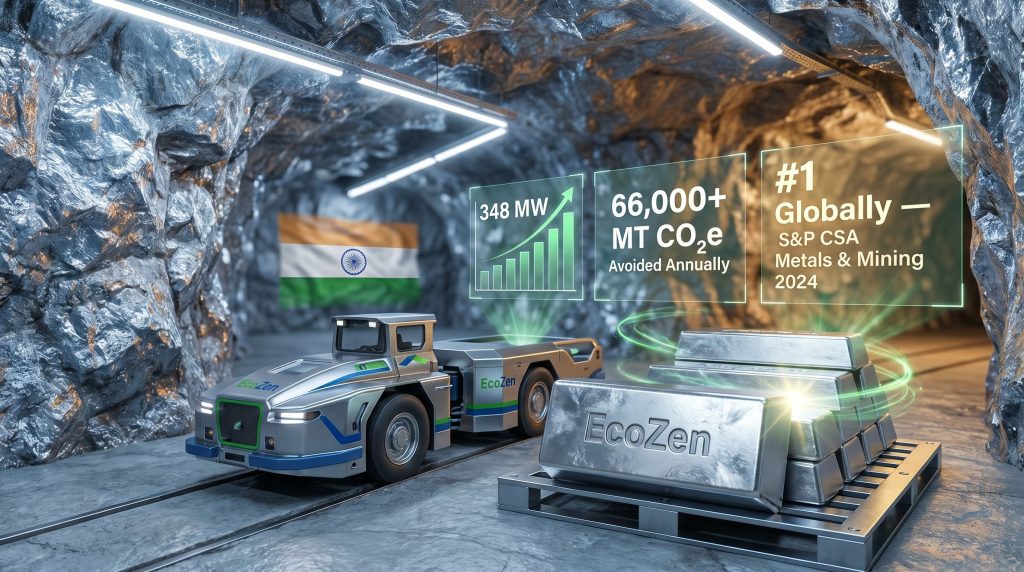
Mining is an energy-intensive sector. The electrowinning process used to refine zinc from roasted ore concentrates consumes approximately 3,000 to 3,500 kilowatt-hours per tonne of zinc produced, making the carbon intensity of electricity supply a central lever in decarbonisation strategy. Hindustan Zinc has invested in building a renewable energy portfolio of 348 MW of green power capacity, with this baseload delivering annual carbon dioxide equivalent avoidance of more than 66,000 metric tonnes per year.
To contextualise this impact, a conservative estimate suggests 66,000 MT of CO₂e avoidance is roughly equivalent to eliminating the annual emissions from approximately 14,000 passenger vehicles, based on the United States Environmental Protection Agency's standard conversion of 4.6 MT CO₂ per vehicle per year.
| Decarbonisation Metric | Reported Figure | Significance |
|---|---|---|
| Total green power capacity | 348 MW | Substantial renewable baseload for mining operations |
| Annual CO₂e avoided | 66,000+ MT | Equivalent to removing approximately 14,000 vehicles from roads |
Beyond renewable electricity generation, the integration of electric mining fleets into underground operations represents a compounding decarbonisation lever. Diesel-powered underground equipment is a significant source of both carbon emissions and particulate matter in underground environments. Replacing diesel loaders, haulers, and drill rigs with battery-electric equivalents eliminates the direct emissions source while also improving underground air quality, reducing ventilation energy requirements, and improving worker health outcomes.
The ventilation energy savings from underground electrification are often underestimated. Diesel equipment typically requires ventilation airflows three to four times greater than electric equivalents to dilute exhaust gases to safe levels, meaning electrification reduces energy consumption at two points simultaneously: the equipment itself and the ventilation systems supporting it. The broader mining decarbonisation benefits extend well beyond emissions metrics, encompassing long-run operational cost reduction and regulatory risk mitigation.
Science-based target commitments provide the governance scaffolding for these individual initiatives. By aligning emissions reduction targets with the trajectories required by the Paris Agreement goals, Hindustan Zinc creates accountability structures that connect operational decisions to climate outcomes in ways that are externally verifiable and independently assessed.
The next major ASX story will hit our subscribers first
EcoZen: What Asia's First Low-Carbon Zinc Product Means for the Market
Product-level decarbonisation represents the frontier of sustainability strategy in metals markets, and Hindustan Zinc's launch of EcoZen in FY 2024–25 places the company at that frontier. EcoZen is positioned as Asia's first certified low-carbon zinc product, achieving a carbon intensity of less than 1 tonne of CO₂ equivalent per tonne of zinc produced.
To appreciate what this threshold means, consider that conventional zinc production using grid-average electricity in major producing countries typically generates between 3 and 4.5 tonnes of CO₂e per tonne of metal, according to benchmark data from industry lifecycle assessment studies. Achieving sub-1 tonne CO₂e intensity therefore represents a reduction of roughly 70 to 80% against conventional production, a performance level that is not achievable through incremental operational efficiency alone and requires structural transformation of the energy supply and process chemistry.
"The commercial logic of EcoZen extends well beyond environmental stewardship. Automotive manufacturers facing scope 3 emissions reduction obligations under customer and regulatory pressure are actively seeking verified low-carbon inputs for galvanised steel production. A certified low-carbon zinc product gives these buyers a credible mechanism for reducing their supply chain emissions footprint, creating premium pricing potential for the producer."
The construction sector faces similar pressures. Green building certification schemes such as LEED and BREEAM award credits for the use of low-embodied-carbon materials, and verified low-carbon zinc provides a documented pathway for project teams to accumulate these credits in applications ranging from structural steel cladding to roofing systems.
First-mover positioning in low-carbon metals certification carries durable competitive advantages. Once buyers have integrated a certified low-carbon supplier into their procurement systems and sustainability reporting frameworks, the cost of switching to an uncertified alternative increases, even if the uncertified product is marginally cheaper. EcoZen consequently functions as a market positioning asset as much as a product.
How Hindustan Zinc's ESG Performance Benchmarks Globally
Independent benchmarking provides the most defensible evidence of genuine ESG integration, and Hindustan Zinc's performance in the S&P Global Corporate Sustainability Assessment provides a meaningful reference point. The company achieved the number one global ranking in the Metals and Mining sector within the S&P Global CSA, a position it held for two consecutive years as of the most recently confirmed assessment cycle.
| ESG Benchmark | Hindustan Zinc Result | Ranking Context |
|---|---|---|
| S&P Global CSA, Metals and Mining | #1 Globally | Second consecutive year at top position |
The S&P Global CSA is a rigorous, data-intensive assessment covering over 90 questions across economic, environmental, and social dimensions. Companies are evaluated on criteria including climate strategy, energy consumption, emissions reporting, water stewardship, human capital development, supply chain management, and corporate governance quality. Crucially, the assessment methodology uses document verification and company-level data submission rather than self-reported scores, creating a substantially higher evidentiary bar than narrative ESG reporting.
Achieving the top position once could reflect favourable conditions in a particular assessment year. However, retaining the top position across two consecutive assessment cycles indicates that the performance is systemic, embedded in operational processes and governance structures rather than dependent on exceptional circumstances. For institutional investors applying ESG screens, consecutive benchmark leadership represents precisely the kind of persistent, independently verified performance signal that sustainable investment frameworks require.
Building a Digital Sustainability Framework: A Step-by-Step Model
The Hindustan Zinc experience suggests a transferable framework for mining operators seeking to integrate digital transformation with genuine sustainability progress. The sequence matters as much as the individual steps.
- Establish a formal sustainability framework aligned with globally recognised standards such as IFC Performance Standards and ICMM Principles, creating the governance architecture before deploying technology.
- Deploy underground digital infrastructure, including Wi-Fi connectivity networks, telemetry control systems, and real-time data platforms that create the data substrate for subsequent analytical applications.
- Integrate predictive analytics across maintenance and operational planning, using the data infrastructure to shift from reactive to anticipatory operational management.
- Digitise procurement and commercial processes to create traceable, auditable supply chains that support responsible sourcing compliance and ESG verification.
- Transition energy supply toward renewable sources with measurable CO₂e reduction targets linked to science-based climate commitments.
- Develop certified low-carbon product offerings to capture premium market positioning and satisfy the growing demand from industrial buyers facing scope 3 emissions reduction obligations.
- Submit to independent ESG assessments such as the S&P Global CSA to provide externally verified performance benchmarks that differentiate genuine integration from aspirational reporting.
The Broader Implications for Indian and Global Mining
The question of whether the Hindustan Zinc model is replicable across India's broader mining sector requires honest engagement with the structural advantages the company enjoys. Scale creates investment capacity that smaller operators lack; market leadership creates revenue stability that funds long-term infrastructure development; and Vedanta Group membership provides access to expertise, technology, and governance frameworks that standalone operators would need to build from scratch.
Nevertheless, the underlying architecture of the approach is not intrinsically scale-dependent. Digital infrastructure costs have fallen dramatically over the past decade, and cloud-based analytics platforms have democratised access to predictive maintenance capabilities that previously required proprietary investment. The regulatory pressure toward renewable energy and emissions reduction applies across the sector regardless of company size.
What the Hindustan Zinc digital sustainability journey most clearly demonstrates is that digital transformation and sustainability improvement are not competing priorities requiring trade-off decisions. Remote equipment operation reduces both worker safety incidents and operational downtime. Predictive maintenance reduces both unplanned equipment failures and consumable material waste. Renewable energy reduces both carbon emissions and long-run electricity costs as renewable generation economics continue to improve.
Frequently Asked Questions
What is Hindustan Zinc's digital sustainability strategy?
Hindustan Zinc's digital sustainability strategy integrates underground digital infrastructure, predictive analytics, renewable energy investment, and certified low-carbon product development within a governance framework aligned with IFC Performance Standards and ICMM Principles, assessed annually across operational sites.
How does Hindustan Zinc use technology to improve underground mining safety?
Telemetry-controlled equipment enables surface operation of heavy machinery in hazardous underground zones, eliminating worker exposure to blast areas, poor air quality zones, and seismically active sections. Real-time environmental monitoring through underground Wi-Fi networks enables faster response to developing safety conditions.
What is EcoZen and what makes it a low-carbon zinc product?
EcoZen is a certified low-carbon zinc product launched in FY 2024–25, achieving a carbon intensity below 1 tonne of CO₂e per tonne of zinc produced. It is positioned as Asia's first product of its kind, targeting automotive and construction buyers with scope 3 emissions reduction obligations.
How much renewable energy capacity does Hindustan Zinc operate?
Hindustan Zinc operates 348 MW of green power capacity, delivering annual avoidance of more than 66,000 MT of CO₂e through the displacement of grid-average electricity with renewable generation.
What ESG frameworks does Hindustan Zinc align with?
The company's sustainability programme aligns with the International Finance Corporation's Performance Standards and the International Council on Mining and Metals Principles, both of which require independent third-party verification of performance data.
Why did Hindustan Zinc rank number one in the S&P Global Corporate Sustainability Assessment?
The S&P Global CSA evaluates companies across more than 90 data-verified criteria spanning environmental, social, and governance dimensions. Hindustan Zinc's consecutive top rankings reflect systemic integration of sustainability across operations, governance, and product strategy rather than performance in a single assessment category.
What role does zinc play in the global energy transition?
Zinc is essential for galvanised steel used in renewable energy infrastructure including wind turbines and solar mounting systems. Emerging zinc-ion battery technology also positions the metal as a potential contributor to grid-scale stationary energy storage as the technology commercialises.
Key Performance Metrics at a Glance
| Performance Area | Key Metric | Strategic Implication |
|---|---|---|
| Renewable energy capacity | 348 MW | Significant green baseload supporting decarbonisation targets |
| Annual emissions avoided | 66,000+ MT CO₂e | Measurable climate impact from energy transition investments |
| EcoZen carbon intensity | Under 1 tonne CO₂e per tonne of zinc | First-mover advantage in certified low-carbon zinc markets |
| Global ESG ranking | #1 in metals and mining, S&P CSA | Benchmark leadership across two consecutive assessment years |
| Procurement digitalisation | Near 100% digital | Supply chain transparency supporting responsible sourcing |
| Marketing digitalisation | Approximately 50% online platform | Commercial process modernisation and data infrastructure |
| Sustainability pillars assessed | 13 | Comprehensive, multi-dimensional governance coverage |
Digital Transformation as the Foundation of Sustainable Mining Leadership
The mining industry's sustainability challenge is not primarily a communications challenge. It is an operational one. Reducing emissions, improving worker safety, building transparent supply chains, and developing low-carbon products all require structural changes to how mines are built, managed, and connected to the broader economy. Digital technology is the enabling layer that makes these structural changes achievable at production scale.
The Hindustan Zinc digital sustainability journey illustrates how this enabling layer functions in practice, not as a collection of isolated technology pilots, but as an integrated operational architecture in which connectivity, analytics, energy infrastructure, and product innovation reinforce each other. The result is a performance profile that independent benchmarking consistently places at the top of the global peer group. For a closer look at how this has been communicated externally, Hindustan Zinc's digital transformation journey has been featured across industry sustainability platforms.
For investors, the implications are clear: companies that have built genuine operational sustainability capabilities are better positioned to navigate tightening environmental regulation, customer-driven scope 3 emissions scrutiny, and the long-term repricing of carbon-intensive production. For the broader mining industry, the model provides a framework that is analytically transferable even where direct replication may require adaptation to different scales, jurisdictions, and commodity contexts.
The next phase of this journey will likely involve deeper integration of artificial intelligence into underground decision-making, further electrification of mining fleets, and the expansion of low-carbon product portfolios as buyer demand for certified sustainable metals accelerates. The infrastructure and governance foundations built through the current phase position the company to navigate that next phase from a position of operational and reputational strength.
Disclaimer: This article contains forward-looking statements and projections regarding energy transition trends, battery technology adoption, and market demand for low-carbon products. These statements are based on publicly available industry research and should not be construed as investment advice. Past ESG performance rankings do not guarantee future outcomes. Readers should conduct independent research before making investment decisions.
For further perspectives on digital transformation in sustainable mining, readers can explore executive interviews and operational case studies at miningdigital.com.
Want to Invest in the ASX Companies Driving the Next Wave of Mineral Discovery?
Discovery Alert's proprietary Discovery IQ model scans ASX announcements in real time, instantly identifying significant mineral discoveries across zinc and more than 30 other commodities — turning complex data into clear, actionable opportunities for investors at every level. Explore how historic discoveries have generated substantial returns on Discovery Alert's dedicated discoveries page, and begin your 14-day free trial to position yourself ahead of the market.