May 12, 2026
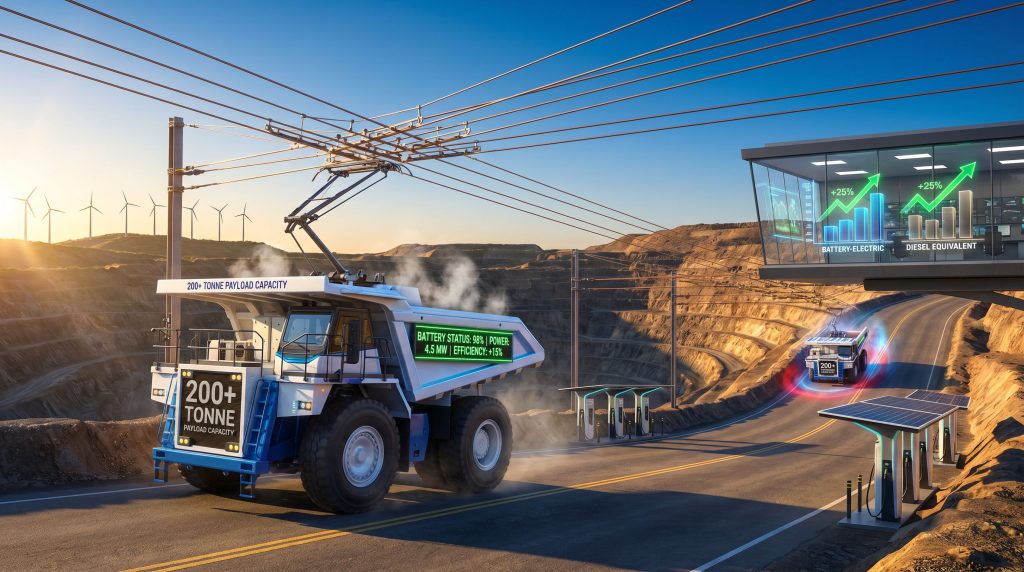
Mining operations worldwide are increasingly recognising the potential of Hitachi Full Battery Dump Truck technology as they seek to reduce emissions and operational costs. Furthermore, these developments align with broader electric vehicles transforming mining initiatives across the industry. The transition to battery-electric haul trucks represents a significant shift in heavy equipment deployment strategies.
Understanding Advanced Battery-Electric Haul Truck Engineering
Battery Architecture and Energy Management Systems
Modern battery-electric mining haul trucks integrate sophisticated energy storage configurations designed to handle extreme operational demands. The Hitachi Full Battery Dump Truck demonstrated at Kansanshi Copper Mine achieved comprehensive performance validation across diverse operational scenarios. During trials spanning June 2024 through August 2025, the vehicle accumulated over 4,000 kilometers of haul road distance while transporting more than 30,000 tons of material.
Energy density requirements for large-scale mining applications demand careful balance between power output, thermal stability, and weight distribution. Battery systems must maintain consistent performance across temperature variations, altitude changes, and continuous duty cycles that exceed typical automotive applications by several orders of magnitude.
Key Performance Metrics:
- Operational range: 4,000+ km demonstrated during trial period
- Zero emissions: Achieved through renewable energy integration
- Noise reduction: Significant decibel level improvements over diesel equivalents
- Enhanced acceleration: Improved uphill performance capabilities
Trolley Line Integration Technology
Pantograph connection systems enable seamless transition between battery operation and overhead power supply. This dual-mode capability allows vehicles to charge while operating under trolley lines, extending operational range without requiring dedicated charging downtime. The Kansanshi demonstration showcased this technology utilising existing infrastructure, indicating retrofit potential for mines with established overhead power systems.
Power management algorithms optimise energy distribution between battery reserves, regenerative braking systems, and external charging sources. Real-time monitoring systems track energy consumption patterns, enabling predictive maintenance scheduling and operational efficiency optimisation.
When big ASX news breaks, our subscribers know first
Performance Analysis: Battery-Electric vs Traditional Diesel Operations
Operational Capability Comparison
| Performance Category | Battery-Electric | Traditional Diesel |
|---|---|---|
| Emissions (CO2) | Zero (renewable grid) | 150-200 tons annually per vehicle |
| Noise Levels | Significantly reduced | 85-95 decibels |
| Acceleration | Enhanced torque delivery | Standard power curve |
| Maintenance Intervals | Extended (fewer moving parts) | Standard intervals |
| Fuel/Energy Costs | Variable (grid dependent) | Diesel price volatility |
The Zambia trial benefited from exceptional conditions where 92% of electricity supply derives from hydropower, creating optimal circumstances for zero-emission operations. This renewable energy foundation enabled the demonstration to achieve complete carbon neutrality during operational phases.
Total Cost of Ownership Considerations
While initial capital expenditure for battery-electric systems typically exceeds diesel alternatives, operational cost structures differ substantially. Maintenance requirements decrease due to simplified drivetrain configurations, though battery replacement costs and specialised technician training represent new expense categories.
Economic Variables:
- Battery degradation rates under continuous duty cycles
- Electricity pricing structures vs diesel fuel costs
- Infrastructure modification expenses
- Technician training and certification requirements
- Resale value considerations for emerging technology
Infrastructure Development Requirements for Fleet Electrification
Overhead Power System Integration
Existing trolley line infrastructure provides significant advantages for battery-electric adoption. The Kansanshi demonstration leveraged First Quantum's established overhead power distribution network, reducing infrastructure investment requirements while validating integration capabilities.
Infrastructure Advantages:
- Reduced capital expenditure: Utilising existing electrical systems
- Proven reliability: Trolley systems with operational track records
- Scalable deployment: Progressive fleet conversion capability
- Grid integration: Established connection points to local power systems
Charging Network Development Strategy
Strategic placement of charging infrastructure across mine sites requires comprehensive analysis of operational patterns, duty cycles, and power distribution capabilities. High-capacity charging stations must integrate with existing electrical infrastructure while providing backup power systems for operational continuity.
Critical Infrastructure Components:
- High-voltage distribution networks
- Rapid charging station deployment
- Grid connection capacity planning
- Renewable energy integration systems
- Emergency backup power solutions
Optimal Deployment Scenarios for Battery-Electric Mining Vehicles
Geographic and Operational Suitability Factors
The Kansanshi trial demonstrated optimal conditions combining renewable energy access, existing infrastructure, and operational scale. Approximately 30 mining customers from 25 companies attended the April 2026 showcase, indicating significant industry interest across diverse operational contexts. This development forms part of broader mining industry innovation trends shaping the sector's future.
Deployment Advantages by Operation Type:
- Trolley-equipped mines: Reduced infrastructure investment
- Renewable energy regions: Lower operational emissions
- High-altitude locations: Improved performance vs diesel efficiency losses
- ESG-focused operations: Carbon footprint reduction priorities
- Noise-sensitive areas: Community relations benefits
Commodity-Specific Applications
Copper mining operations like Kansanshi represent ideal initial deployment scenarios due to operational scale, infrastructure investment capacity, and long-term production horizons. Large-scale operations can justify technology adoption costs while benefiting from operational efficiency improvements.
Factors Influencing Adoption Timing:
- Mine life expectancy and capital investment recovery periods
- Commodity price stability affecting capital allocation
- Regulatory requirements for emission reductions
- Community impact considerations
- Investor ESG expectations
Environmental Impact and Regulatory Framework Analysis
Carbon Emission Reduction Potential
The Hitachi Full Battery Dump Truck demonstration achieved zero CO2 emissions during trial operations due to Zambia's renewable energy infrastructure. This result illustrates the critical importance of grid composition in determining environmental benefits from electric vehicle adoption. These developments support the wider critical minerals energy transition currently reshaping global markets.
Emission Reduction Categories:
- Scope 1 emissions: Direct diesel combustion elimination
- Scope 2 emissions: Grid electricity carbon intensity
- Particulate matter: Local air quality improvements
- Noise pollution: Community impact reduction
Global Regulatory Trends
Mining operations face increasing pressure to reduce carbon footprints through investor ESG requirements, regulatory frameworks, and community expectations. Carbon pricing mechanisms in various jurisdictions create economic incentives for emission reduction technologies.
Policy Drivers:
- Carbon credit value creation
- Tax incentive structures for clean technology
- Emission standard compliance requirements
- International trade considerations
- Community licence to operate expectations
Energy Recovery Through Regenerative Braking Systems
Kinetic Energy Capture Technology
Regenerative braking systems convert kinetic energy from loaded vehicles descending haul roads into electrical energy for battery charging. This technology significantly improves overall energy efficiency while reducing brake wear and maintenance requirements.
During downhill operations, electric motors operate in reverse mode, generating electricity while providing controlled deceleration. Energy recovery rates depend on grade percentages, vehicle weight, and descent distances, with optimal conditions achieving substantial battery charge recovery.
Efficiency Improvements:
- Reduced net energy consumption per ton-kilometre
- Extended brake component life
- Heat dissipation management
- Real-time energy optimisation algorithms
The next major ASX story will hit our subscribers first
Technology Development Challenges and Solutions
Technical Limitations and Advancement Requirements
Battery technology continues evolving to meet mining industry demands for extended range, rapid charging, and extreme environment reliability. Cold weather performance, high-temperature operation, and charging time optimisation represent ongoing development priorities. These initiatives contribute to the advancement of data-driven mining operations across the sector.
Development Focus Areas:
- Battery chemistry improvements for energy density
- Thermal management system advancement
- Charging infrastructure standardisation
- Component durability in harsh environments
- Integration with existing mine systems
Economic Adoption Barriers
Capital investment requirements, training costs, and supply chain development represent significant barriers to widespread adoption. Mining operations must evaluate return-on-investment timelines against technology advancement rates and regulatory requirements.
Economic Considerations:
- Technology cost reduction trajectories
- Infrastructure investment requirements
- Operational staff training and certification
- Parts availability and service networks
- Financing options for capital equipment
Market Leadership and Technology Development
Industry Collaboration Approaches
Hitachi's commitment to innovation in mining technology demonstrates the importance of mining company collaboration in technology validation. Real-world operational data provides credibility for commercial deployment while identifying refinement opportunities.
The FY2027 commercialisation target reflects confidence in demonstrated performance capabilities, though broader market adoption will depend on cost competitiveness and infrastructure availability across diverse mining regions.
Technology Partnership Benefits:
- Operational validation in real mining environments
- Customer feedback integration in design refinement
- Market credibility through demonstrated performance
- Risk sharing between manufacturers and operators
Future Industry Transformation Projections
What Does the Adoption Timeline Look Like?
Industry transformation toward electric mining vehicles will likely follow infrastructure availability, regulatory requirements, and economic competitiveness. Mines with existing trolley systems represent early adopter opportunities, while greenfield operations may design-in electric capability from project inception. These developments align with broader mining electrification decarbonisation efforts worldwide.
Transformation Factors:
- Technology cost reduction rates
- Infrastructure investment capabilities
- Regulatory timeline requirements
- Carbon pricing mechanism development
- Battery technology advancement rates
Supply Chain Evolution
Electric mining vehicle adoption creates new supply chain requirements for battery materials, specialised components, and maintenance capabilities. Furthermore, ABB's innovative battery technology solutions are supporting the development of these advanced systems. Local manufacturing opportunities may develop in mining-intensive regions to support fleet conversion timelines.
Investment Implications:
- Battery material demand increases
- Specialised component manufacturing
- Technical training infrastructure development
- Service network establishment
- Technology transfer opportunities
Disclaimer: This analysis is based on publicly available information and represents general industry trends. Specific investment decisions should consider detailed technical evaluations, economic modelling, and professional consultation. Technology performance may vary significantly across different operational environments and applications. Market projections involve uncertainty and should not be considered guaranteed outcomes.
Are You Seeking the Next Major Mining Discovery?
Discovery Alert's proprietary Discovery IQ model provides instant notifications on significant ASX mineral discoveries, empowering investors to identify actionable opportunities ahead of the broader market. Explore how historic mineral discoveries have delivered exceptional returns and begin your 14-day free trial today to position yourself at the forefront of mining investment opportunities.