July 4, 2026
Why the Architecture of Gold Settlement Is Being Rebuilt From the Ground Up
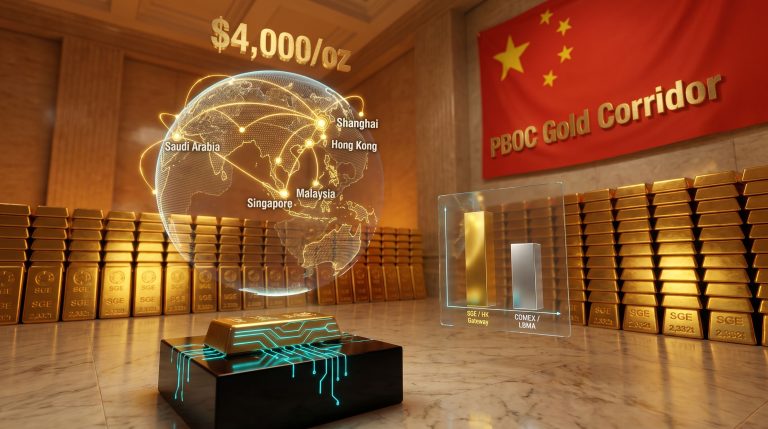
The history of financial dominance is rarely written in armies or politics alone. It is written in plumbing, specifically the pipes, clearing houses, and settlement rails that determine where capital flows, how quickly it moves, and who controls the rules of movement. For nearly two centuries, the global gold market's plumbing has been maintained almost exclusively in the West. That infrastructure advantage is now being systematically challenged by a new Hong Kong gold clearing house designed to redirect the flow of bullion settlement toward Asia.
Understanding why this matters requires stepping back from the daily gold price ticker and examining the deeper mechanics of how gold markets actually function at an institutional level.
When big ASX news breaks, our subscribers know first
How Clearing Infrastructure Defines Who Controls a Market
Most retail investors think of gold as a physical asset, bars, coins, and vaults. But the overwhelming majority of global gold trading occurs through paper-based settlement systems where physical metal rarely changes hands. The entity that controls the clearing infrastructure for these trades effectively controls the price formation process, the fee structures, the counterparty relationships, and ultimately the geopolitical leverage that comes with financial market dominance.
London's gold market has held this position through its unallocated account framework, which allows institutions to trade gold at extraordinary speed and volume without physically segregating specific bars for each transaction. Instead of owning a numbered bar in a vault, a participant holds a legal claim for a specific quantity of gold against a bullion bank. The settlement occurs on paper, and physical delivery is the exception rather than the rule.
This architecture creates three powerful advantages:
- Liquidity depth: trades can be executed and settled almost instantly without logistics bottlenecks
- Market breadth: a far larger notional volume of gold can be traded than physically exists in settlement vaults
- Price discovery efficiency: concentrated liquidity in a single settlement hub produces tighter bid-ask spreads and more reliable benchmark prices
The LBMA and COMEX markets model has been the global standard precisely because no competing infrastructure has matched its liquidity or institutional depth. Until now, no serious alternative architecture has been developed at scale in Asia.
What the Hong Kong Gold Clearing House Actually Is
The Hong Kong Precious Metals Central Clearing Co., a wholly government-owned entity under the Hong Kong Special Administrative Region, is developing a centralised settlement system modelled closely on the LBMA's unallocated account framework. Operational testing is scheduled to begin in 2026, with a full system launch targeting July 2026.
The system is designed to centralise the settlement of over-the-counter spot gold trades that currently occur bilaterally between counterparties, a friction-heavy process that creates settlement risk and limits the scalability of Asian gold trading. According to Bloomberg, by funnelling these trades through a single clearing infrastructure, Hong Kong aims to replicate the efficiency advantages that London has enjoyed for decades.
A direct comparison of the settlement approaches clarifies what is actually changing:
| Feature | Allocated Gold | Unallocated Account System |
|---|---|---|
| Ownership structure | Specific numbered bars assigned | Claim on a quantity held by a clearer |
| Liquidity | Lower, physical movement required | Higher, paper-based settlement |
| Counterparty risk | Minimal | Present, credit exposure to the clearing entity |
| Settlement speed | Slower | Faster |
| Common usage | Private vaulting, central banks | OTC trading, institutional markets |
The Hong Kong system will operate on the right side of this table, prioritising speed and liquidity over the transparency of allocated ownership. This is a deliberate strategic choice: the goal is to create a competitive alternative to London, not to build a niche physical delivery platform.
A high-level governance board has been established to oversee operational standards, and the Shanghai Gold Exchange is providing technical and regulatory input on system design, rulemaking, and risk management. A select group of financial institutions aligned with Chinese interests have been invited to participate as initial clearing members.
The Hong Kong and Shanghai Connection: Building a Dual-Node Gold Corridor
A formal cooperation agreement between the Hong Kong Precious Metals Central Clearing Co. and the Shanghai Gold Exchange is central to the broader strategic vision. This is not simply a bilateral arrangement between two financial entities. It represents an attempt to create a structurally integrated Asian gold market with two complementary nodes.
Shanghai anchors onshore physical delivery and domestic price discovery within China's regulatory framework, while Hong Kong provides the offshore, cross-border clearing gateway accessible to international counterparties that cannot directly participate in mainland Chinese markets.
The cooperation framework covers physical gold delivery facilitation, warehousing coordination, and the deepening of financial connectivity between the two markets. Critically, the system is designed to increase the use of renminbi in gold settlement, which serves a purpose well beyond precious metals market efficiency. A functioning RMB-denominated gold clearing system creates a parallel pricing mechanism to USD-benchmarked gold, incrementally reducing the structural role of the US dollar in Asian commodity markets.
Furthermore, China's gold influence over this broader de-dollarisation strategy operates through market infrastructure rather than through political declarations, making it considerably more durable and difficult to counter.
Hong Kong's Existing Gold Market Foundation
One reason the new clearing system has credibility beyond aspirational intent is that Hong Kong already possesses meaningful gold market infrastructure. The Chinese Gold and Silver Exchange Society, one of Asia's oldest precious metals trading institutions, has long provided a framework for physical gold and silver exchange in the territory. Existing settlement linkages connect Hong Kong's market to the Shanghai International Gold Exchange, and Bank of China (Hong Kong) plays an established institutional role in related gold-trading channels.
The new clearing house builds upon this legacy rather than starting from a blank canvas, which reduces the integration risk and technical credibility gap that often undermines new financial infrastructure projects.
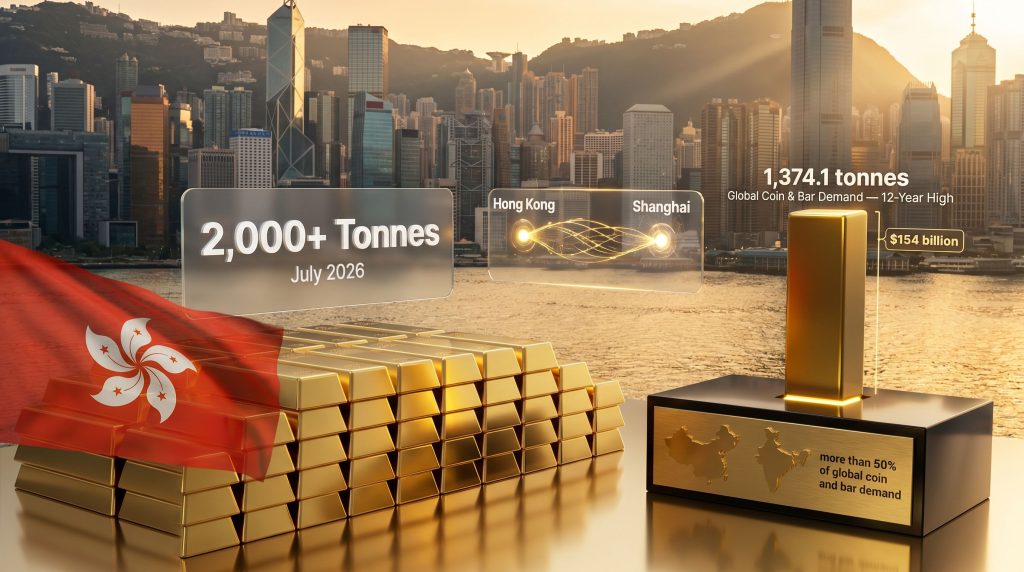
However, the most striking signal of long-term intent is the planned expansion of physical vault capacity. Hong Kong currently holds approximately 200 tonnes of gold in storage infrastructure. The target is to expand this to over 2,000 tonnes within three years, a tenfold increase.
| Metric | Current Capacity | Target Capacity | Timeline |
|---|---|---|---|
| Gold storage (tonnes) | ~200 | 2,000+ | Within 3 years |
| Expansion multiplier | Baseline | 10x | 3-year horizon |
This storage expansion is not incidental. A clearing system that cannot support meaningful physical delivery risks being dismissed as a paper market, a concern that has periodically been levelled at the LBMA itself. By building out vault capacity at this scale, Hong Kong is signalling its intent to attract commodity trading houses, sovereign wealth funds, and central banks that require genuine physical delivery capability as a backstop to their paper trading activities.
The Macro Forces Behind the West-to-East Gold Migration
The Hong Kong gold clearing house does not exist in isolation. It is a response to measurable, structural shifts in where gold is consumed, stored, and valued.
Global gold coin and bar demand reached a 12-year high of 1,374.1 tonnes in 2025, generating a record aggregate value of $154 billion. Critically, more than 50% of that global coin and bar demand was concentrated in just two countries: China and India. Chinese gold investment has been identified as a primary driver of the broader precious metals bull market cycle currently underway.
Shaokai Fan, Head of Asia-Pacific and Global Head of Central Banks at the World Gold Council, has noted that the centre of gravity of the global gold market has shifted eastward, driven by rapidly rising gold consumption across emerging market economies, the majority of which are concentrated in Asia.
Several reinforcing forces are accelerating this shift:
- Central bank accumulation: Central bank gold demand from emerging market institutions, particularly across Asia and the Middle East, has been systematically reducing the pricing influence of Western financial institutions
- De-dollarisation motivation: Following the precedents set in 2022 regarding the freezing of sovereign foreign exchange reserves, Asian economies have intensified efforts to diversify into assets that operate outside Western jurisdictional reach
- Domestic savings behaviour: Chinese retail investors have demonstrated a deepening preference for gold as a store of value, a trend that has been amplified by property market pressures and equity market volatility
- Physical delivery infrastructure: As Asian storage and logistics capacity improves, the friction cost of holding and trading physical gold in the region decreases, further concentrating activity in Asian time zones
The next major ASX story will hit our subscribers first
Competitive Positioning Across Global Gold Hubs
The development of the Hong Kong gold clearing house does not occur in a vacuum. It enters a competitive landscape that already includes London, Shanghai, Singapore, and Dubai as meaningful gold market nodes. Each has distinct structural characteristics:
| Attribute | London (LBMA) | Shanghai (SGE) | Singapore | Hong Kong (New System) |
|---|---|---|---|---|
| Settlement model | Unallocated OTC | Physical delivery focus | Mixed | Unallocated, LBMA-mirrored |
| Currency denomination | USD / GBP | RMB | USD / SGD | RMB / USD |
| Regulatory jurisdiction | UK FCA | Chinese regulators | MAS | HKSAR / Chinese oversight |
| Physical storage depth | High | High | Moderate | Expanding to 2,000+ tonnes |
| Cross-border accessibility | High, global | Restricted, domestic | High | Designed for regional access |
| Institutional participant base | Global banks | Domestic institutions | Regional players | China-aligned institutions |
What Hong Kong offers that Shanghai structurally cannot is international accessibility. The Shanghai Gold Exchange operates primarily as a domestically-focused market, with the renminbi's limited convertibility and China's capital controls restricting participation from foreign institutions. Hong Kong's common law framework, its status as an international financial centre, and its distinct regulatory environment under the one-country-two-systems model make it accessible to non-Chinese institutions in a way that mainland markets are not.
This positions Hong Kong as the offshore gateway to Chinese gold market depth, analogous to how the Stock Connect programme allows international investors to access mainland Chinese equities through Hong Kong as an intermediary layer. In addition, gold in the monetary system more broadly is increasingly shaped by exactly these kinds of infrastructure decisions rather than by policy announcements alone.
Understanding the Risks: What Could Limit the System's Impact
Institutional credibility in financial infrastructure is earned slowly and lost quickly. Several material risks could constrain the Hong Kong gold clearing house's trajectory.
Counterparty concentration risk: The unallocated account model concentrates credit exposure at the clearing institution level. Participants hold a claim against the clearer, not ownership of specific physical bars. If the clearing entity faces financial stress, participants bear direct credit risk. This structural vulnerability mirrors that of the London OTC market, which has historically faced scrutiny over the opacity of its gold float relative to the notional volume of unallocated claims.
Participant base limitations: The initial invitation of China-aligned institutions as clearing members may deter Western banks and trading houses from engaging with the system. A clearing house derives its value from network effects: the more participants, the deeper the liquidity and the tighter the pricing. A system that remains geopolitically siloed will struggle to compete with London's genuinely global participant base.
Geopolitical and sanctions exposure: Any escalation in US-China tensions that results in sanctions targeting Hong Kong financial infrastructure could severely impair the system's cross-border settlement utility. This is not a remote tail risk; it is a scenario that institutional risk managers at non-Chinese banks will model explicitly before committing to membership.
Liquidity bootstrapping: New clearing systems require critical mass before they become self-reinforcing. The period between launch in 2026 and genuine market depth could extend for several years, during which the system may not offer competitive bid-ask spreads relative to London.
What This Means for Gold Investors and Long-Term Allocators
For investors evaluating gold as a long-term allocation, the emergence of the Hong Kong gold clearing house introduces several analytical dimensions worth tracking.
A functioning Asian clearing hub with sufficient volume could begin to exert independent influence on gold spot pricing, particularly during Asian trading hours where London's benchmark has historically been set during off-peak periods for Asian markets. The emergence of a competing RMB-denominated benchmark price could gradually fragment the USD-centric gold pricing structure, redistributing some of the pricing premium that Western institutions currently extract through their control of benchmark mechanisms.
For physical gold accessibility in Asia, improved clearing infrastructure reduces transaction friction for institutional buyers. Lower settlement costs and faster execution times could stimulate incremental demand from regional wealth managers, sovereign funds, and family offices that have historically faced operational barriers to large-scale gold participation. Moreover, central bank gold reserves held across the region stand to benefit from the improved settlement efficiency that a local clearing hub provides.
Investor consideration: The development of the Hong Kong gold clearing house does not immediately displace London or New York as the dominant gold settlement centres. However, it creates a structurally significant alternative pathway for Asian capital to access and settle gold outside Western jurisdictional frameworks. For long-term investors, monitoring the pace of institutional adoption through 2026 and 2027 will be a meaningful indicator of whether this system achieves genuine market depth or remains a regionally constrained alternative.
This article contains forward-looking statements and market analysis based on publicly available information. It does not constitute financial advice. Investors should conduct independent research and seek professional guidance before making investment decisions.
Frequently Asked Questions: Hong Kong Gold Clearing House
What is the Hong Kong gold clearing house?
The Hong Kong gold clearing house refers to the centralised settlement infrastructure being developed by the Hong Kong Precious Metals Central Clearing Co., a wholly government-owned entity, to facilitate OTC gold trade settlement within Asia. It is modelled on the unallocated account framework used by the London Bullion Market Association.
When will the Hong Kong gold clearing house begin operations?
The system is scheduled for operational testing in 2026, with a full launch targeted for July 2026, subject to regulatory approvals and participant onboarding.
How does the Hong Kong clearing system differ from the LBMA?
Both systems use unallocated account structures for settlement efficiency. Key differences lie in jurisdictional oversight (HKSAR versus UK FCA), currency denomination (RMB-inclusive versus USD-dominant), and participant base (China-aligned institutions versus globally distributed banks).
What is the relationship between the Hong Kong clearing house and the Shanghai Gold Exchange?
A formal cooperation agreement establishes a collaborative governance structure, with the Shanghai Gold Exchange providing technical and regulatory input. The two entities are developing an integrated framework for physical delivery, warehousing, and cross-border financial connectivity.
Why is gold storage capacity being expanded so significantly in Hong Kong?
Hong Kong plans to increase vault capacity from approximately 200 tonnes to over 2,000 tonnes within three years to support physical delivery credibility and attract commodity trading houses, sovereign entities, and institutional allocators that require genuine physical settlement capability.
Does the unallocated account model increase risk for participants?
Yes. The unallocated account model introduces counterparty risk because participants hold a claim against the clearing institution rather than owning specific physical bars. This mirrors the structure of most London OTC gold trades but means credit exposure to the clearing entity exists and must be factored into institutional risk management frameworks.
The Long Arc: A Multi-Polar Gold Market Is Taking Shape
The emergence of the Hong Kong gold clearing house is best understood not as a singular disruptive event but as one structural node in a broader multi-decade reconfiguration of how the world trades, stores, prices, and thinks about gold.
London retains its dominant position by a significant margin. Its participant depth, benchmark credibility, and historical institutional relationships will not be displaced quickly or easily. But the conditions for a genuinely multi-polar gold settlement landscape, spanning London, Shanghai, Dubai, and Hong Kong, are now structurally in place in a way they were not a decade ago.
The pace of transition will ultimately be determined by three variables: the rate of institutional adoption by non-Chinese counterparties, the geopolitical stability of Hong Kong's financial infrastructure, and the credibility of physical delivery mechanisms as vault capacity expands. Each of these variables is trackable, and each will offer early signals about whether this initiative achieves its ambition of rebalancing the architecture of the global bullion market.
What is not in question is the direction of the underlying demand shift. With China and India collectively representing the majority of global physical gold demand, and with Asian central banks continuing to accumulate reserves, the gravitational pull on settlement infrastructure will only intensify. The Hong Kong gold clearing house is, at its core, an attempt to ensure that the market infrastructure catches up with where the buyers already are.
Want to Stay Ahead of Major Mineral Discoveries Driving the Next Gold Bull Market?
As gold's global settlement architecture shifts eastward and institutional demand accelerates, Discovery Alert's proprietary Discovery IQ model delivers real-time ASX mineral discovery alerts straight to subscribers — transforming complex market signals into actionable investment opportunities the moment they emerge. Explore historic examples of major discovery returns and begin your 14-day free trial today to position yourself ahead of the market.